Closing with the enemy
Soulis had planned to shoot through the back window if Palmer drew a weapon, but for reasons he still doesn’t fully understand, he moved forward and to his right, stopping alongside the passenger door, not more than two feet from the window. Instantly, he realized he’d made a grievous blunder.
Officer Down: The Peter Soulis Incident One of Brian McKenna’s excellent analyses.
Unconsciously closing with an adversary is something I have seen many times in Force on Force. The response was so uniform and so prevalent that it is one of the few things I feel sanguine in saying the probability of people doing it borders on 100%. We need to train ourselves rigorously to hold position or to retreat unless there is a valid purpose for closing. Closing with an enemy needs to always be a conscious decision, never an unconscious one.
When I was an infantryman, the stated mission of the Infantry was to “Close with and destroy the enemy by means of fire and maneuver.” Infantry units consist of numerous men, who are capable of mutually supporting each other with automatic weapons fire and explosive munitions. Private Citizens rarely have those resources available and law enforcement officers generally don’t. Our desired outcome and tactics have to be different.
It’s very common to see in news reports where Armed Citizens have pursued criminals after the criminal has broken off from the crime. Pursuit is fraught with hazards, both legal and tactical. Dependent on the laws of the particular State, pursuing a robber or attacker could result in losing the ‘mantle of innocence.’ This could result in charges being brought against the original victim. It also could put you in a position leading to becoming the victim of a mistaken identity shooting by a responding police officer. Keep in mind that although you know the victim/aggressor roles of the parties involved, the police have to sort that out upon arrival and it’s not always easy.
One of my students was involved in a shooting during the course of an invasion of his home. Despite the fact that he is an excellent marksman, he closed with the invader and the final shot was fired at contact distance. Closing with the enemy causes the defender to give up distance, which favors the marksman, and barriers/cover, which favor whomever is behind them, at least temporarily.
At home or in your place of business, decide ahead of time where your Limits of Advance are located. This is probably no further than your front door, perhaps even further in. The stairwell in your home or the counter in your store may be as far as it is advisable to go.
Palmer flinched as two more rounds hit center mass, and then started backpedaling toward the Toyota. He was still holding his gun, but never raised it to fire.
After reaching the car, Palmer dove over the trunk and dropped out of sight. Soulis paused, and then cautiously started forward again.
Outside the home, pick a spot, preferably something tangible. Then stick to your decision unless a good reason to change it arises. Keep in mind that all cover is temporary until it is defeated by fire and/or maneuver. If there is imminent danger of the cover being defeated, then move. That’s a conscious decision.
You don’t have to make a terrain diagram but making your decisions ahead of time helps you pick better decisions in the moment.
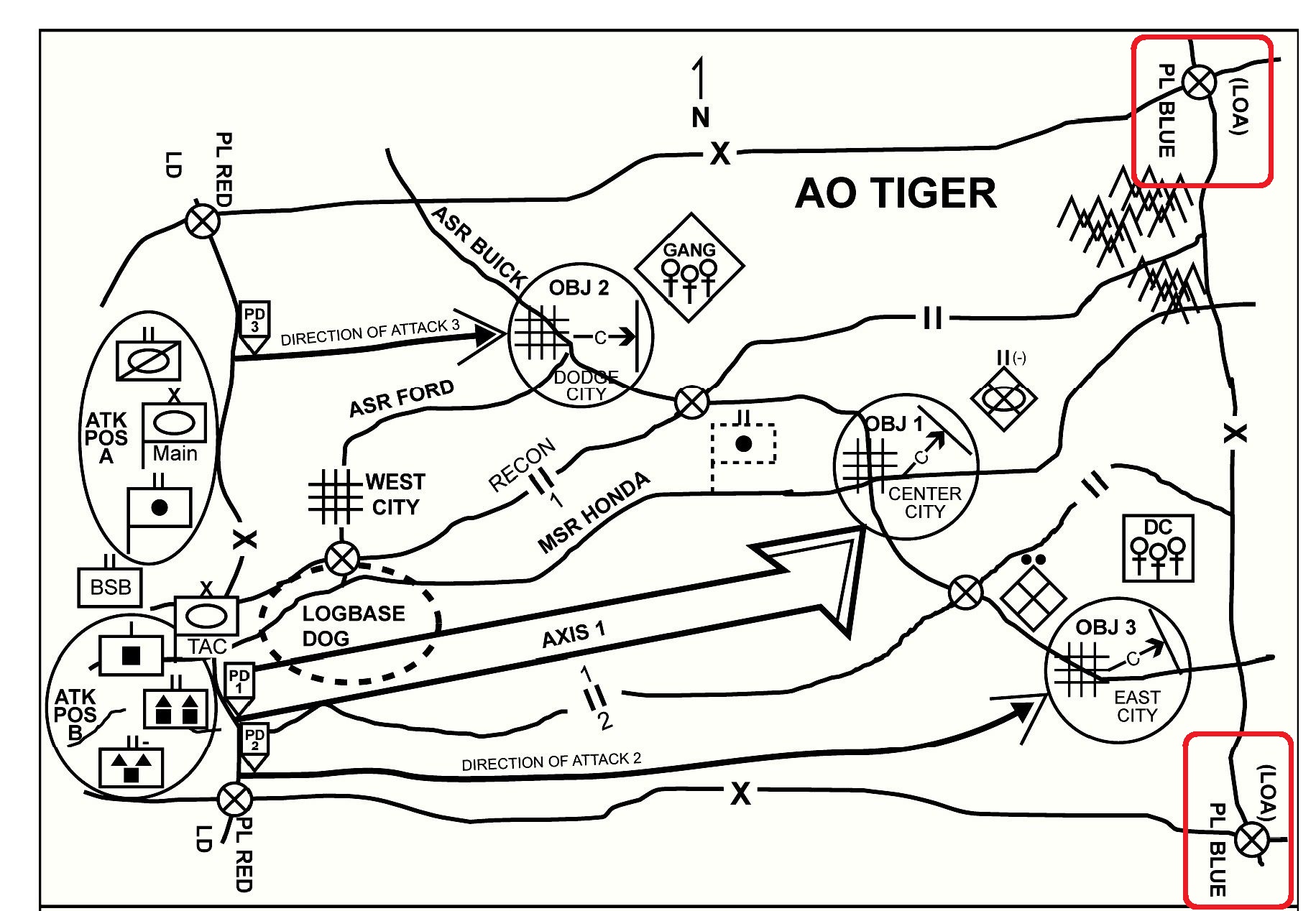
Limit of Advance
Common sense
Isn’t it just common sense to ensure you know what you’re shooting at?
That question was posted on my Claude Werner, Researcher and Analyst page.
It’s an important question that we need to put in perspective.
Not intending to be pejorative but there is no such thing as ‘common sense.’ What we refer to as ‘common sense’ is actually learned behavior based on our past experience.
For instance, as adults, we consider it ‘common sense’ to not stick our hand in a fire. When we were three years old, we didn’t know it would hurt and probably found it out the hard way.
Similarly, we as gun people would consider it ‘common sense’ to not look down the bore of a firearm. If you gave a pistol to an Australian Aborigine, one of the first things they would do is look down the bore because in their worldview, knowing what’s in a hole is really important. Even Al Gore did it when he was searching for the Internet in Viet Nam. That was before he realized he had to invent it.
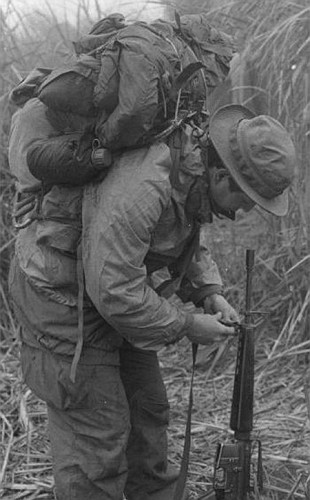
Al Gore looks down bore.
Ninety-nine percent of what most people know about firearms usage they learned from TV and the movies. In those media, there is never any ambiguity about the shoot/no shoot decision. As a result, when people get placed in a real set of circumstances, they do indeed default to their ‘training,’ which is the media programming. So they tend to make mistakes and shoot, even if it’s not appropriate. I once bemoaned to a colleague that my Threat Management classes didn’t sell. His response was “Nobody buys a gun with the idea that they’re not going to use it.” His comment put it in perspective for me.
The Importance of Target Identification
Deputies found a 32-year-old man who said that he and his wife were sleeping when they heard a noise in the kitchen.
The husband took his handgun and walked in the kitchen area, where he shot the victim.
After the shooting the husband recognized the victim as his younger teenage brother.
Man shoots, kills brother thinking he was burglarizing home
Yet another tragic example of why I stress target identification so much. These situations are absolutely preventable. As I’ve said before, if you live with anyone else, my analysis is that there is a 97 percent probability that the ‘bump in the night’ is a member of your own household. With those kinds of numbers, gunowners cannot take the risk of shooting someone at home without establishing a positive ID.
This kind of situation is a further example of why I say we have to be very cautious of what we take of from our training, and even more so, what we read. Much of the good training available is conducted by former law enforcement or military personnel. Just as much as any of us, they are subject to unconscious biases resulting from their experiences and training. Since most reading now is done on the Internet, you have to assume everything you read is wrong because most of it IS wrong.
Responding with a firearm to a noise at night in the home absolutely requires that you visually verify your target before shooting. You probably will need a flashlight for that. And stealth is not your friend, it is your enemy. Therein lies a major divergence from the law enforcement officer or soldier, to whom stealth is an ally. The notions that ‘the light draws fire’ or that criminals will wait in ambush for you if they hear you coming are nonsensical. Those are bad paradigms for us to insert in our thinking. If your background is such that having assassins waiting in ambush for you in your own home is a concern, you need to work on some serious hardening of access points to your home.
If you keep a gun at home, put a flashlight next to your gun; no ifs, ands, or buts about it.
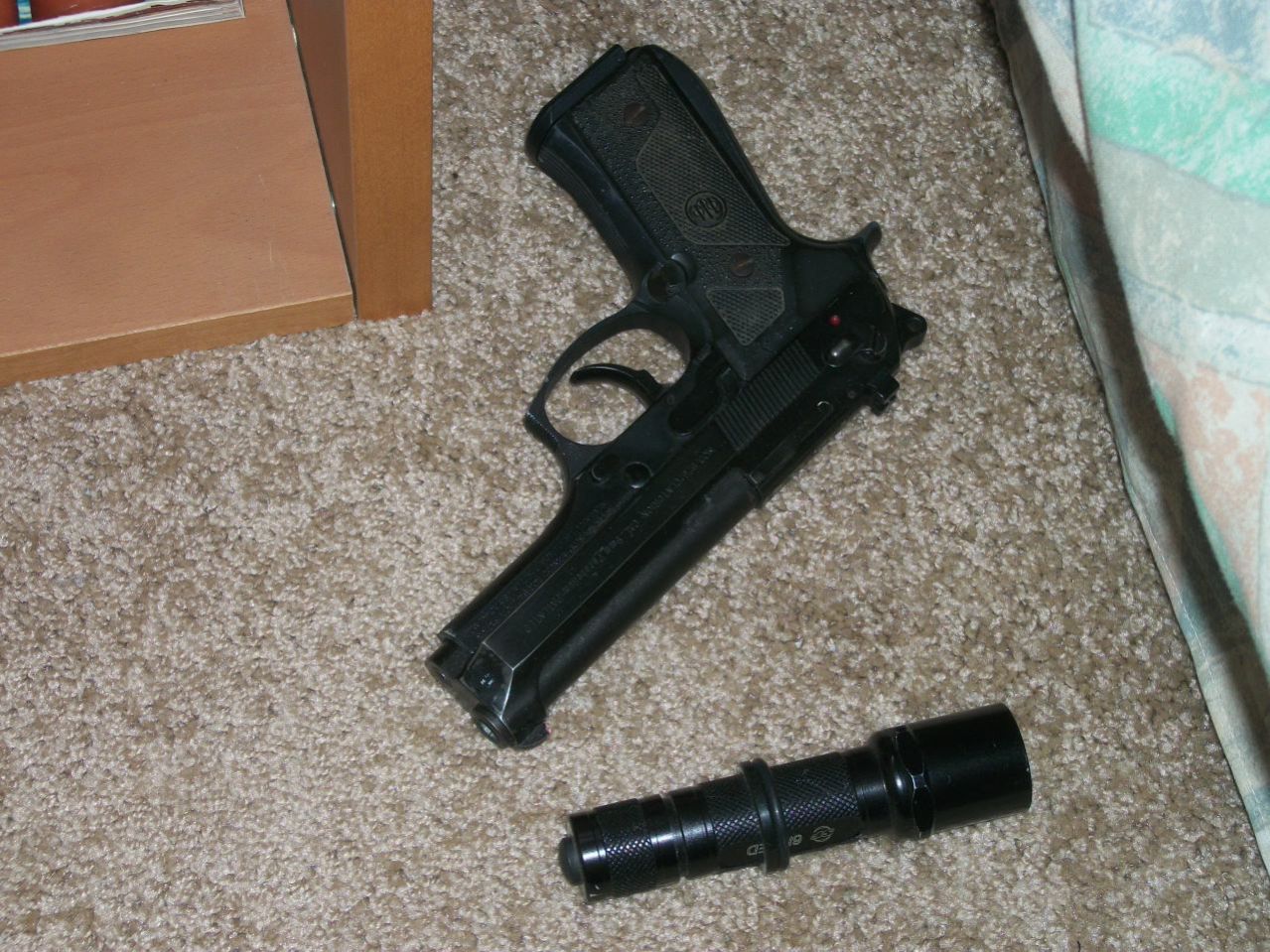
Next time you go to the range, take the flashlight with you. Instead of just blasting 50 holes in a silhouette, shoot two shots at the silhouette 25 times. Sequence is very important in how you do this.
- Have your gun in your shooting hand and your flashlight in your support hand. The gun is not pointing at the target and the light is off.
- Before each two shot string, say out loud “Who’s there?”
- Wait to listen for an answer. If you go to the range with someone, have them stand behind you and sometimes respond with “it’s me, Daddy” or something similar.
- If they say that, immediately put your gun down on the bench and abort that sequence.
- Then illuminate the target without pointing the gun at it.
- Finally, bring the gun up and fire the two shots.
One of the things you will find when using this sequence is that the worthwhile two handed shooting techniques don’t work well for it. Harries is both clumsy and dangerous to assume when you already have the light on the target and are keeping it illuminated while presenting the pistol. The Rogers/Surefire technique takes some time and manipulation skill to assume. What you will discover is that only the Cheek Technique or the FBI Technique work well in this context.
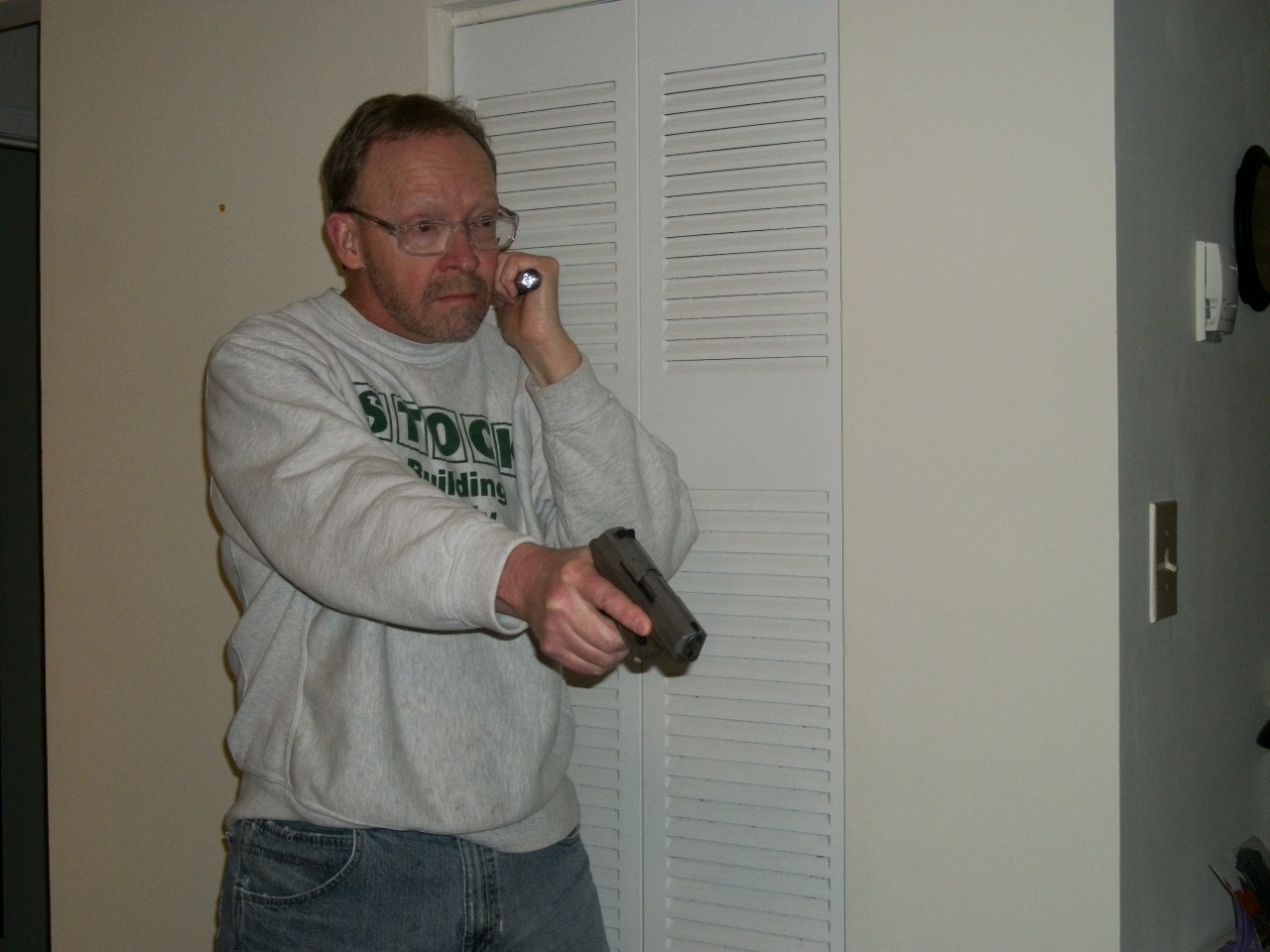
That means you have to learn to:
- Speak while holding your gun.
- Abort the shooting sequence if there is not a threat.
- Do a dissimilar task with the other hand, i.e., orient the flashlight and work the switch, while keeping your gun off target and your finger off the trigger.
- Shoot with one hand only while continuing to perform the dissimilar task.
- Manipulate the safety or decocker of your weapon with one hand while holding something in the other.
For the final 5 repetitions (10 rounds), put up a clean silhouette target and shoot the LAPD Retired Officer Course (10 rounds at seven yards). Measure how well you do. You’re going to find it’s a lot harder than you think.
That sequence is obviously rather involved; practice it before you have to do it for real or you’ll forget to do it or get it wrong. Forgetting to do it is what leads to tragedies.
Structured practice (Part II)
Part I of this series focused on Dryfire Practice. Now let’s focus on livefire practice, especially for those who are new to pistol shooting. To learn, maintain, and improve physical skills, we have to practice them regularly. We also need a plan for how we are going to practice. In that regard, shooting a gun is no different from learning to throw or hit a ball.
The problem many people have is that when they go to the range to practice, they have no plan and use no structure. At least a motivated police officer has the course required for periodic qualification as a structure for practice. Competitive shooters have courses of fire, either for Classification purposes or something that was appealing in a match. Few Private Citizens have either of these, which is why the most common ‘practice’ is blasting 50 holes in a silhouette at 5 yards. Shooting a bunch of holes in a silhouette gives familiarity with recoil and muzzle blast but not much else. Something further is needed to develop skill.
A very good starting point for new shooters is the NRA’s Marksmanship Qualification Program, which is really a marksmanship development program. This is a self-paced and self-administered program that the NRA has made available for decades. There are a number of different courses of fire available within the Program. The one I recommend for those who have just purchased a pistol for personal protection is Defensive Pistol I. DPI is designed to improve skills that contribute to a successful home defense.
Defensive Pistol I includes tasks such as:
- Hit a target to an accuracy standard
- Shoot within time limits
- Pick the loaded gun up from a bench and then engage the target
- Pick up and load an unloaded gun
- Move to a position of cover
- Shoot from behind cover
- Issue a verbal challenge
- Reload
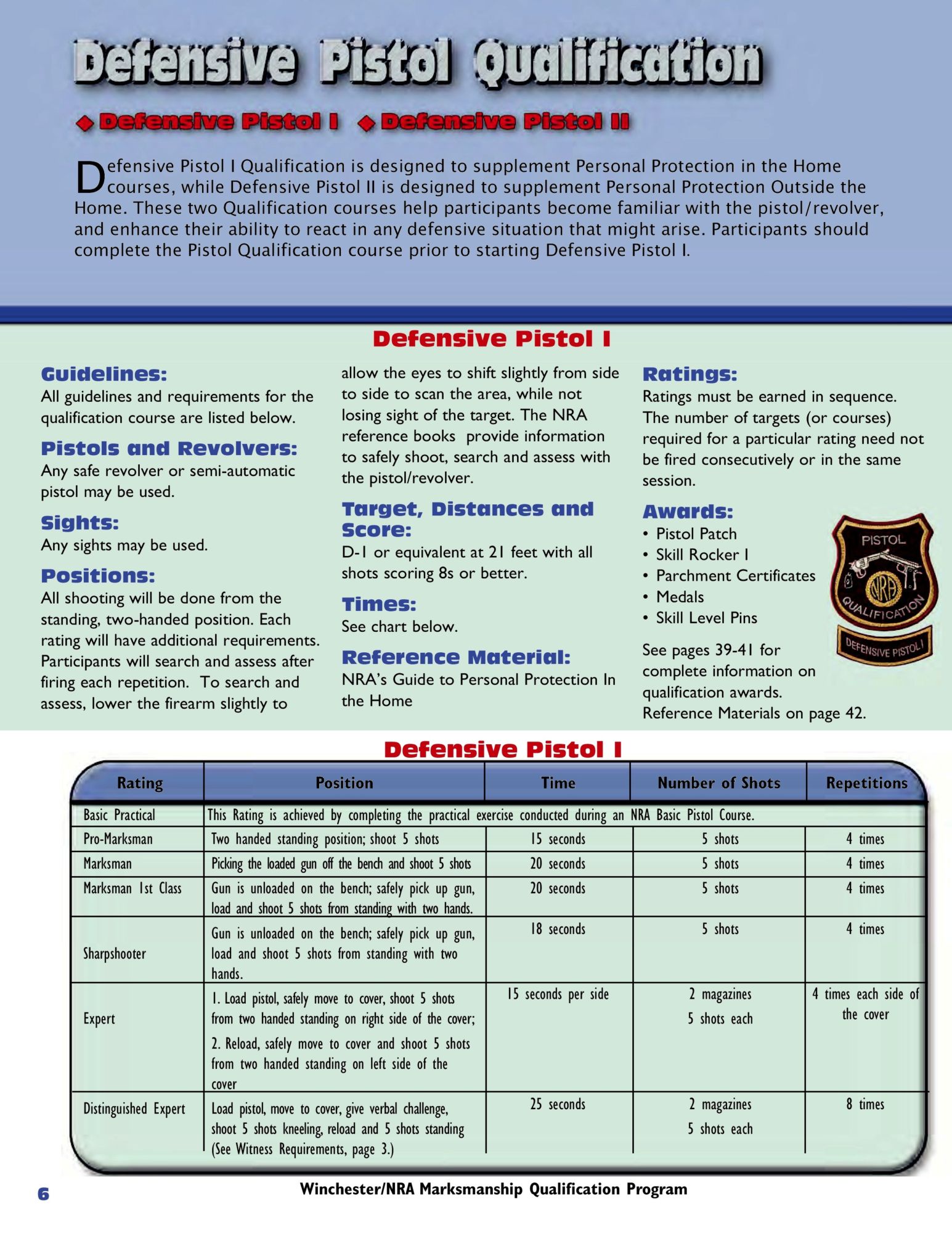
Courtesy of NRA Training Division
Something I really like about Defensive Pistol I and II is that the accuracy standard is 100%, not a fraction thereof. The allowable area and time limits are generous but you have to make every shot count. As I mention periodically, every bullet you fire in an urban area that doesn’t hit your target is heading for a busload of nuns and orphans being followed by a limousine full of personal injury lawyers on a conference call with the District Attorney. We have to get used to the idea that the only safe backstop for our bullets is the criminal’s body, period.
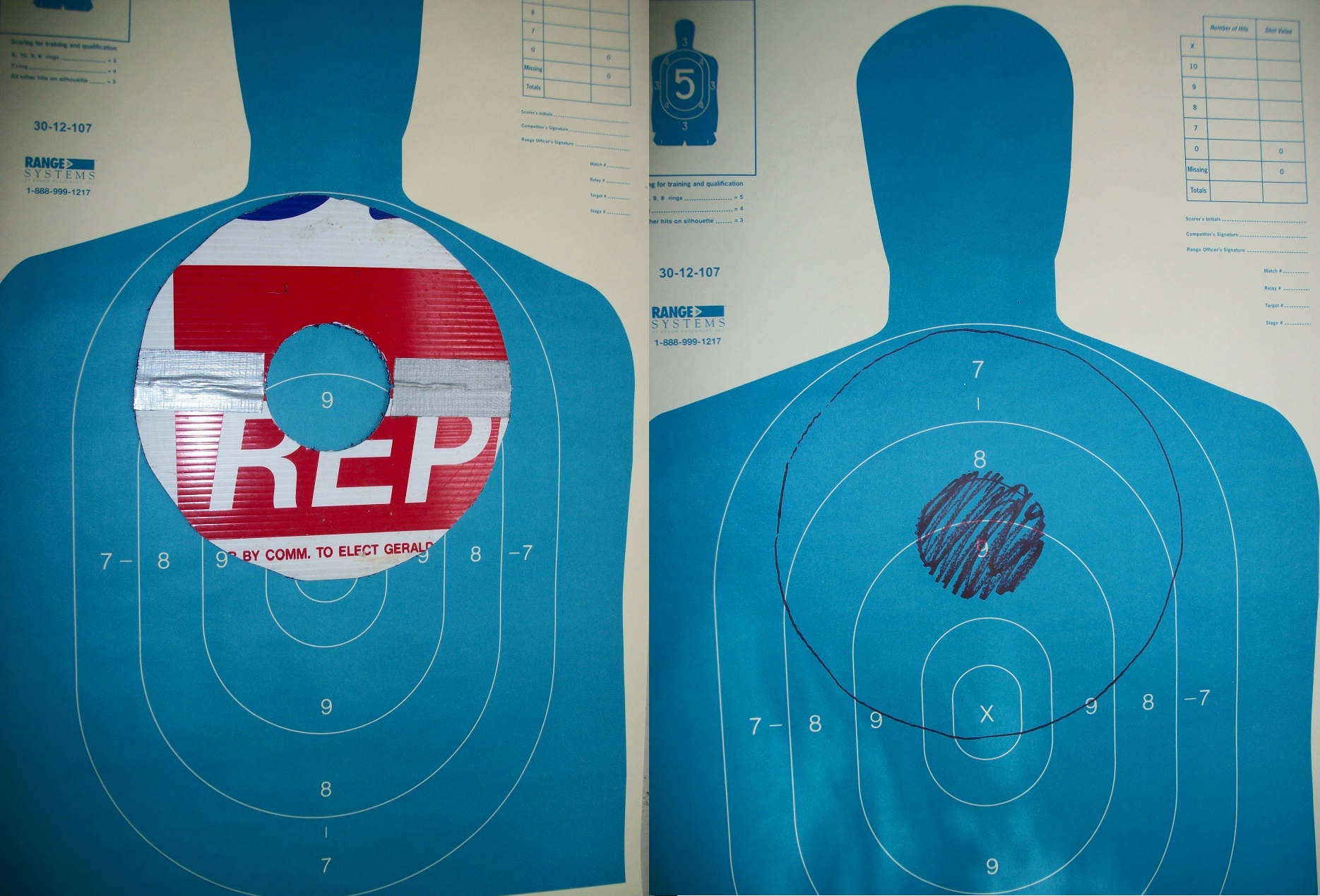
The target area specified for the NRA program is the 8 ring of the NRA D-1 (Bianchi Tombstone) or equivalent. The 8 ring of the D-1 is 12 inches in diameter. The shooter must place five shots in the 12 inch circle at 7 yards within a time limit of 15 seconds. Many shooters I talk to think this is a very simple marksmanship task. The reality is that because of the 100% standard it’s not as easy as people think. In order to meet the standard for the first level (Pro-Marksman) of the program, the task has to be done four times. Therein lies the rub. I have run over 100 people through the program and only about 10% have passed on the first attempt. What happens is that on one or two runs, one shot will not hit the 12 inch circle. Sorry, you didn’t make it.
The good news is that the four runs don’t have to be done consecutively. If you mess up a run, just shoot another until you have four that meet the standard. My experience has been that 10 percent of shooters can do it in four runs, another 40% will make it in five runs, another 40% will make it in six runs, and the final 10% need a lot of coaching to get through it.
While the Tombstone target isn’t available at all ranges, the allowance for an ‘equivalent’ means you can make a template of the 8 ring and apply it to whatever target is available. Just take your template and a marker with you to the range. I cut mine in half and then taped the halves together with duct tape so it folds and fits easily in my range bag.
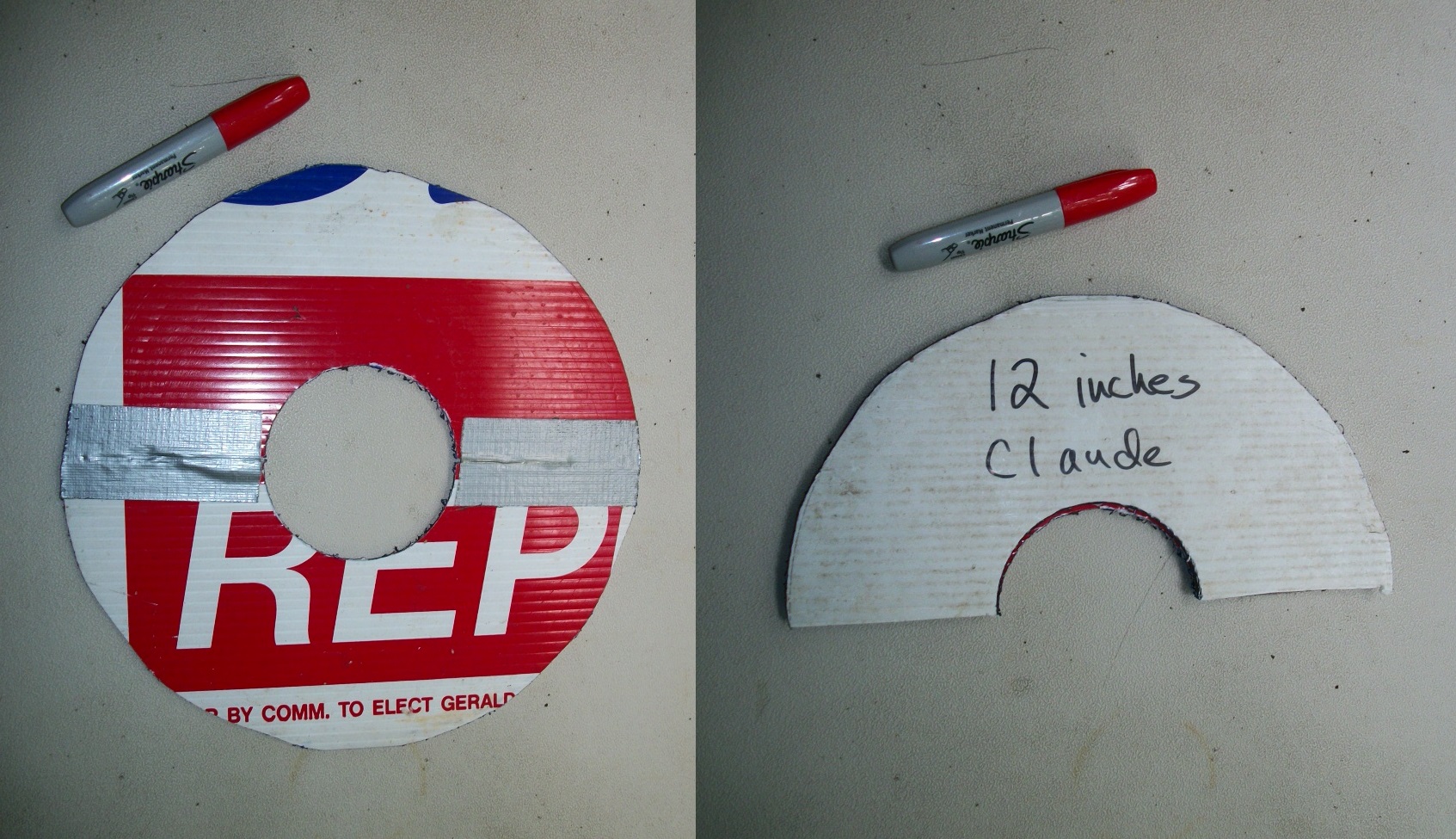
Once you get to the range, outline the template on your target and you’re ready to go. Be sure to take some kind of tape or marker with you so you can mark each run. Marking each run is how you learn to shoot well. As a general rule, I mark my targets after no more than 10 shots. When doing this program, you should mark your target after each string of fire, i.e., each five shots.
A new shooter can structure their practice sessions in many ways. What’s important is to plan what you do before you go to the range so you don’t waste your time and resources. The NRA program appeals to me because it’s already made up, it contains relevant skills, and it’s workable at most indoor ranges.
There are also awards available from the NRA for participating in the program. NRA membership is not necessary to participate. The NRA Marksmanship Qualification Program Booklet explains the entire program in detail. It is available for download from the NRA Training Division’s website.
Summer Special on DVDs
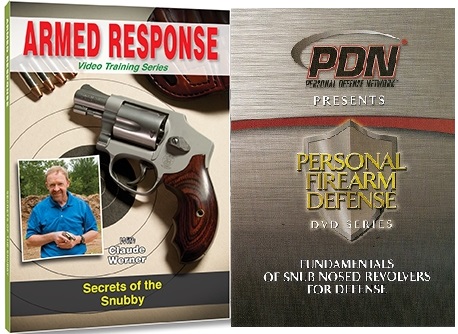
The warm weather is here and I know a lot of folks are going to start carrying snub revolvers for the summer. I love snubs and have spent years learning how to run them well. As far as I know, I’m the only person to ever have won six Sanctioned IDPA Championships with a snub.
At the same time, I acknowledge they’re not the easiest guns in the world to shoot. That’s why I made two DVDs about the best techniques for using snubs and getting the most performance out of them.
To kick off the Summer, I’m offering both DVDs together as a package at a discounted price. Also included is a free bonus CD with two dryfire practice regimens and a reduced scale practice target to help you keep your skills up.
You can get the package on my webstore.
You can tell from the music (DJ Siamey) on this one that I’m a Trance music kind of guy.
Securing pistols in cars
“The 3-year-old located a handgun that was in the vehicle and discharged a round which resulted in the striking of the 1-year-old,” said Sarasota Sheriff’s Office Lt. Vince Mayer.
This morning, yet another Negative Outcome was brought to my attention. In this incident, a young boy gained unauthorized access to his mother’s pistol, which was unsecured in her car, and accidentally shot his little sister. I use the term ‘accidentally’ because from the little boy’s perspective, it was utterly accidental. In the broader context, it was a training and doctrine failure. Fortunately, her injuries are not life threatening, but I bet they will be life changing for all involved.
Informally, a number of people in our community are starting to include an addition to the cardinal Four Rules of Safe Gunhandling. ‘Rule 5’ tends to be worded something like “In addition to the Four Rules of Safe Gunhandling, always store weapons where they are not accessible to unauthorized persons.” It’s about time we break with tradition and make Rule 5 a formal part of our doctrine.
I don’t know if her pistol was in her purse, in the glove box, or somewhere else in the car. Whichever was the case is irrelevant. The little boy got hold of it and touched off a round. It’s inexcusable and irresponsible. More than getting stolen, I consider this kind of occurrence to be the major downside of off body carry. And when I say ‘off body carry,’ I’m not just talking about purses and briefcases.
The incident demonstrates yet another reason I am totally opposed to glove box carry, console carry, door pocket carry, etc. that are commonly used in vehicles These foolish methods people use to secure pistols almost always result from having a pistol that’s too big to carry on them or with them consistently. It’s a downside of the ‘carry enough gun’ doctrine espoused by the training community.
In that sense, I think the community needs to take some responsibility for recommending equipment that simply doesn’t fit into the totality of our students’ lifestyles. With regard to understanding the lifestyles of normal people, our ‘square range’ mentality is complete.
Many trainers tend to view their students in the military or law enforcement model where the students are molded into something new and different, as a result of the training. Sorry folks, that’s just not the case. What we’re doing is the equivalent of teaching people how to paint, not turning them into painters. Sometimes, it seems to me that the training community’s approach to ‘walk a mile in someone else’s moccasins’ turns into ‘put a load of buckshot into someone, then take their moccasins and walk off in them.’
When I first started writing this post, I had in mind talking about lockboxes for securing pistols in cars, which I still think is a necessary idea. But, as I began writing, I realized I was on the wrong track. In this case, trying to secure the pistol in a lockbox would most likely have entailed repeated instances during the trip of gunhandling in the car to secure the pistol. That’s dangerous and unrealistic. The less we handle guns in vehicles, the better. It’s a target rich environment with too much potential for a Negative Outcome.
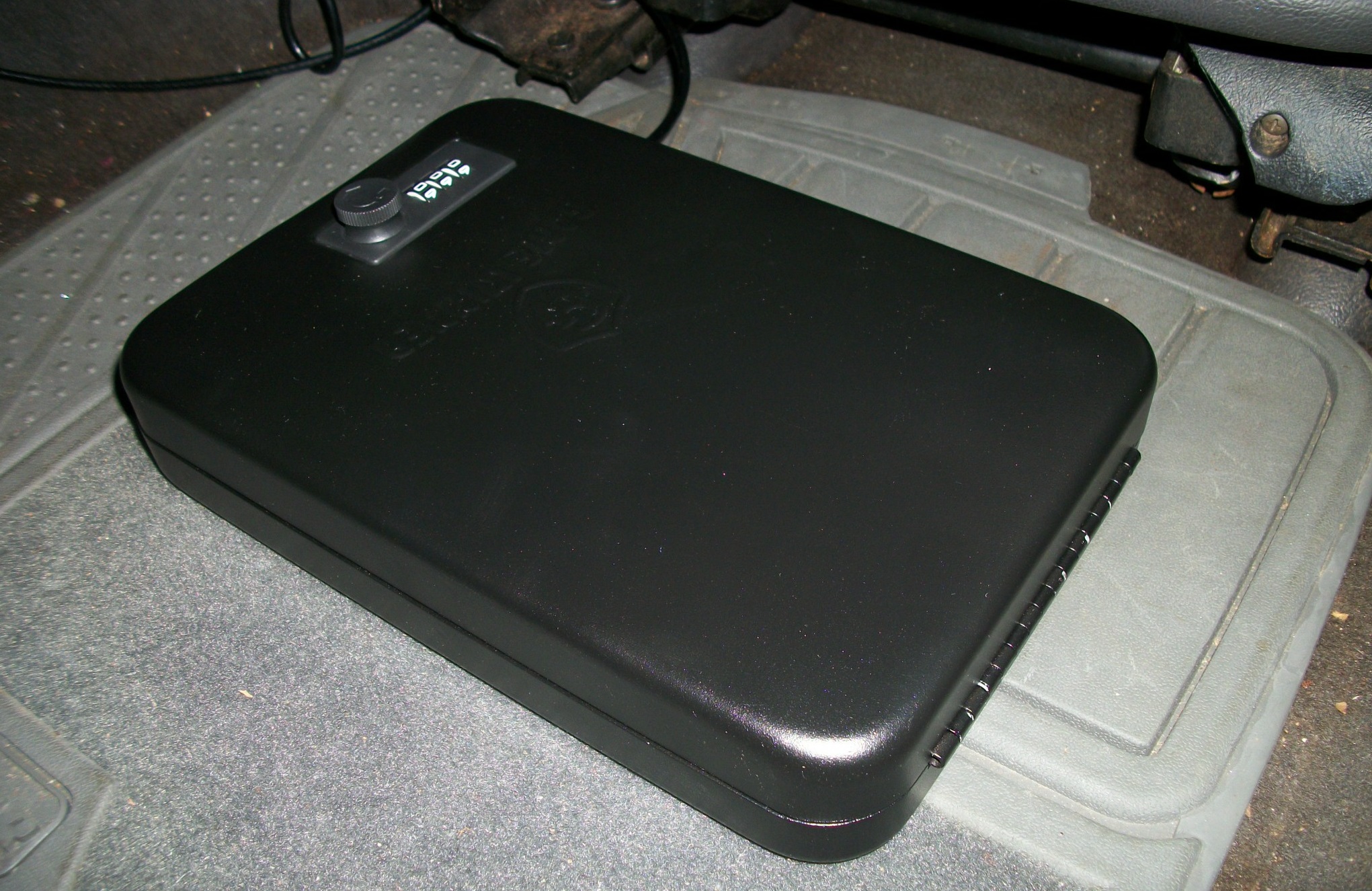
As the number of people who carry guns continues to increase, we trainers are going to have to focus more on ‘Living with Guns,’ as John Farnam put it years ago, rather than just ‘shooting guns.’ Shooting guns is fun and provides immediate gratification; we can see when our students get it. Teaching people about Living with Guns provides no gratification whatsoever because it happens after they leave our class. Are we performers or teachers?
Let’s consider a variant of my question “What’s the ‘worst possible case’?” Is it encountering a really determined criminal who soaks up whole magazines of bullets or having a family member accidentally shoot another family member? I’d really like to hear a definitive answer to that question.
Living with Guns is the tedious drudgery of the armed lifestyle that we, both trainers and gunowners, tend to ignore. It’s easy to focus on marksmanship, ballistics, legalistics, and equipment because those things are obvious and we’re reminded of them regularly. The hard part will be re-directing our attention toward the less obvious but just as important lifestyle aspects. That change in focus needs to happen quickly if we really want to consider ourselves responsible.
Perhaps a criterion we need to add to our selection list when talking about purchasing a pistol is something like “How convenient is it for this purchaser to carry, and secure, this particular pistol 18/7?” If it fails that criterion, that might be a deal breaker.
Police and Glocks
The Los Angeles Times recently published an Op-ed piece entitled Why the police shouldn’t use Glocks. I find it shortsighted and the author’s reasoning incomplete and faulty.
Although I prefer a Double Action Only or Double Action/Single Action gun for my personal use, I perceive several issues with the article.
The half-inch difference of trigger travel may not sound like much, but it can be the difference between life and death.
The statement is a core issue. There’s no control statement about how many successful uses can be attributed to the GLOCK’s shorter trigger. The first shot is both the most important and, with DA guns, the most often missed. Aside from the possibility of ending the fight sooner, the issue of errant rounds flying around the community is also disturbing.
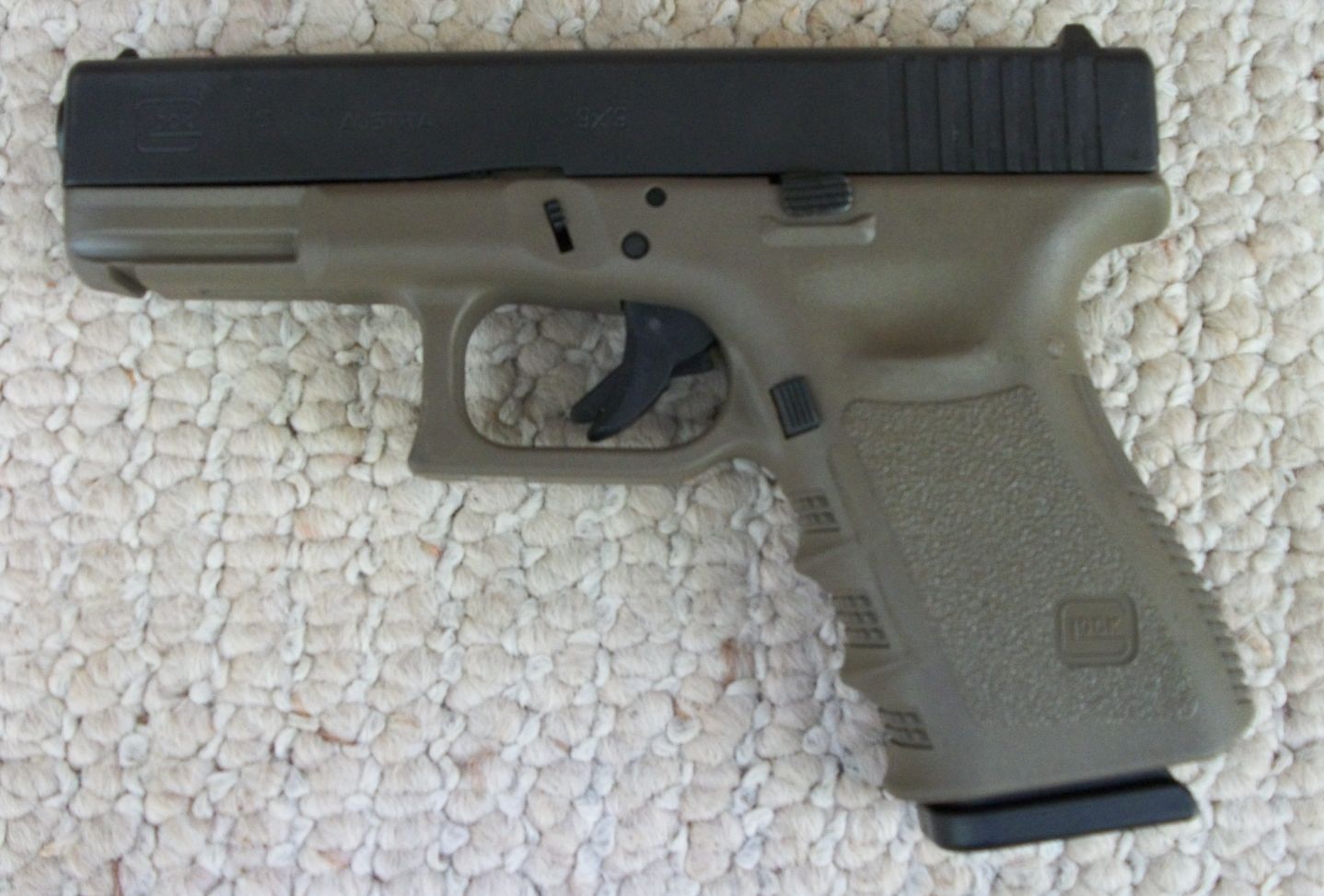
A number of major and minor agencies use guns with much longer double-action triggers that are just as easy to fire deliberately but that are much harder to fire accidentally.
That’s a well couched statement. If we substitute the term ‘hit with’ for ‘fire,’ it completely falls apart. Making the gun go off is just part of the equation; hitting the intended target is equally important.
Much as I like them, double-action triggers are NOT just as easy to hit with deliberately as a Glock’s. If we include shooting in reaction time, vis–à–vis deliberately, the equation shifts even more in the Glock’s favor. For smaller statured officers, it’s sometimes nearly impossible to grip and shoot a double action gun well. Having taught numerous smaller military personnel to use the M9 pistol, I can say unequivocally that grip size and trigger reach can be a major problem.
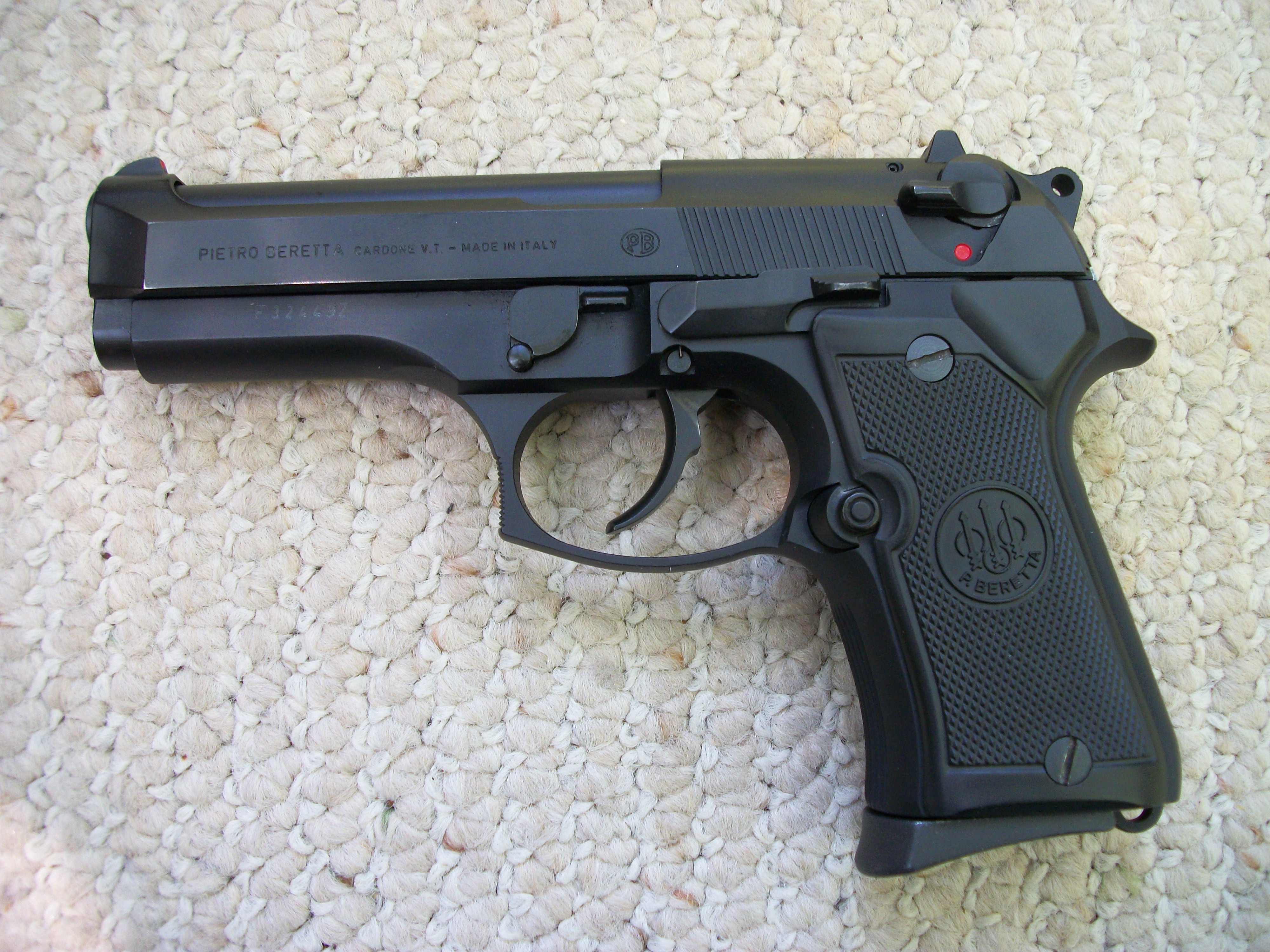
Granted, many officers can learn to shoot a double action gun reasonably well with plenty of training and regular practice. However, that’s not the reality of police administration, either from the hiring or the budgetary perspectives.
What critics should be addressing instead is the brutal reality that short trigger pulls and natural human reflexes are a deadly combination.
In a shootout with a criminal, that’s exactly the point that the author seems to miss. A well-placed source provided some insight to me about the FBI’s decision to issue Glocks years ago, after resisting them for years. “The New Agents could shoot them so much better than the Sigs it was striking.” This from the law enforcement agency with perhaps the most extensive firearms training program in the world.
All equipment has issues associated with it. The accidents cited in the article are tragic and regrettable. However, arguments similar to the author’s could be made for putting speed governors on police vehicles because police officers sometimes get into crashes, with resulting casualties, during pursuits or requests for service. I don’t see any call for that. If avoiding unintentional casualties is the main issue and only criterion, why not just go back to revolvers?
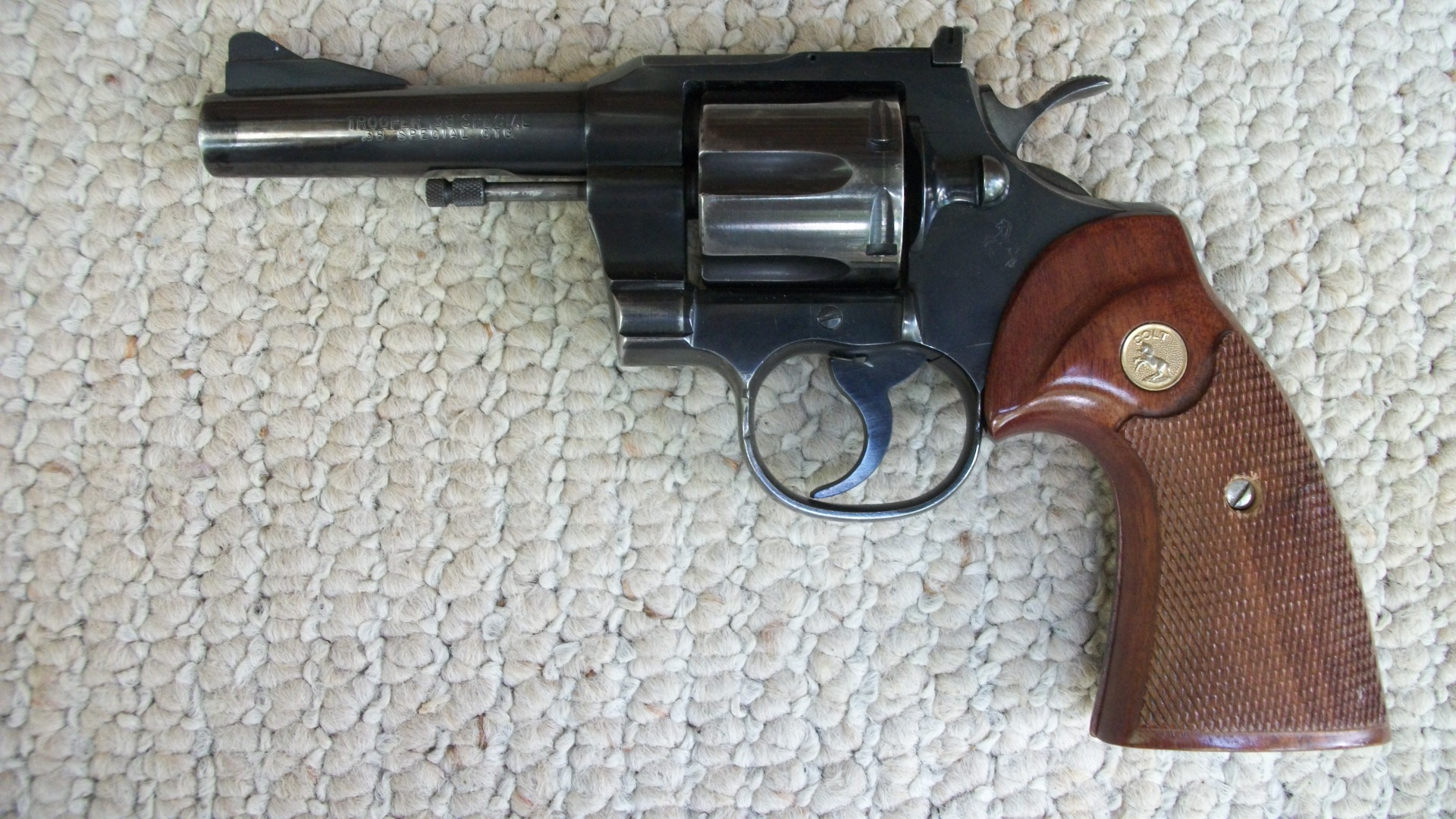
The author didn’t make much of a case for his opinion other than citing a few Negative Outcomes. Without providing the other facets of the decision making process and then weighting the various aspects, it’s a weak argument. The selection of a firearm, whether for police service or individual use, is a complex one. The ability to use it safely is key. However, the ability to use it effectively is just as important.
Hardware solutions to software problems
Several times, I have been pointed to an article about a cop who decided he needed to carry a lot more ammo on the job. The story is an excellent example of having the answers right in front of you and then ignoring them. While I don’t disagree with the idea of having plenty of ammo, it wasn’t the real solution to the problem in his case.
The nitty gritty of the story is that a cop got into an extended shootout with a determined attacker. The shootout went on for quite a while with a lot of spraying and praying on both sides. Eventually, the cop shot the suspect in the head and the situation was over.
As the incident progressed, he figured out that the answer to his problem was a software solution.
Then I told myself, ‘Hey, I need to slow down and aim better.’
My mother used to frequently comment about life in general, “If you don’t take the time to do it right in the first place, what makes you think you’ll have the time to do it over?” That’s a good commentary about situations like the one the officer encountered.
In retrospect, the officer mentioned that there were also other software solutions available. “ ‘I didn’t have time to think of backing up or even ramming him,’ Gramins said. ‘I see the gun and I engage.’ ” I’ve never put it on a timer but I bet that stepping on the gas pedal is faster than drawing from a security holster while seat belted in a car. Just recently a police officer proved the efficacy of this solution. As Massad Ayoob said many years ago, “What is a car to a pedestrian? A multi-ton high speed battering ram.”
But the officer’s overall conclusion about his experience was a hardware solution, i.e., ‘Be ready to do a bunch of spraying and praying’ by carrying 145 rounds of ammo on his person. His conclusion doesn’t follow from his self-evaluation of the solution to his problem. Perhaps, despite being a “master firearms instructor [I’m not sure what that means] and a sniper on his department’s Tactical Intervention Unit” he needs to learn to shoot a handgun on demand in a way that gets good results.
He did draw one conclusion I agree with, to wit: the mighty .45 ACP isn’t all it’s cracked up to be. The officer switched from carrying a Glock .45 to a Glock 9mm. He’s not the first police officer I know of who has drawn that conclusion after a gunfight.
In one of the incidents my colleague Tom Givens describes in the DVD Lessons from the Street, the citizen came to the conclusion that he needed a larger caliber pistol. My analysis in that case was similar to the solution the author of the story about the police officer’s situation drew, “Practice head shots.”
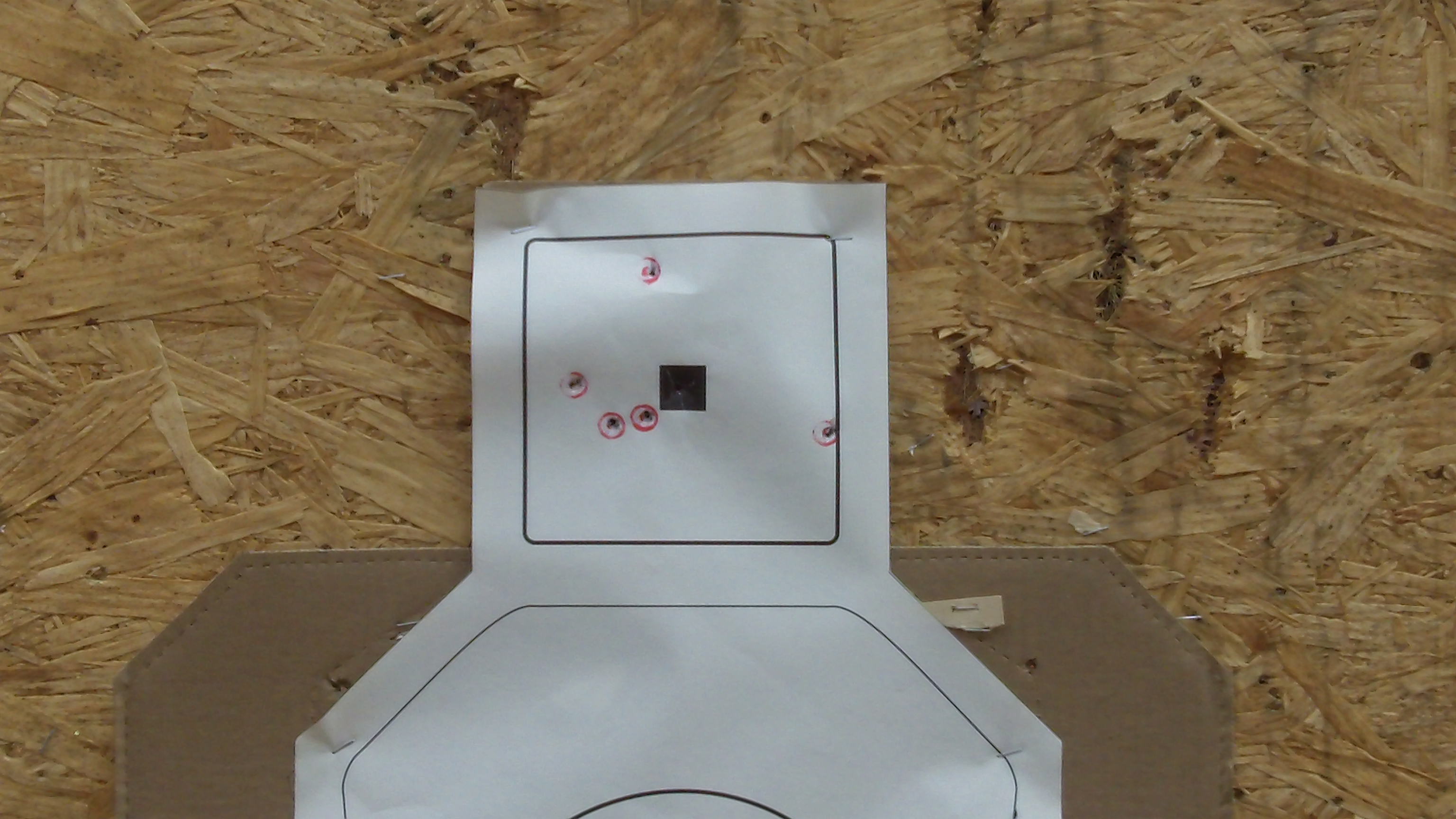
I often see people draw erroneous conclusions from their experiences. While we think about ‘the fog of war’ as occurring during the battle, it often sets in afterward, too.
Decision-making in the Kimball shooting
I am 62 and not nearly as strong as I once was. So long as he is only shouting, that’s where it will stay. Touch [me], I’m too old to fight. I will shoot.
An Internet Common Tater
Merrill “Mike” Kimball encountered one of the worst Negative Outcomes, being convicted of murder. Leon Kelley experienced the worst of them all, getting killed.
There are a number of items relating to decision-making, both during the confrontation and preceding it, that bear discussion in this case. Decisions are often made based on attitude and feelings, rather than facts. Most gun control arguments are rooted in feelings and we gunowners belittle anti-gunners for that. However, don’t think that the same reliance on fact rather than feeling can’t come back to haunt us in the courtroom.
An aspect of the Kimball shooting that I find interesting is that the ‘disparity of force’ aspect swayed the jury not at all. Leon Kelly was half a foot taller and outweighed Merrill Kimball by over 100 pounds but the jury didn’t care. The above Common Tater has the same attitude Mike Kimball displayed on October 6, 2013. Unfortunately, the jury didn’t see it that as a justification. A fear of serious bodily injury has to be seen as ‘reasonable.’ As a Maine defense attorney wrote on his blog
note the use of the word ‘reasonably’ [in the Maine statute]. Whimsical or irrational beliefs attributed to the defendant do not suffice.
Just because some of us are older (I’m 60) doesn’t mean we can think every assault is cause to respond with deadly force. This is why I tell every Defensive Pistol class I teach:
Failure to have an Intermediate Force option implies that all you are willing to do to protect yourself and your family is kill someone. That’s not a position I care to put myself in, nor should any rational adult.
For now, I’m not going to address the wisdom of even going to the scene of the confrontation, all things considered. However, if Mr. Kimball had carried a can of pepper spray with him, he probably wouldn’t be facing the probability of spending the rest of his life behind bars. I hear many objections to carrying pepper spray. Without exception, they are foolish, yet speciously alluring. As the prosecutor commented about the Kimball case:
People have a right to carry firearms, but the law only provides for use of firearms in defense in very limited and particular circumstances, and this was not one of them.
I would much rather carry a can of pepper spray than a spare magazine or a defensive knife. The chances you will need a spare magazine are infinitesimal. The reasons I hear for carrying a spare magazine tend to be:
- Carrying an extra implies you know what you’re doing.
- That you know that most semi-auto malfunctions are mag-related.
- That you know to top off after the fight.
- That you know that 6 rounds of .380 isn’t that much.
- That there might be another adversary.
The chances you will need a non-lethal response to an ugly situation are much higher than any of those reasons. Being shoved, even repeatedly, is not sufficient legal provocation for a killing. Even if it was, do you want to kill someone in front of your wife and son, as Mr. Kimball did, unless it’s absolutely necessary? But if all you have is a hammer, everything looks like a nail.
Ponder the implications the next time you strap on your heater.
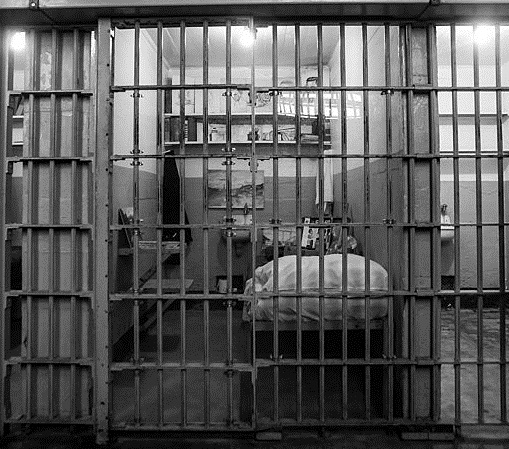
Cells in Alcatraz prison, San Francisco, California
Author William Warby from London, England
Anatomy of a Negative Outcome
I’m shocked because I thought the case was a question of manslaughter. Hung jury, possibly guilty of manslaughter, but more likely ‘not guilty.’ It just seemed to me that the relative sizes of the two people made it clear that my client was in a jam that he couldn’t get out of except to use a firearm.
So said the defense attorney for Merrill “Mike” Kimball after his client was found guilty of murder for fatally shooting 63-year-old Leon Kelley in 2013. Obviously, things did not come to pass the way he thought they would. Regardless of the outcome of an appeal, being convicted of murder is a Negative Outcome.
Cast of characters for the drama:
- Stan Brown – 95 year old owner of Brown’s Bee Farm
- Karen Thurlow-Kimball – shooter’s wife. Managed the farm and sold the honey
- Merrill “Mike” Kimball – shooter (5 feet 11 inches tall, 170 pounds)
- Damon Carroll – Thurlow-Kimball’s son
- Daniel Lilley – Kimball’s attorney
- Leon Kelley – victim (6 feet 4 inches tall, 285 pounds)
- Kathleen Kelley – victim’s wife, Stan Brown’s daughter, and witness
- Craig Rawnsley – Kathleen Kelley’s son (6 feet 2 inches tall, 205 pounds)
- Robin Rawnsley-Dutil – victim Kelley’s stepdaughter and witness
- Daryl Rawnsley – deputy chief of the Cumberland Fire Department
- Libby Adams – Brown’s daughter-in-law, bookkeeper for the bee business
- Matthew Crockett – Assistant Attorney General
- John Alsop – Assistant Attorney General
Events preceding the day of the shooting.
- Thurlow-Kimball begins working for Brown at the farm in 2009, when Brown’s son died.
- Thurlow-Kimball becomes manager of the bee farm.
- Brown eventually includes Thurlow-Kimball in his will, leaving the bee business and a part of his property to her. The family deeply resents this.
Oct. 6, 2013
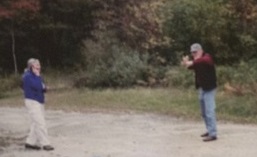
- Around 1 p.m., Craig Rawnsley calls Thurlow-Kimball and accuses her of wrongdoing. He tells her “things were going to change at his grandfather’s farm.”
- At the time of the phone call, Merrill Kimball had just gotten off his boat and gone to a friend’s house to watch a Patriots game. He drank two rum and cokes while he was there.
- Thurlow-Kimball immediately calls Brown’s daughter-in-law, Libby Adams. Adams tells her the Kelley family plans to change the locks on the bee farm sales shop.
- The shop contains about two dozen jars of honey, totaling about 700 pounds. The honey, which contractually belongs to Thurlow-Kimball, has a value between $4,000 and $7,000.
- Rawnsley-Dutil calls her mother and Kelley, her stepfather, at their home 40 miles away, and asks them to come to the farm. The senior Kelleys then drive to the Bee Farm and arrive before the Kimballs.
- Thurlow-Kimball enlists her husband and son to help her get the honey out of the shop. They drive to the shop in two vehicles.
- Around 3 p.m., Kimball and his family arrive to load the honey jars.
- Rawnsley-Dutil and her brother follow the vehicles up the driveway on foot. Kelley drives up in his 3½-ton truck with the license plate ‘AWFUL.’
- Kelley family confronts Kimball family.
- Craig Rawnsley blocks the shop door and accuses the Kimball family of trespassing.
- Kimball asks who Kelley was. The two men had never met before that day.
- Kathleen Kelley calls the police.
- Thurlow-Kimball refused to leave the property, insisting on waiting for a police officer to arrive.
- Kelley put his hand on Kimball’s shoulders, spins him around, and follows as Kimball backs down the driveway. Kimball later states that Kelley shoved him five or six times total.
- Kimball retreats roughly 35 feet being followed by Kelley until he is in the driveway nearly to the treeline. The driveway extends to his right and left, at this point.
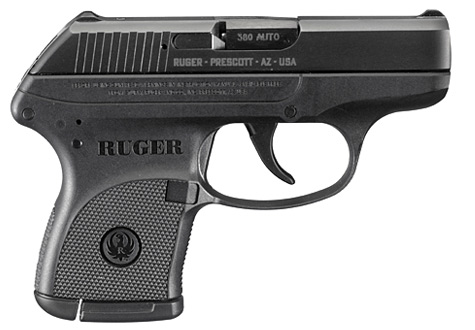
- Kimball, who is licensed to carry a concealed weapon, draws his Ruger LCP .380, and fires three shots into Kelley’s torso at a range of 4 -10 feet.
- Kelley falls down after being shot and clutches his abdomen.
- Robin Rawnsley-Dutil immediately takes a photograph of the scene and then begins recording a video.
- Kathleen Kelley remains on the 911 call after her husband is shot.
- Rawnsley calls his brother, Daryl Rawnsley, deputy chief of the Cumberland Fire Department, for medical assistance.
- Kelley is transported by ambulance to a hospital and dies shortly thereafter.
- The state police sergeant who was the first officer to arrive at the scene said he could “smell the odor of liquor” on Kimball. Kimball did not seem impaired, other than failing to immediately respond when when the sergeant commanded him to put his hands up and get on the ground.
- Kimball maintains the shooting was done in self-defense. “The man attacked me. The man pushed me back. I was in fear for my life. I nearly fell down, and he kept coming.” Kimball’s words were captured on a police cruiser’s onboard camera.
- Kimball is questioned but not arrested.
November 2013
- A video re-enactment is recorded by Kimball at Brown’s Bee Farm on November 4.
- Kimball is indicted on the charge of murder.
- He posts bail and remains free.
April 2015 (not necessarily in chronological order)
- Kimball rejects a plea offer to manslaughter before the start of the trial.
- The trial commences on April 6, 2015.
- The prosecution contends that Kimball could have continued to retreat by turning left or right down the driveway rather than shooting.
- Maine is one of 16 states whose self-defense laws require retreat for as long as safely possible before using deadly force.
- The prosecution alleges that Kimball took a concealed pistol and an extra clip [sic] of ammunition to Brown’s Bee Farm because he expected trouble from the Kelley family.
- Kelley family members admit in court that Thurlow-Kimball was not trespassing and that they had no right to tell her to leave.
- Members of the Kelley family make several contradictory statements about the events leading up to the shooting.
- Rawnsley-Dutil states that Kelley put his hand on Kimball’s shoulders shortly before the shooting, spun him around and followed Kimball as he backed down the driveway. She admits Kelley may have shoved Kimball additional times.
- Craig Rawnsley admits he put his hand on Carroll’s shoulder to stop him from moving and states “Damon (Carroll), he is not as big as me.”
- Assistant Attorney General Alsop describes the shooting as: “Bam. Bam. Bam. There was no pause. Merrill Kimball fired three rapid shots right in the middle of Leon Kelley.”
- The video re-enactment recorded by Kimball is played for the jury.
- The state’s chief medical examiner testifies that the first shot had most likely felled Kelley. He also stated that “All three of these were potentially fatal.”
- The cellphone photo taken after the shooting is shown to the jury.
- Craig Rawnsley testifies that Kelley wouldn’t have “escalated the situation” if he had known Kimball was armed.
- Defense Attorney Lilley says “They brought him [Kelley] along because he was mean and he was a badass. They brought him along because he was big.”
- “The issue for me in this case is there were three shots fired and whether he was acting in self-defense in all three shots or less,” said Justice Roland Cole.
- The jury deliberates for six hours over two days. They have the options of finding him guilty of murder, manslaughter or acquittal.
- The jury finds Kimball guilty of murder on April 15, 2015.
- The possible sentence is 25 years to life in prison.
- Kimball is taken into custody.
- Kimball’s lawyer indicates the intent to appeal, which cannot be filed until after Kimball is sentenced. Sentencing will be scheduled in the next six weeks.
The above account is based on the trial reporting of Scott Dolan, Staff Writer for the Portland Press Herald newspaper.
I’ll look at the implications of this over the next few days.
 tacticalprofessor
You must be logged in to post a comment.