Be a good instructor
Claude, I really like your blog, I have been a fan and a reader, since I saw it linked over at georgiapacking.org
I’m scheduled to get my NRA certification as a firearms instructor for basic pistol next month.
Do you have any advice for me, in starting out as an instructor?
My main recommendation would be to continuously improve your knowledge and skills. I can’t tell you how many NRA Instructors I know who haven’t
read a single gun book beyond the NRA manuals, have never taken another
class, and who don’t do anything to measure and improve their skills.
My personal library has over 400 books about guns, shooting, tactics, police work, and military history. The subjects run the gamut from appropriate rifles for African hunting in the early 20th century to analyses of the effects of using deadly force by the shooter. My collection has over 100 DVDs in it too. Granted that took me over 40 years to accumulate but it’s indicative of what I try to know about the subject. Many instructors have neither depth nor breadth to their repertoire. They learn one set of skills at a mediocre level and stop there. I see it time and again. That’s a mistake; never stop learning.
I take classes from others regularly, frequently just short evening courses. Those short evening courses are how we are going to begin to reach the majority of new gunowners. And, even if someone else’s class is terrible, like one I took at an indoor range last week, you get important insight about how NOT to do things. Learn from others’ mistakes as well as your own.
With regard to measuring one’s skills, I think it’s important for everyone to benchmark where you are and try to improve that continuously. For an instructor, it’s doubly important. There are a lot of different benchmarks you can use, just having one is the important thing. Shoot it periodically and try to get better at it. You may find that the benchmark you use changes over time to something more challenging and that you have multiple benchmarks that measure different aspects of shooting. One of the main advantages of shooting in competition is that you find out you’re not as good as you think you are. Ego is the Achilles heel of many shooters and instructors.
I also think it’s important to demonstrate drills for the class. Time dependent, it doesn’t have to be all of them, but the first drill and any complex drills should be demonstrated. People are visual learners, for the most part. Telling people how to perform a physical skill is simply not as effective as showing them, IMO. And don’t take your subject matter knowledge for granted about what constitutes a ‘complex’ drill. I have had very intelligent students who couldn’t figure out what the NRA MQP drills were until I demonstrated for them.
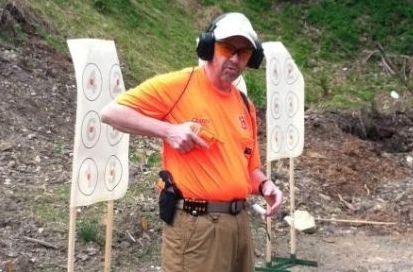
Have an inert gun to do this, where it’s appropriate. If it’s livefire, I use a live gun. If I’m demonstrating gunhandling or tactics, the inert gun comes out. I have both of them on me when I’m teaching.
Most importantly, don’t get complacent about anything. Your skills, safety, communication, etc. need to be at the forefront of your mind whenever you’re teaching. Every story we hear about an instructor having a Negligent Discharge or shooting a student in class has complacency as its root. Complacency is a killer, don’t go there.
Structured shooting is a whole new world for most people. Help them understand it in every way you can.
Structured practice (Part I)
What exactly is Claude Werner’s ‘1,000 Day Dry Fire’ program? Is it published anywhere? Anybody tried it? What were the results? Would you do it again?
This question was asked on a forum I visit occasionally. In a narrow sense, the question refers to an idea I had a while ago. About 12 years ago, a friend was working on his Yoga instructor certification and had to do 1000 days straight of meditation. That inspired me, so I decided to do it with dryfire. He said that dryfire is my form of meditation; I will defer to his judgment on that. Another friend of mine wanted to try it last year, so I’m doing it with him now, my second time, his first. We’ll be finished at the end of 2015 but we both agree it’s become such a habit that we probably won’t stop then.
First of all, the ‘program’ is not any particular drill or set of drills. Rather, it’s the commitment to do dryfire each and every day, without fail, for 1000 straight days. If you miss a day, you have to start again at the beginning. The important thing is do some dry practice every single day, even if it’s just a little. My last trigger press is never more than 24 hours in the past. Days that I practice livefire are not exempt from the dryfire requirement. I like to finish each range session with a few dryfire trigger presses.
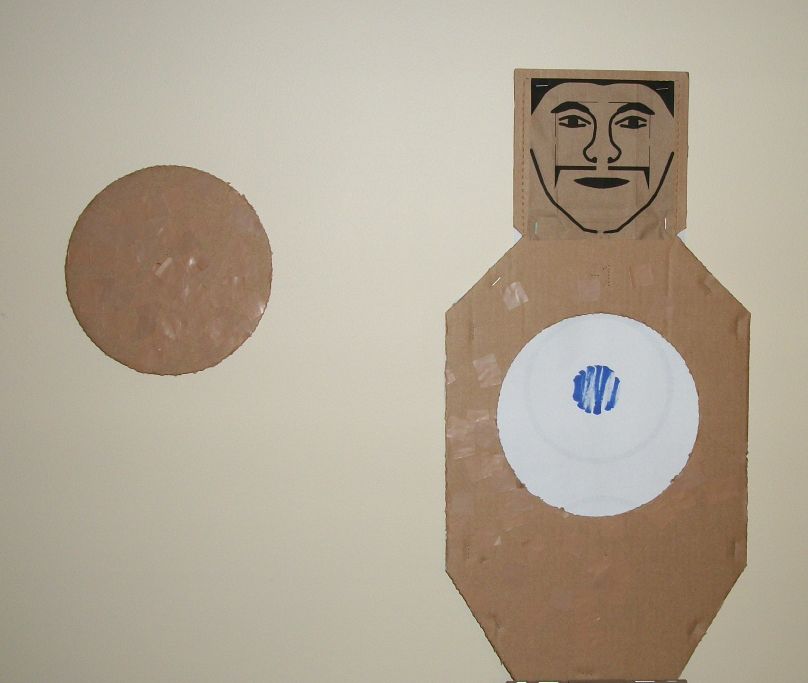
The first time I did the program, when I was at the GF’s house, I’d do it in the bathroom by using the tile intersections as targets. She finally figured out what I was doing and had me set up a little dryfire range in the spare bedroom. The range consisted of a reduced size target behind a picture and a cassette tape I had made with a specific regimen on it. Eight minutes and I was done.
The reason there’s not one drill or set of drills is to avoid boredom. I regularly change up my regimen. Run different qualification courses dryfire, practice bullseye shooting, run the NRA Defensive Pistol I & II, etc. It doesn’t matter. I make different targets and reduced size target arrays from time to time to change things up, as well.
The most important aspect of the program is that it represents a philosophy of practicing our skills on a regular basis. Those skills might be shooting, threat management, surveillance detection, pepper spray, unarmed combat, etc. Any physical skill is perishable, meaning after a length of time, it’s not as easily performed on demand. The ‘riding a bicycle’ analogy does not completely apply. When we get back on a bike after a long time, we have some time to refresh ourselves with those motor skills. If someone is attacking you, a refresher session for your personal protection skills is not an option for you. You need to be on your game at that point. Shooting skills are especially perishable for those who have never become Unconsciously Competent at them in the first place. That’s most people, frankly.
I dryfire even when I shoot an IDPA match. When I go through the “Unload and Show Clear” process, I don’t just do a trigger mash at the hip like most people. I pick out a spot on the berm, aim at it, and do a good dryfire trigger press. What I don’t want to do is to ever program myself to do a motor skill in a sloppy or detrimental way.
As a friend of mine once remarked, “Claude doesn’t do anything that doesn’t have a purpose.” My cardiologist told me “You are a very programmatic person.” Both of those are completely true, to the extent I can make it that way.
Spot shooting
“Do you want it in the belly or in the teeth?” –my father, to a would-be robber, who suddenly remembered a previous appointment.
My dad’s eyesight was pretty bad by then, so he couldn’t aim at the eye. However, the teeth remained a viable aiming point for him. At age 83, he and I took the training to get our Nevada Concealed Handgun Permits. He outshot everyone in the class except me. One reason was he knew to aim at something.
One of the biggest problems I see in current training methods is the concept of “aim for center of mass.” Coupled with the blank targets used, it’s no wonder that people have a hard time learning to hit anything. That’s the equivalent of what’s called an “area target” in the Army. Area targets are best engaged with some form of area weapon, such as a machinegun, grenade launcher, mortar, or artillery. However, we don’t carry area weapons for self-defense.
One of the greatest handgun shooters ever, Ed McGivern, was asked how he could hit playing cards so quickly and with such tight groups. His answer was “I’m not aiming at the card, I’m aiming at a spot on it.” Ed established some speed records that have never been broken, so this is does not have to be a slow process, either. The idea that aiming at a spot on a target is too slow is a common misconception. It does require practice, though.
To facilitate this when I am dryfiring, I have targets with spots on them. The one I am using now has a variety of spots on it. There is a face, a cut out area of the IDPA -0 zone with a spot in it, and a series of circle and dots on the back. When I’m shooting IDPA, I do my best to pick out a spot on the target to aim at, such as a paster or group of pasters. So, I’m not aiming at ‘center of mass,’ I’m aiming at a spot.
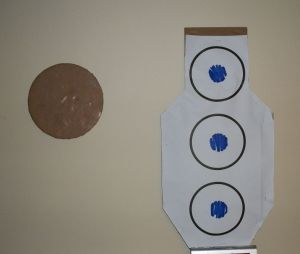
When I explain this concept to students in my Defensive Pistol classes, I reference the Internet meme “Be polite, be professional, but have a plan to kill everyone you meet.” Whenever I hear that meme, I ask “What are the elements of your plan?” I have yet to receive any meaningful response; it’s just a platitude that people repeat to sound like they’re ‘switched on.’ I tell my students that one element of my plan is that as soon as I meet someone, I pick out the spot on their body that I am going to aim at, should it become necessary to shoot them. Then I describe to each person in the class what the aiming point for them would be. This tends to generate considerable discomfort but makes the point very clear. Most of the class is shot on dot targets. Only when the students shoot the qualification course do they shoot at a silhouette, which has a discernible aiming spot on it.
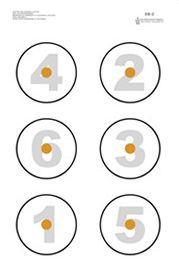
Spot shooting is a fundamental part of the instruction at the elite Rogers Shooting School. There is always a spot on the body plates at the School. When practicing recoil control via the ‘Bill Drill,’ aiming at that spot is key to firing a good group.
What we are trying to achieve when aiming at a spot is not necessarily to hit the spot but rather to get our bullet very close to it. As I explain to my students, our groups are always going to be larger than what we are aiming at. This is true because guns are not generally capable of putting all the bullets in the same hole, nor are we Terminators who can hold and press the trigger exactly the same way every time. However, by aiming precisely, we minimize the amount of error induced by mechanical tolerances and our human fallibilities.
This is the fundamental problem with ‘aiming at center of mass.’ In that philosophy, the entire silhouette is the target. So if the group is larger than the target, misses become an inevitable part of the result. Throw in poor trigger manipulation and you end up with a 20% hit rate.
Try this out the next time you go to the range, I think you will notice a difference.
 tacticalprofessor
You must be logged in to post a comment.