10 Rules for Being a Safe Gun-Owning Parent
If I never had to make another entry to my ‘Accidental Shootings by Children’ datafile, I would be quite happy.

Rebecca Bahret of SheKnows.com contacted me recently about compiling a list of the top X-number of safety tips for gun storage when kids are present. I was flattered she thought enough of the blog to ask me. I obliged, obviously, and thought of ten items. With word-count limits, deadlines, and so forth, it was trimmed down a good bit.
It was even worthy of an infographic! Legit.
 Image: Terese Condella/SheKnows
Here is her final article. It’s a great article for her target audience.
Since I’m not obligated to any word count limits, here’s what I sent her. I hope it makes a good compliment to her article:
- This whole list will share a common theme. I teach it as the *Fifth* fundamental firearms safety rule. Here’s the first four. The rule is, “Prevent access to your firearms by unauthorized people”. Children are on that list of people we don’t…
View original post 429 more words
Friday Fundamentals – Measuring time in your firearms practice
Fast is fine, but accuracy is everything. In a gun fight… You need to take your time in a hurry.
–Wyatt Earp
One of the memes in firearms training is “I’ve never seen a timer in a gunfight.” This is hugely misleading in the way it’s often understood. The timer that is present is your life-clock. Don’t think it isn’t running every nanosecond of a deadly force encounter. While we need to be deliberate and make our hits, as Earp stated, we don’t have all the time in the world to do so, as he also stated. So we need to establish some kind of time standards in our practice, at least for some of our drills. The question is how do we do so, both in principle and in practice?
There are two principal ways of measuring time. One is measuring it directly. For instance, a shooter might be able to draw and fire a pistol in 1.4 seconds. To achieve a meaningful level of accuracy in that measurement, we would use a ‘shot timer.’ Shot timers give an audible or visual signal to the shooter and then record the time taken for the task via a microphone in the timer that hears the shots. Shot timers range from fairly simple push a button types costing around $125 to more complex devices with numerous features than run about $200. They all work fairly well. The choice largely depends on the features you want. One downside is that shot timers cost more money than many people want to spend.

On outdoor ranges, shot timers work really well. On an indoor range, not so much. Measuring time is much more difficult in the indoor environment. Multiple shooters adjacent to each other interfere with using a standard shot timer. If your timer is picking up the sound of someone else’s shots, it’s not doing you any good.
This issue brings us to the second way of measuring time, par time. Par time means that the shooter has a fixed amount of time to accomplish the task. Drawing, reloading, and presenting from ready are all tasks that can be accomplished in par time. For instance, we might say that a police officer is allowed 2.0 seconds to draw from a security holster. Par time lends itself much better to mass training, such as in the police and military than individual measurement, which would be prohibitive for training time-wise.
The times in the NRA Marksmanship Qualification Program and The Tactical Professor’s Pistol Practice Program are par times. So are most police qualification courses. Some ‘proficiency demonstrations’ that private citizens are required to do to obtain a Concealed Handgun License are timed. Those are par times, as well.
Par time can also be an effective way of practicing on an indoor range because we don’t have to be concerned with the effects of other shooters’ gunfire on a shot timer. Most shot timers will also do par time by sounding a second beep at the end of the par time. Unfortunately, the second beep is easily drowned out by nearby gunfire.
The simplest solution is to have a partner time you using a watch or stopwatch. Your partner can tap you on the back once for go and again for stop. It’s not terribly accurate but better than nothing.
If you go by yourself, an interval, or countdown, timer can provide a workable solution, especially if it has a visual signal or vibrates. This is a good way to get around the noise issue of indoor ranges. The vibration is becomes your start/stop signal
The first solution I used is a vibrating wristwatch. It has a countdown timer function.
 Another is the Gymboss that can be clipped to the pants or belt.
 The CED Universal Countdown Timer vibrates and also has a visual signal the form of a blinking light. This is the one I find myself using most.
 Time is a critical component of defensive training that many people don’t work on for a variety of reasons. Adding in time pressure to your shooting practice is a worthwhile way to increase your proficiency. If you are going to get a Concealed Carry License in a state that times the qualification course, it’s a good idea to practice ahead of time to get a feel for the cadence you’ll have to shoot at.

Friday Fundamentals – Performance Standards
Without testing, there has been no training
Shooting a pistol is an athletic activity. Like any athletic endeavor, we need to have some performance measurement standards. Measurement is the operative word here. We need to measure our downrange performance, i.e., how well we can hit the target, if we want to become better at shooting. There are numerous variables that can be called into play for measurement.
As an example of athletic measurement, the current US Army standard for my age cohort is a minimum of 27 sit-ups in one minute. More sit-ups means more points scored. The Army Physical Fitness Test has to be taken twice a year.
In weight training, we might simply measure how many repetitions of lifting a given amount of weight we can do until we can’t lift anymore. Over time, our objective is to be able to lift more weight and/or perform more repetitions.
Police officers have to undergo periodic testing of their shooting ability. The period might be anywhere from once a year (mandated by every state I am aware of) to four times a year (LAPD and FBI).
What might be a set of reasonable standards for the average gun owner? I’ll offer the following as a progression that a gunowner could use to see where their skills stand on a periodic basis. It’s less than 100 rounds, so there is some room for remediation, if necessary. Because firearms skills are perishable, I’m more in favor of the LAPD/FBI approach of doing an evaluation four times a year rather than just once.
1) LAPD Retired Officer Course
Shoot 10 shots at a silhouette at 7 yards with no time limit. The LAPD standard is simply that 7 of the ten have to hit. Our standard should be to have, at a minimum, all 10 rounds hit within the 7 ring of a B-27 or an equivalent.
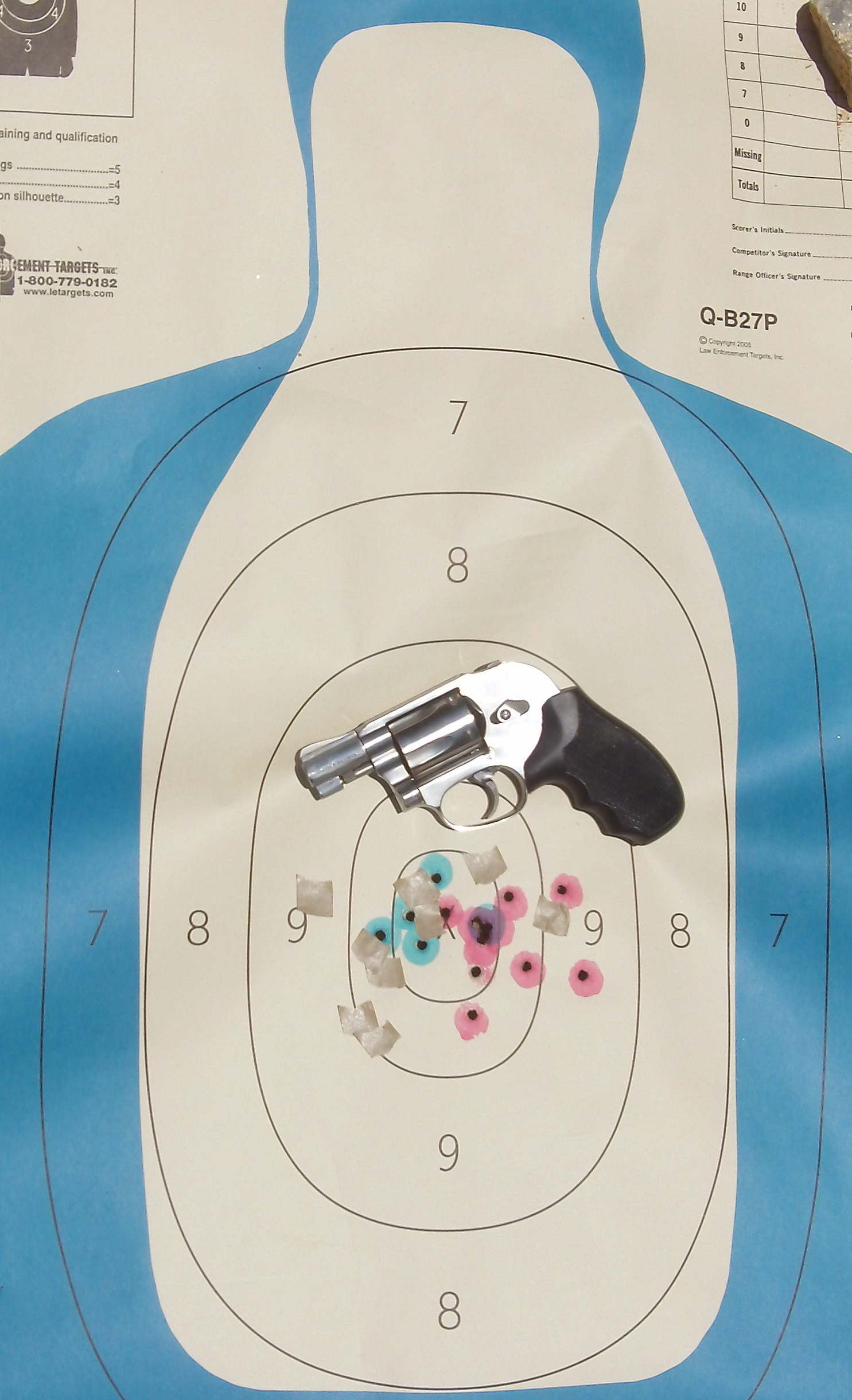 The point of this is to learn how fast we can shoot and still make our hits. Even the LAPD SWAT has learned and trained the cadence they can make consistent hits on a target. It’s not by shooting as fast as they possibly can, it’s by paying attention to what they’re doing while they’re shooting. I got that from Darryl Bolke.
If you meet the standard, then move on to the next component. If not, work on getting your fundamentals in better shape.
2) NRA Basic Pistol
Shoot a five-shot group within a 9-inch diameter circle (paper plate) at 15 feet with no time limit. Repeat twice for a total of three times. All the shots have to hit the plate. My colleague Chuck Haggard commented to me:
I wonder how many people never shoot anything but a full value target [i.e., complete silhouette] at 3-5 yards and call it gtg [Good To Go].
I agree with him completely; assuming that we’ll always have a full body presentation to shoot at in a defensive encounter is a mistake. If you can’t hit a paper plate consistently at five yards, you should work on being able to do that. See the sights and press the trigger smoothly. If you can make the standard, then move on to the next.
3) NRA Defensive Pistol I – Pro-Marksman
Shoot a five-shot group within a 12-inch diameter circle at 21 feet in fifteen seconds. Repeat until you’ve done it four times. The four times don’t have to be consecutive, however the standard of every shot having to be in the circle is. This drill is a lot more difficult than most people think because of the 100 percent hit requirement. Even though 15 seconds is a very generous time standard, knowing you’re on the clock makes it more difficult. Once you’ve made it four times, move on to the next component.
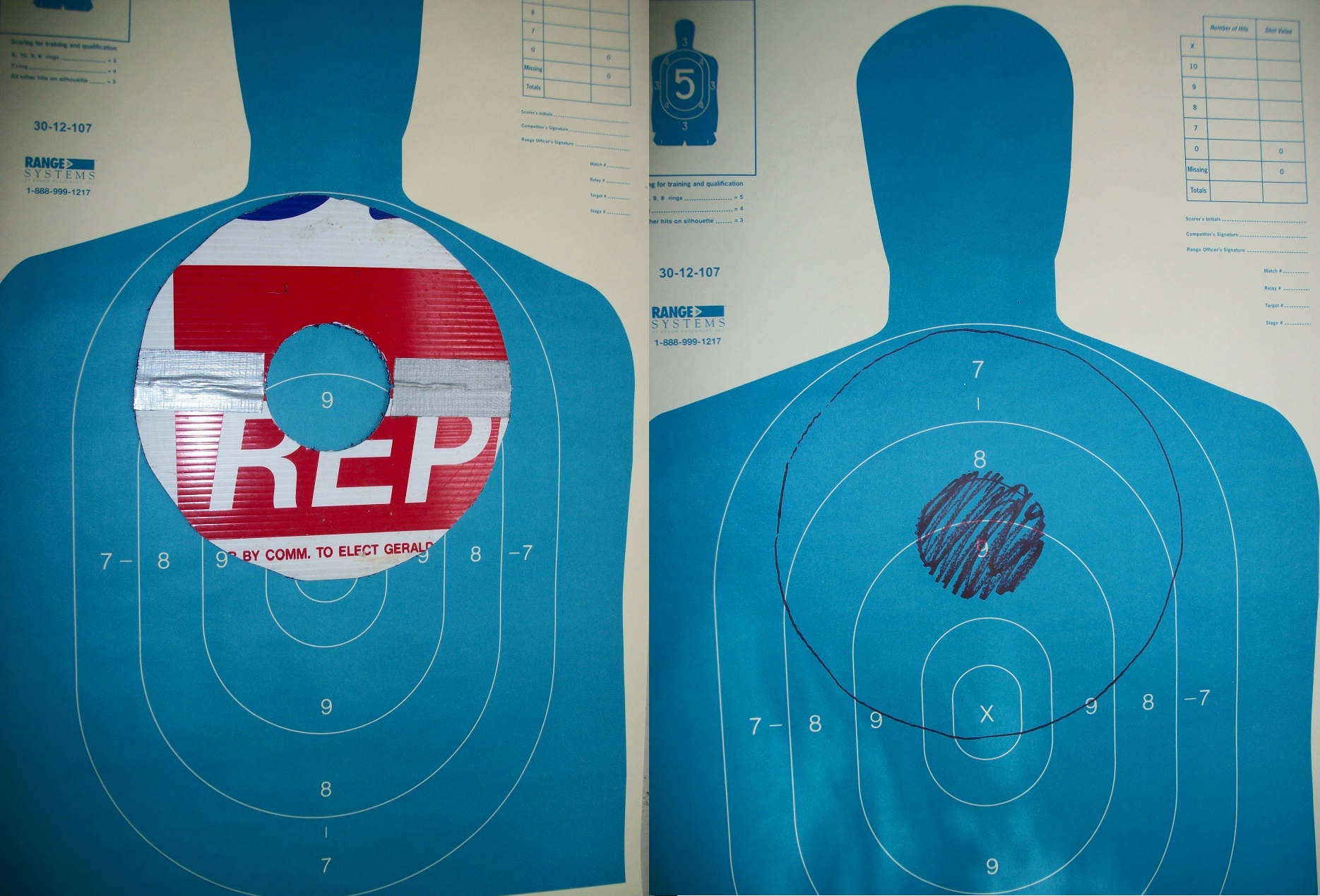 4) 5^5
Shoot five shots into a five inch circle at five yards in five seconds. Do it five times in a row. This is a very difficult drill for most people. Only do it once to get an idea of how well you can shoot it. It’s a good practice drill for other times you shoot. After shooting it once, move on to the final component.
 5) NRA Off-Duty Pistol Course – Stage 3
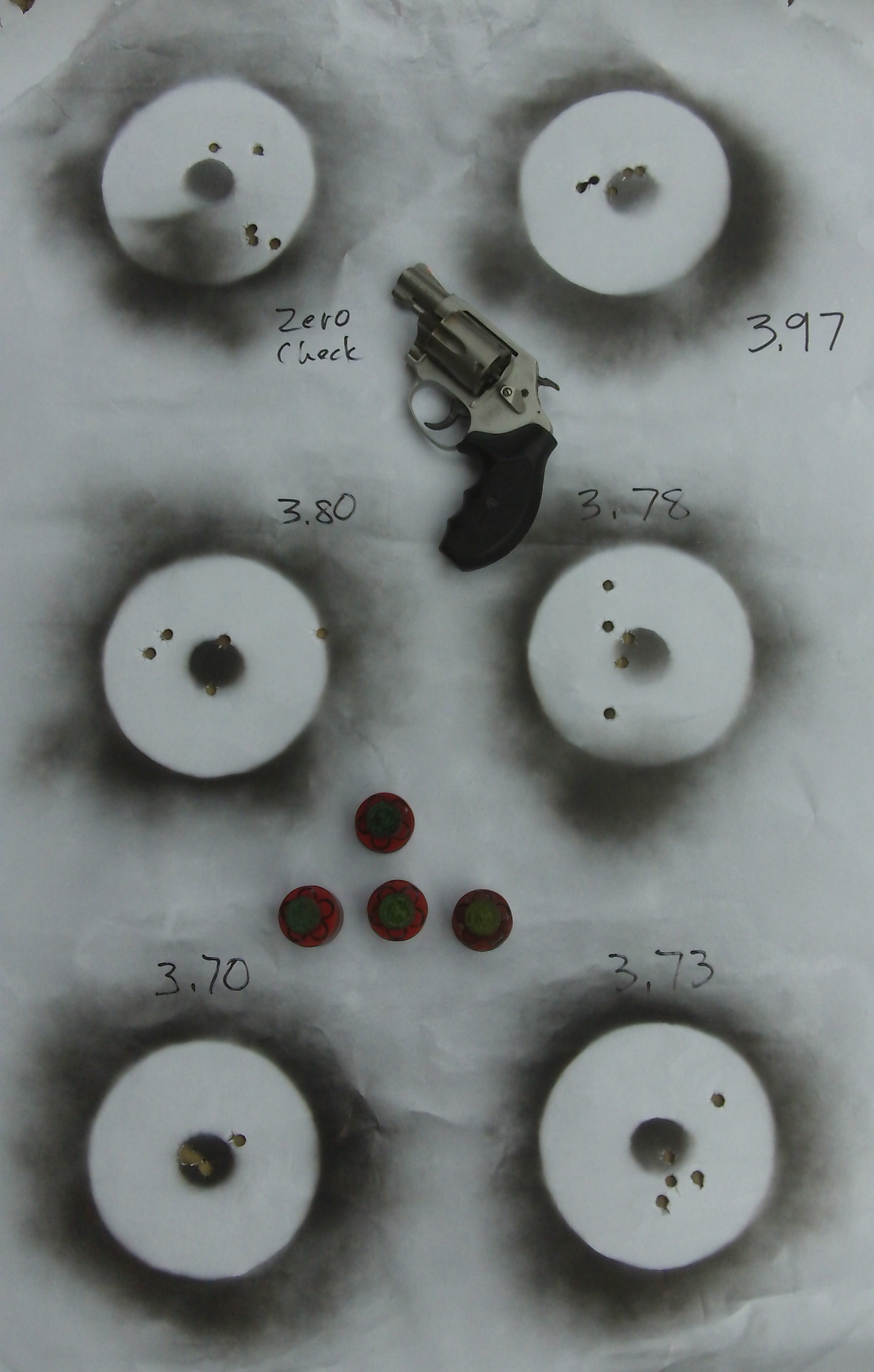
Shot at 15 yards on a B-27 silhouette target. Load with six rounds only; you will need another magazine or speedloader loaded with six rounds also. Start double action if your pistol is so equipped. Fire six shots, reload, and fire another six shots for a total of 12 shots from a standing position, no support from bench or wall allowed. The time limit is 20 seconds, including the reload for the second 6 shot string. Score it based on the number value of the rings. The maximum point value for the string is 120.
Although many people think that a Private Citizen cannot legally justify shooting past seven yards, that is absolutely not true. I have a number of incidents in my database where Private Citizens shot at longer distances and it was completely justified. If a gang banger is shooting at you and your children at 23 yards, you are legally justified in shooting back. That assumes you have the skill and are cognizant of the background.
If you don’t need to do any remedial work during the session, you will fire 82 rounds total. That gives you a little left over to play around with as you please. Using a progression of drills that increase in difficulty gives you the opportunity to evaluate where you need to work on your skills to improve. Keep a record of how you did on each drill. Having a record is key to knowing what you need to work on in your practice sessions.
If it all seems easy, you can do the drills one handed; either dominant hand only or support hand only.
Friday Fundamentals (Segment 4) Shooting with a flashlight
Several Negative Outcomes were brought to my attention this week. One was yet another incident of someone shooting their spouse, thinking it was a burglar. She died as a result of one shot to the chest.
The husband told police it was an accident. He told officers he woke up around 4:15 Saturday morning and heard noises in his house … He told investigators he grabbed his gun and when he saw a light on and someone standing in the distance, he took a shot. He said the person he ended up hitting once in the chest was his wife.
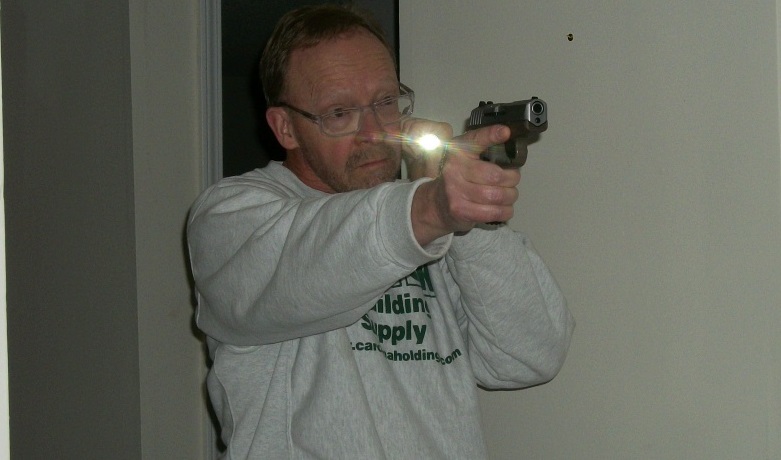
This sad situation bolsters my contention that when we pick up a pistol at home, we have to pick up a flashlight at the same time. That’s why I made flashlight shooting an integral part of The Tactical Professor’s Pistol Practice Program. To get some repetitions in and reinforce the habit for myself, I went to the range this week and shot the entire NRA Defensive Pistol I marksmanship program using a flashlight.
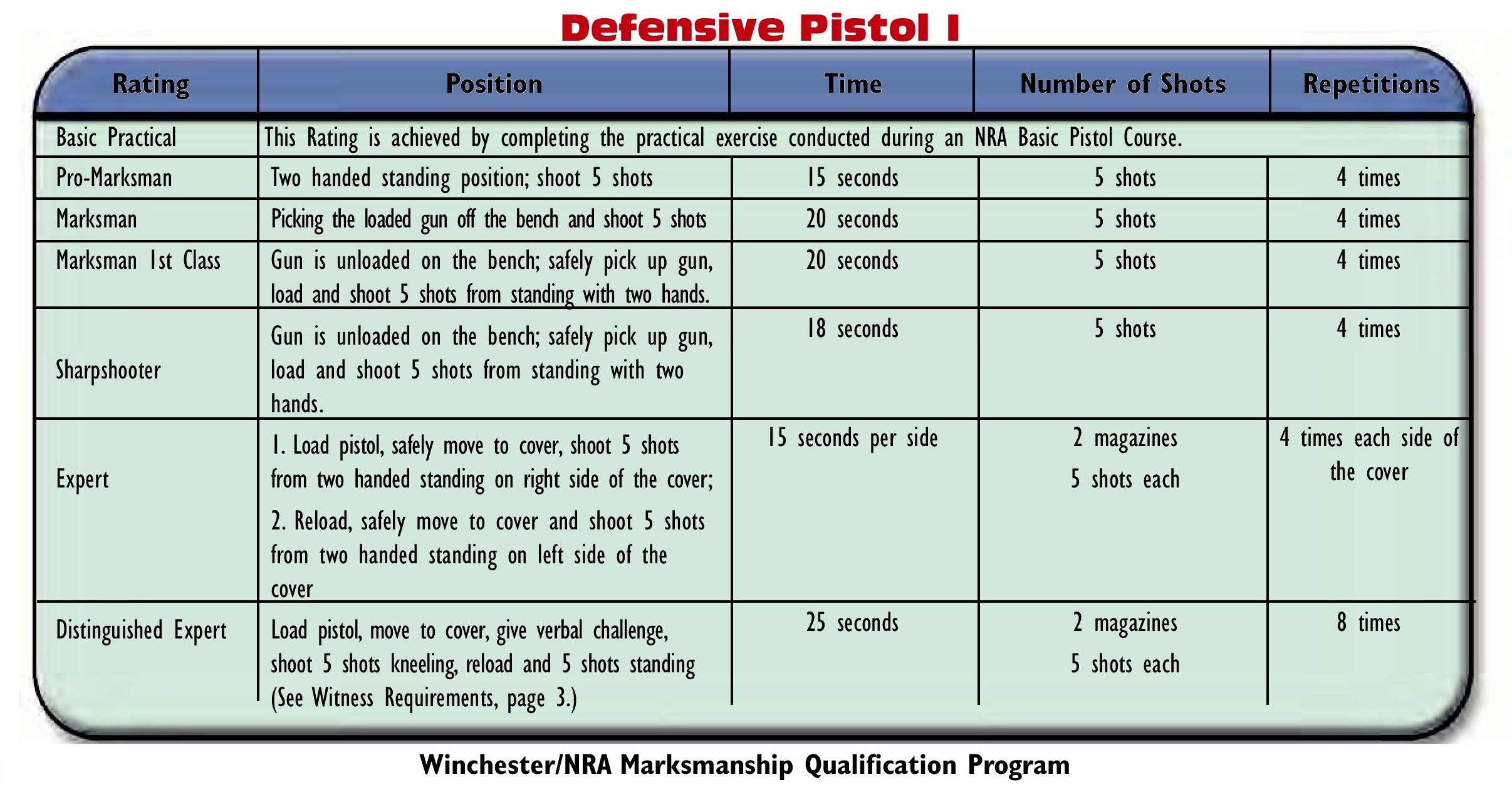 As a curiosity, I also used a timer instead of going by the PAR times in the program. The pistol I used was a Beretta Jaguar in .22 Long Rifle. Many in the industry poo-poo the .22 as a defensive tool but .22s have worked for me. An aspect of .22s I like in the practice context is that shooting several hundred rounds in one session isn’t punishing, either physically or financially. I shot it at my gun club but the way Defensive Pistol I is structured, it can be shot at just about any indoor range. That’s an aspect of the program I really like.
What I did was to have my pistol, my flashlight, and the timer on a stool in front of me. The target was downrange at the specified seven yards.
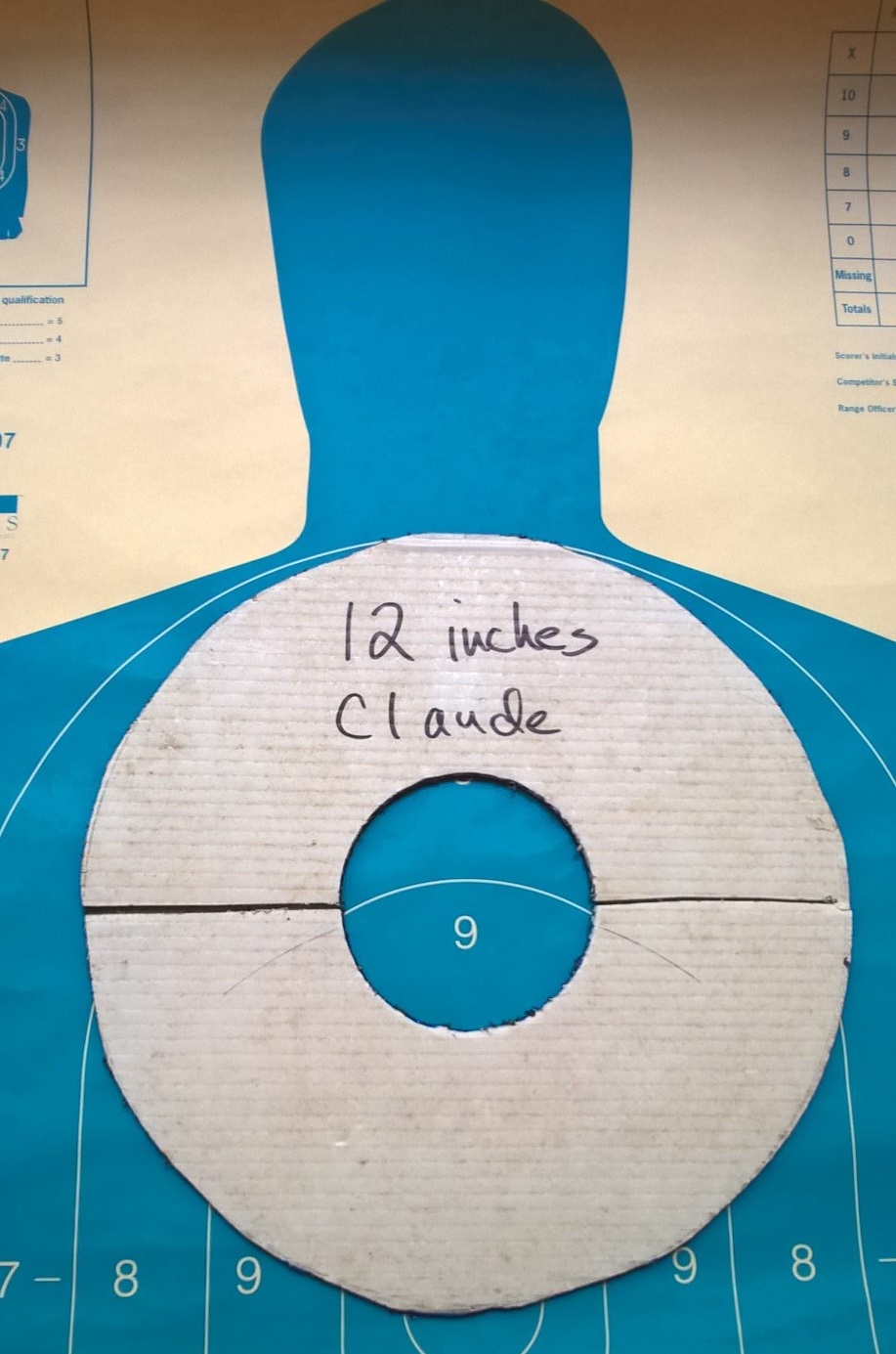
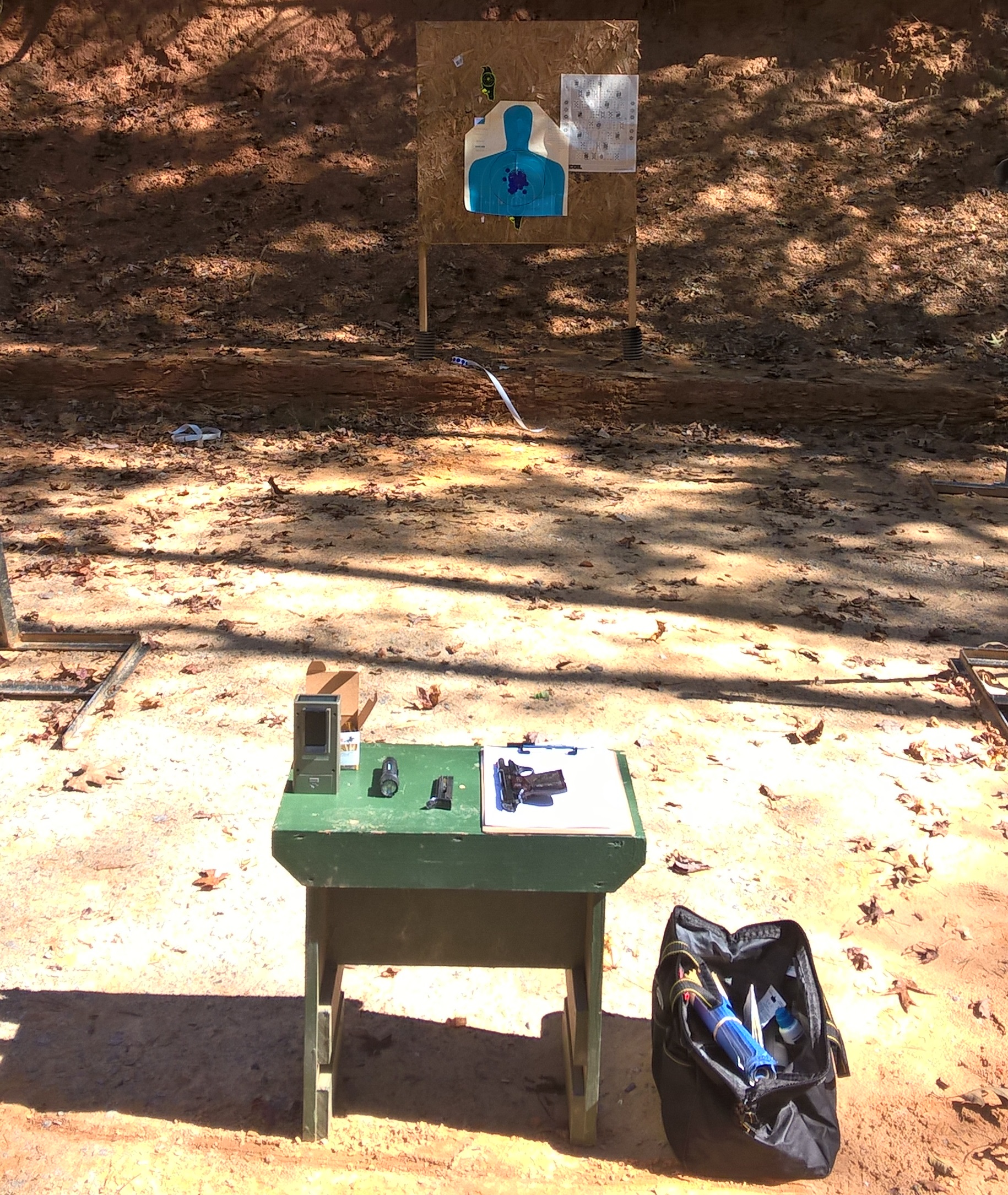 The target was a B-27 with the NRA AP-1 8 ring and X ring marked on it with a template.
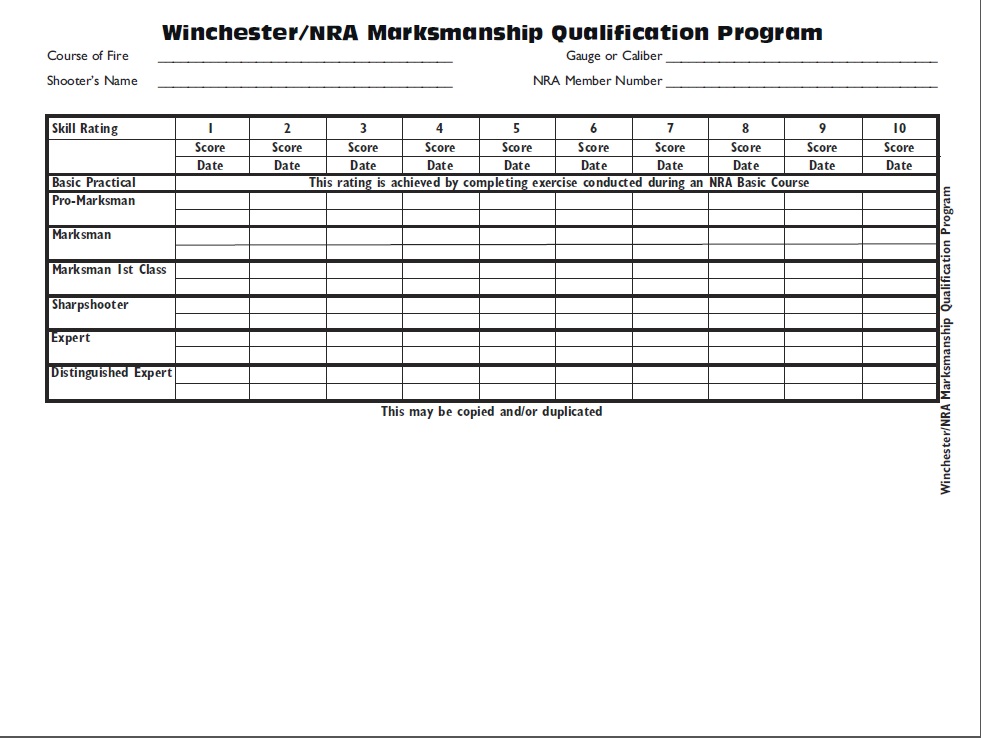
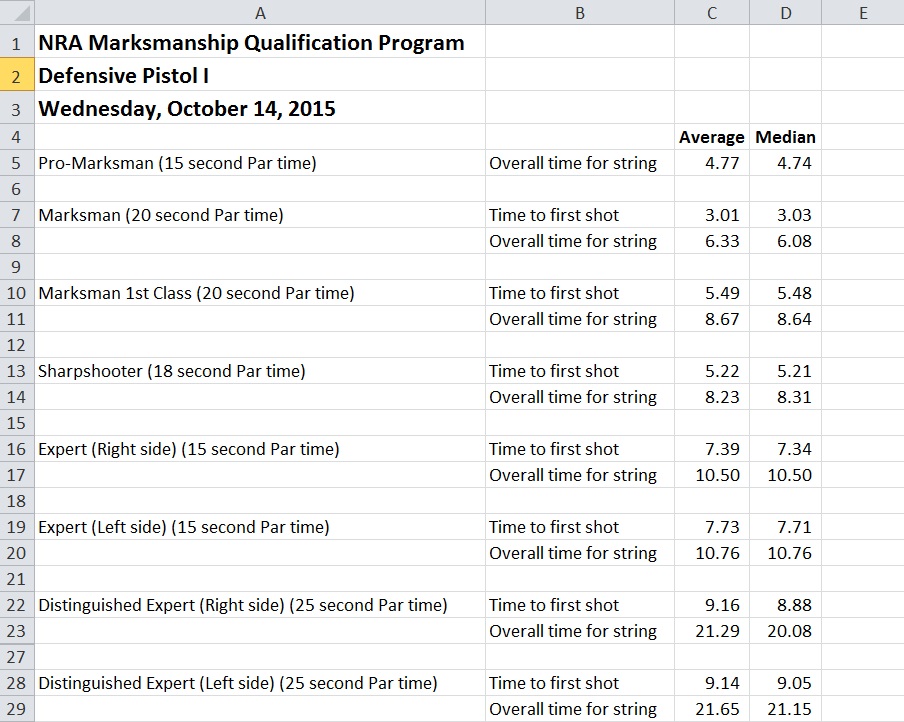
 When the timer went off, I would pick up my pistol and flashlight simultaneously, assume the cheek position, and then shoot the specified string of fire. For the phases requiring loading the pistol on the clock, I picked up the pistol and magazine, loaded it, and then picked up the flashlight. After each string, I recorded my times. The NRA provides a scoresheet but it is set up for Pass/fail scoring, so I made my own scoring matrix.
 I checked the target after each string to make sure that I had the required 100 percent hits. At the end of each phase; Pro-Marksman, Marksman, etc., I marked the target with blue dots to cover my hits.
For most of the program, I used the cheek technique.
 The Expert and Distinguished Expert phases require shooting from behind cover. There weren’t any barricades readily available so I used the dueling tree in the bay to simulate cover.
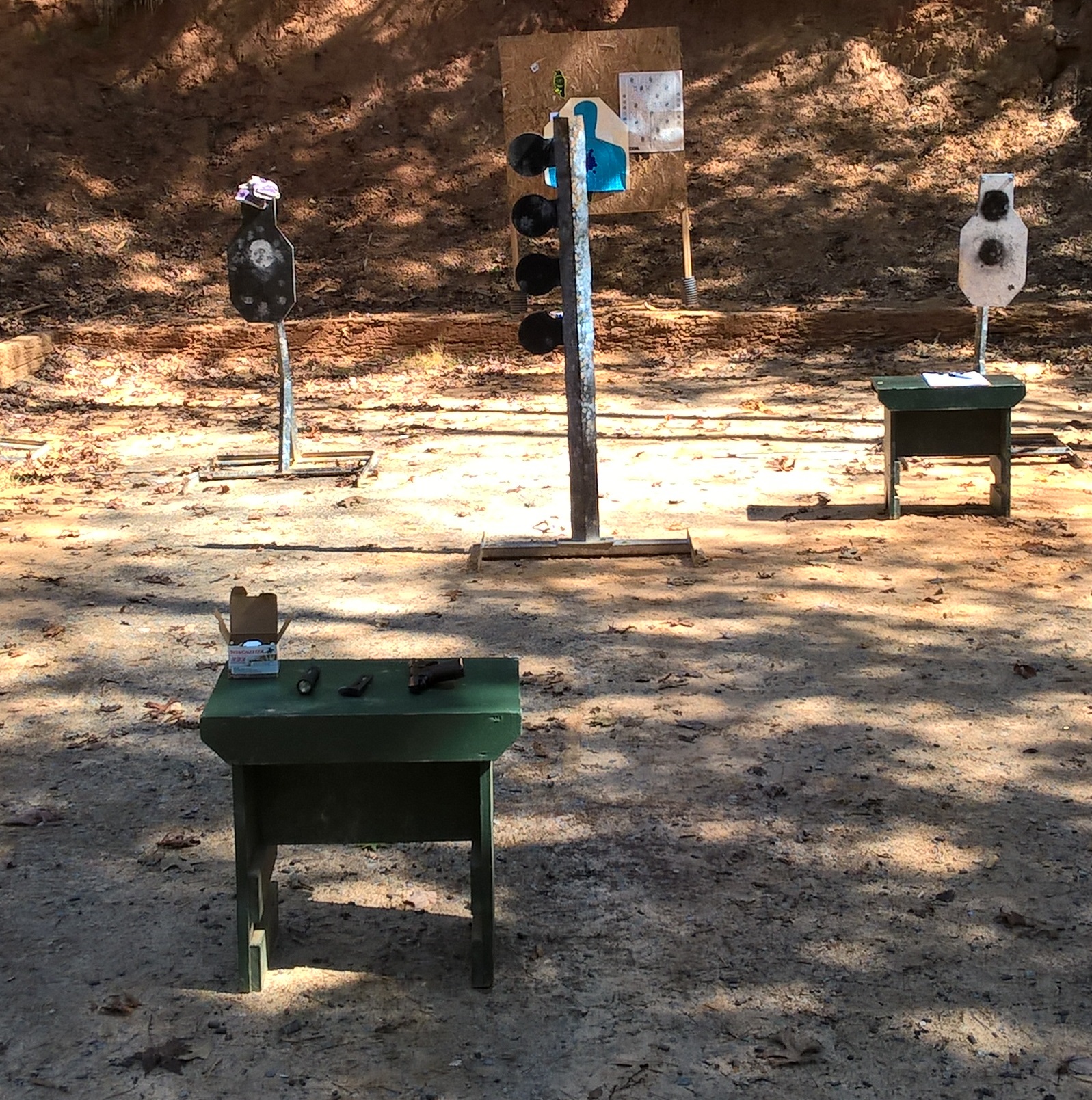 The Expert phase requires shooting around both sides of the cover. When shooting around the left side, I continued to use the cheek technique. When shooting around the right side, I used the Harries technique.
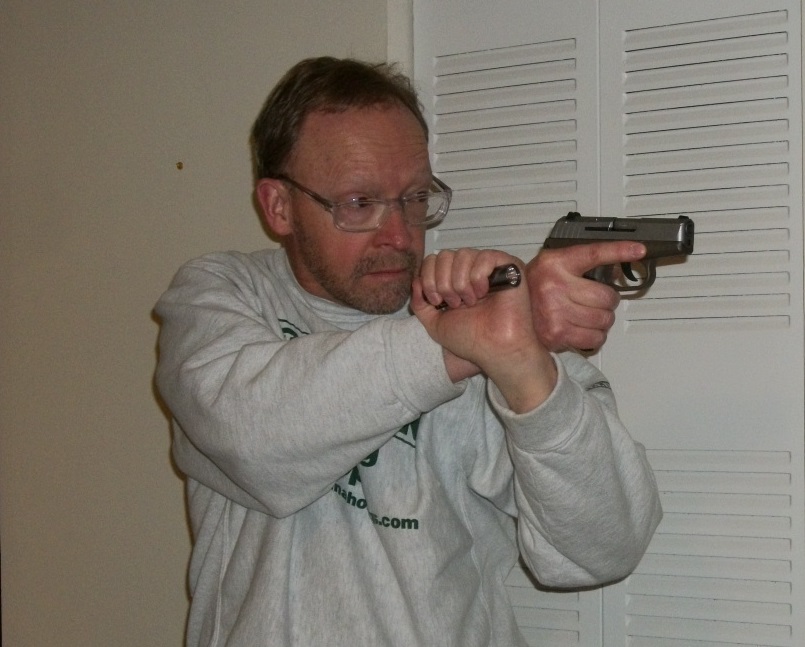 The Distinguished Expert phase doesn’t specify shooting around both sides of the cover. However, it does requires eight runs instead of four, so I shot four around the right side and four around the left side.
I was able to maintain the 100 percent standard and got a good idea of my times to accomplish each Phase.
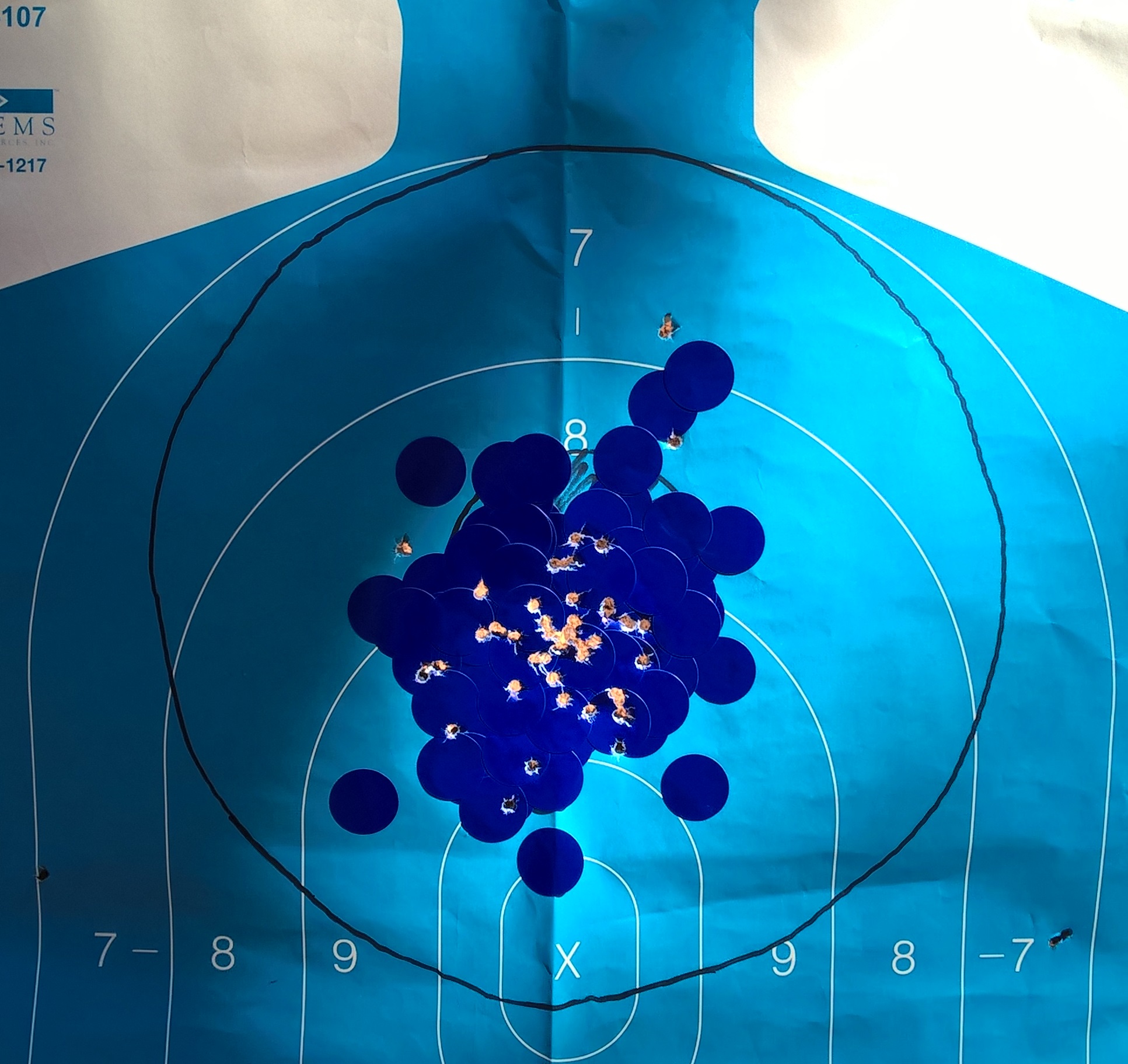
 To finish off the day, I used the dots to create some eyes on the target. Then I shot a couple of groups at five yards.
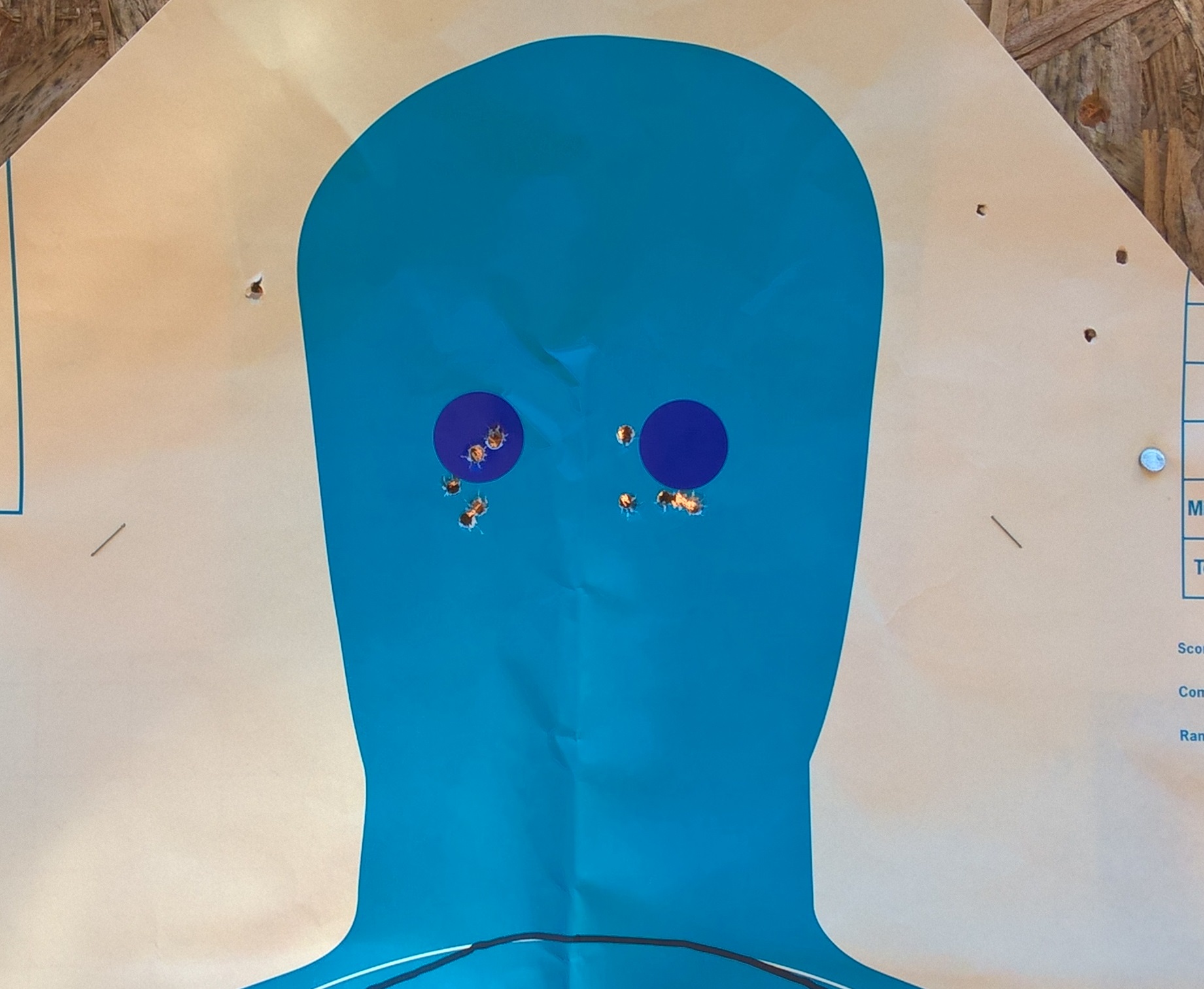 Getting in relevant practice isn’t necessarily hard; it just requires a little creativity and forethought.
Why many Americans insist on owning weapons
A friend posted a comment on his Facebook page about police response policies and times today. His post related to the hypocrisy of politicians who are protected by armed guards around the clock but desire to have the populace disarmed and at the mercy of the criminal element.
In the wake of the Umpqua Community College and Northern Arizona University shootings, there have been renewed calls by Mr. Obama for increased gun control, along with other politicians. The implication of these calls is that law enforcement authorities are always available to protect the citizenry at a moment’s notice. If the government will not allow the citizenry to protect itself, as is now the case in Lesser Britain, then that responsibility must fall to the organized government. A frequently validated saying in the Army is
If no one in particular is responsible for something, then no one is responsible for it at all.
There are several problems with making the government responsible for our safety in the United States, two in particular.
First, the Supreme Court ruled in 1989 and again in 2005 that the government does not have the duty to protect us as individuals. Government in general, and the police in particular, only have the duty to preserve a general sense of order in the US. Only society at large is owed a duty of protection.
Second, there are practical considerations. The following was how I responded to my friend’s post:
I have a recording of an actual 911 call by a woman whose home is broken into while she is on the phone with 911. It is not fiction and was used as an exemplar in 911 dispatcher training.
The dispatcher is shocked into silence by the events, which allows hearing the gruesome sounds and screams as the woman is murdered. It is 2 minutes and 51 seconds long from the time she calls when he is outside until the murderer calmly hangs up the phone after the woman is dead. She is screaming “Who are you?” and has no idea of her attacker’s identity. To my knowledge, the murderer has never been identified, much less caught and brought to justice.
The recording is so horrible and shocking that I am very judicious about whom I play it for. I have listened to it many times and it still turns my stomach every time I hear it.
It’s not the only such macabre recording like that in my collection. They range in length from 1 minute 1 second to 3 minutes 3 seconds.
Every scumbag politician, including police chiefs who serve as mouthpieces for their political masters, should be required to play it at the conclusion of their spiels about how they will protect us and a five to eleven minute response time is plenty. It would be the end of that [you know what].
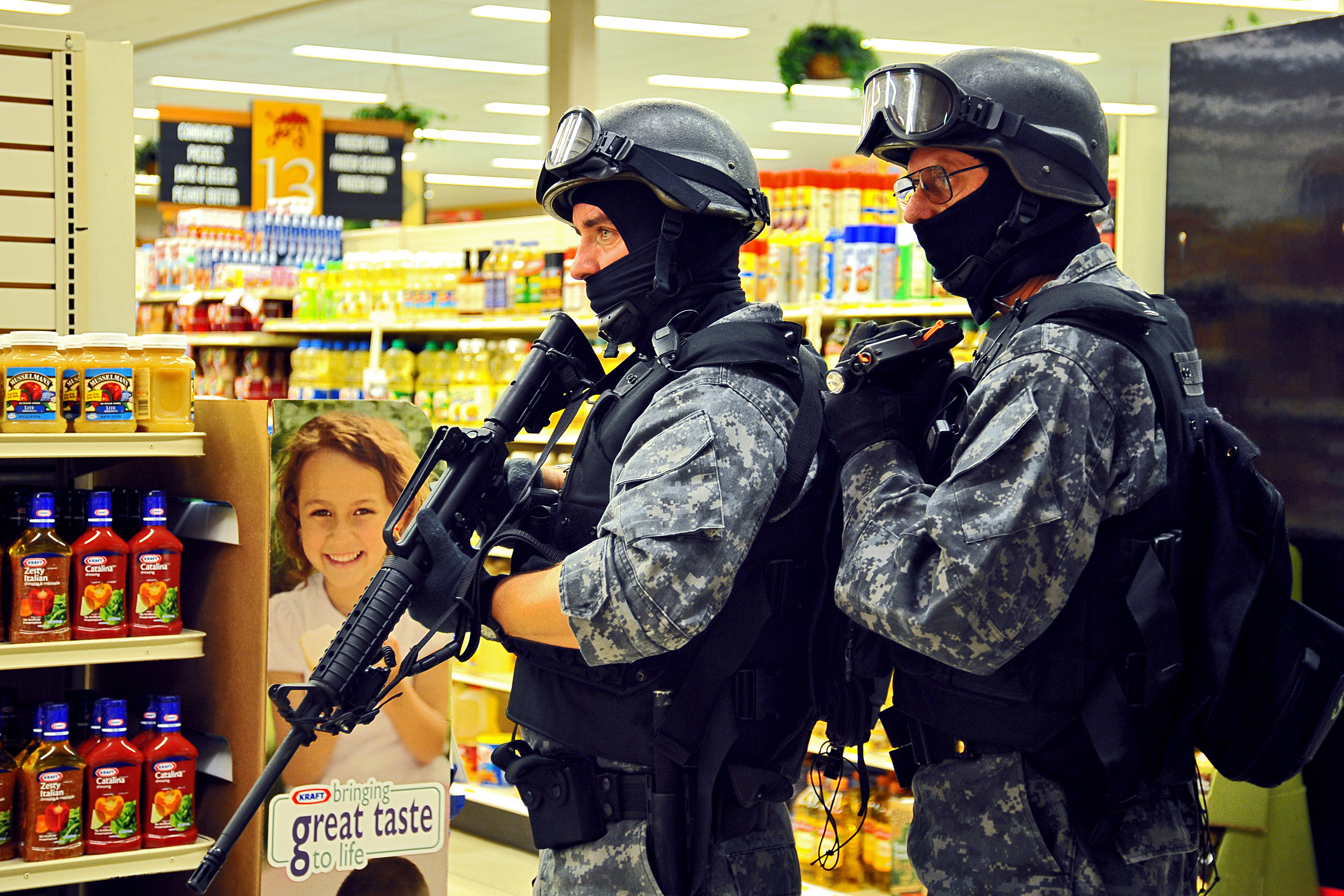
090928-N-1783P-005
(U.S. Navy photo by Machinist’s Mate 3rd Class Juan Pinalez/Released)
Friday Fundamentals (Segment 3) Properly gripping an autoloading pistol
As my colleague Wayne Dobbs of Hardwired Tactical Shooting says, there are three fundamentals of handgun shooting that can make you or break you in a defensive situation; grip, sights, and trigger [manipulation]. I would also add follow through, as a student who came back today from the elite Rogers Shooting School called to mention to me.
For this segment, let’s look at the autoloading pistol grip discussion contained in Advanced Pistol Practice.
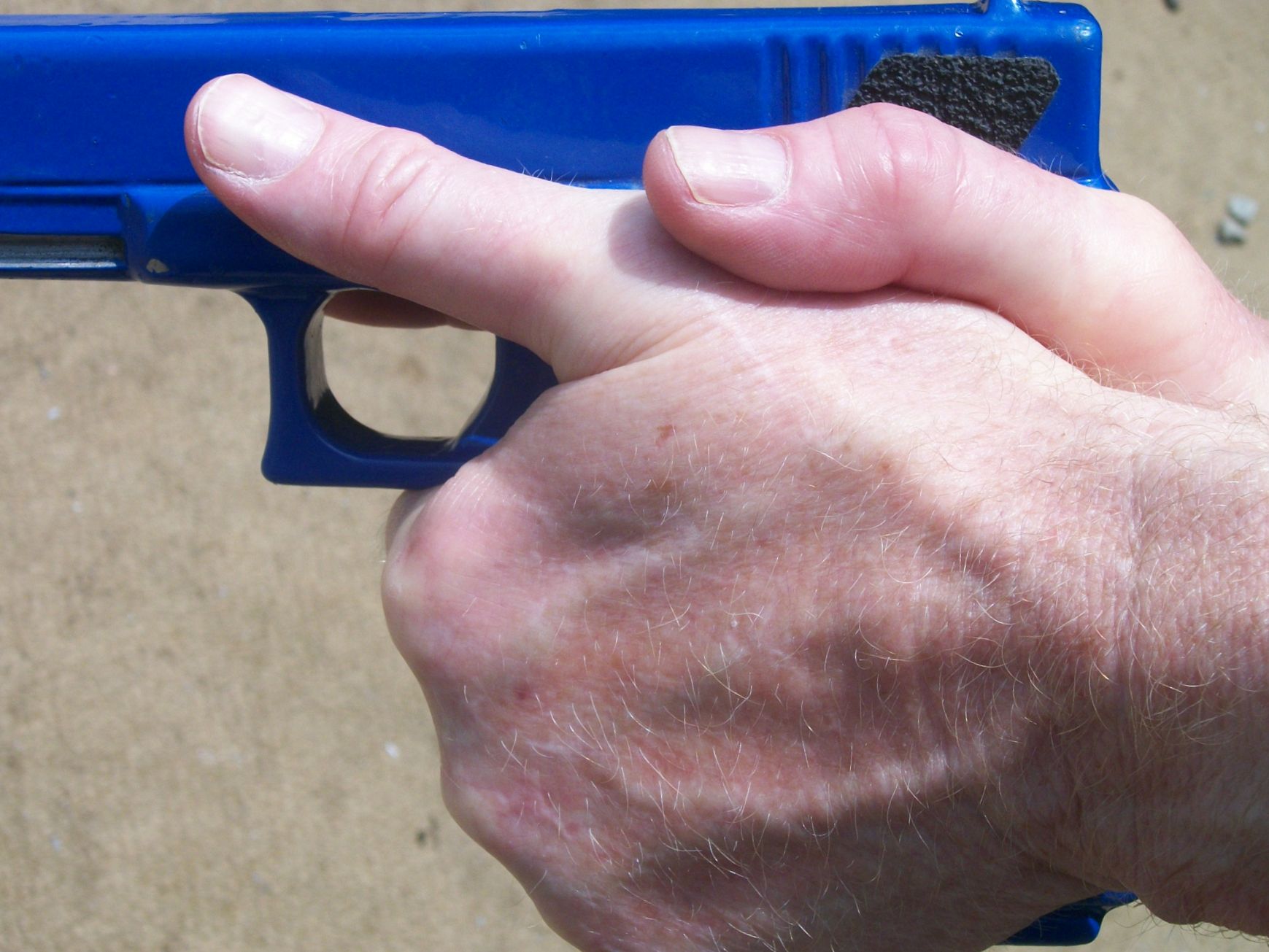 The proper grip for any handgun should accomplish several objectives:
- Maximize our hand friction on the handgun. The way we prevent the handgun from moving around in our hand(s) is simply via friction. Therefore, the more hand surface we have in contact with the gun, the more friction we can achieve.
- Minimize the gun’s motion during recoil by stabilizing the supporting joints, principally the wrists, when the gun fires.
- Reduce the distance between the line of the handgun’s bore and our hands to the smallest amount possible. This diminishes the rotational torque generated by the handgun upon firing.
After establishing the appropriate grip, a series of index points can be used to feel when the grip has been properly achieved. Especially in defensive encounters, there is no time for visually checking whether the proper grip is in place. Having a set of index points allows a shooter to establish a proper firing grip in the holster and during the drawstroke to know that the grip is as it should be.
With an autoloading pistol, this grip is commonly referred to as the ‘thumbs forward grip.’ Being aware of four specific index points will allow a shooter to know that a proper grip has been achieved without having to visually verify it. There are nuances to this grip that sometimes escape even experienced shooters, however. The first three index points are essentially the same for all shooters. The fourth index point may vary among shooters, dependent on individual physiology.
There is still debate as to how hard the fingers of the support hand should grip the firing hand. In any case, they should certainly grip firmly enough to not break free of the firing hand during recoil.
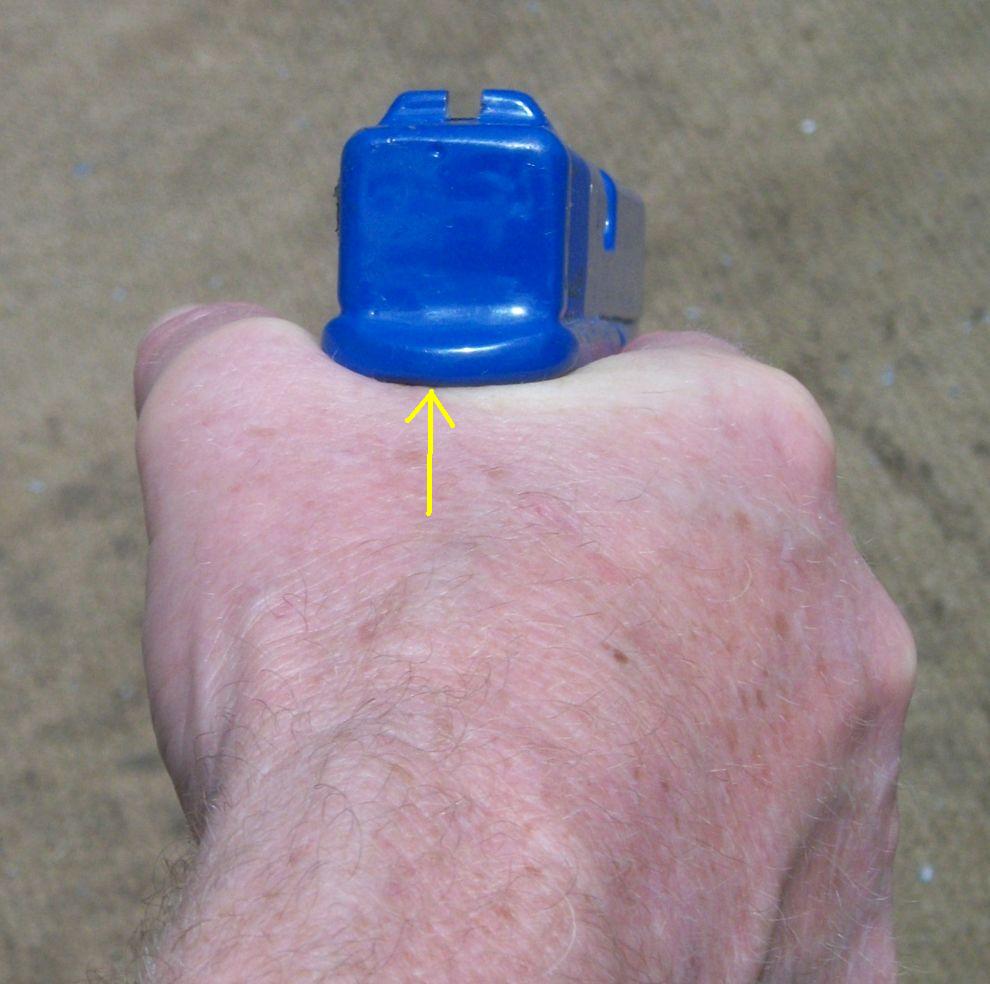
Web of the firing hand
The firing hand should be as high as possible on the back strap of the pistol. Gripping the pistol low increases the rotational torque of the pistol in the hand. So the first index point is the relationship between the tang of the pistol and the web of the hand. For most people, there should be no space between the tang and the web. The shape of a few people’s hands will leave a small space even when the gun is gripped as high as possible but this space should be minimal. Those with large hands may experience contact by the slide on the firing hand when it is held this high. The use of a beavertail or Grip Force Adapter on the Glock pistol can reduce this contact.
 Bases of the thumbs mate
As much of the support hand as possible should make contact with the pistol to maximize the friction the support hand can generate on the pistol. To achieve maximum contact, the bases of both thumbs should make contact firmly. This is the second index point. It is common to see space in shooters’ grips between the bases of the thumbs. This is a clear indicator that the support hand is not making maximum contact with the pistol.
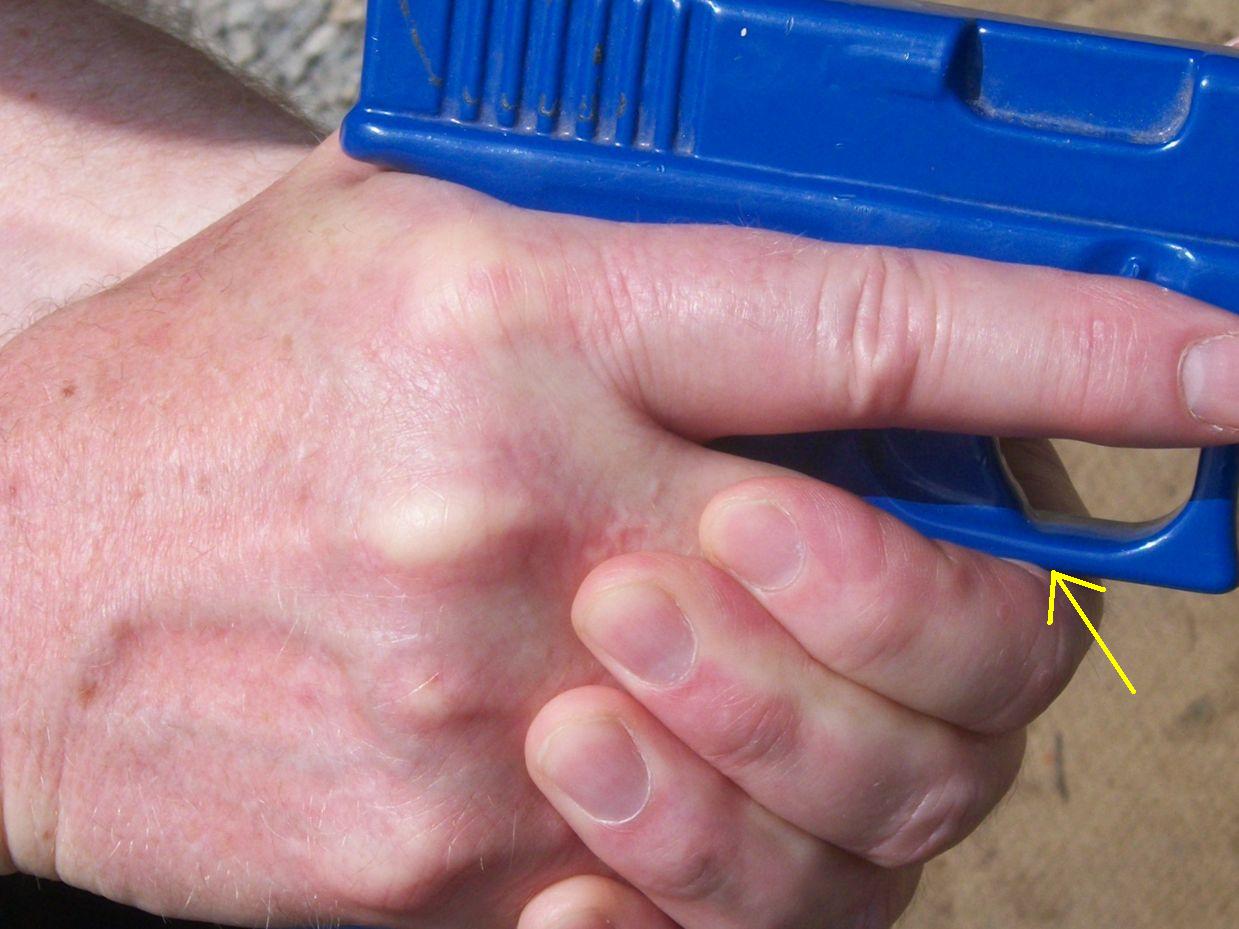
 Support trigger finger touches trigger guard
The support hand should be as high as possible on the pistol to reduce rotational torque. Lightly touching the underside of the trigger guard with the side of the support hand trigger finger is the third index point of a proper grip. When the support hand trigger finger touches the trigger guard, the support hand is properly high on the gun. The ‘cup and saucer’ hold used by most TV and movie actors is an excellent demonstration of how NOT to form the grip of the support hand. Because blanks generate no recoil, controlling the handgun is not of importance to them. The ‘cup and saucer’ method does keep the actor’s arms down and allows a better view of the face, which is why it is used so often in that format.
 Wrist is extended downward
Stabilizing the support wrist is a key component of a proper grip to achieve recoil control. This is the element that many people do incorrectly when forming the grip. The wrist is most stable when it is extended downward.
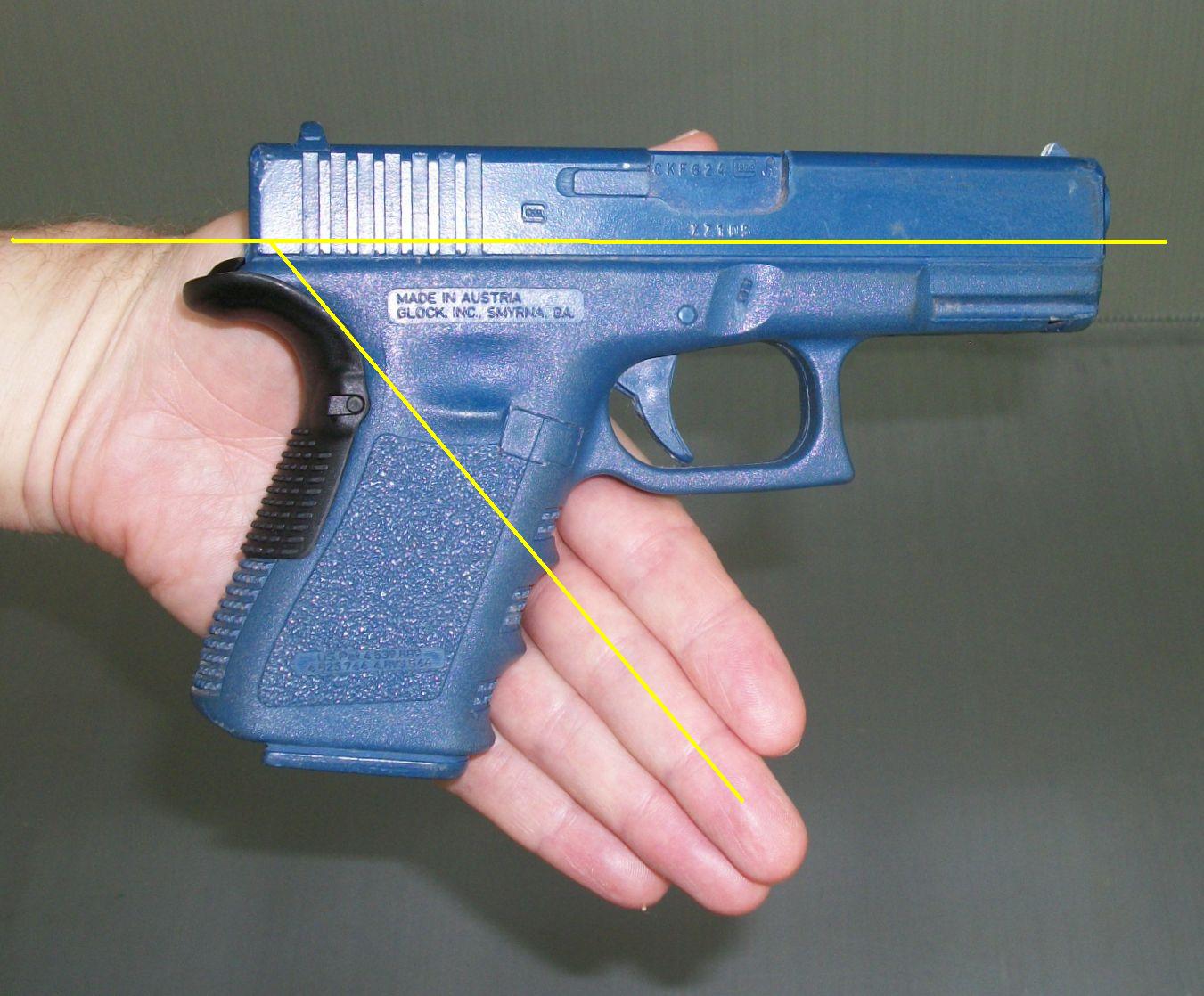
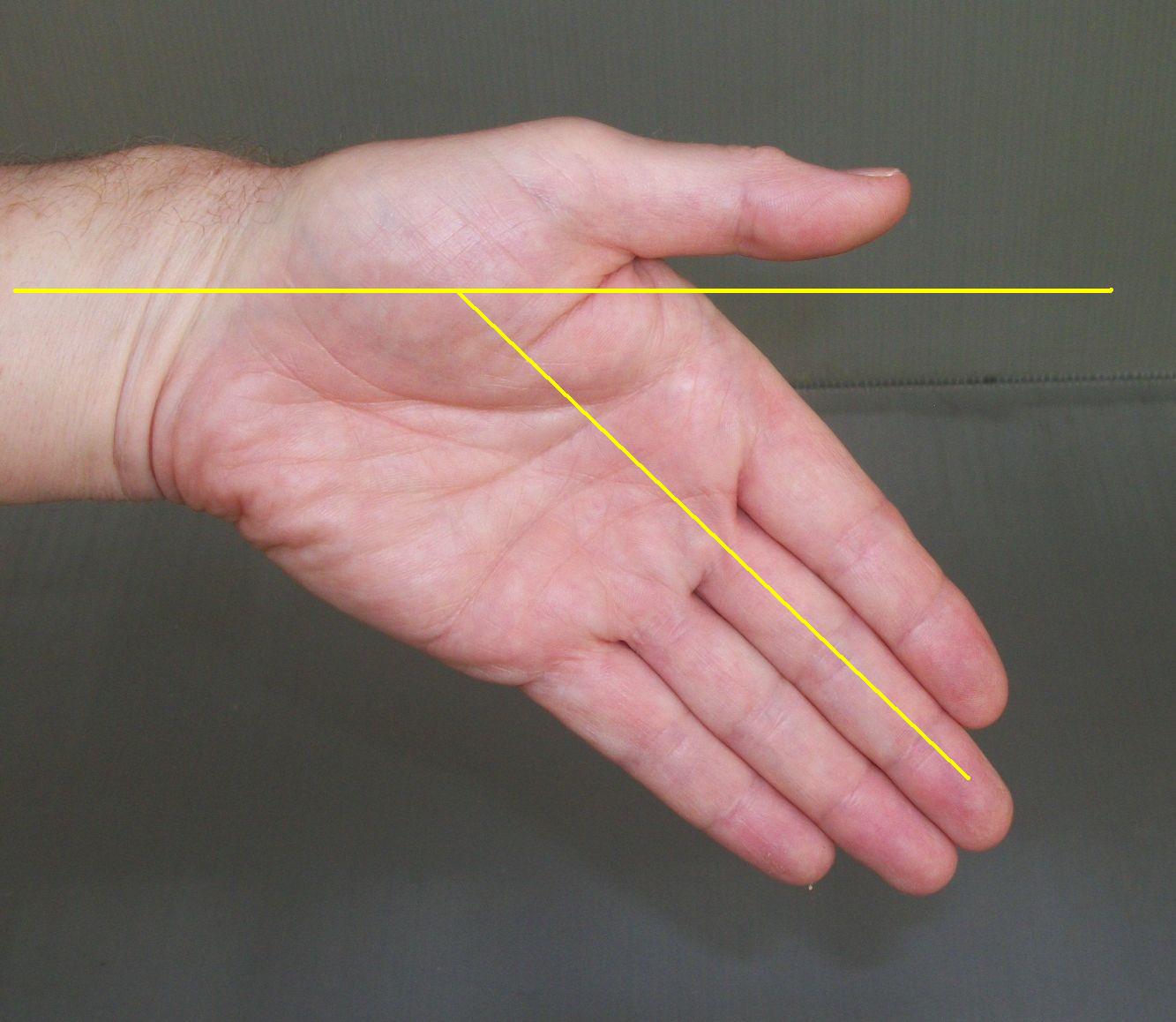 Angled downward in relation to bore
So when the support hand is applied to the pistol to form the grip, it should be angled downward in relation to the line of the pistol’s bore.
 Wrist should not be straight
The downward extension is initially slightly uncomfortable and feels somewhat unnatural. As a result, shooters tend to unconsciously keep the wrist of the support hand straight instead of extending it downward.
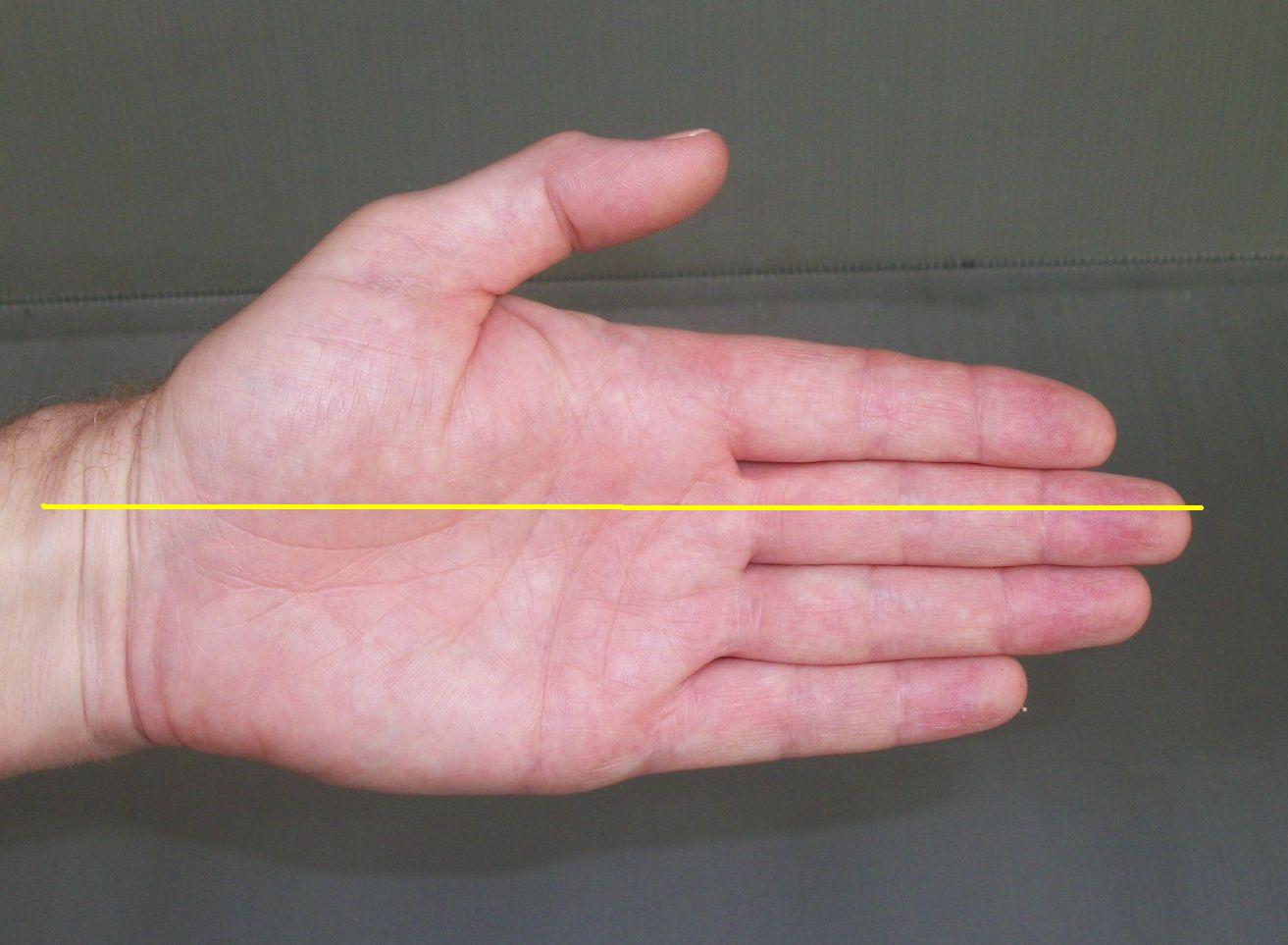 Wrist incorrect
So, it is common to see the wrist held almost straight when the support hand is applied to form the grip. This is incorrect and does not provide much stability to the pistol when it fires.
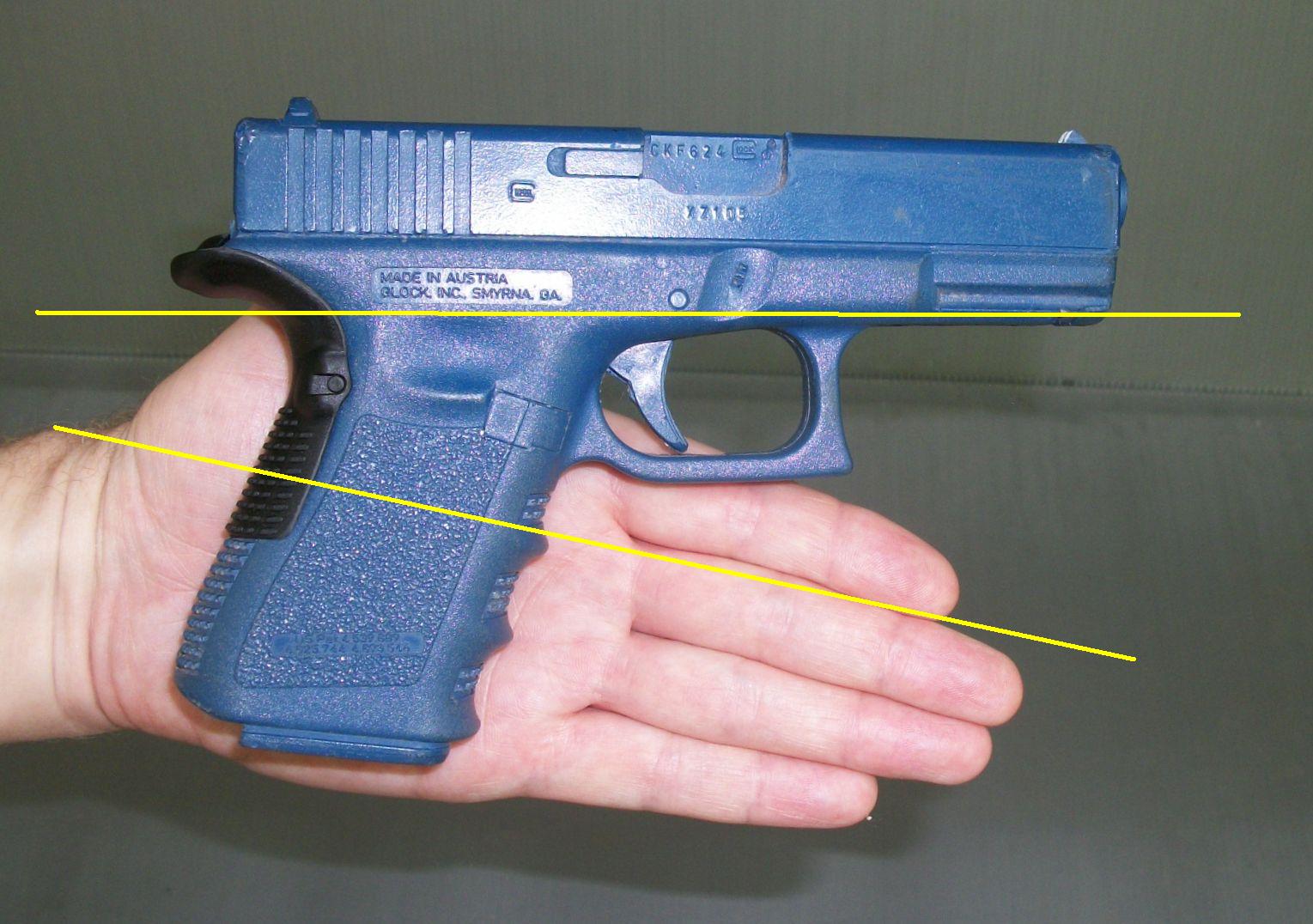 Firing thumb on support thumb
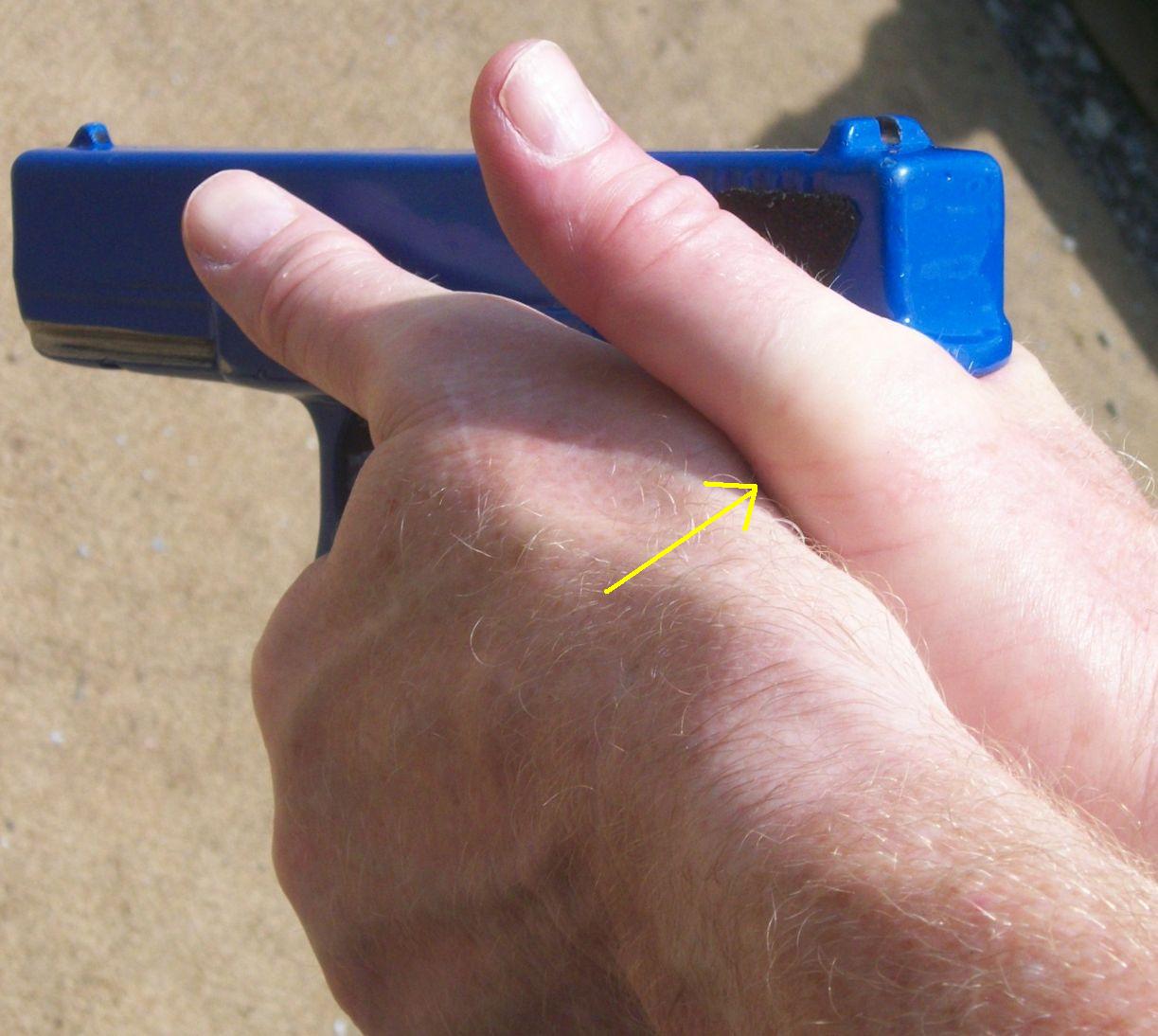
Consequently, the fourth index point is the contact point of the firing thumb on the support thumb. By knowing location of this point when the support wrist is properly extended downward, a shooter can immediately tell whether or not the best grip has been achieved. For most shooters, the tip of the firing hand thumb should be aligned in the area of the base knuckle of the support hand, rather than on top of the knuckle, as is commonly seen. The support hand thumb can either float free or lightly touch the frame of the pistol. It should NOT apply any significant sideways pressure to the pistol frame, as this can create a shift in the pistol’s point of impact.
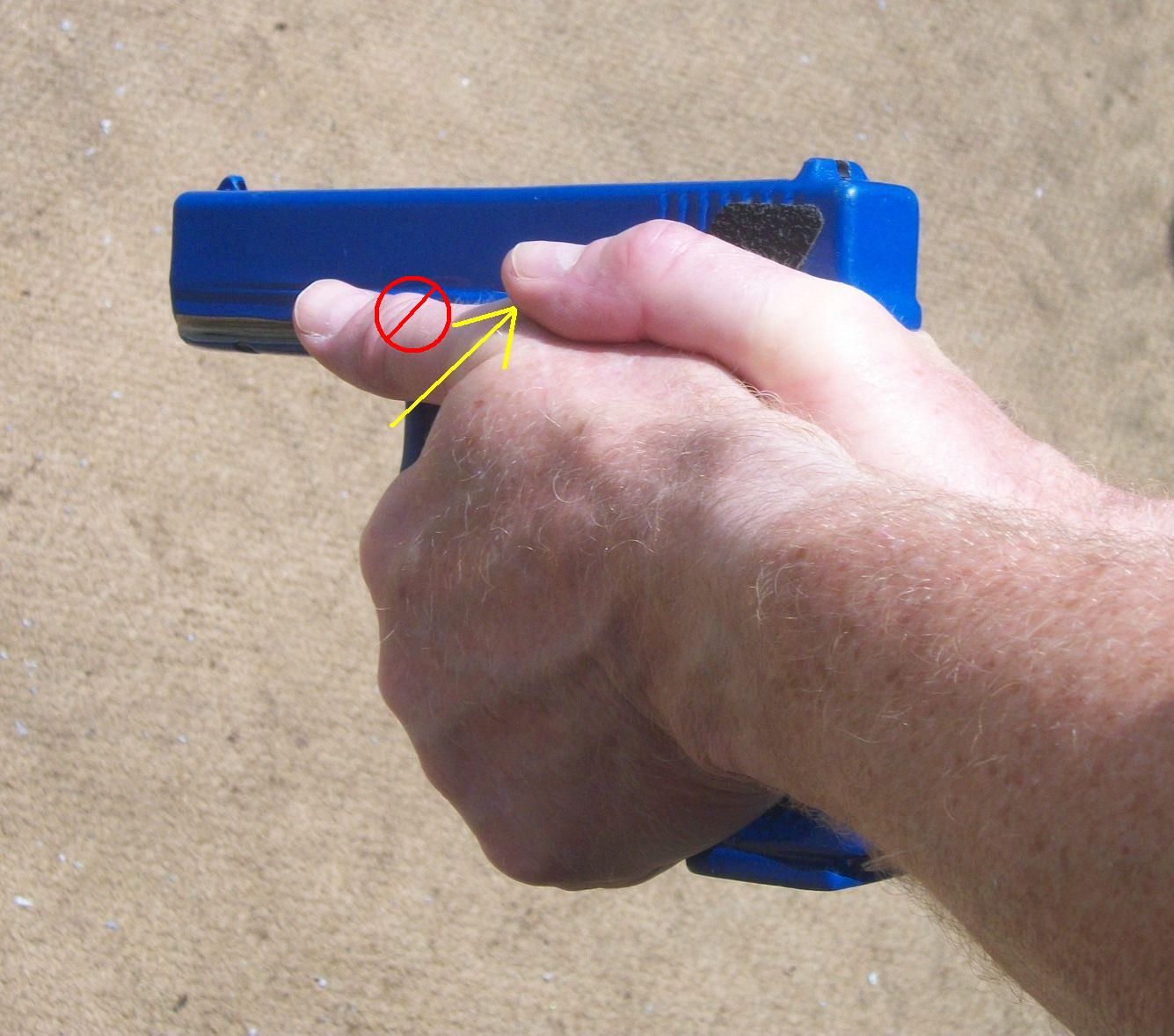 Two components of fourth index point
The fourth index point has two components. First, it verifies that the support wrist is extended downward. Second, it is located such that the firing hand thumb clears the slide stop to the maximum extent possible.
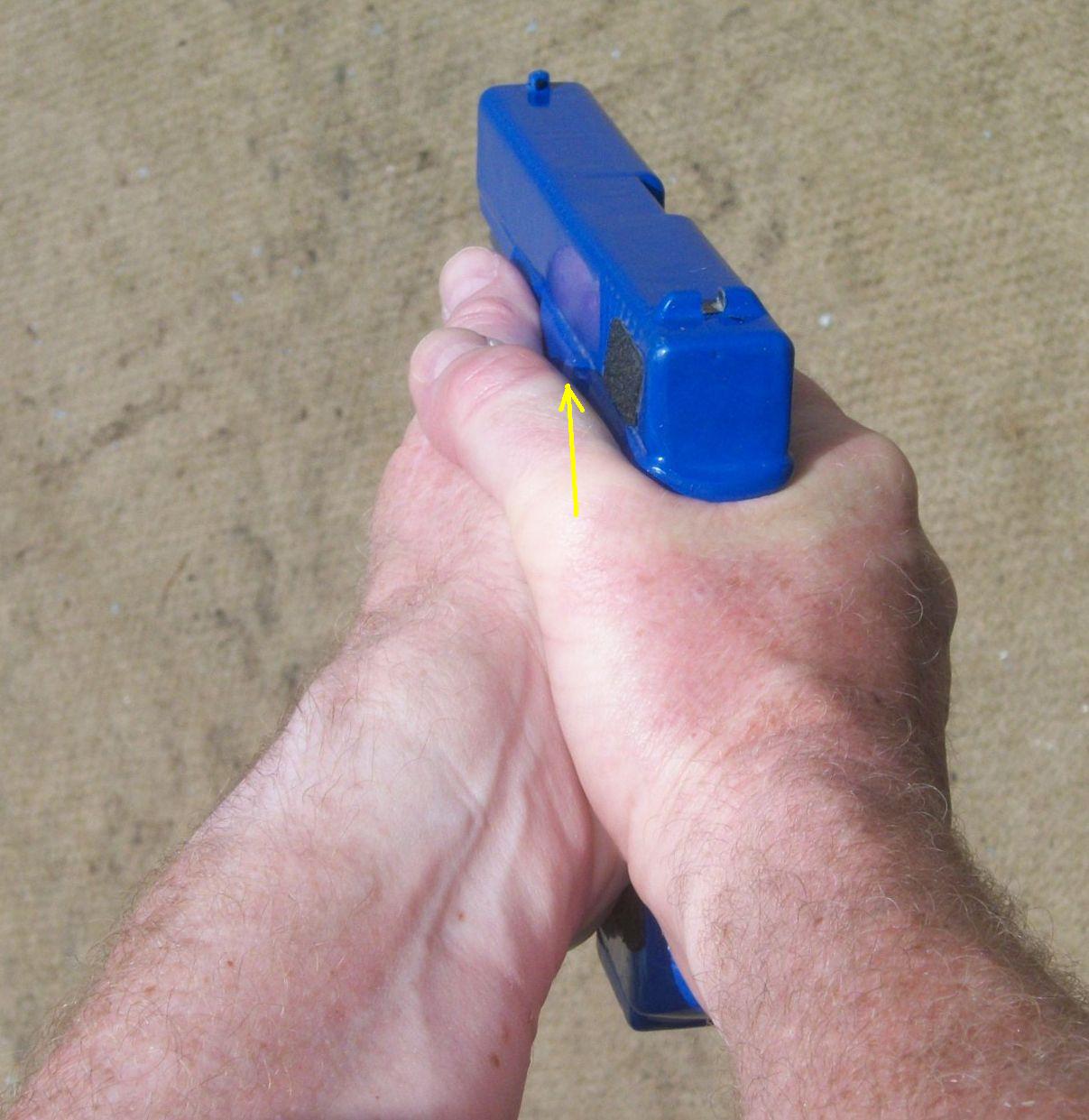 If the firing hand thumb is placed directly alongside the slide of the pistol, it’s easy for that thumb to prevent the slide stop from functioning. This will prevent the slide from locking back after the last shot fires. The subsequent click upon a firing attempt when the slide does not lock back can be either annoying or fatal, depending on circumstance.
For most shooters, the firing thumb should be placed directly in line with the support thumb, as opposed to beside it near the slide. Learning to place the firing thumb in line with the support thumb will minimize the possibility of interfering with the slide stop.
In summary, the four index points of the proper grip on an autoloading pistol are:
- Web of firing hand meets tang of pistol.
- Bases of both thumbs mate closely.
- Support hand trigger finger makes contact with trigger guard.
- Contact point of the firing thumb on the support thumb.
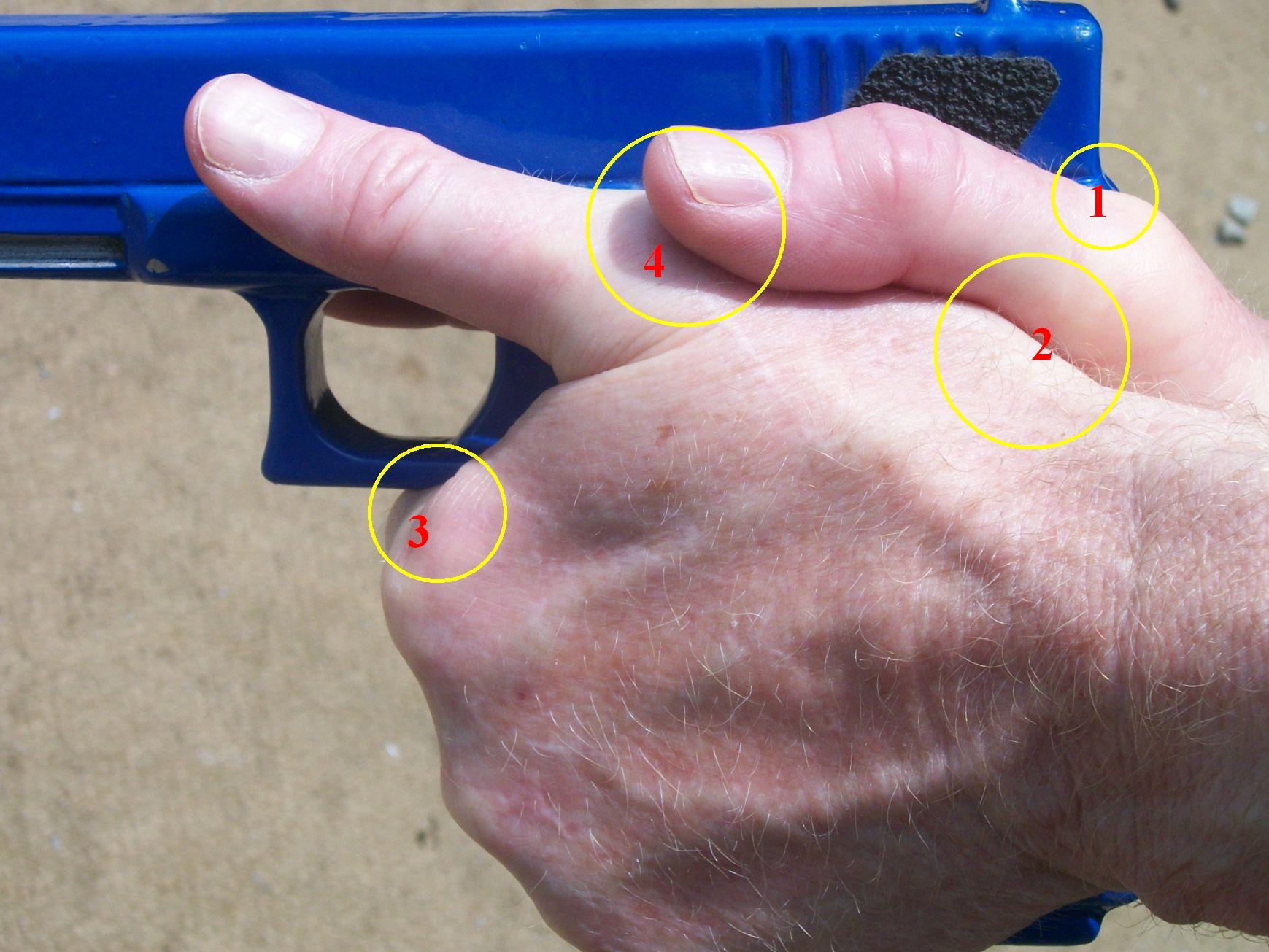 Developing a proper grip takes some effort and analysis but yields big dividends in terms of your shooting ability. Note that the issue of sights is important enough for me to cut a rear sight notch in my blue guns. I cannot abide a gun without functional sights, even when it is an inert gun. The sights discussion is for another time, however.
Friday Fundamentals (Segment 2)
We’re continuing on with the series of ‘Friday Fundamentals’. I’ve written about Sight misalignment, speed, and accuracy before. It’s a key fundamental to increasing your speed while still maintaining an acceptable degree of accuracy. This drill is part of the second session of my Pistol Practice Program.
Required equipment:
- Any silhouette target; B-27, B-21, Q, IDPA, IPSC, etc. Put a 2-3 inch aiming point on the silhouette in about the center of the target.
- Masking tape (preferred) or magic marker to mark the target.
- Pistol, 24 rounds of ammunition
- Eye and ear protection
Overview
This drill consists of three (3) Sequences of 8 shots each. You are going to deliberately misalign your sights so you can see the effect of this at increasing distances. The drill is to fire the pistol with the front sight on a spot on the target but with the rear notch deliberately misaligned. The Sequences are untimed.
Setup:
Place target at five (5) yards
Procedure:
Sequence 1 (8 rounds at 5 yards)
1) Start with handgun held in both hands. If possible, sit and rest your arms on the bench. You want to be as steady as you can for these three sequences. Do not let the pistol touch the bench; this can change where the bullets hit. Shift your support hand slightly under the pistol, if needed.
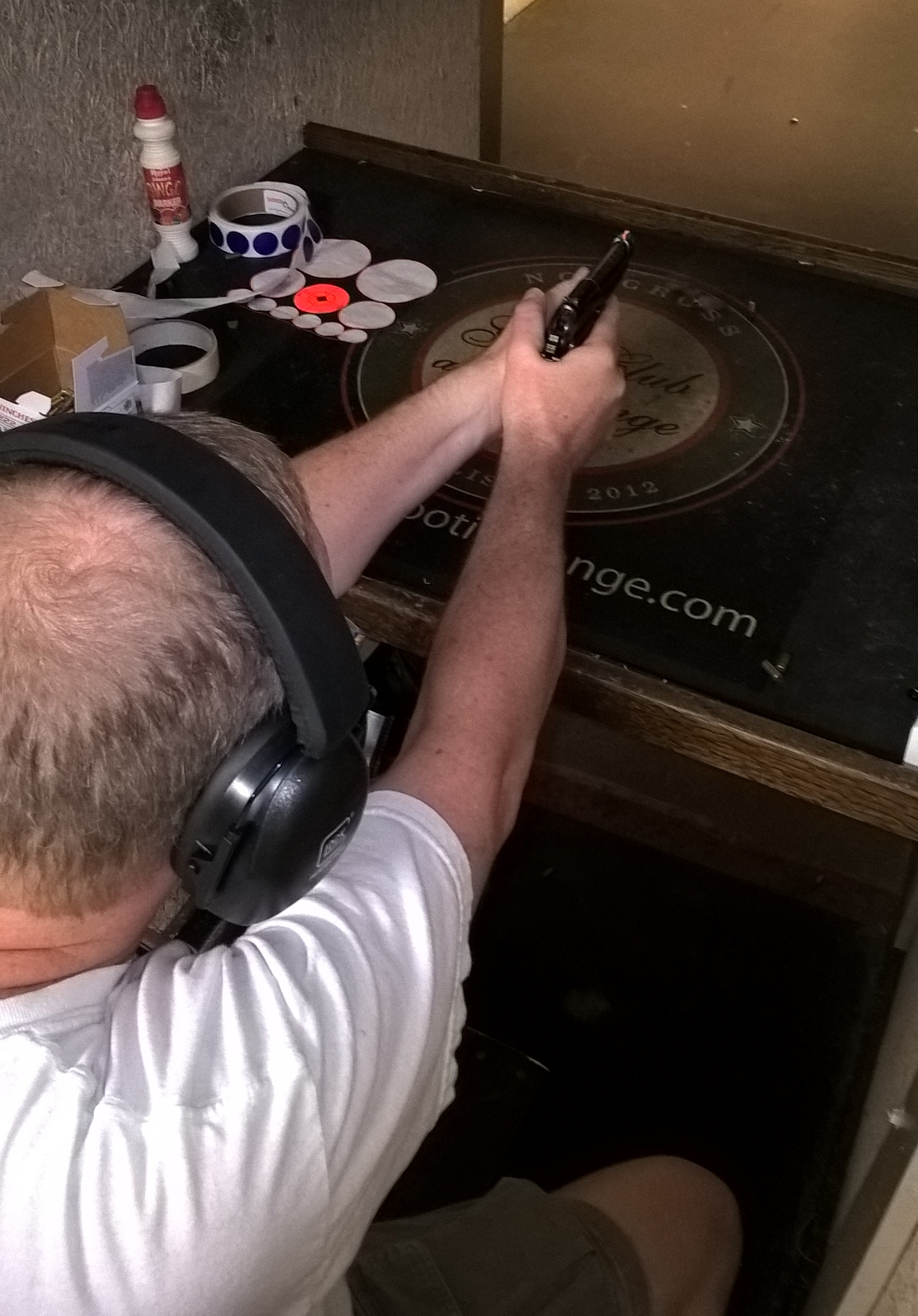 2) Put the front sight just below the aiming spot on the target with the front sight half way above the top of the rear notch. Carefully fire two shots. Your sight picture should look something like this.
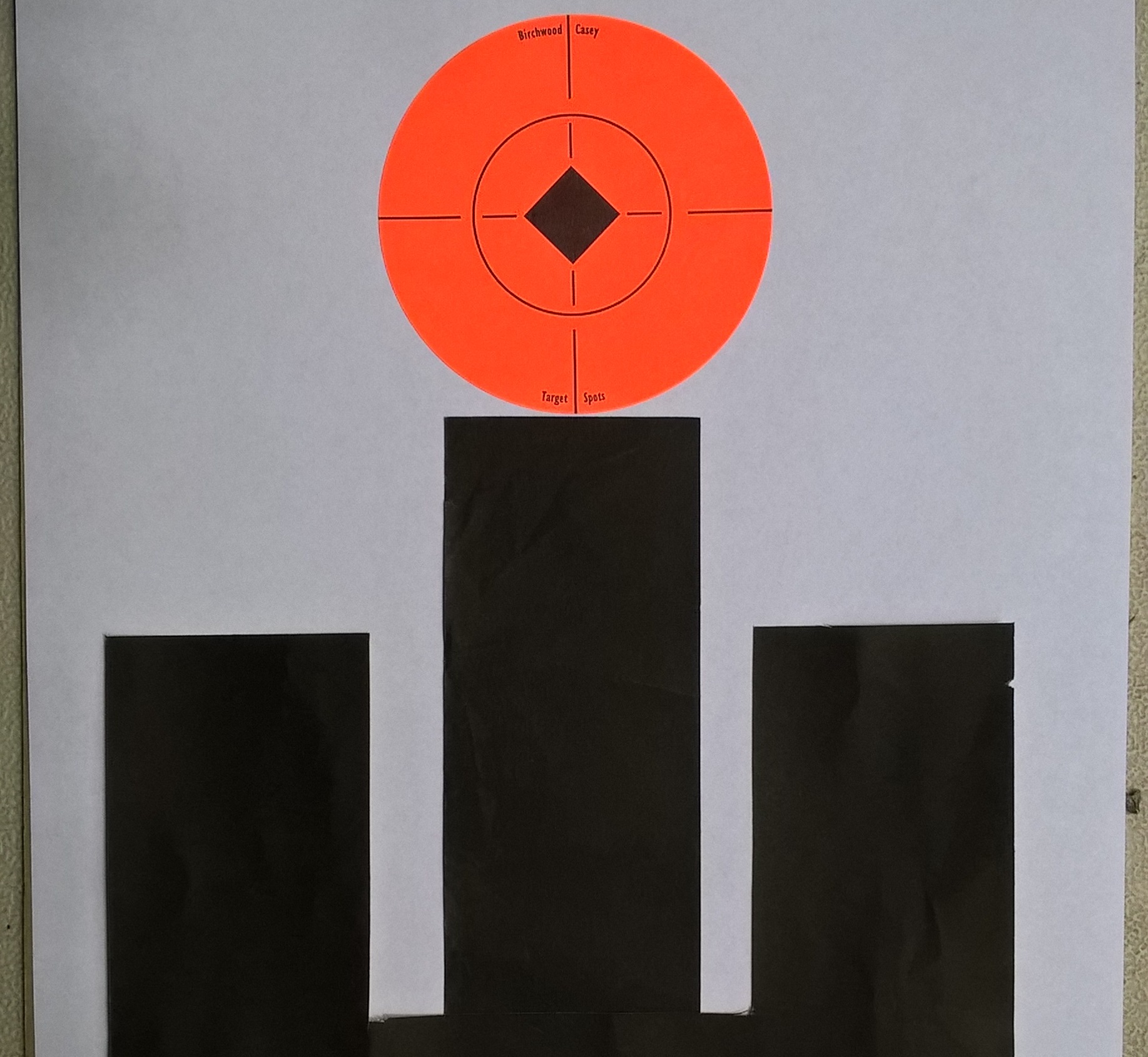
3) Put the front sight just below the aiming spot on the target with the front sight lowered so that its top edge is half way down in the rear notch. Carefully fire two shots. Your sight picture should look something like this.
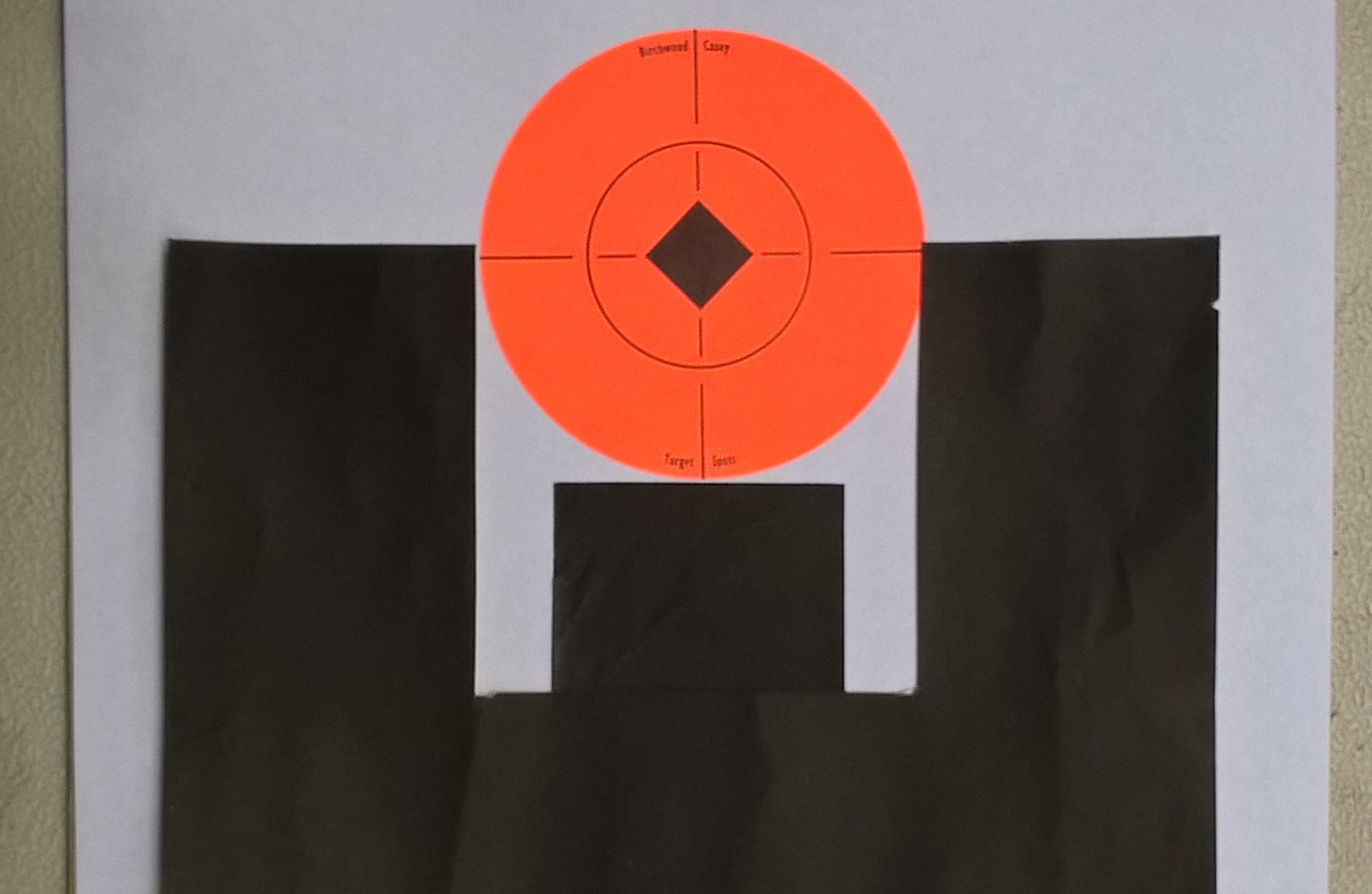
4) Put the front sight just below the aiming spot on the target with the front sight over to the right so that its right edge is touching the right side of the rear notch. Carefully fire two shots. The sight picture should look something like this.
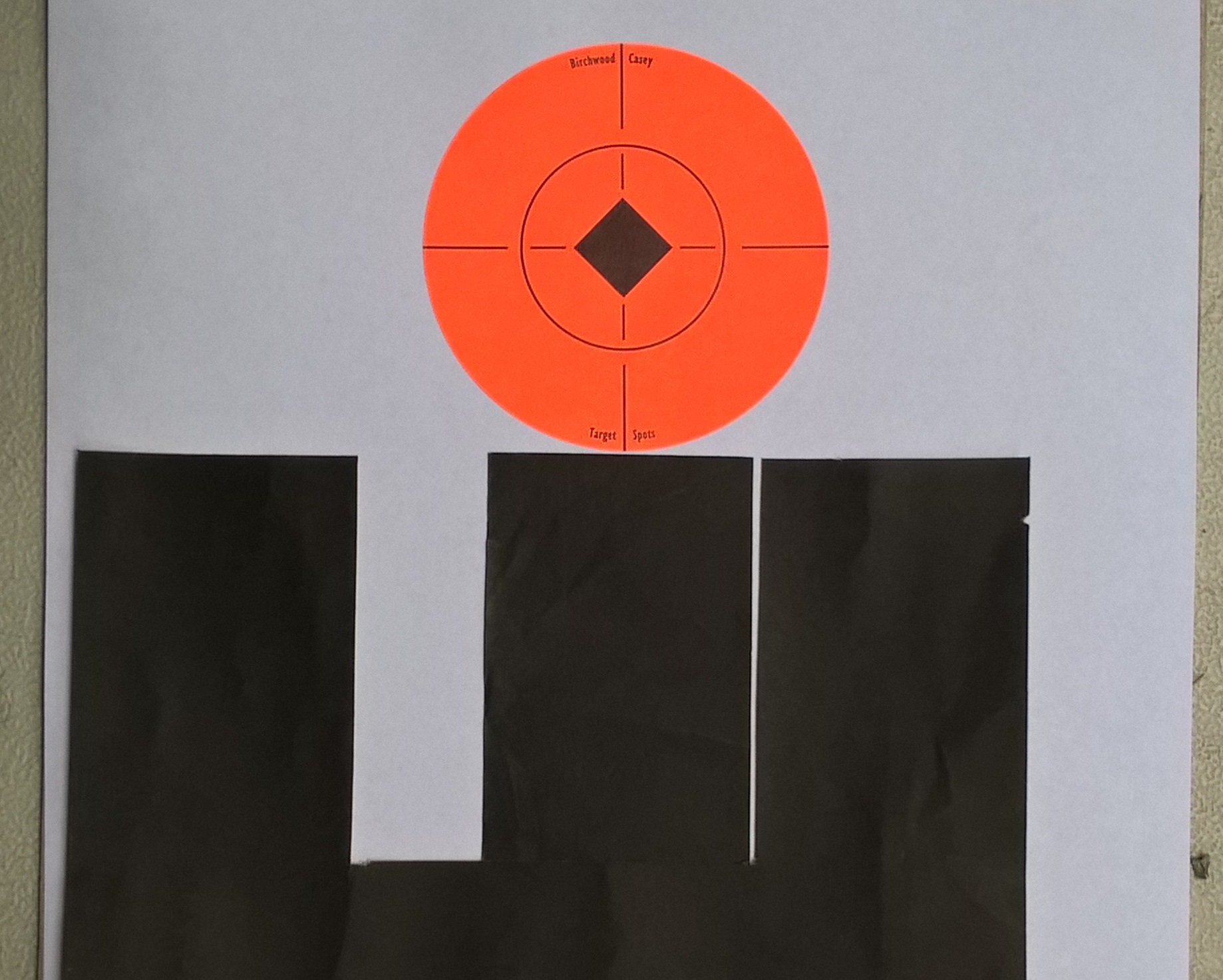 5) Put the front sight just below the aiming spot on the target with the front sight pushed to the left so that its left edge is touching the left side of the rear notch. Carefully fire two shots. Your sight picture should look something like this.
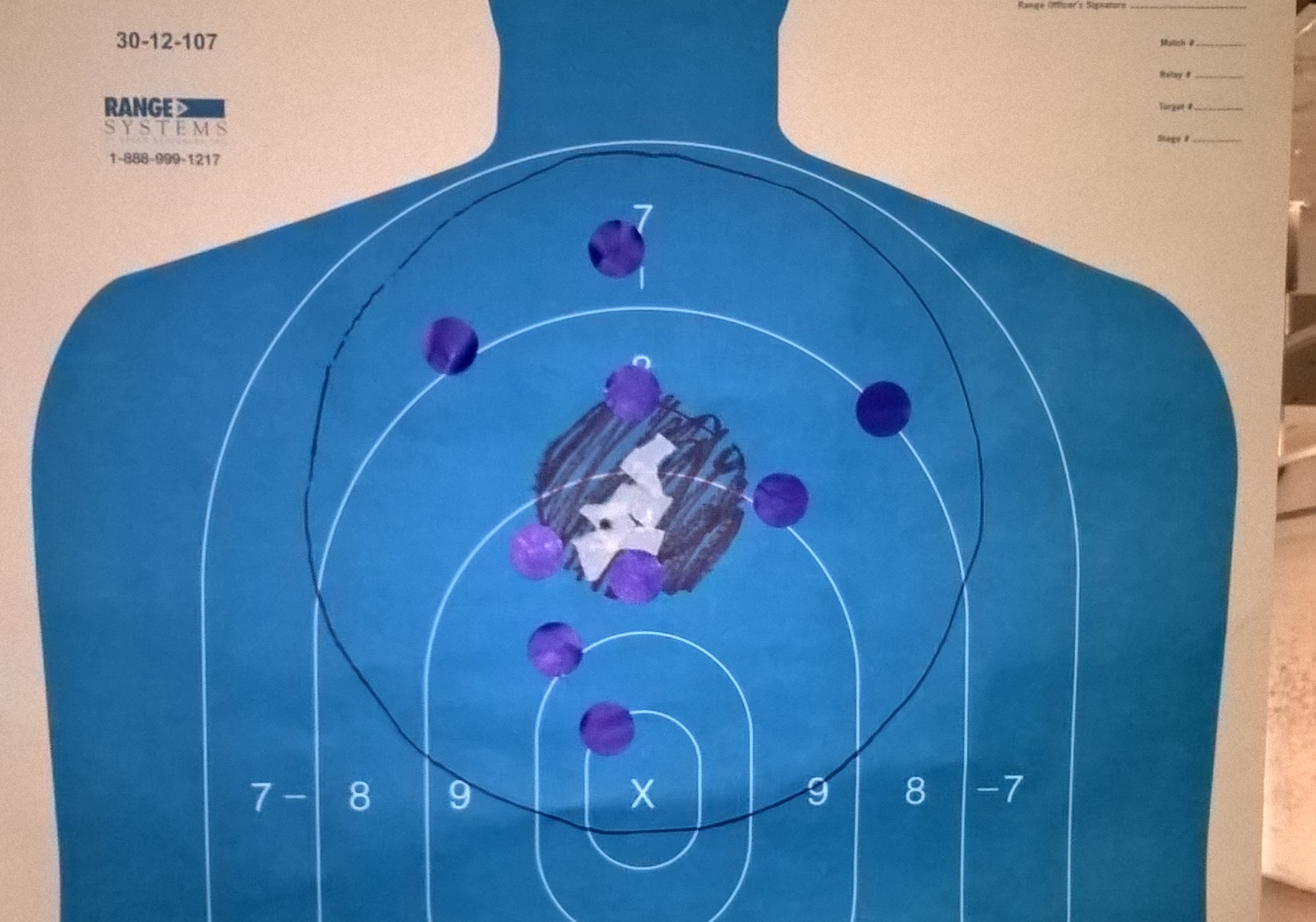
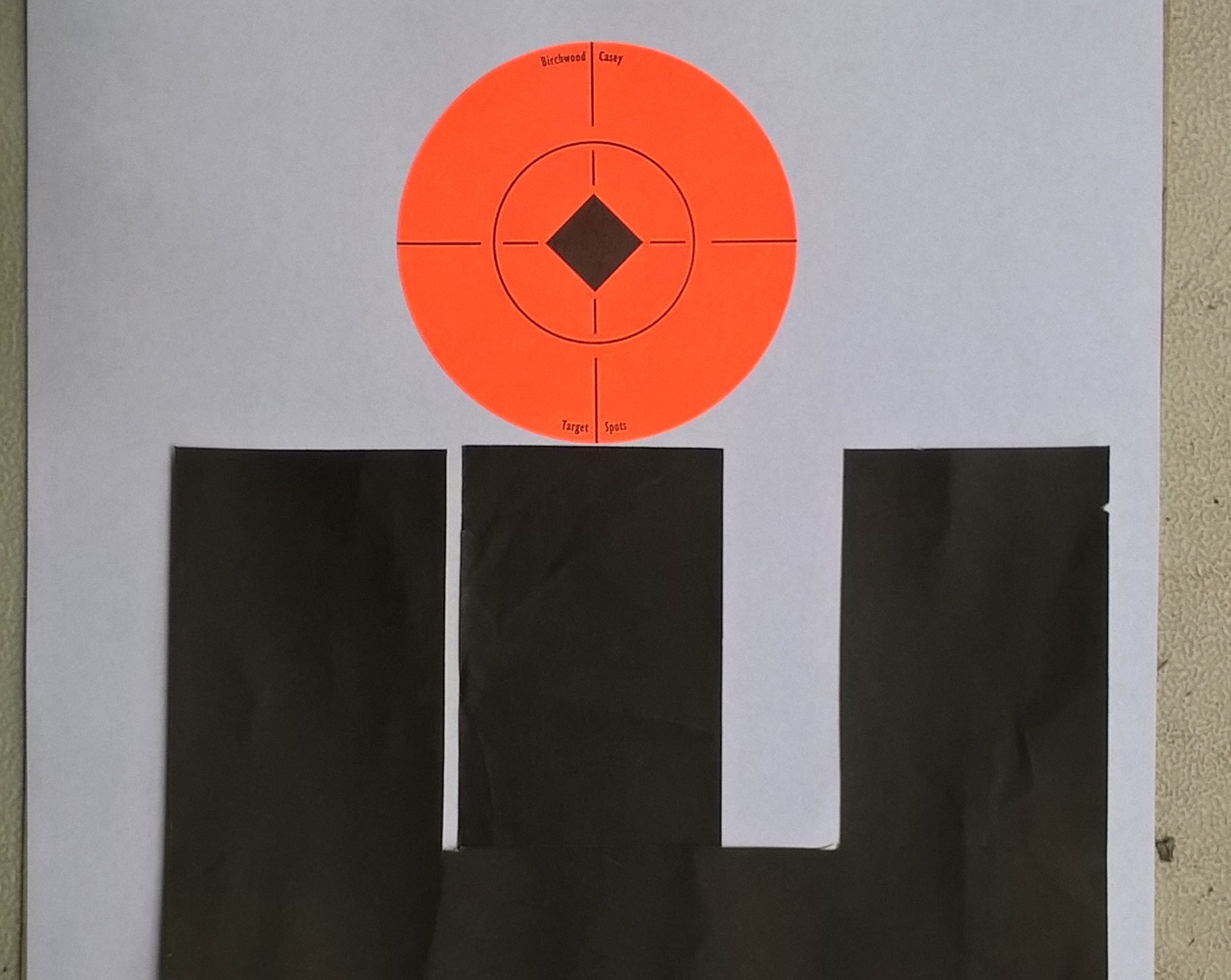 Bring the target back and mark your shots with masking tape, pasters, or a marker. You will end up with eight shots on the target that will be dispersed up, down, left, and right. The target should look something like this:
 Sequence 2 (8 rounds at 10 yards)
1) Send the target out to 10 yards.
2) Repeat Sequence 1 but with the target at 10 yards.
3) Bring the target back and mark it.
Sequence 3 (8 rounds at 15 yards)
1) Send the target out to 15 yards.
2) Repeat Sequence 1 with the target at 15 yards.
3) Bring the target back and mark it.
Depending on your eyes and the nature of your sights, you may find that even at 15 yards your group stays on the target, despite the slightly misaligned sights.
Objective:
The purpose of this exercise is to demonstrate that the sights do not have to be perfectly aligned to get an acceptable hit on a silhouette size target. Many people waste time trying to get a perfect sight picture when it isn’t necessary. This principle of acceptable misalignment is the basis for what is called the “flash sight picture.” What we are trying to do is to get the front sight close to our aiming point and then refine the sight picture only to the extent we need to in order to get an acceptable hit. As your skill improves, your groups will get smaller and smaller but the principle remains the same.
 tacticalprofessor
You must be logged in to post a comment.