Upcoming Class Announcements
Personal Performance – May 3, 2020 (Dahlonega, Georgia)
$99 class fee, payable in advance. $20 range fee, payable day of class.
This Course is designed to give clients a clear measure of where their skills are at and what they need to do to improve their current skill level. It is based on the NRA Marksmanship Qualification Program and all shooters will receive NRA awards, based on their achievement during the Course. Shooters do not need to be NRA members to receive their awards. Clients will receive a take home program to maintain and improve the skills exercised during the Course.
The Course is taught in conjunction with Brian and Shelley Hill of The Complete Combatant.
To register, visit: https://www.eventbrite.com/e/may-2020-personal-performance-tickets-86377997917
Pocket Pistol 101 and Strategies, Tactics, and Options for Personal Protection (A weekend with the Tactical Professor) – May 30 – 31, 2020 (Weatherford, Texas near Forth Worth)
$300
Join us for two full days of practical skill development, theoretical concepts, and realistic application of both skill and theory to Personal Protection Problem Solving with Claude Werner, AKA “The Tactical Professor”. All instruction is based on twenty years of research and analysis of over 5,000 actual incidents involving Armed Citizens rather than the Police.
Pocket Pistol 101 (Day One): Learn the skills needed to effectively use SMALL handguns for Personal Protection. Pocket Pistols, such as snubnose revolvers and .380 and small 9mm autoloaders, have manuals of arms and performance limitations that differ significantly from service-size handguns. They are very frequently carried for Personal Protection but often not trained with. This course is designed to teach students proven gunhandling techniques unique to Pocket Rockets, increase the students’ understanding of the shooting characteristics associated with handguns that are smaller, shorter, lighter, and often equipped with sub-optimal sights, and how to enhance their ability to make timely and accurate hits. Both firing line drills and scenario-based exercises (NOTE: Man v. Man Drills) are used as skill builders in the course.
Strategy, Tactics, and Options for Personal Protection (STOPP) (Day Two – Morning): This classroom segment focuses on helping clients define the Strategies, Options, and Tactics that are appropriate for them personally in the area of Personal Protection. By defining personal Strategies and being aware of possible Options, the Tactics appropriate to a person’s goals and lifestyle can be chosen. These are unique to each person and no one size fits all. Being aware of a range of possibilities in advance of criminal encounters helps the client avoid Serious Mistakes and achieve Positive Outcomes. All clients taking the class will receive a copy of the book Serious Mistakes and Negative Outcomes by the Tactical Professor.
Scenario Based Live Fire Exercises (Day Two – Afternoon): The ability to perform effectively on an individual basis is a fundamental aspect of Personal Protection. Each client will have the opportunity to individually examine their performance envelope in re-creations of actual incidents that involved Armed Citizens. The re-creations will mirror the conditions and difficulties that Armed Citizens face when protecting themselves and their families from the criminal element.
To register, visit: https://www.ptgtrainingllc.com/store/p48/A_Weekend_with_the_Tactical_Professor.html
Revolver Operator Course – July 11, 2020 (Dahlonega, Georgia)
$149 class fee, payable in advance. $20 range fee
Small revolvers are often carried for Personal Protection. However, their size and light weight make training and practice difficult. This class uses service size revolvers as the principal training tools for learning the general principles of trigger manipulation, reloading, and gunhandling with revolvers.
After learning the general principles for Revolver Operators with service revolvers, small revolvers will be introduced into the curriculum. The differences between using service revolvers and small revolvers will be explained and practiced. An evaluation test will be shot at the end of the course to allow clients to establish a baseline for their own future performance evaluations. Clients will be given a handbook to guide their practice efforts after the course.
To register: email tacticalprofessor@gmail.com You will be invoiced for the class fee. Once the payment is received, your spot is reserved. The range fee will be collected in cash the day of the class.
Sad incident
Restraining orders aren’t worth shit; I want a Glock.
–a former gf who was in a position to know
Well-known sex therapist murdered, former boyfriend arrested
https://abc7chicago.com/well-known-sex-therapist-murdered-ex-boyfriend-arrested/5938962/
“According to TMZ, Harwick had “recently expressed concerns about an ex-boyfriend.” The Los Angeles Times reports that Harwick applied for orders of protection against Pursehouse twice before, in 2011 and again in 2012. A judge granted Harwick’s request for protection following evidence given by Harwick and Pursehouse. The restraining order ended two weeks before Harwick’s death, according to TMZ.”
https://heavy.com/news/2020/02/gareth-pursehouse/
I have a question …
A friend sent me an email today that I think is very worthy of sharing. He is a twice retired POlice Officer, graduate of the elite Rogers Shooting School, and very seasoned firearms and tactics trainer.
What is your overall opinion of competition preparing you for a real gunfight?
I published my response on my Patreon page, which is generally limited to my subscribers there. It’s an important topic so I decided to make it publicly available. https://www.patreon.com/posts/33975252
Vallejo Parking Lot Shooting – Collateral Action
off-duty cop shoots and kills father-of-six
How about that as a way to describe a convicted felon who kept “a semi-automatic handgun with a 30-round magazine [in] its hiding place under the hood”
Hat tip to my friend and colleague Greg Ellifritz https://www.activeresponsetraining.net for bringing up the incident. Greg mentioned the fact that concealing weapons [and drugs] underneath the hood is a common technique for the criminal element.
The Vallejo POlice Department posted several videos of the incident on YouTube.
Video #4 is very useful from the collateral action (avoidance of becoming collateral damage) perspective.
It wasn’t these folks’ first rodeo; you don’t see them trying to get video for WorldStar.
Clarification about the .25 ACP
An article about the .25 ACP pistol cartridge came to my attention today. It says I endorse the use of that caliber for Personal Protection. This is not true. Through personal experimentation, not on humans, I have determined it simply does not have enough penetration to be a viable cartridge for the purpose.
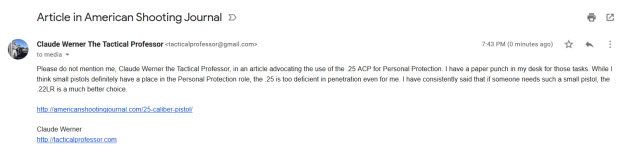
The only incident in my database in which an Armed Citizen was seriously injured after shooting a criminal with a ‘mousegun’ occurred with a .25. The first round bounced off the attacker’s teeth at point blank range.
I would much rather have a .22LR for Personal Protection than any .25 ACP. At least it will penetrate a piece of wood enough to stick in. That has not been my experience the .25 ACP.
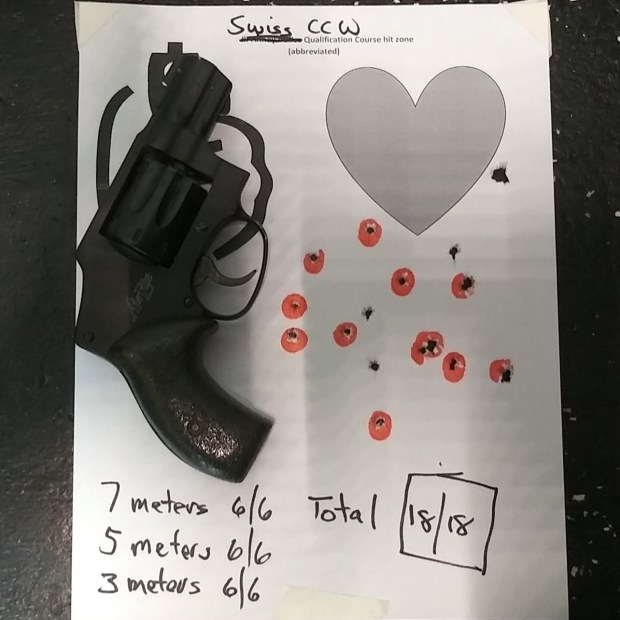
S&W 43C .22LR revolver
Factors relevant to church shootings
After my initial thoughts about the White Settlement church shooting, a list of other relevant factors came to mind. The conversation about the incident mostly has centered around the ability to make a 12-15 yard head shot. The tactical factors have largely been ignored or overlooked. That’s a Strategic Mistake.
Here’s my list for those wishing to do their own research and METT-TC analysis.
Requisite level of skill (part II)
This morning there was a murder in a church in Texas. A few seconds later, further murders were prevented by the quick action of a counter-murderer who protected the congregation. In the incident, it appears that someone tried to draw a pistol but was unsuccessful and got shot for his trouble. It is possible he was trying to get his cell phone to call for help, though. The footage is not very clear.
What was the requisite level of skill to end this situation? The shot would appear to be two aisles plus the width of a pew.
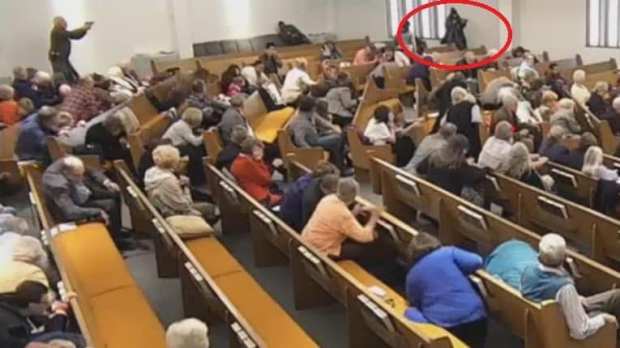
At the recommended 24 inches per person for 12 people (4 hymnal racks per pew with 3 per), that would be 24 feet for the pew plus 10 feet (two 5 foot aisles). https://www.lifeway.com/en/articles/church-architecture-rules-thumb-space-dimensions
Thinking about what’s important
Man shot in neighbor’s home charged after allegedly undressing in 12-year-old’s bedroom during break-in
Although this incident occurred in April, it recently re-surfaced as an example of a Defensive Gun Use. As is frequently the case, Internet common taters had numerous things to say about it.
- Needs more practice.
- Only six? Should have emptied the magazine!
- Too bad the dirtbag’s not in the morgue.
- Etc.
It’s easy to focus on the unimportant aspects of an incident. All of the commentary focused on feelings, which are unimportant, instead of Lessons to be Learned (LTBL), which are important.
How do we focus on what’s important? One way to start is to identify who was involved by role rather than name. Most the time, news stories use last names but that tends to obscure who did what. Substituting a role for names in the story leads to more clarity about the actions of the participants. For this incident, it would look as follows.
Cast of characters in the drama
Donald Oliver – Intruder
Tina Burton – female of household (Female)
Ali Bracey – male of household (Male)
Daughter
Important aspects of the incident
- The Male knew there was an actual intruder because of the Daughter’s text.
- Despite knowing it wasn’t just a ‘bump in the night,’ the Male went to confront the intruder unarmed.
- The confrontation between the Male and Intruder started verbally and then turned physical.
- It was either an entangled fight or within arm’s length.
- When it went physical, the male employed an improvised weapon, to wit: a broom.
- The broom was apparently ineffective in the confrontation, so the male continued using unspecified improvised weapons.
- They had a gun but didn’t think initially to bring it to the fight.
- The Female eventually brought the gun to the Male to use.
- There was a weapon handoff from the Female to the Male.
- Shooting the gun caused the Intruder to flee.
Unimportant aspects of the incident
- The intruder wasn’t killed.
- The householder didn’t practice enough at the gun range.
Lessons To Be Learned (LBTL) and other important aspects
Guns are not useful if you don’t bring them to the fight. Have a plan ahead of time about how to handle an intrusion.
You can’t practice appropriately for an entangled or close range fight at a gun range anyway. This would most likely have been best handled as a retention shooting situation. Retention shooting is a skill best learned by taking a class from someone who knows what they’re doing. Few instructors are qualified to teach this task. I can recommend Brian Hill of The Complete Combatant, Greg Ellifritz of Active Response Training, and Craig Douglas of Shivworks.
Males of the household will often confront an intruder unarmed. It’s not uncommon for another family member to have to access the firearm and bring it to the fight. A handoff to the Male periodically occurs at that point. This means that several implied Personal Protection tasks for the other family member come into play.
- Know where the gun is.
- Be able to access the gun. Is it in a safe and can the family member open it?
- If the gun is not stored Ready to Fire, be able to place the gun into Ready to Fire condition.
- Move safely from the storage location to the fight location. Having an Unintentional Discharge en route will probably be a Tactical Disaster.
- Either be able to engage the Intruder with the firearm, or
- Safely hand off the firearm to the Male engaged in the confrontation. If the confrontation is physically entangled, a handoff may not be safely possible.
Whether the Intruder is killed or not is completely irrelevant. Let’s keep in mind The Cost of Killing. Achieving a Break In Contact is our objective as Non-Sworn Citizens. Note that in this incident, the Intruder had to be taken to court in a wheelchair. That probably means that he has some serious injuries, perhaps debilitating for his entire life.
We need to focus on the important tasks in Personal Protection incident analysis and not our feelings, which are unimportant. That is what I will be doing in the monthly incident analysis on my Patreon page.
‘Good Guys’ is a relative term in this video
From my Strategies, Tactics, and Options for Personal Protection Class:
Triumvirate of Success in Decision-Making (adapted from David Brin’s The Uplift War).
In no particular order:
• Consequences [nee Cost and Caution] – financial, political, and physical.
• Decency or Civility [nee Propriety] – honor and nobility. Actually being ‘the good guy.’
• Courage [nee Beam and Talon] – Aggressive spirit, daring and seeking out opportunities.
Failure to achieve some balance of the three factors significantly increases the possibility of a catastrophic failure to achieve the objective. In this incident, there was no sense of decency or civility among the ‘Good Guys.’
Unintentional Discharge (causing the death of an innocent) – Serious Mistake
Mistaken Identity Shootings – Serious Mistake
After the fact beatdown of an innocent party – Serious Mistake
Most likely spending a long time in a Brazilian prison – Negative Outcome.
What gets people in trouble is usually not marksmanship but instead Serious Mistakes in the Decision-Making process. There are exceptions but that’s the general rule. The reason we become proficient with firearms is not because the marksmanship problem is likely to be difficult but rather to avoid having the tool (firearm) become our focus in the moment instead of the situation.
Tactical Professor books (all PDF)
Serious Mistakes Gunowners Make http://seriousgunownermistakes.com
Indoor Range Practice Sessions http://indoorrangepracticesessions.com
Concealed Carry Skills and Drills http://concealedcarryskillsanddrills.com
Advanced Pistol Practice http://bit.ly/advancedpistolpractice
Shooting Your Black Rifle http://shootingyourblackrifle.com
Worst Possible Case and 100 percent Standards
#Fridayfundamentals
Last night, I had an interesting conversation with John Daub of KR Training about the new NRA CCW Course. KR Training is one of, if not the, premier provider of firearms training in Texas, so his thoughts about the CCW Instructor Course he and Karl recently completed were something I wanted to hear. One of the most interesting items of the conversation was that the NRA has adopted a 100 percent hit standard for the NRA’s Qualification Course, if instructors choose to use the NRA’s Qual Course.
I’ve been a big believer in 100 percent standards for a long time. The importance of an exacting standard was emphasized by a recent Incident where a woman in Oroville, California shot and paralyzed her husband as a result of taking a Hostage Rescue shot on a home invader. Although she killed the home invader when she “emptied the clip” at him, her husband is now paralyzed for life. That incident reminded me of how imprecisely we use the term Worst Possible Case.
‘Worst Possible Case’ discussions inevitably devolve to one of two possibilities; TODD, the heavily armed criminal who is as impervious to gunfire as Superman or becoming involved in an entangled fight. However, there are numerous possibilities of what could be the Worst Possible Case as listed in Serious Mistakes Gunowners Make. So there actually is no single Worst Possible Case, there are various Negative Outcomes; it’s situationally dependent. The situation will dictate which of the possible Negative Outcomes is the ‘worst.’
It’s very important for us to understand our capabilities. The CAN, MAY, SHOULD, MUST paradigm developed by Steve Harris, Esq. puts CAN first for a reason. CAN, what are you able to accomplish at that moment?, has two components – Mental and physical. The Oroville woman had the mental part of CAN but not the physical. Let’s compare and contrast her incident with that of Meghan Brown, who also shot and killed a home invader during a struggle. Ms. Brown had been to the range with her pink Taurus revolver and knew she was not a very good shot. As a result her strategy was to close with the struggle and take the shot at a point where she was sure she could make her hits.
The ‘Downrange problem,’ in which an innocent person is downrange of the shooter, is far more common than we think. Those who keep a firearm for Personal Protection need to keep in mind that the situation may not be ‘self-defense’ but rather protecting another person.
How to put this into practice becomes the question. The Decisional Exercise Family taken hostage from Concealed Carry Skills and Drills is one example. Simply use two sheets of paper as the hostage. Put them on the same side as your Support Hand so you maximize your opportunity to hit them if you jerk the trigger. If you hit those two sheets of paper, assume you seriously wounded or killed a member of your family.

To add some realism, you can put a facial photo of a family member above the printed sheets or just draw a face above them. Here’s a Non-threat PDF Printable Non threat Silhouette torso that is included in Advanced Pistol Practice and Shooting Your Black Rifle. When practicing on an indoor range, you probably won’t be able to set up the full scenario but you can still do the individual strings.
What’s the Worst Possible Case? It’s a situationally dependent individual decision. Using a little forethought and doing some practice may help you solve it without a Negative Outcome. Going to the range and figuring what distance YOU can make 100 percent hits will give you a very important piece of information in the context of Personal Protection.
 tacticalprofessor
You must be logged in to post a comment.