Standards (Part III – Who Sets the Standards?)
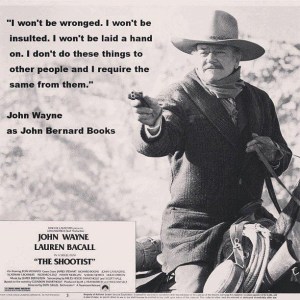
I won’t be wronged, I won’t be insulted, I won’t be laid a hand on. I don’t do these things to other people and I require the same from them.
–J.B. Books
When discussing Standards, we should keep in mind that Standards come from several sources.
- Ourselves (personal standards)
- Private Sector (social values and employment criteria)
- Public Sector (legal requirements)
Of those, the standards we set for ourselves are the most important. For instance, I don’t drink if I’m driving. I enjoy having a cocktail but I either have one at home or in the company of a designated driver. That’s my personal standard. In most cases, I could probably ‘get away with’ driving home after I’ve had a drink. However, even if I wasn’t close to the legal limit of intoxication, alcohol consumption reduces the margin of safety I consider acceptable for operating a two ton potential manslaughter machine. Not only is my personal safety at stake but the safety of others. It’s the same reason we accept not handling firearms after consuming alcohol as personal and community standards; to maintain an acceptable margin of safety.
What are some other personal standards that might apply to aspects of personal protection and shooting? A few come to mind immediately:
- Know the rules (law) of where we live and places we travel to.
- Shoot only at positively identified threats.
- Shoot only in a manner we can make 100 percent hits on a threat, thus not endangering innocents downrange. Factors affecting this include:
- Personal skill
- Distance
- Cadence (rate) of fire
- Relationship of the weapon to the eye-target line
My presentation at the Rangemaster Tactical Conference last week was titled Strategies, Tactics, and Options for Personal Protection (STOPP). Since many of us were not from Arkansas, I asked the audience how many of them from out of state had researched the Arkansas statutes about the Use of Force and Deadly Force. Not everyone had. Researching this piece of information took me less than 30 seconds on my phone before I entered the State. Was it a prudent decision to do so? I think so.
Arkansas Code Title 5. Criminal Offenses § 5-2-607. Use of deadly physical force in defense of a person
I’ve harped quite a bit about Identifying Friend or Foe already so, for the moment, Point 2 requires no further elaboration . Please remember that the Flashlight Practice Session of Indoor Range Practice Sessions is available as a free download.
Let’s consider point 3. My colleague Darryl Bolke’s presentation at the Conference included an important tidbit about the rate of shooting. The LAPD SWAT Team, one of the most highly trained and experienced shooting units in the world, practices to shoot at .5 (½) seconds per shot, no faster. They do this regardless of whether they are on the square range, in the shoothouse, or in actual confrontations with criminals. Why? Because that’s the rate they can identify threats and make decisions about using or continuing to use (follow up shots) deadly force.
The Force Science Institute has found that it takes about .3 seconds or more for the ‘stop shooting’ decision. That’s considerably longer than the splits we consider important in the world of competition shooting. There is a tension inherent between those two situations.
We all like to consider ourselves to be responsible gunowners. Is it prudent for us to practice shooting faster than we can guarantee a hit and whether it’s necessary to shoot at all? That’s an open question in my mind. I shot the Match at the Conference very deliberately and relatively slowly. I’m okay with that. All my hits were exactly where I wanted them to be and nowhere else. In the measured environment, that’s now become my personal standard.
Claude, I’m haunted by that last shot because I don’t know where it went.
–A friend who is both an Expert competitive shooter and a practitioner of personal protection.
Going to public sector standards, a fear is periodically raised that the standard will be set too high for gunowners to meet. The State of Illinois was the last State in our Nation to allow concealed carry because its political elite has a pathological fear of firearms (hoplophobia) in the hands of private citizens. Consequently, that State makes an interesting case study regarding Standards for private citizens. Let’s compare the standards Ill-Annoy has established for police officers v. private citizens.
| Tested Criterion | Police | Citizen |
| Rounds | 30 | 30 |
| Strings of fire | 12 | 3 |
| Furthest distance | 15 yards | 10 yards |
| Time Limits | 6 – 10 seconds | None |
| Target | 8.5″ x 14″ (119 sq. in.) | Entire B-27 (~700 sq. in.) |
| Starting Position | Holster | Ready |
| Hit Requirement | 23/30 (77%) | 21/30 (70%) |
Strings of fire is a useful criterion to include because less skilled shooters tend to ‘walk’ their rounds into the center of the target during a longer string. Having more strings reduces the effectiveness of this technique and makes a given course of fire more difficult for an equal number of rounds fired.
The qualification requirements of some States are so low that a reasonably skilled shooter can literally pass them blindfolded. For instance, the State of Michigan requirement is to hit an 11×25 inch target (three sheets of paper) at four yards with five rounds, two times out of three tries, starting from a ready position. It should be noted that although this seems like a large target, it has roughly the same area as the FBI ‘Q’ target; 281 square inches v. 275 square inches, respectively. The fear of established marksmanship criteria being excessively high seems unfounded in reality.
It should also be noted that reflexively firing a number of rounds can be a legal liability. In the Mike Kimball case in Maine, the first shot was deemed by the medical examiner to be deadly. The two additional rounds fired by Kimball were raised as an issue by the Judge in his trial. Kimball was ultimately convicted of murder and will most likely spend the rest of his life in prison. There were additional factors in his conviction, but the number of shots was definitely a question.
A lawyer friend pointed out recently an aspect of the California jury instructions regarding self-defense cases. The wording can be interpreted to mean that shots fired after the threat has ceased could be viewed as excessive force and no longer reasonable self-defense. Whether we like it or not, the rules are the rules. We need to be cautious about parroting and then internalizing memes such as ‘shoot him to the ground.’
When you start [and continue] shooting at someone, you have to assume you’re going to kill them. That’s why we call it ‘deadly force.’ Doing so needs to be a decision not a reflex.
–The Tactical Professor
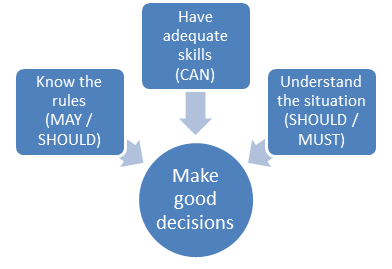
Should we settle for having mediocre personal standards and being able to only do the bare minimum? It’s true that ‘getting better is not for everyone.’ Especially if that is the case, having an objective benchmark of how we can and cannot perform is worthwhile information. That’s the main reason there is a benchmark test included in Indoor Range Practice Sessions. link to purchase all 24 Sessions
Standards (Part II – Why)
A good man always knows his limitations.
–Inspector Harry Callahan
As early as the colonial times, it was recognized that shooting firearms is an athletic endeavor. Thomas Jefferson implied as much to his nephew, when he recommended shooting rather than “games played with the ball” as a pastime. In any physical endeavor, it’s useful to establish a benchmark. This concept applies in:
- Medicine – what’s your blood pressure? Your doctor probably doesn’t just look at your face and decide if you have high blood pressure or not. A measurement is required. And that measurement is then evaluated in relation to established benchmarks for normal, pre‑hypertensive, or hypertensive conditions.
- Sports – universally, sports rely on numerical performance indicators. A team would certainly not field a player without having looked at the player’s performance stats. While good stats are no guarantee of success on the playing field, poor stats are unlikely to lead to success.
- Education – making acceptable grades is generally required to graduate from any educational institution. If your child went to a school that never evaluated performance, you probably would be unhappy about that. The general problem of that in our schools today is beyond the scope of this discussion. Suffice to say that any parent whose child can’t read but still is allowed to graduate from school should be very, very unhappy.
Avoiding Negative Outcomes is another key reason for why people might choose to have standards. This is where Dirty Harry’s statement comes into play. Two particular incidents come to mind as examples.
- A woman in Mississippi shot and killed her husband with a handgun while trying to protect him from an attacking dog. One bullet missed the dog and struck the husband in the chest, killing him.
- In Texas, a woman and her roommates were victims of a home invasion. When she fired her shotgun at the invaders, she missed them both but shot and seriously injured one of her roommates. This incident highlights a downside of owning a shotgun for home defense. There are few places those who live in urban or suburban areas can do any meaningful home defense practice with a shotgun.
“Weapons System” is a military buzzphrase that should be considered in the context of having standards. When a person picks up a firearm for personal protection, the combination of person and firearm become a ‘weapon system.’ Compatibility of the firearm with the person operating it is an important aspect of an appropriate choice.
- What works for you? Although the Glock pistol is enormously popular, it’s not the right choice for everyone. The other side of the coin is that the snub nose .38 revolver often recommended for women isn’t necessarily the right choice either.
- One of my colleagues somewhat rhetorically posed the question “What I shoot the best is a .22; is that what I should carry [or keep for home defense]?” That’s actually a really good question. If a person could only successfully shoot a very simple testing protocol with a .22, what’s the answer? Especially where senior citizens are concerned, how should they make a decision?
Psychology is yet another aspect of the standards decision. People like to think they know what they’re doing. Conversely, they don’t like not knowing what they’re doing. My friend and colleague Ken Hackathorn states a concept he calls Hackathorn’s Law.
You won’t do something under conditions of stress that you’re not subconsciously sure you can do reasonably well.
His Law has a distinct relationship to the concept of ‘Critical Distance’ in proxemics. Critical Distance is the distance at which pursued prey will turn and initiate a counter-attack against the predator. My analysis is that the North American subconscious Critical Distance is in the zone of 4-7 feet (the near phase of social space).

Diagram by WebHamster
Those familiar with the Tueller Principle will recognize that primal Critical Distance is only one-third of ‘too close.’ As the late Paul Gomez said, “We’re not teaching people to start shooting soon enough.” If a person never has an inkling of the standard they are capable of shooting to, most likely they will default to the primal Critical Distance.
Liability mitigation is sometimes cited as a reason for having standards. Other than as an unstated barrier to entry, standards have been mentioned as a way for issuing authorities to reduce their liability. To what extent this is actually true remains to be seen but it is stated as a reason.
A significant downside to standards is that encountering or testing them may force a conflict with a person’s ego. The Dunning-Kruger Effect is a well-recognized aspect of human nature. It’s the opposite side of the Hackathorn’s Law coin. As one shooter wryly observed,
Getting better is not for everyone.
If a person never tests what their skill level actually is, then this ego conflict is avoided. Many people are okay with that. Unless meeting a standard is mandated, it’s a personal decision.
Standards (A Series)
Standards (Part I – Introduction)
While I’ve been on hiatus, I’ve been thinking a great deal about Standards. The Free Dictionary lists the first noun definition of Standard as: An acknowledged measure of comparison for quantitative or qualitative value; a criterion.
In the area of personal protection, standards can apply to many different facets of our skills and body of knowledge. Standards imply measurement, something that many people are deathly afraid of. While ‘public speaking’ is often mentioned as being the most prominent fear, that is merely a subset of a larger body, individual performance measurement.
The most obvious and contentious type of standard regarding Private Citizens who own firearms is the concept of marksmanship standards. The discussion comes up regularly among the training and gun communities without any general consensus about what is appropriate. Generally, the topic revolves around Citizens who have some form of of License to carry a weapon. We should keep in mind that it can also apply to those who keep firearms for home defense.
Opinions vary widely about what standards are appropriate for those who carry weapons. On one end of the spectrum, some people feel there should be no standards at all. Rob Pincus of I.C.E. Training holds this view as do advocates of Constitutional Carry. On the other end of the spectrum, there are very difficult standards such as the FAST Drill developed by the late Todd Green, the Humbler popularized by Larry Vickers, or the Handgun Testing Program developed by Bill Rogers of the elite Rogers Shooting School.
In the middle are the Qualification tests used by many States as one of the prerequisites for obtaining a Weapons Carry License or whatever name the State puts on the card. For those who wish to carry a weapon in those States, the discussion of what standard is appropriate starts with what their State’s requirement is and how to meet it. No two States having a Qualification requirement are alike
The difficulty of these State Qualifications varies quite widely. Anywhere from 10 rounds to 50 rounds have been mandated. The distances shot at fluctuate from six feet to 15 yards. Some are timed but most are not. The targets may be large or much smaller. Interestingly, very few States have a test requirement that includes drawing from a holster. In fact, some States specifically prohibit the Qualification test from including drawing from a holster. While this might seem paradoxical, it is not because of liability and fairness issues.
What this series will explore is the various types of standards that exist, what skills are required to meet them, and how to choose what is appropriate for you, if anything.
Chinese Whispers and the FBI (Part I)
Chinese Whispers is the game in which a short message is whispered from person to person and then the beginning and ending stories are compared. Often what begins as “I like that girl’s dress” ends up as something like “her Grandmother slept with Batman!”
The FBI released its annual report Law Enforcement Officers Killed and Assaulted (LEOKA) report on October 17. LEOKA will eventually be the starting point for numerous Chinese Whispers in the firearms and law enforcement communities. Whispers will circulate about statistical data such as distances of ‘gunfights,’ lighting conditions, weapon disarms, etc. Often, these claims will not even be based on current data but ‘commonly cited information,’ ‘well known statistics,’ or other such dubious sources.
What can we actually learn from LEOKA about how to be safer? The best single source in the Report is the Summaries of Officers Feloniously Killed and a recent addition, Selected Summaries of Officers Assaulted and Injured with Firearms or Knives/Other Cutting Instruments. Rather than relying on tabular data, which is interesting but not instructive, reading the Summaries provides us clues about circumstances, positioning, and actions. The FBI uses the term ‘The Deadly Mix’ to describe the combination of officer, offender, and circumstances. Reading the Summaries can give us insight about how that mix occurs and its outcome.
The circumstances of incidents in LEOKA are categorized as:
- Disturbance call,
- Arrest situation, including pursuits
- Civil disorder,
- Handling, transporting, custody of prisoner,
- Investigating suspicious person/circumstance,
- Ambush,
- Unprovoked attack,
- Investigative activity,
- Handling person with mental illness,
- Traffic pursuit/stop,
- Tactical situation.
While LEOs have interest in all the categories, Private Citizens can learn from incidents such as Investigating suspicious persons/circumstances and Handling person with mental illness, too. For those who think intervening in others’ affairs is a good idea (I do not), looking at the incidents in the Arrest category is a worthwhile exercise to see how easily things can go bad.
The West Virginia incident in the Summaries of Officers Assaulted and Injured is an entertaining, if somewhat macabre, example of just how weird and unpredictable the life of a police officer can be. The rookie involved certainly got a baptism of fire that day.
On January 1, a lieutenant and a patrol officer with the Lewisburg Police Department were both shot during a traffic stop at 4:20 p.m. The 36-year old veteran lieutenant, who had 15 years of law enforcement experience, and the 20-year-old patrol officer, who been on the job for 1 month, were both wearing body armor when they stopped a man driving a vehicle that had been reported stolen by a law enforcement agency in Texas.
More about LEOKA in the next Part.
The cost of killing
‘too bad they didn’t kill him’
‘needs to get more practice at the range so they have better aim [to kill him]’
–Internet common-taters
Often when a story surfaces in which an armed citizen wounds but doesn’t kill an attacking criminal, statements such as that will quickly show up in the comments section on the Internet. Persons who make such comments have no clue about the cost of killing someone. Even when there are no legal and financial costs, the emotional, psychological, and social costs will be considerable.
As in every class I attend or teach, I learn something from the students. Yesterday was no exception. I attended, as a student, the Proactive Mindset class taught by The Complete Combatant. The trainers graciously allowed me to give a short presentation at the end. One of the things I mentioned was the psychological cost of killing. The incident I cited was that of the citizen near Chattanooga who shot an old man with Alzheimer’s. The killing was ruled justifiable and he was not prosecuted. Coincidentally, someone who knows him was in the class. When the class was over, she came up and filled me in on how things developed after the incident. Suffice it to say that the emotional costs to him were enormous and continue to this day.
The cost is not only borne by the individual who does the shooting but also by their family. At some point their children are going to go to school and one of their classmates is going to taunt them with ‘my daddy says your daddy is a murderer!’ No matter how justifiable the shooting may be, someone in the community who feels that self-defense is an unacceptable concept will express their feelings to their children and the children will pass it on to your children.
Even one of the great police gunfighters of our time, the late great Jim Cirillo, bore the cost. Despite the fact that all his shootings were eminently justifiable and he didn’t suffer psychologically, he still had to pay the social cost. When his superiors recognized his bravery and devotion to duty, they recommended him for promotion. The promotion was turned down in the upper echelons of the NYPD because they said it would send the wrong message to the department and the public. ‘We don’t promote people for killing.’ This is one example of what Massad Ayoob calls the ‘Mark of Cain syndrome.’
Now imagine what it’s like for people who unintentionally kill a member of their own family. A parent who kills their child or someone who kills their spouse will probably never get another good night’s sleep as long as they live. The saddest part of these incidents is how avoidable they are. A flashlight and the ability to verbalize ‘who’s there?’ would have prevented almost all of them. A small flashlight was included in the goodie bag given out for Proactive Mindset. Great idea; everyone should have a couple of flashlights. Good ones are very inexpensive now.
That’s why our priorities should always be:
- Avoid,
- Escape,
- Confront,
- Resist
When we jump to Confront and Resist before we absolutely need to, we’re being emotionally hijacked by the situation, our pasts, our current influences, and our egos. Allowing an emotional hijacking is no more a recipe for success than going along with any other kidnapping attempt. There’s always going to be a very high cost.
Internet common-taters take note; you’re not the ones who will pay the cost.
Thinking ahead
If we get carjacked, as long as you and I can both get out of the car, they can have it; I have insurance. But if either of us can’t get out of the car because we get hung up in the seat belts or something, turn your face away from me and close your eyes because I am going to start shooting. I don’t want his loathsome blood-borne pathogens to get in your eyes.
–my personal policy/Standard Operating Procedure, as related to a former girlfriend who lived near Murder Kroger in Atlanta
A California man shot the carjacker of his van Friday as the carjacker drove away. The carjacker died shortly thereafter and the shooter was arrested for Murder. Once the threat of Death or Serious Bodily Injury has passed, the time for gunfire has ended.
“Nice people lock their doors.” –my mother
‘Don’t sit around in unsecure parking lots working on your czechbook, writing reports, texting, or talking on the phone.’ –paraphrased from Bill Rogers and Craig Douglas
“Firearms shall not be discharged at a moving vehicle unless a person in the vehicle is immediately threatening the officer or another person with deadly force by means other than the vehicle. The moving vehicle itself shall not presumptively constitute a threat that justifies an officer’s use of deadly force.” —LAPD Manual Volume 1 Section 556.10 POLICY ON THE USE OF FORCE
Policies, SOPs, or whatever you wish to call them are simply committing to memory, or writing down, actions that you have thought about ahead of time. For some reason, the word ‘policy’ evokes a great deal of resistance on the part of people I talk to about it. Not thinking about things ahead of time is probably the most Serious Mistake Gunowners Make and I will have to add that to the next edition.
In a crisis, the conscious mind has an extremely short life span, probably less than a second. Once the conscious mind expires, either training/practice or the amygdala will take over. Trying to make up a plan on the spot is an extraordinarily difficult task.
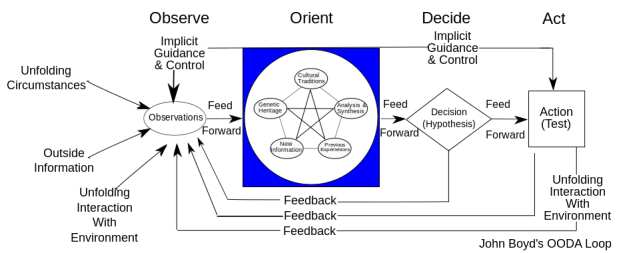
Perhaps the inability or lack of desire to think ahead is the reason for the popularity of the OODA Loop. Relying on the OODA Loop implies that you can out-think the situation in the moment. This is just being lazy and an excuse for not thinking ahead. No plan survives the test of combat, as the saying goes, but it is ALWAYS easier to modify a pre-existing plan than to make one up on the spot.
Fighter pilots have been at the forefront of developing policy and procedure for ‘in the moment’ encounters. Their creations over the past century have shown increasing sophistication as they have evolved.
- Dicta Boelcke, a list of principles, was formulated during WWI by Hauptmann Oswald Boelcke, a German fighter pilot and squadron commander. It is interesting to note that he was killed when he violated one of his own dicta, never close in on a single combatant when others are also pursuing it.
- Lieutenant Commander Jimmy Thach recognized the superiority of Japanese fighter aircraft in the early days of WWII. To counter them, he developed, using matchsticks on a tabletop, the Thach Weave as a defensive maneuver. Then he tested the maneuver under conditions simulating the disadvantages US Navy fighters would face.
- No Guts, No Glory, a USAF training document, was written by Major General (then Major) Frederick C. Blesse shortly after the Korea Conflict. It was an explanation of his experiences flying F-86 Sabres against MIG fighters and how to defeat them.
- Colonel John Boyd wrote the Aerial Attack Study, which is the most comprehensive manual on fighter combat ever written, in 1959. In it, he methodically worked out all the possible attacks and counters a fighter could make in relation to both bombers and other fighters. His study was heavily based on a thorough understanding of the flying and weapons capabilities of both US and Soviet aircraft.
In every one of these documents, specific principles, procedures, and pitfalls are worked out in advance. Speed of decision in tactical situations is achieved by picking from a list of possible options to best solve an unfolding incident rather than trying to ‘think faster,’ which is physiologically impossible. The distinction between ‘thinking faster’ and picking from a menu of possible decisions escapes many common taters about the OODA process. Boyd’s description of the process is much more involved than generally assumed and explained using a simplistic circular diagram. That circular graphic does no justice to the concepts that Colonel Boyd developed.
In order to make decisions in advance, it’s necessary to think about likely scenarios, at least, ahead of time and decide how to solve them. This includes the legal ramifications of your possible actions. Thinking ahead is a key component of avoiding becoming a victim or incurring a Negative Outcome in the criminal justice system.
John Johnston and I will be discussing this timely topic in more depth on Ballistic Radio tonight. Ballistic Radio is available over the Internet.
Serious Mistakes now available as a download
There have been many requests for the Serious Mistakes Gunowners Make recording as a download. Despite being something of a Luddite, I figured out a way to do it.
The recording is now available as a download for $9.95. Link
The Woman’s Gun Pamphlet
Through an oblique reference, I recently found a link to The Woman’s Gun Pamphlet. Edit: The link and the server appear to be gone. A PDF of the Pamphlet is available at the edit of this post.
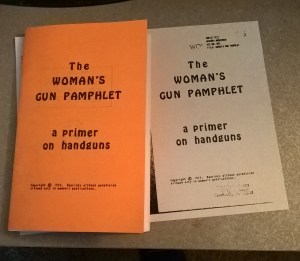
It’s a very interesting publication that was written and published by a colloquium of radical feminists in 1975. The intent was to provide information about both guns themselves and about personal protection attitudes to women of that era who knew nothing about guns or personal protection. As such, I consider it an historically significant document. There’s quite a bit of political rhetoric in it but also a goodly amount of information. Even dry practice is touched on. Some morsels of dry wit are quite entertaining.
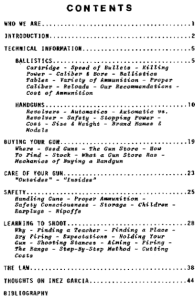
Especially interesting to me is that it was written from the perspective of self-taught women of the time with some input from men and by doing primary and secondary research. What they considered important, how the information was structured, and how it was presented is insightful. There are a number of items in it that made me realize there are areas of my subject matter knowledge I take for granted.
Given this week’s confrontation between the Federal government and a quasi Posse Comitatus group in Oregon, I also found the political views and fears presented in a 1975 publication to be notable. When I graduated high school in 1972, I doubted I would be able to own a handgun, much less carry one in the majority of States, even slightly into the future at that time. The recent shenanigans regarding Weapons Carry reciprocity in Virginia by its anti-gun Governor and his lackey Attorney General echo items in the Pamphlet. The attitudes and tactics of hoplophobes and political control freaks have changed little in the past 50 years. A common one is ‘take something away, then give it back in exchange for something else.’ The saying ‘One step forward, two steps back’ comes to mind. Gun controllists play the long game, just like Mao Zedong, and never view their playbook as a zero sum game.
The Pamphlet took me a little over an hour to read cover to cover, so it’s not heavy reading. Anyone who teaches, either formally or informally, women or Gun Culture 2.0 will find it worthwhile reading.
Why many Americans insist on owning weapons
A friend posted a comment on his Facebook page about police response policies and times today. His post related to the hypocrisy of politicians who are protected by armed guards around the clock but desire to have the populace disarmed and at the mercy of the criminal element.
In the wake of the Umpqua Community College and Northern Arizona University shootings, there have been renewed calls by Mr. Obama for increased gun control, along with other politicians. The implication of these calls is that law enforcement authorities are always available to protect the citizenry at a moment’s notice. If the government will not allow the citizenry to protect itself, as is now the case in Lesser Britain, then that responsibility must fall to the organized government. A frequently validated saying in the Army is
If no one in particular is responsible for something, then no one is responsible for it at all.
There are several problems with making the government responsible for our safety in the United States, two in particular.
First, the Supreme Court ruled in 1989 and again in 2005 that the government does not have the duty to protect us as individuals. Government in general, and the police in particular, only have the duty to preserve a general sense of order in the US. Only society at large is owed a duty of protection.
Second, there are practical considerations. The following was how I responded to my friend’s post:
I have a recording of an actual 911 call by a woman whose home is broken into while she is on the phone with 911. It is not fiction and was used as an exemplar in 911 dispatcher training.
The dispatcher is shocked into silence by the events, which allows hearing the gruesome sounds and screams as the woman is murdered. It is 2 minutes and 51 seconds long from the time she calls when he is outside until the murderer calmly hangs up the phone after the woman is dead. She is screaming “Who are you?” and has no idea of her attacker’s identity. To my knowledge, the murderer has never been identified, much less caught and brought to justice.
The recording is so horrible and shocking that I am very judicious about whom I play it for. I have listened to it many times and it still turns my stomach every time I hear it.
It’s not the only such macabre recording like that in my collection. They range in length from 1 minute 1 second to 3 minutes 3 seconds.
Every scumbag politician, including police chiefs who serve as mouthpieces for their political masters, should be required to play it at the conclusion of their spiels about how they will protect us and a five to eleven minute response time is plenty. It would be the end of that [you know what].
090928-N-1783P-005
(U.S. Navy photo by Machinist’s Mate 3rd Class Juan Pinalez/Released)
Double trouble: Media bias and downrange incident
I follow the stories in The Armed Citizen column of the NRA Journals each month. For copyright reasons, the stories have to be re-written. With the more interesting ones, I try to track down the original story to see if there is more detail. A story in the August 2015 issue involves a downrange incident and piqued my interest to find out more about it. The results were interesting. The Armed Citizen entry is as follows:
Breaking up before the big dance carried a price for several people. Two Wisconsin teens had a lovers’ spat before the prom, after the girl’s parents had spent $500 on a dress. The girl’s parents asked the boy to partially reimburse them since he backed out of the date. The Madison boy stewed about the request and became enraged. He returned to his girlfriend’s house in the wee hours of the morning and tried to break in. The girl’s father caught the boy and called him to task, prompting the boy to draw a knife and stab the man seven times. While the two males were grappling, the girl’s mother came out and fired a handgun into the air. The gunfire distracted the youth, and the man wrestled the teen to the ground. The boyfriend faces multiple charges, including attempted homicide. The girl’s father was airlifted to a hospital to have his wounds treated. (Wisconsin State Journal, Madison, Wis., 5/8/15)
One of the first links I found was to the original Wisconsin State Journal article. It did indeed provide more details, such as how the boy attempted to make entry into the house and the fact that he first of all nailed the father with a shovel. Several other links I found, for instance CBS News, referenced the Associated Press edition of the original article. Somehow, the fact that a handgun had been involved in stopping the incident was left out of the AP edition I found at CBS. At first I thought CBS had edited it but I decided to check. I found other outlets carrying the exact same words from AP, so it was the Associated Press that omitted the handgun detail, not CBS. I’m sure that was unintentional due to brevity requirements or somesuch. Yeah, yeah, brevity requirements, that’s the ticket.
There are several things I find worthy of consideration regarding the event itself. First, incidents where there is a family member or other innocent person in between an Armed Citizen and a criminal attacker are what I call downrange incidents. These are much more common than people like to think. The reason is simple. We’re around our families and friends at lot, typically at least half of each day. But the amount of forethought and practice gunowners tend to give this fact tends to be minimal. Part of that represents the way the indoor range practice environment is set up. It doesn’t lend itself well to practicing for downrange incidents. Unless someone is very confident of their skills, downrange incidents are probably going to be resolved at very close range as Meghan Brown did after a man broke into her home and began fighting with her fiance.
The two rolled around, breaking the dining room table and chairs. Planthaber [the fiance] said it lasted about two minutes. Hill [the invader] had a good 80 pounds on him and was winning.
While they were fighting, Brown got her gun from the bottom drawer of her nightstand.
She trained the weapon [a pink .38-caliber revolver] on the man, but was unable to shoot because Planthaber was too close. [I am willing to bet money she positioned herself as close to them as she possibly could.] She followed his movements.
‘I had my gun drawn, focused in on him; as he moved, my gun moved,’ she said. ‘I waited for my shot, and when I saw an opening, I fired.’
Unfortunately, I don’t have a really good answer about how you practice for this, especially in the indoor range environment. If your range will allow you to place a hostage type target at 1 yard, you could practice single shots starting from a ready position off the target. Many ranges will not permit this though, so ask first. You may have to explain what your objectives are and perhaps allow the staff to supervise you.
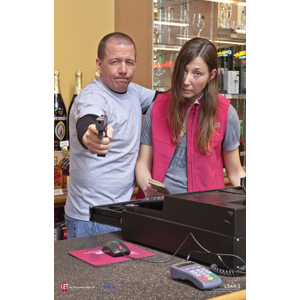
LSAR-2 target from Law Enforcement Targets
At the very least, some mental preparation and mental rehearsal is in order. DO NOT dryfire practice this with a real gun and real people, even if you think the gun is unloaded. That’s a recipe for a Negative Outcome.
If you have access to an outdoor range, here’s a practice drill you could do. If your situation permits it, you could also try this with Airsoft in your backyard.

Another aspect worth considering is the possibility that the male of the household will end up in a physical struggle with a criminal attacker and a female member of the household will end up doing the shooting. Both of the above incidents are examples of that dynamic. I have dozens more in my database. Knowledge of how to operate a firearm and having the will to use it will probably work out better than having a stab a man to death with a butcher knife. Note also that wasp spray didn’t have any effect in this incident.
At some point, ‘the husband was having trouble controlling the suspect and called out to his wife,’ [the Sheriff’s Office spokesperson] said. That’s when the woman ran to the kitchen and retrieved a [butcher] knife, fatally stabbing [the attacking criminal].
For those couples who are serious about personal protection, thinking about it ahead of time may pay off. This is an article I wrote about Protecting Your Family: Training for Mutual Defense.
 tacticalprofessor
You must be logged in to post a comment.