Analyzing the Armed Citizen® – July 2018
JULY 2018 AMERICAN RIFLEMAN
Looking at circumstances and tasks involved in the Monthly Armed Citizen® column of the NRA Official Journals provides us with some food for thought about personal protection. The incidents are summarized in the column for copyright reasons. I have provided links to the original stories for further study.
We can look at the incidents from two perspectives; circumstances and the tasks involved for the defender. This post will categorize the circumstances for each incident. Tomorrow will analyze the tasks involved.
Circumstances Analyses
Door locks work – Part II
SoBro residents on alert after rash of thefts, robbery
‘Until I actually saw the video of him running up to my house and getting in my vehicle, it was just extremely unsettling,’ said a woman whose Land Rover was stolen from her driveway. She said she had accidentally left the keys in the vehicle.
… Besides her surveillance video, her neighbors’ cameras caught what could be the same suspect trying their car doors and rifling through vehicles for valuables.
The Woman’s Gun Pamphlet
The Woman’s Gun Pamphlet came up in conversation during The Mingle yesterday. Since the original source is no more, I’m republishing this post for interested parties.

Through an oblique reference, I recently found a link to The Woman’s Gun Pamphlet.Edit: The link and the server appear to be gone. A PDF of the Pamphlet is available at the edit of this post.
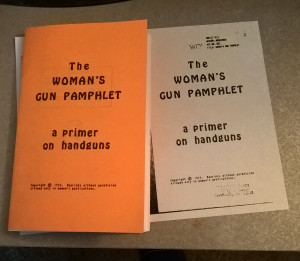
It’s a very interesting publication that was written and published by a colloquium of radical feminists in 1975. The intent was to provide information about both guns themselves and about personal protection attitudes to women of that era who knew nothing about guns or personal protection. As such, I consider it an historically significant document. There’s quite a bit of political rhetoric in it but also a goodly amount of information. Even dry practice is touched on. Some morsels of dry wit are quite entertaining.

Especially interesting to me is that it was written from the perspective of self-taught women of the time with some input from men and by doing primary…
View original post 239 more words
Door locks work
“This is the first year since I have been tracking that 100% of vehicle thefts occurred in unlocked vehicles. Not a single car window was broken to steal anything.”
I learned my lesson about this when I was 17 in Chicargo. It only took one occurrence for me to get the message. One response to Greg’s post on Facebook was:
In that 3 month period my next door neighbor had his UNLOCKED car broken into IIRC 4 times.
Locking your doors is part of what’s called Defense in Depth. Sure, some criminals could still get in but the harder you make it, the more of them will just go somewhere else.
And please don’t leave firearms in your car, either, even if it’s locked. Your car is not a holster, as Pat Rogers put it. If you sometimes have to go into places where you aren’t allowed to have your firearm on your person, get a lockbox or safe for your vehicle. The ‘truck gun’ concept is a load of Horse Hockey.
NRA Personal Protection Courses
Last weekend, I traveled to Florida to take the NRA Instructor Basics of Personal Protection Outside The Home Course (PPOTH). I was asked by several people why I would want this particular “Basic” Certification in light of my background and training experience. It’s simple,
I like training new shooters.
My colleague Grant Cunningham made a pertinent blog post about this shortly after I took the PPOTH Student Basic and Advanced Student Course. Experienced instructors often shy away from training the newest students. There has been a massive increase in people licensed to carry firearms over the past few years. In addition, several States have adopted Constitutional or Permitless Carry. That market base probably needs experienced trainers and coaches.
And I don’t feel the need to reinvent the wheel. It’s unfortunate that the NRA Training Department’s best marketing statement for its Personal Protection training is contained in the PPOTH Instructor manual. “The NRA Basic Personal Protection Series is based on the building-block approach, moving from the simple to the complex.” The most effective training courses I have taken over the past two decades have used a step by step approach to skill building.
The Training Department sees the progression of the courses for new gun owners interested in learning how to defend themselves and their loved ones as follows.
- NRA Basics of Pistol Shooting Course, the first course, develops the basic skills of handling, shooting, and cleaning the firearm, as well as a thorough grounding in firearm safety.
- NRA Basics of Personal Protection In The Home Course, the second course, teaches:
- the defensive or flash sight picture,
- firing single shots and/or aimed pairs from various shooting positions
- shooting using a center-of-mass hold,
- effectively using cover and concealment,
- employing point-shooting and multiple target engagement techniques.
- techniques for improving awareness and promoting mental preparation,
- methods of enhancing home safety without a firearm, and
- legal aspects of the use of deadly force in self-defense.
- NRA Basics of Personal Protection Outside The Home, the third course in the series, covers:
- Introduction to Concealed Carry Safety and The Defensive Mindset,
- Introduction to Self Defense and Concealed Carry,
- Legal Aspects of Concealed Cary and Self-Defense,
- Carry Modes and Handgun Concealment,
- Presenting the Handgun from Concealment, and
- Presentation, Position and Movement.
- Another offering in the series is the NRA Defensive Pistol Course. This is a shorter course than PPOTH. It teaches:
- How to apply the NRA Rules for Safe Gun Handling when carrying a concealed firearm,
- basic principles of concealment,
- drawing from a hip holster
- levels of mental awareness,
- developing the proper mindset when using a pistol for personal protection,
- flash sight picture
- reloading
- clearing common stoppages,
- shooting a qualification course,
- use of pocket pistols,
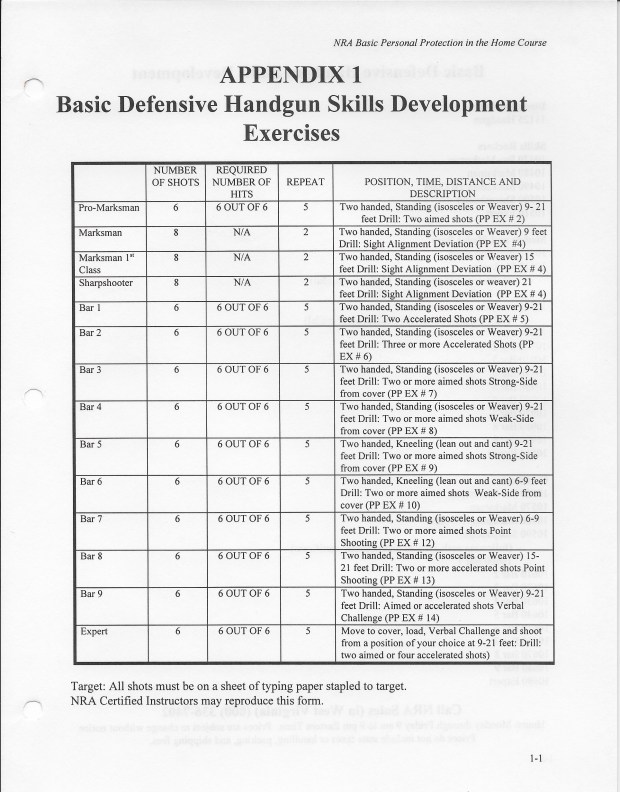
In addition to the Courses themselves, the Training Department provides additional Skill Development Exercises for NRA Instructors to use with students after PPITH and PPOTH.
And the NRA Marksmanship Qualification Program has even more exercises that interested shooters can use to increase their skills and earn awards from the NRA.
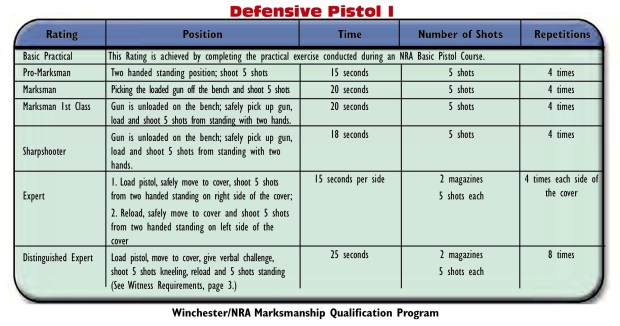
Looking at all the topics covered, that’s a really comprehensive training program. Those who are interested in a defensive firearm as more than a talisman to ward off evil can really get a lot out of such a “Basic” program.
There are a number of aspects of the NRA’s series that I really like. First of all, the classes are between 4 to 9 hours long. Because they’re constructed in modules, even the 9 hour classes don’t have to be conducted in a single day. Most people’s lives are quite busy and asking new shooters to take an entire weekend or even week of training is both difficult and sometimes counter-productive.
The NRA’s program is really the only one in the industry that is built around the student’s capabilities and time constraints rather than a trainer’s weekend convenience. Mea culpa; I’ve done both the traveling trainer and hosting trainer routines, so I’m as guilty of it as any of my colleagues. It’s something I want to try a different approach to.
There’s a place for both newer trainers and experienced trainers in the NRA’s Personal Protection Series. I’m very much looking forward to seeing how I can implement that.
Standards (Part V – Know the Rules)
Deputies: Homeowner arrested after fatally shooting intruder in shower
The man went inside and confronted another man he found in his shower, deputies said. The homeowner left after the two exchanged words.
‘He returned home, retrieved a firearm, came back over to the residence and fired multiple rounds into the shower … killing the intruder,’ said Mason County Sheriff’s Lt. Travis Adams.
The homeowner called 911 and told dispatchers that he had just shot and killed an intruder, Adams said.
It’s not clear how long [the intruder] had been inside the home, but detectives don’t believe the homeowner gave him any warnings before he fired his gun, they said.
Deputies later arrested the homeowner for second-degree murder. They believe he had ample time to call for help when he went back home.
The odds are that the shooter will spend a significant portion of the rest of his life in prison. This is a Negative Outcome. It’s a clear example of how foolish the “I’ll shoot anyone I find in my house” ideology is.
I’ll shoot anyone I find in my house.
—Bad idea
When I posted the link to the story on my Facebook page, one person replied that he SHOULD have been allowed to kill the intruder. My response was: “No, adjusting our response to the context of the situation is what keeps us from being savages.” Usually, it makes me cringe when news stories refer to someone being ‘gunned down’ but in this case, I think it would be appropriate. What the shooter did was a savage act of unnecessary lethal violence. It wasn’t motivated by fear for his safety or the safety of his loved ones; rather, it was a senseless expression of emotional outrage. We shoot people only when we have to not because we want to.
Another person commented that it was his property and the intruder had committed the offense of breaking and entering. The question was why wasn’t this a Castle Doctrine case. The Castle Doctrine is not an absolute defense. Reasonableness of your response will almost always be applied as a test of the response’s legality. Gunning someone down while they’re taking a shower isn’t likely to be viewed as ‘reasonable.’ As Massad Ayoob put it in the linked article:
Yes, your home is that castle. However, that doesn’t mean you’re allowed to install an execution chamber.
The number of people who own firearms or other deadly weapons and yet haven’t the slightest clue about the legal ramifications of their use is astounding. Know the Rules needs to be a standard of our conduct just as much as the physical ability to use the weapon. What you might think the rules are or should be is irrelevant. The actual rules are all that are important.
It used to be that reliable information about the legalities of personal protection was hard to come by. Not anymore. There are numerous readily available sources of information about the law. Without leaving the comfort of your home, several good sources are available.
- What Every Gun Owner Needs to Know About Self-Defense Law (free download)
- Deadly Force: Understanding Your Right to Self Defense
- The Law of Self Defense: The Indispensable Guide to the Armed Citizen
- Law Of Self Defense online course
For the lack of reading and understanding a book, the Washington shooter will pay dearly. His legal fees for the trial will most likely cost him everything he owns and he’ll still probably go to prison.
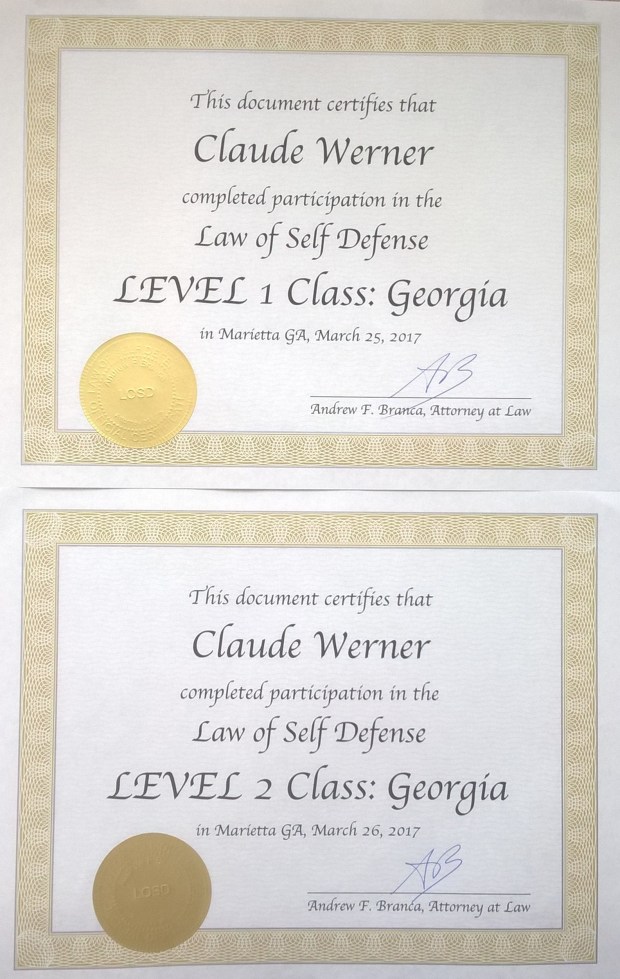
I recently attended the Law Of Self Defense Level I and II classes. They were an excellent legal education resource, tailored specifically to the State I live in, Georgia. The law does not necessarily make sense nor does it have anything to do with what you think it should be. The cost of such training is minor compared to the cost of a trial or even just being arrested on a charge that is later dropped. The optional simulator exercise at the end of the day was also a sobering demonstration of how poorly unpracticed people tend to shoot under stress. LOSD classes are available all over the country and are specifically tailored to the laws of the State they are given in.
A benefit of membership in the Armed Citizens’ Legal Defense Network is the training DVDs provided with membership. Once again, you can learn a great deal about the appropriate and inappropriate uses of forces without having to leave your living room.
Don’t guess, don’t listen to the foolishness you read on Internet Forums, and don’t make decisions based on what you think the rules SHOULD be. Invest at least a little of your resources and find out what the rules really are. It’s true that most situations are fairly cut and dried and work out legally for the defender. The issue is that when things go bad, they tend to go really badly. The rest of your life can easily be at stake. Very few of us would look forward to spending decades in the can (prison) without a Man Lock by McGard.

Perhaps the most unintentionally funny advertisement ever.
Also, if you’ve taken a State CCW class, the one hour briefing when your eyes glazed over doesn’t count as any kind of meaningful legal education. Don’t confuse that with education that actually teaches you how to apply the law to your personal situation.
Fair disclaimer: I was a guest of LOSD for the classes and didn’t have to pay for them. However, no promotional consideration for my recommendation was offered nor accepted by me.
Endnote: The intruder in Washington was probably a confused drunk. That’s not going to go over well for the shooter, either.
Indoor Range Flashlight Practice Session
Someone who purchased Indoor Range Practice Sessions noticed a discrepancy in Session 11 (shooting with a flashlight).
I’ve updated the downloadable eBook for future purchases, but I want existing customers to have the update also. Accordingly, I created a downloadable file with Session 11 only.
As most of my readers know, using a flashlight to avoid tragedies is one of my hot buttons. It’s important enough information that I am going to make the updated Session 11 only available as a free download to all my blog followers, as well as previous purchasers.
The link to the updated Session 11 is here: Session 11 – Shooting with a flashlight
The Woman’s Gun Pamphlet
Through an oblique reference, I recently found a link to The Woman’s Gun Pamphlet. Edit: The link and the server appear to be gone. A PDF of the Pamphlet is available at the edit of this post.
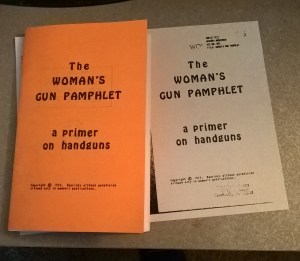
It’s a very interesting publication that was written and published by a colloquium of radical feminists in 1975. The intent was to provide information about both guns themselves and about personal protection attitudes to women of that era who knew nothing about guns or personal protection. As such, I consider it an historically significant document. There’s quite a bit of political rhetoric in it but also a goodly amount of information. Even dry practice is touched on. Some morsels of dry wit are quite entertaining.
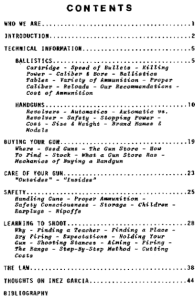
Especially interesting to me is that it was written from the perspective of self-taught women of the time with some input from men and by doing primary and secondary research. What they considered important, how the information was structured, and how it was presented is insightful. There are a number of items in it that made me realize there are areas of my subject matter knowledge I take for granted.
Given this week’s confrontation between the Federal government and a quasi Posse Comitatus group in Oregon, I also found the political views and fears presented in a 1975 publication to be notable. When I graduated high school in 1972, I doubted I would be able to own a handgun, much less carry one in the majority of States, even slightly into the future at that time. The recent shenanigans regarding Weapons Carry reciprocity in Virginia by its anti-gun Governor and his lackey Attorney General echo items in the Pamphlet. The attitudes and tactics of hoplophobes and political control freaks have changed little in the past 50 years. A common one is ‘take something away, then give it back in exchange for something else.’ The saying ‘One step forward, two steps back’ comes to mind. Gun controllists play the long game, just like Mao Zedong, and never view their playbook as a zero sum game.
The Pamphlet took me a little over an hour to read cover to cover, so it’s not heavy reading. Anyone who teaches, either formally or informally, women or Gun Culture 2.0 will find it worthwhile reading.
Friday Fundamentals (Segment 4) Shooting with a flashlight
Several Negative Outcomes were brought to my attention this week. One was yet another incident of someone shooting their spouse, thinking it was a burglar. She died as a result of one shot to the chest.
The husband told police it was an accident. He told officers he woke up around 4:15 Saturday morning and heard noises in his house … He told investigators he grabbed his gun and when he saw a light on and someone standing in the distance, he took a shot. He said the person he ended up hitting once in the chest was his wife.
This sad situation bolsters my contention that when we pick up a pistol at home, we have to pick up a flashlight at the same time. That’s why I made flashlight shooting an integral part of The Tactical Professor’s Pistol Practice Program. To get some repetitions in and reinforce the habit for myself, I went to the range this week and shot the entire NRA Defensive Pistol I marksmanship program using a flashlight.
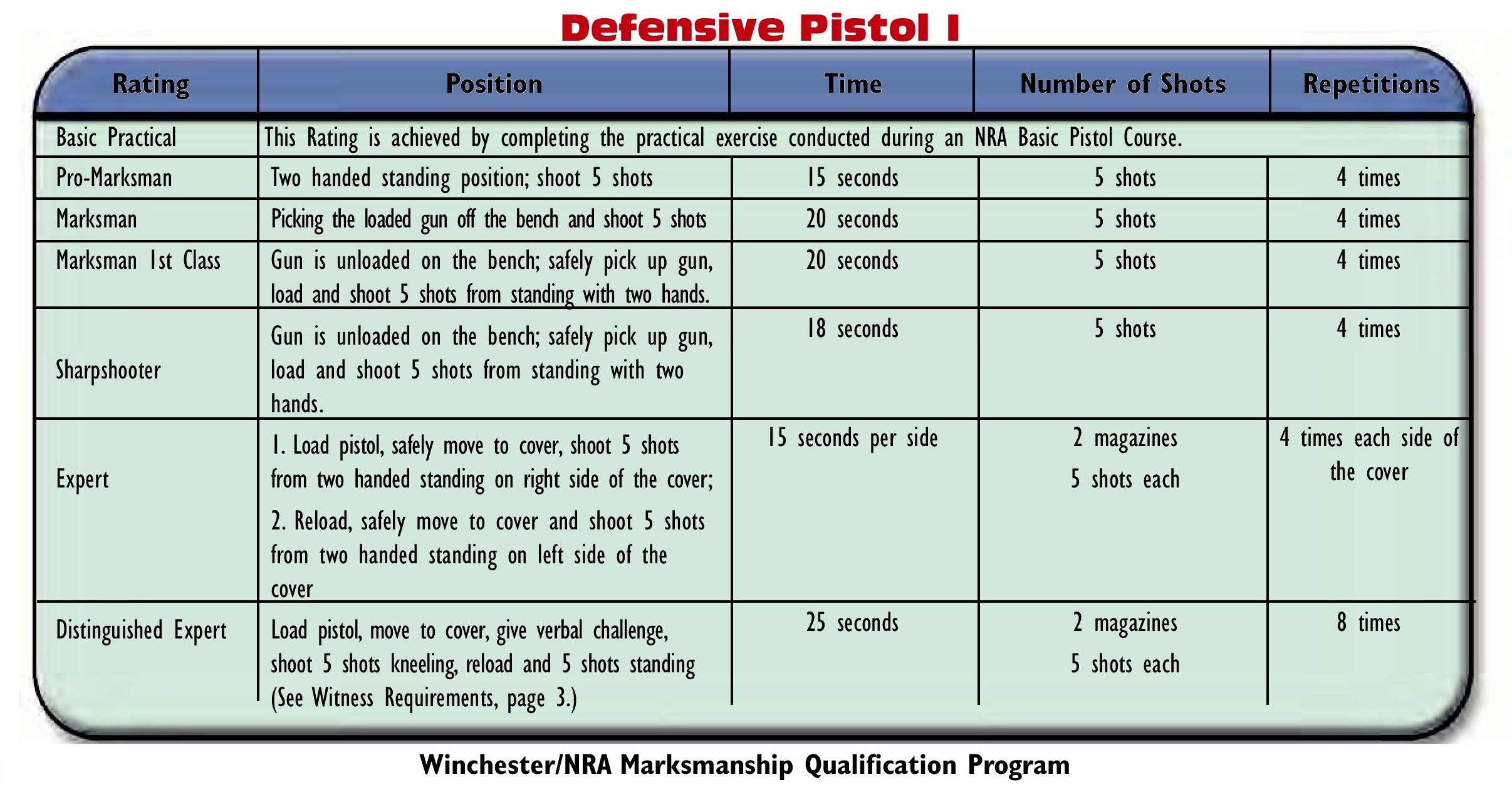 As a curiosity, I also used a timer instead of going by the PAR times in the program. The pistol I used was a Beretta Jaguar in .22 Long Rifle. Many in the industry poo-poo the .22 as a defensive tool but .22s have worked for me. An aspect of .22s I like in the practice context is that shooting several hundred rounds in one session isn’t punishing, either physically or financially. I shot it at my gun club but the way Defensive Pistol I is structured, it can be shot at just about any indoor range. That’s an aspect of the program I really like.
What I did was to have my pistol, my flashlight, and the timer on a stool in front of me. The target was downrange at the specified seven yards.
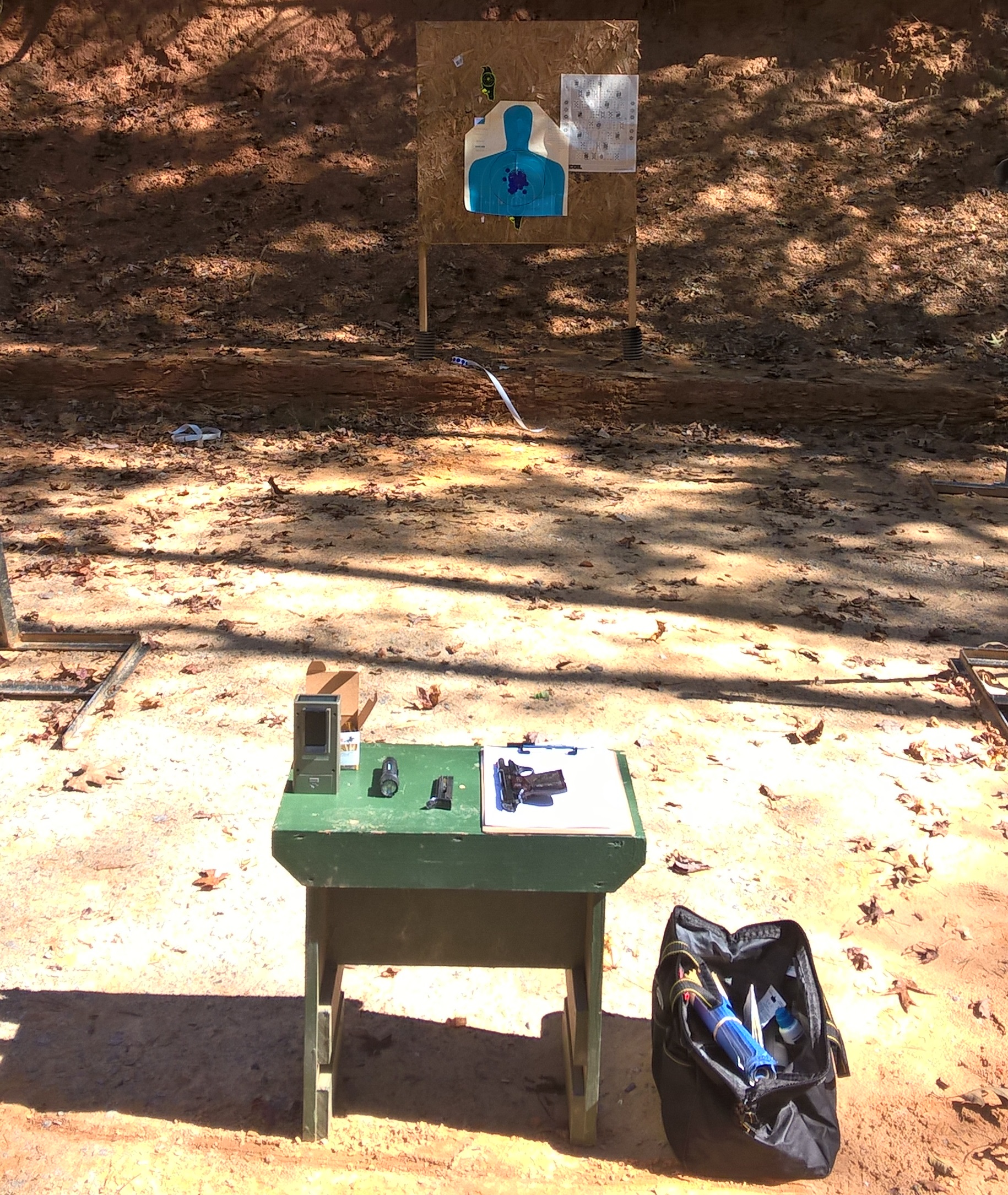 The target was a B-27 with the NRA AP-1 8 ring and X ring marked on it with a template.
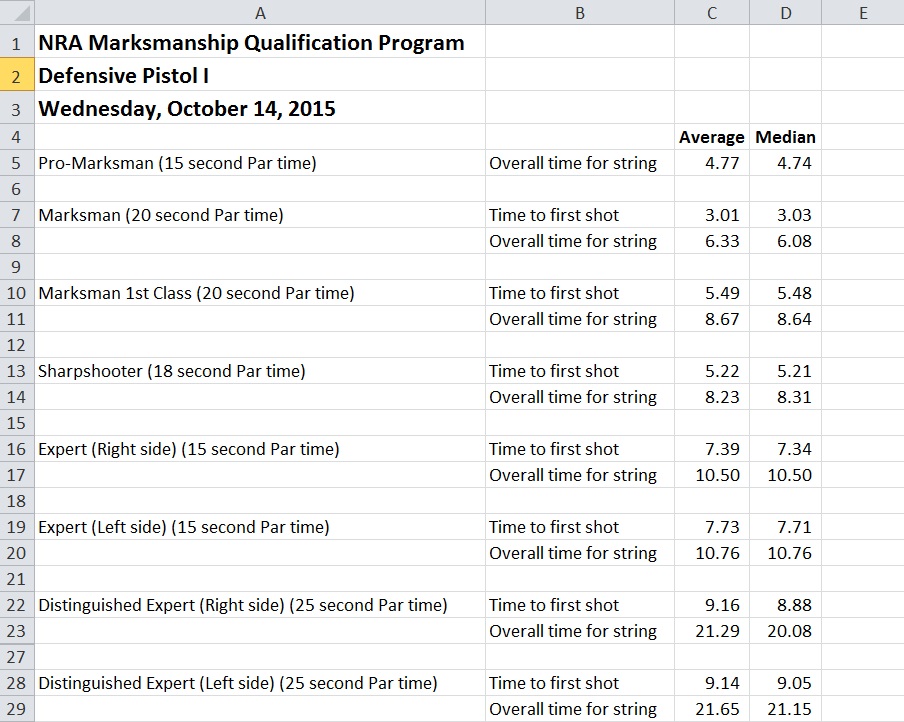
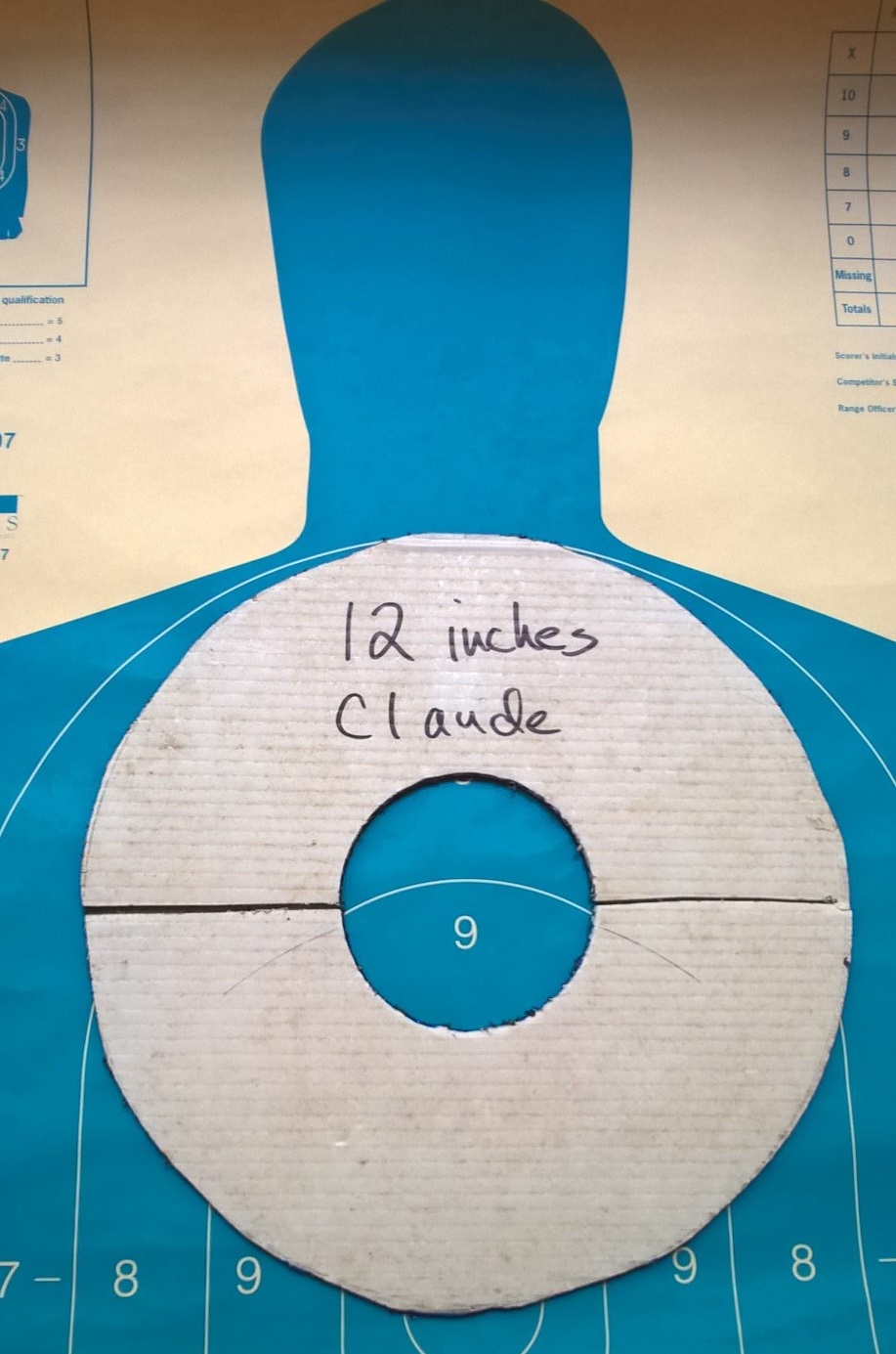 When the timer went off, I would pick up my pistol and flashlight simultaneously, assume the cheek position, and then shoot the specified string of fire. For the phases requiring loading the pistol on the clock, I picked up the pistol and magazine, loaded it, and then picked up the flashlight. After each string, I recorded my times. The NRA provides a scoresheet but it is set up for Pass/fail scoring, so I made my own scoring matrix.
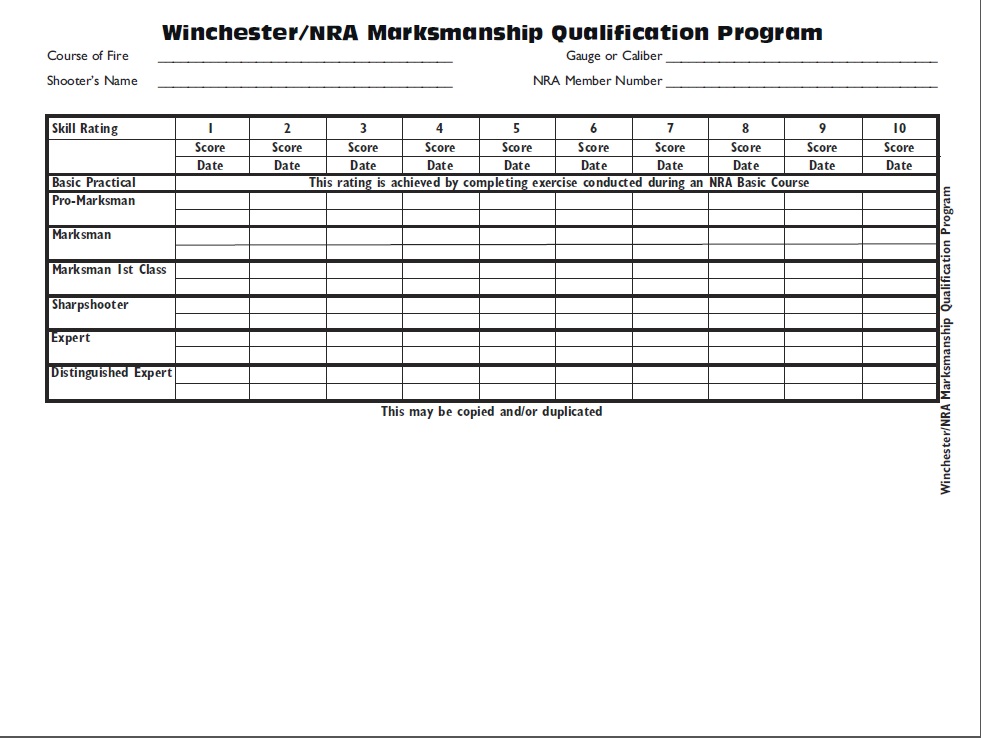 I checked the target after each string to make sure that I had the required 100 percent hits. At the end of each phase; Pro-Marksman, Marksman, etc., I marked the target with blue dots to cover my hits.
For most of the program, I used the cheek technique.
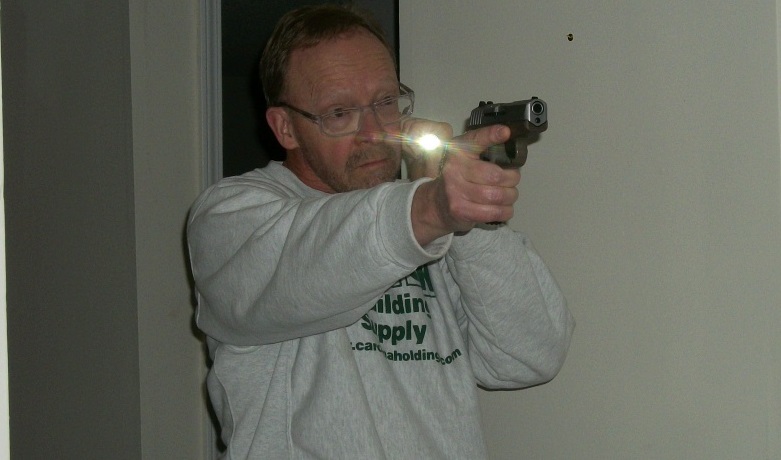 The Expert and Distinguished Expert phases require shooting from behind cover. There weren’t any barricades readily available so I used the dueling tree in the bay to simulate cover.
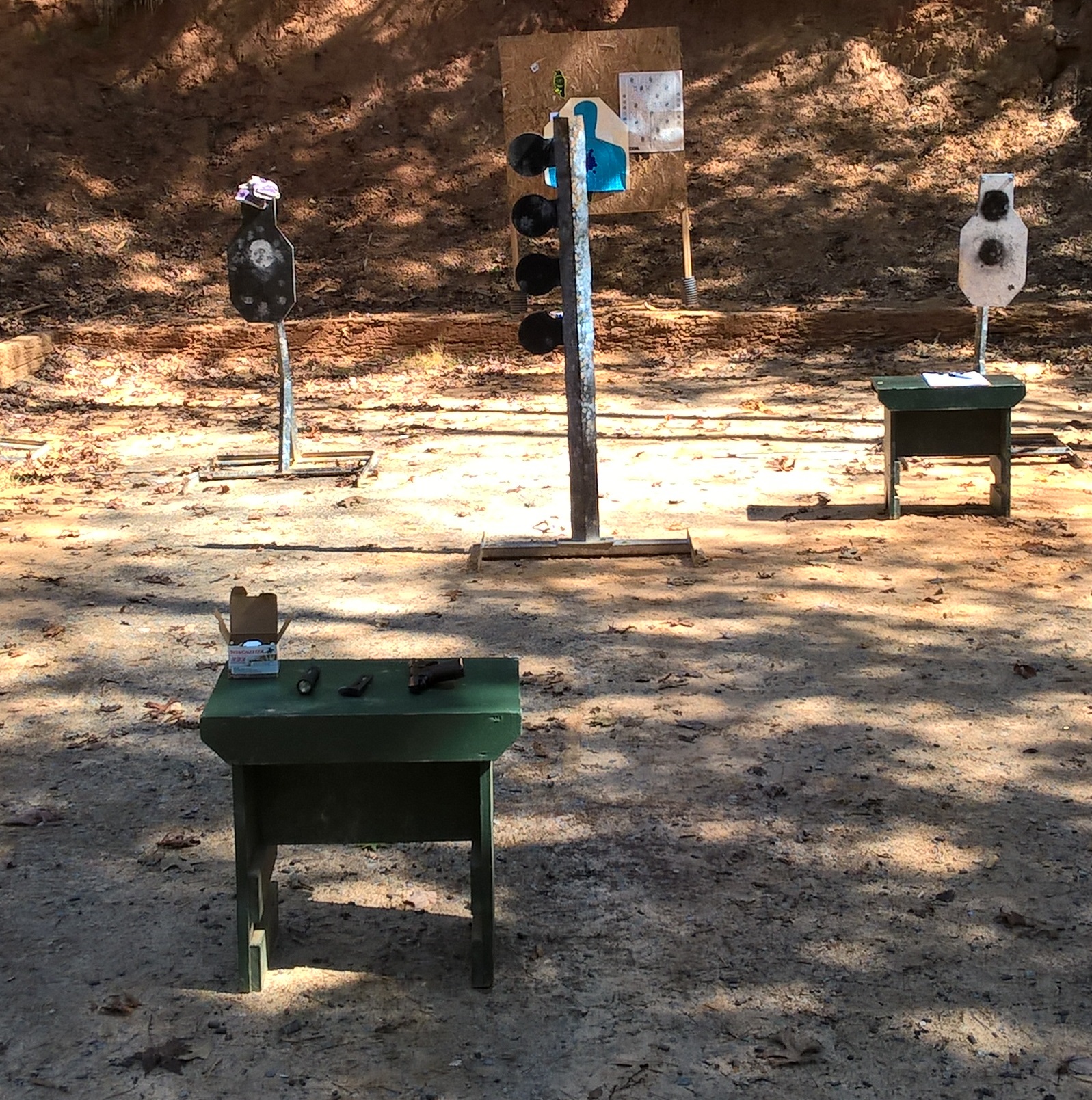 The Expert phase requires shooting around both sides of the cover. When shooting around the left side, I continued to use the cheek technique. When shooting around the right side, I used the Harries technique.
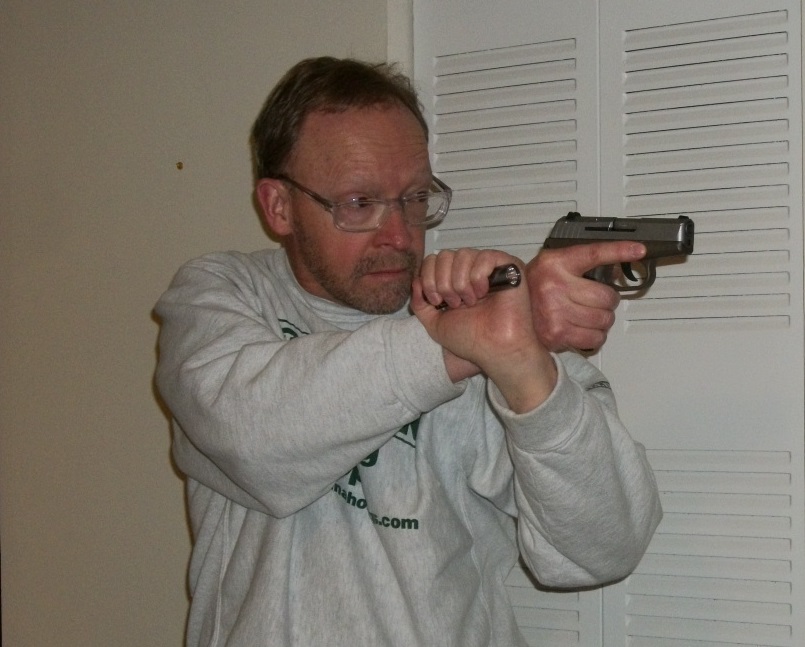 The Distinguished Expert phase doesn’t specify shooting around both sides of the cover. However, it does requires eight runs instead of four, so I shot four around the right side and four around the left side.
I was able to maintain the 100 percent standard and got a good idea of my times to accomplish each Phase.
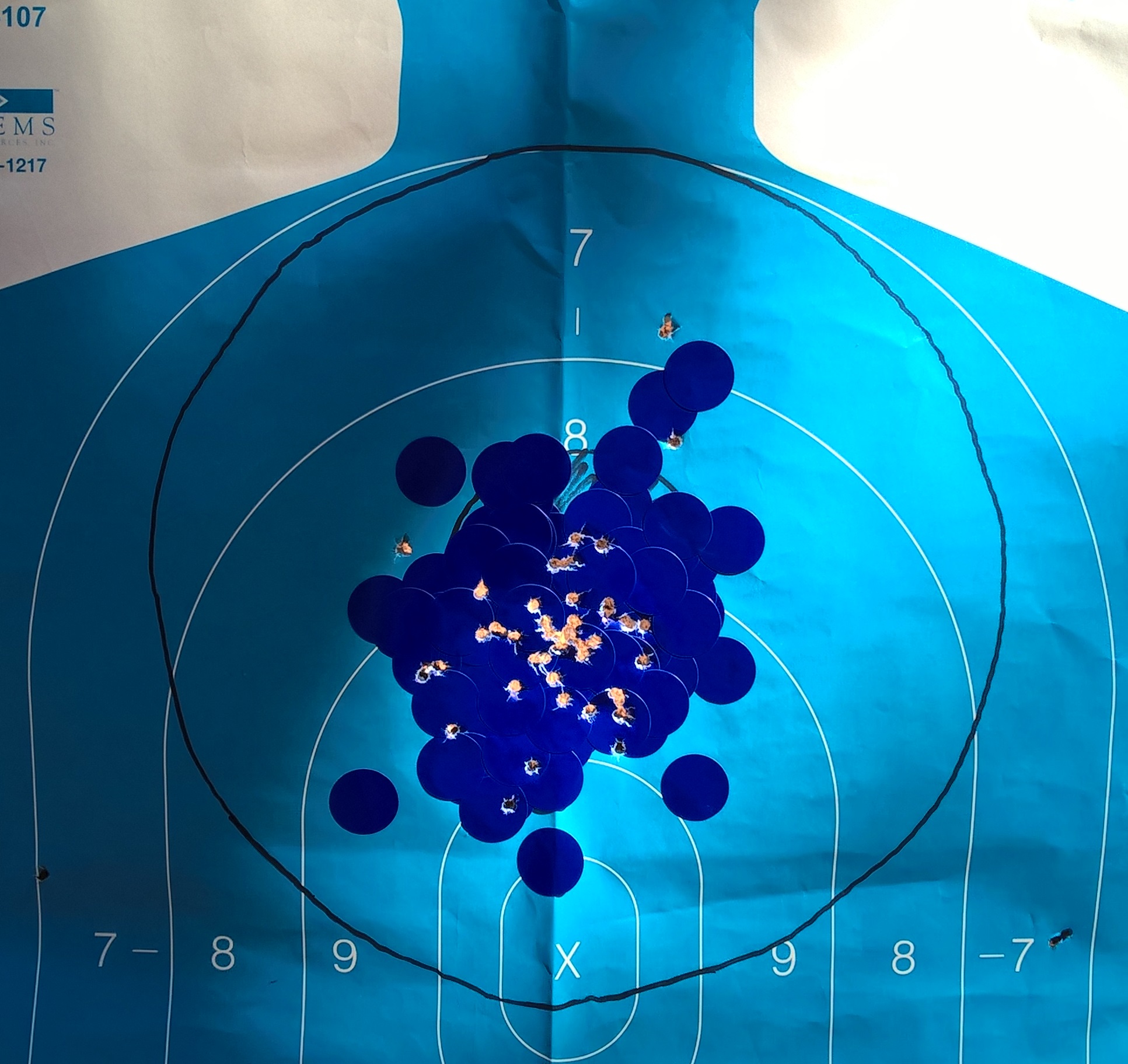
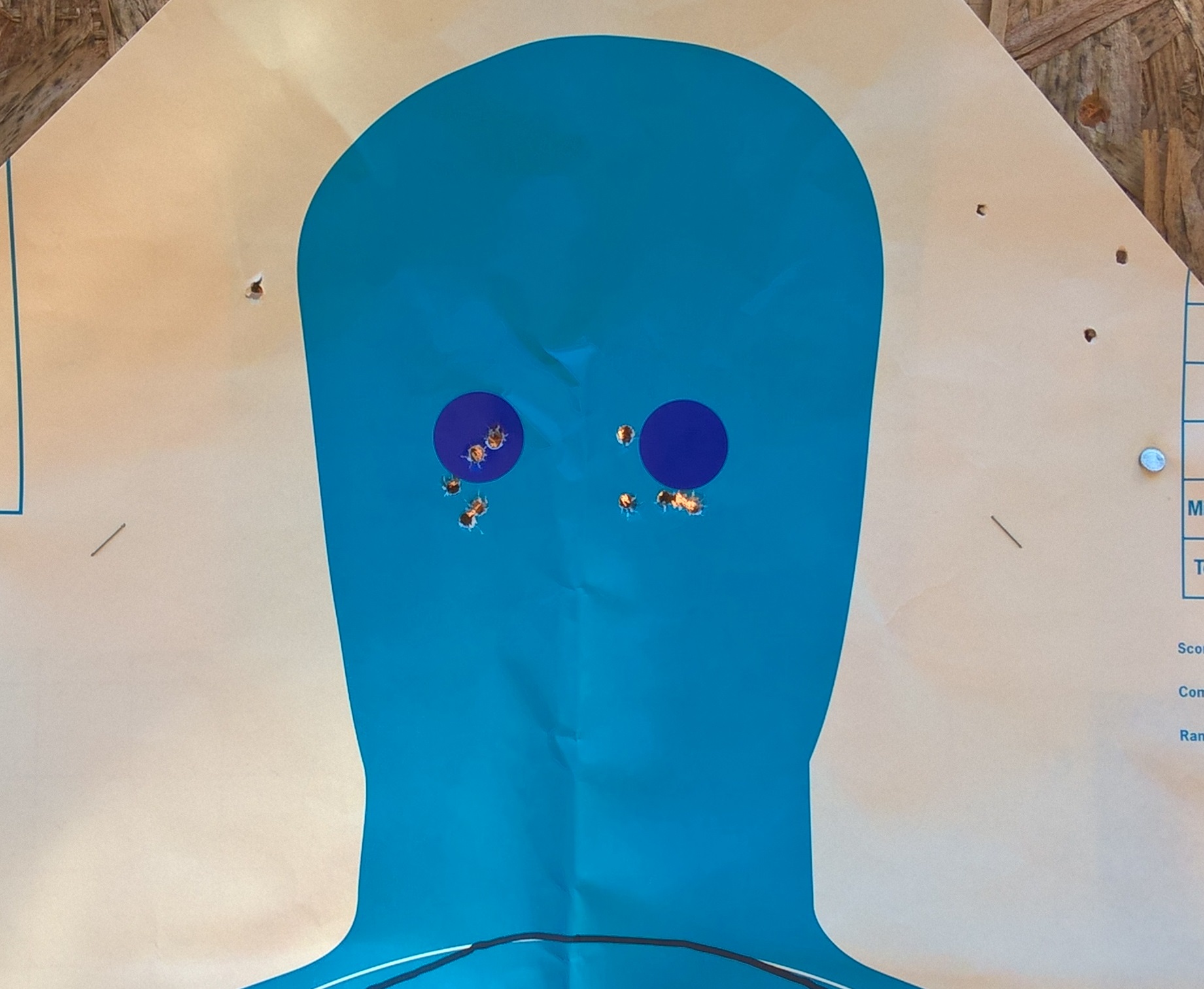
 To finish off the day, I used the dots to create some eyes on the target. Then I shot a couple of groups at five yards.
 Getting in relevant practice isn’t necessarily hard; it just requires a little creativity and forethought.
Why many Americans insist on owning weapons
A friend posted a comment on his Facebook page about police response policies and times today. His post related to the hypocrisy of politicians who are protected by armed guards around the clock but desire to have the populace disarmed and at the mercy of the criminal element.
In the wake of the Umpqua Community College and Northern Arizona University shootings, there have been renewed calls by Mr. Obama for increased gun control, along with other politicians. The implication of these calls is that law enforcement authorities are always available to protect the citizenry at a moment’s notice. If the government will not allow the citizenry to protect itself, as is now the case in Lesser Britain, then that responsibility must fall to the organized government. A frequently validated saying in the Army is
If no one in particular is responsible for something, then no one is responsible for it at all.
There are several problems with making the government responsible for our safety in the United States, two in particular.
First, the Supreme Court ruled in 1989 and again in 2005 that the government does not have the duty to protect us as individuals. Government in general, and the police in particular, only have the duty to preserve a general sense of order in the US. Only society at large is owed a duty of protection.
Second, there are practical considerations. The following was how I responded to my friend’s post:
I have a recording of an actual 911 call by a woman whose home is broken into while she is on the phone with 911. It is not fiction and was used as an exemplar in 911 dispatcher training.
The dispatcher is shocked into silence by the events, which allows hearing the gruesome sounds and screams as the woman is murdered. It is 2 minutes and 51 seconds long from the time she calls when he is outside until the murderer calmly hangs up the phone after the woman is dead. She is screaming “Who are you?” and has no idea of her attacker’s identity. To my knowledge, the murderer has never been identified, much less caught and brought to justice.
The recording is so horrible and shocking that I am very judicious about whom I play it for. I have listened to it many times and it still turns my stomach every time I hear it.
It’s not the only such macabre recording like that in my collection. They range in length from 1 minute 1 second to 3 minutes 3 seconds.
Every scumbag politician, including police chiefs who serve as mouthpieces for their political masters, should be required to play it at the conclusion of their spiels about how they will protect us and a five to eleven minute response time is plenty. It would be the end of that [you know what].
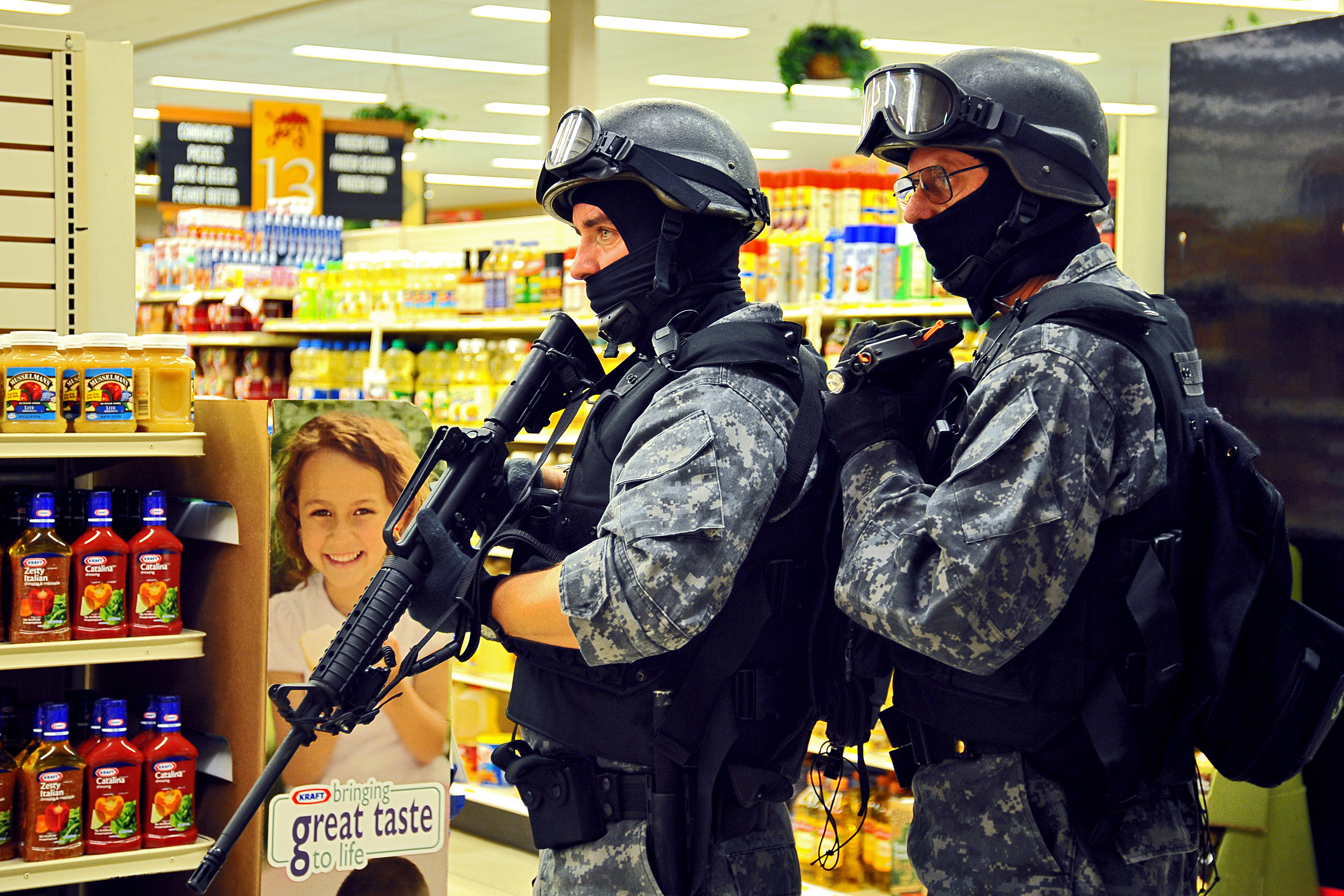
090928-N-1783P-005
(U.S. Navy photo by Machinist’s Mate 3rd Class Juan Pinalez/Released)
 tacticalprofessor
You must be logged in to post a comment.