What snubs can do
#Smith&WessonSunday
I shot the I’m With Roscoe 2019 Internet Match Friday at a local indoor range. The Match is modeled on the Pocket Revolver Championship of the US Revolver Association, as described in the 1915 edition of the book Pistol and Revolver Shooting by A.L.A. Himmelwright. This Match is an Internet enabled version of Postal Matches that were commonly shot in the 20th Century. The Course of Fire is five strings of five shots each at 50 feet. The time limit for each string is 30 seconds and the shooting is done Primary (Strong) Hand Only.
To time it, I used the Dry Fire Par Timer app, available on Google Play, on my phone with ear buds underneath my muffs. That’s a very workable setup for indoor range work.

The outer 4 Ring of the target measures 7 5/16 inches in diameter. Only two shots went outside the 4 ring, so that’s 23 hits in the largest circle out of 25 shots. I think Inspector Erskine would be satisfied with that.
There’s a common misconception that snubs are “arm’s length guns.” As I periodically remind people, that’s only true for the incompetent. Dry practice can go a long way toward improving our skills.
Tactical Professor books (all PDF)
Serious Mistakes Gunowners Make http://seriousgunownermistakes.com
Indoor Range Practice Sessions http://indoorrangepracticesessions.com
Concealed Carry Skills and Drills http://concealedcarryskillsanddrills.com
Advanced Pistol Practice http://bit.ly/advancedpistolpractice
Shooting Your Black Rifle http://shootingyourblackrifle.com
S&W Revolver Frame Sizes (part II)
#Smith&WessonSunday
Broadly speaking, Smith & Wesson swing out cylinder (Hand Ejector) revolvers come in nine frame sizes. In order of increasing size, they are: M, I, Improved I, J, J Magnum, K, L, N, and X frame.
Perceiving a market for a more powerful pocket sized revolver, S&W introduced the J Magnum frame in 1995. It was created to accommodate the length of the .357 Magnum cartridge in a J frame revolver, having a longer cylinder and larger frame opening. This frame was first introduced as the Model 640-1 in 1995. Since then, other J frames, even .38 Specials, have been offered in this frame size. In 1996, the Model 60 (60-9) and 642 (642-1) were changed to the J Magnum sized frame.
The K frame was the original .38 caliber Hand Ejector frame introduced in 1899 as the Military & Police 1st Model. It served as the service revolver for the US Army in .38 Long Colt caliber until the adoption of the Colt 1911 autoloading pistol. The K frame was the most widely used and issued POlice revolver for nearly a century. The US Air Force continued to issue K frame revolvers to its Security POlice until almost the end of the 20th Century. It has been produced in a wide variety of calibers from .22 Long Rifle up to .357 Magnum but .38 S&W Special was the most popular.
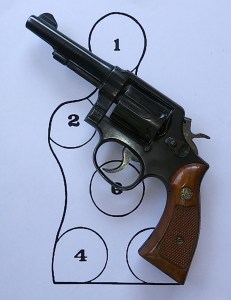
Model 10-5 (K frame) on reduced Langrish Limbless target from the 1930s
Bill Jordan, of the US Border Patrol, convinced S&W to make the K frame size revolver in the .357 Magnum cartridge for POlice service. The .357 had only been produced in N frame revolvers until 1955. His original idea was to practice with .38 Special and only occasionally use .357s. As people started shooting .357 Magnums in quantity, they found that it was hard on a K frame. This led to the introduction of the L frame, which along with the other larger frame sizes will be covered in the next installment.
Tactical Professor books
Indoor Range Practice Sessions http://indoorrangepracticesessions.com
Concealed Carry Skills and Drills http://concealedcarryskillsanddrills.com
Advanced Pistol Practice http://bit.ly/advancedpistolpractice
Shooting Your Black Rifle http://shootingyourblackrifle.com
Serious Mistakes Gunowners Make http://seriousgunownermistakes.com
Part I of the series
https://tacticalprofessor.wordpress.com/2019/09/08/sw-revolver-frame-sizes-part-i/
DRY PRACTICE WITH REVOLVERS
#Fridayfundamentals
I am really enjoying getting back into the habit of structured dry practice. Revolvers are great tools for dry practice, in some ways better than autoloading pistols.
This month, I am serving as the Match Director for the I’m With Roscoe http://imwithroscoe.com 2019 Internet Match. It’s based on the Pocket Revolver Championship of the US Revolver Association. The Championship, along with the other USRA Championships, is described in A.L.A. Himmelwright’s 1915 book Pistol and Revolver Shooting. https://www.amazon.com/Pistol-Revolver-Shooting-L-Himmelwright-ebook/dp/B00AQM9SK0
The course of fire is quite demanding. Originally, it consisted of five strings of five shots in 30 seconds at 50 yards on the original NRA B-6 bullseye target. It is shot one-handed. Since not many people have access to a 50 yard range, I changed it to using an NRA B-2 target at 50 feet. The B-2 is the 50 foot reduction of the B-6 so this was an easy change. Official Rules are available on the IWR Facebook page. https://www.facebook.com/groups/370742620287566/
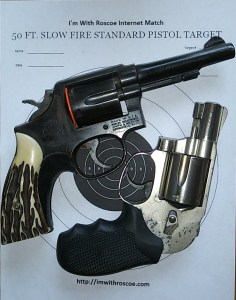
Since it is a demanding course of fire, I’ve been doing dry practice for when I have the opportunity to shoot it live. My preparation is to work on the fundamentals. I practice with two revolvers each day, my pencil barrel Model 10 and my Model 38-2 J frame.
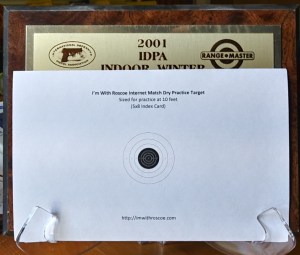
I created a reduced size target for dry practice, scaled for use at 10 feet. It is printed on a 5×8 index card. The target is stored behind a plaque for safety reasons. I take it out and position it when I start the session. Immediately after finishing the session, I conceal the target back behind the plaque prior to reloading my gun.
Since they’re both older guns, I protect their firing pins (hammer noses). For the K frame, I’m using a piece of plastic that fills in the rear of the cylinder. It was manufactured years ago by a gunsmith in New Jersey, long since out of business. The plastic has proven remarkably durable though. For the 38-2, I’m using ST Action Pro Dummy Rounds that I filled the primer pocket in with hot melt glue.
For a timer, I use the Dry Fire Practice Par Timer, from the Google App store, on my phone. It’s set to give me five strings of 30 seconds each with a six second delay between strings. At the beep, I snap five times single action. My actual times are working out to about 25-26 seconds per string. This allows some leeway to accommodate recoil management when I live fire. I rest briefly between the strings.
What I am concentrating on when snapping is minimizing my wobble zone, pressing the trigger smoothly, and following through. These are especially important when shooting one handed. The follow-through is the aspect I have to personally work hardest on. Of those three fundamentals, follow-through is the hardest to learn in live fire so the dry practice is doing me a great deal of good.
It’s been good getting back into daily dry practice. I include dry practice in my shooting workbooks for a reason; it works. If you would like to try your hand at it, this is the reduced scale target. IWR Internet Match dry practice target 5×8 10 feet
Tactical Professor books
Indoor Range Practice Sessions http://indoorrangepracticesessions.com
Concealed Carry Skills and Drills http://concealedcarryskillsanddrills.com
Advanced Pistol Practice http://bit.ly/advancedpistolpractice
Shooting Your Black Rifle http://shootingyourblackrifle.com/
Serious Mistakes Gunowners Make http://seriousgunownermistakes.com
S&W Revolver Frame Sizes (part I)
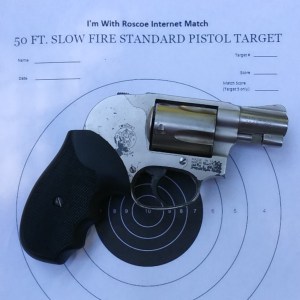
#Smith&WessonSunday
First in an ongoing series. This series owes much to the Standard Catalog of Smith & Wesson. The book is a valuable resource for anyone interested in S&W products and especially the revolvers.
Broadly speaking, Smith & Wesson swing out cylinder (Hand Ejector) revolvers come in nine frame sizes. In order of increasing size, they are: M, I, Improved I, J, J Magnum, K, L, N, and X frame. The factory uses a separate system for lettering stainless steel frames but they are seldom used outside the factory so will not be used here. The most commonly encountered frame sizes today are the J and J Magnum. In the 20th Century, the K frame in various permutations became the dominant POlice revolver in the USA and many people can recognize it on sight. Prior to 1957, their revolvers were named. In 1957, the firm switched to a numbering system that is still in use today.
In the named models, evolutions of a particular model were referred to as 2nd Model, 3rd Model, etc. or 1st Change, 2nd Change, etc. Numbered models have the model number stamped on the frame inside the yoke. In the numbered models, a dash and numeral following the model number is part of the model designation, e.g., 38-2.
The M frame, the original Ladysmith, is a truly tiny revolver that was in production only until 1921. It was made in .22 Long (not Long Rifle) caliber and weighed 9.5 ounces. There is a rumor that it was discontinued because it was a favorite weapon of Ladies of the evening but this is unlikely. An enterprising manufacturer could probably reproduce this revolver with a dual firing pin of the sort used in the original Henry rimfire rifle and enjoy brisk sales.
The I frame was the original S&W swing out frame sized for the .32 caliber cartridge. The I frame was the first S&W revolver with a swing out cylinder; it was introduced in 1896 and became the first Hand Ejector purchased by a US POlice department, Jersey City, New Jersey. They were referred to as ‘Hand Ejectors’ because previous S&W revolvers were top breaks and ejected the cases automatically. Swing out cylinder revolvers require the user to manually eject the cases by pushing on the ejector rod, hence the name Hand Ejector.
Improved I frames have a very slightly larger frame opening than the I frame. The most noticeable feature of the Improved I frame was an engineering change from using a leaf type mainspring to a coil mainspring. The Improved I can be easily distinguished from the I because the Improved I lacks a screw (strain screw) at the bottom of the grip frame. Both the I and Improved I frame openings are too small for the .38 Special cartridge.
S&W developed the J frame in order to allow the use of the .38 Special in a revolver significantly smaller than the K frame, which had been in service for many years. The J frame continued the use of the coil mainspring of the Improved I frame but has an increased frame opening of 1.645 inches compared to the 1.515 frame opening of the Improved I frame.
The larger frame sizes will be covered in the next installment.
Tactical Professor books available for download.
Indoor Range Practice Sessions downloadable eBook. http://indoorrangepracticesessions.com
Concealed Carry Skills and Drills downloadable eBook. http://concealedcarryskillsanddrills.com
Advanced Pistol Practice http://store.payloadz.com/go?id=2613612
Shooting Your Black Rifle http://shootingyourblackrifle.com/
Serious Mistakes Gunowners Make http://seriousgunownermistakes.com
Note that all Tactical Professor eBooks can easily be automatically converted for your Kindle. https://www.amazon.com/gp/sendtokindle/email
Getting more out of your Snub’s Sights
#wheelgunwednesday
If you can’t see the sights on your snub, you can’t use them. While there are some ways gunsmiths can put better sights on a snub, careful application of paint and perhaps Magic Marker can go a long way to improving your ability to see the sights. Most snubs’ sights are not of a color to contrast against the target. The lack of contrast makes it difficult to pick up a quick visual reference. Fire trucks and school buses aren’t painted blue or silver for a reason. Silver generates glare easily and blue doesn’t contrast against a dark target nor in limited visibility.
Colored nail polish or paint is an old trick to increase the visibility of the front sight. If you paint the sight first with white paint as an undercoating, the color will stand out much better. Degrease the sight before applying paint to ensure the paint sticks. Let the white paint cure completely and then apply the color paint over the white.
Revolvers are passé
At least to the general public…
The 2017 BATF production statistics, Annual Firearms Manufacturing and Export Report (AFMER), https://www.atf.gov/file/133476/download have been released. There are some interesting facts about market trends in it. The snub nose .38, which was a long time standard for Personal Protection, has clearly been replaced in popularity by compact .380 ACP autoloaders. This continues a trend that has been building for a decade.
All manufacturers
Total .38 revolver – 177,956
Total .380 autoloader – 848,425
One and two shot presentations
#wheelgunwednesday

Nevada Concealed Firearm Permit Qualification fired with 1 and 2 shot strings
Becoming reasonably skilled with a handgun isn’t always a fun process. A lot of it is simply repetition of basic techniques until we have achieved automaticity, which is frequently and incorrectly referred to as ‘muscle memory.’
The reason most POlice and CCW qualification courses consist of high round count strings is simply to get the testing over with as quickly as possible. The underlying object is to facilitate the evaluation process, not to ‘train’ the shooter. When we’re practicing on our own, ‘getting it over with’ doesn’t have to be our primary concern, nor should it be.
When we’re practicing for skill development, almost all of our time should be spent firing one or two shots at a time. For competitive shooters, using Bill Drills to practice recoil management does have value. For purposes of personal protection, however, the reality is that learning to put the first shot on target every single time has a lot more value.
When learning to shoot at distance, single shot drills are almost mandatory.

15 yards, 1 shot per presentation from Low Ready
As a refresher, here are some links to previous articles about aspects of learning to shoot well.
Press the trigger smoothly
Too quick on the trigger?
Consistency
Comparative Standards
Most of the drills in my eBooks are three shots or less. They’re workbooks, which implies to use them, you have to do some work. Work is not always fun. Sorry, that’s just adult life. It doesn’t mean you can’t have fun shooting but rather that learning to shoot well isn’t always a fun process.
For those who carry a concealed firearm, Concealed Carry Skills and Drills, is appropriate for you. The link to the downloadable eBook is here. http://concealedcarryskillsanddrills.com
For those who don’t carry a concealed firearm but keep a handgun for home defense, Indoor Range Practice Sessions, is appropriate for you. The link to the downloadable eBook is here. http://indoorrangepracticesessions.com
My downloadable recording, Serious Mistakes Gunowners Make, http://seriousgunownermistakes.com is particularly appropriate when analyzing incidents, not necessarily Defensive Gun Uses, involving firearms.
Revolver practice
Question from a reader:
I bought your ebook/pdf “Concealed skills and Drills”. I like the book a lot and am working my way through it.
I have a couple of questions about the drills which feature a magazine to simulate a dryfire trigger press. I am a revolver user and I am using the cylinder spin method from your PDN dvd. It seems to me that that should work as well or am I missing something?
Answer:
The cylinder spin method is ideal and that’s what I use. I had to come up with a solution for the autoloaders because they can’t do this type of exercise as well as wheelguns. Keep doing what you’re doing.
Repetition and Progression (Part 2)
#fridayfundamentals
The most important Fundamental of all is to be sure your gun works. A recently purchased used revolver seemed okay in most aspects except the cylinder lockup had a hitch. Upon actually shooting it, it worked fine for the first 10 rounds. After that, the trigger could not be pulled with the cylinder closed. As I suspected, something was wrong with the center pin spring and the center pin would not push the bolt into position when the cylinder closed. Moving the bolt into position before it will fire is fundamental to double action revolver design.
Upon examining it later, there was no center pin spring, hence the issue. Someone had obviously messed with it because the extractor rod came free quite easily. Fortunately, the sear/bolt spring for a S&W fit adequately and fixed the problem.
As my colleague, the late Paul Gomez, was fond of saying, “Shoot Yor ….. Guns.”
After repairing it, I used it for another form of progression in practice, increasing distance incrementally. Starting out at a close distance, marking your target after each string, and then increasing the distance gives you an indication of where your strengths and weakness lie. Knowing them gives you an idea of what to practice next.
Running the Snub – Recoil Management
First in a series about ‘Running the Snub.’
In a discussion of revolver reloading techniques on my 1000 Days of Dryfire Facebook group, I posted a video of myself shooting the Alabama State IDPA Championship with a snub revolver.
The video generated the following question, which I think is worth some discussion and explanation.
Claude, I watched your video, and to me, you display amazing recoil management – the gun hardly moves. I was under the impression that snubbies are especially hard to shoot and control, particularly in this skill area. Can you share what you are doing to control recoil so well? Maybe details on how you grip the gun, and what kind of load you are firing?
Let’s deal with the simple questions first. I was shooting a two inch K frame at the Championship, which weighs almost twice what an Airweight J Frame does. That has some effect on the recoil management. The load I was using was my IDPA handload, which is ballistically equivalent to 158 grain Round Nose Lead standard pressure. I prefer not to use lead bullets so my load used a plated bullet.
The next issue to deal with is “snubbies are especially hard to shoot and control.” That’s been ‘common knowledge’ among the shooting community for as long as I can remember but how true is it? Like many other aspects of ‘common knowledge’ among gun industry common taters, I’m skeptical about that. So, I decided to do a little more Comparative Testing.
The test I chose was 5^4 (5 rounds in no more than 5 seconds at 5 yards into a 5 inch or less group). The 5^4 protocol was originally developed by Gila Hayes of the Armed Citizens’ Legal Defense Network for her book, Effective Defense: The Woman, the Plan, the Gun and subsequent later editions. .
 tacticalprofessor
You must be logged in to post a comment.