TacCon 2021 Match
The Rangemaster 2021 Tactical Conference is in the books. A small part of the Conference is the shooting match. Of the over 200 attendees, 161 elected to shoot the match. I didn’t bring a gun because of my flight situation, so I borrowed a 642 from a friend and shot with it. Only three of us shot with revolvers.
All shooters have the opportunity to shoot the first two parts of the Course of Fire.
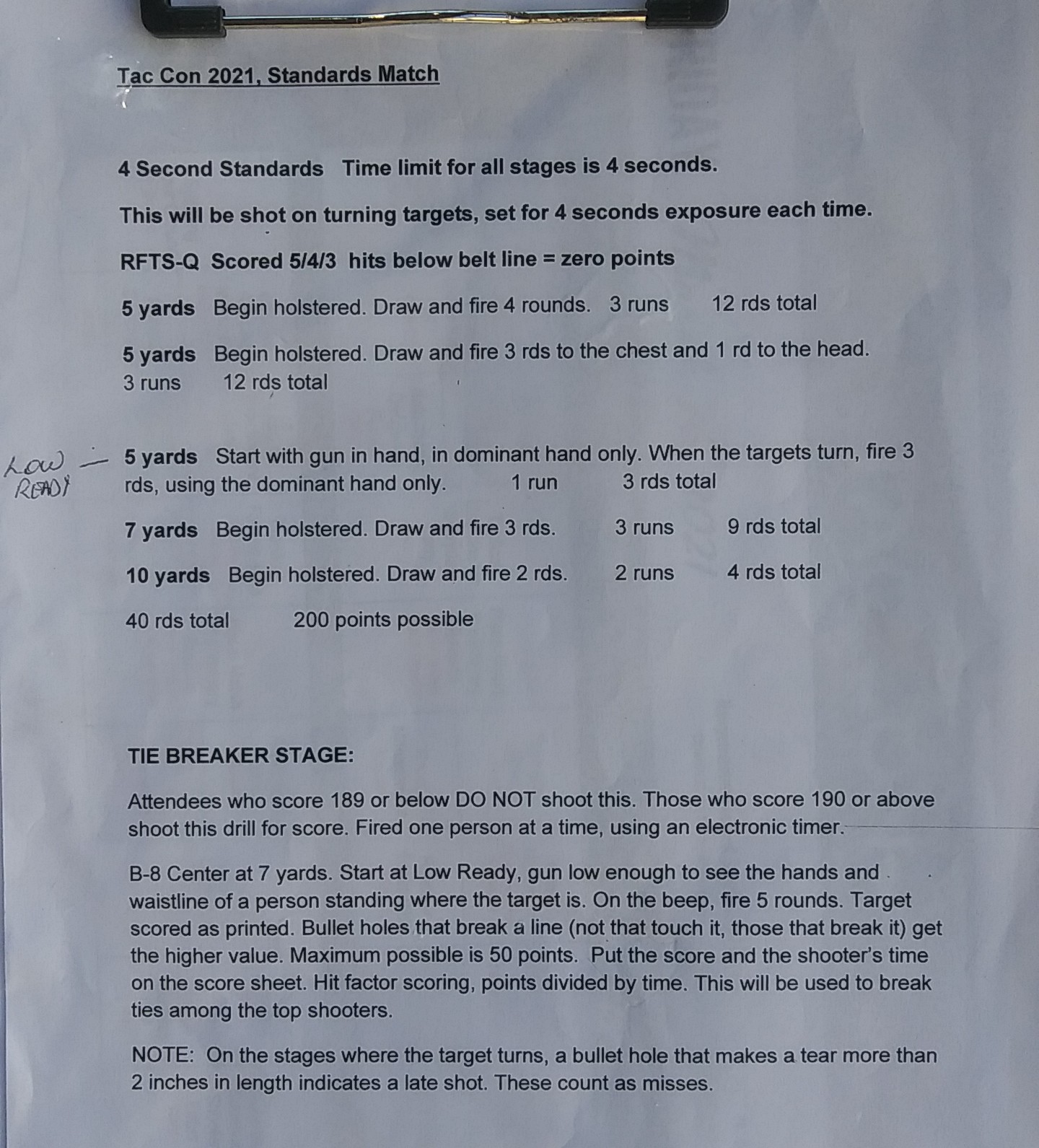
The first part of the match is shot as a standard exercise using turning targets. This was my target for the Standards. My score was 198. The 99 percent score meant I was able to shoot the tiebreaker.

For those who score 95 percent on the standards, a five round tiebreaker is shot on a B-8 target using Comstock scoring (points divided by time). I shot this well, scoring a 49 but using a lightweight snub nose revolver meant I was slower than I needed to be to get into the shootoffs on Sunday.

The top 16 shooters then enter a man v. man shootoff using a double elimination ladder. The shootoff format uses falling steel targets. Each shooter has an array of three clothed steel target with an eight inch steel circle [Correction about the target: The plate is a vertical rectangle, 5.5″ X 6″. If you run a vertical centerline down the mannequin, and a line across at armpit level, the intersection of those lines is the center of the 5.5″X6″ plate] that has to be hit to make the target fall. After knocking down all the shirt targets, the shooter must knock down the mini-popper in back. The popper that ends up on the bottom determines the winner.

It was a fun match and I’m glad I was able to shoot it.
I’ll be recapping the Conference in the next few posts.
Press On!
#mindsetmonday
In 2011, I had heart surgery two weeks before this match and couldn’t move my right arm. The solution for me was to shoot the monthly IDPA match with my Support Hand Only.
Nothing in the world can take the place of persistence. Talent will not; nothing is more common than unsuccessful men with talent. Genius will not; unrewarded genius is almost a proverb. Education will not; the world is full of educated derelicts. Persistence and determination alone are omnipotent. The slogan Press On! has solved and always will solve the problems of the human race.
President Calvin Coolidge
Click anywhere on the cover below to purchase my ebook as a PDF.
Even more about Skill Development
‘three shots, three yards, three seconds,’ https://tacticalprofessor.wordpress.com/2021/02/19/skills-conversation-about-lapd-shootouts/ has generated some good discussion and questions, which makes me happy. Someone posted a question on the Facebook page for Growing Up Guns.
Nothing was said about whether this done from a low or compressed ready, or from concealment, as far as the par time. Being LE based info, I’m assuming this was done from a duty holster. Thoughts?
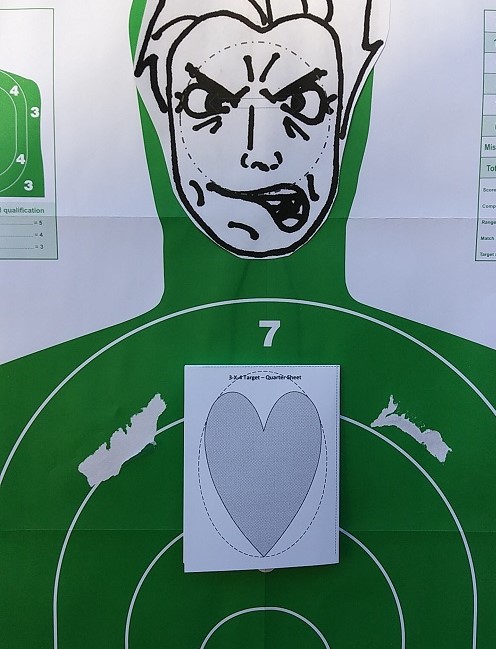
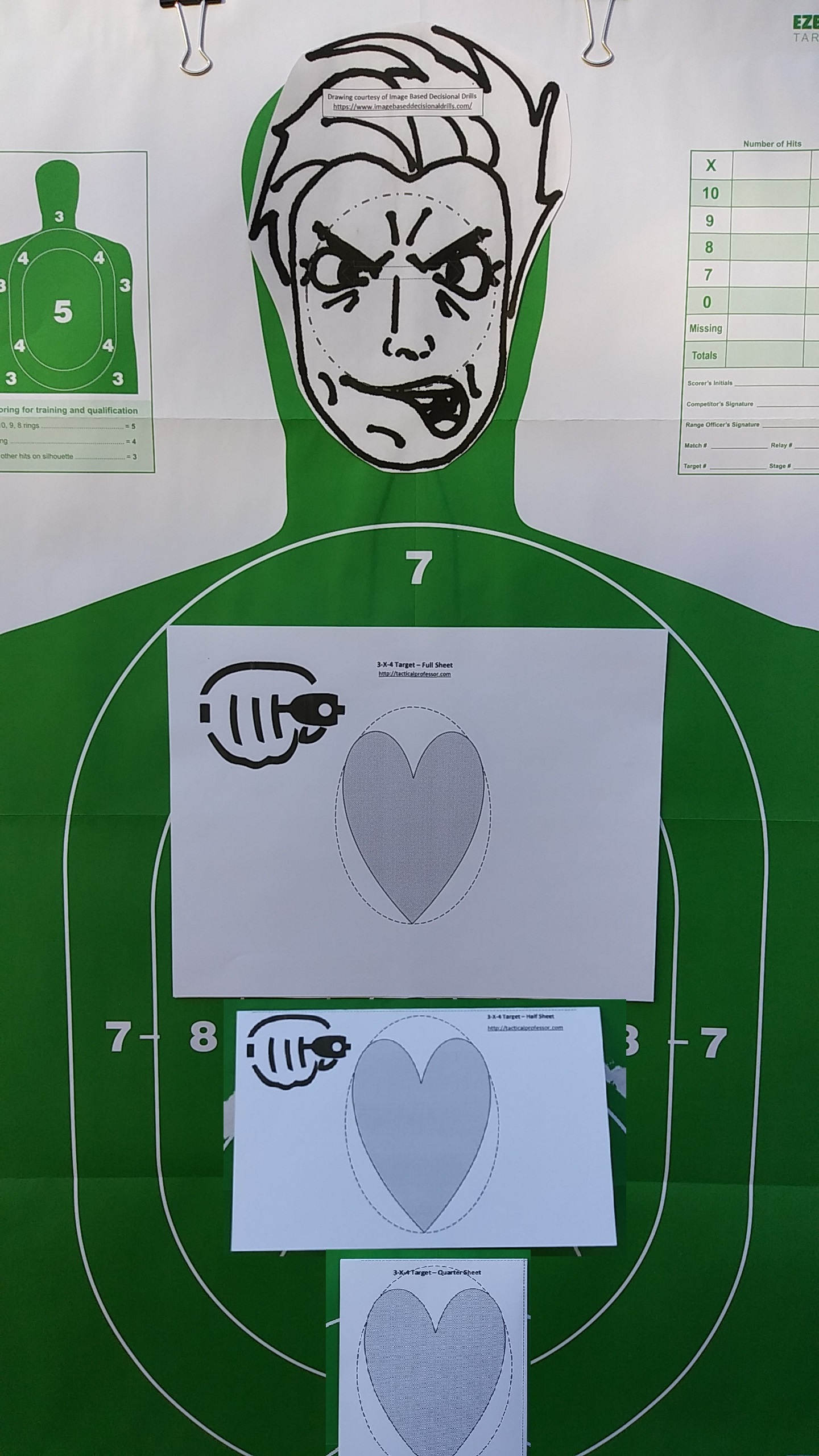
It’s a progression, just like the size of the target. When someone is first learning to shoot, do it from Low Ready, muzzle below the feet of the target, finger off the trigger. Once a shooter achieves some degree of proficiency, which I would personally define as being able to consistently hit the quarter sheet, then branching can begin. Others might be satisfied with hitting the full sheet consistently as a standard.
There are numerous possible branching variations.
- From the midpoint of the drawstroke.
- From the holster. Take your pick of open, concealed, or Level III Security.
- Primary Hand Only from Low Ready
- Support Hand Only from Low Ready
- Etc.
I use the term ‘midpoint of the drawstroke’ rather than ‘compressed ready’ because I’m not a fan of muzzling suspects prior to making the SHOOT decision. If the bore is parallel to the ground, there’s almost no way to avoid muzzling others. From that perspective, the idea of having the bore parallel to the ground as a ready position is purely “square range” thinking.
For those who are feeling exceptionally froggy, try stacking all three targets on a single silhouette. Shoot all three targets as one string using three round magazines and reloading between targets. Obviously, your time will be more than three seconds. Keep in mind that the second most missed shot is the first shot after a Stoppage Clearance. Reloading is a Stoppage Clearance so you’ll have two opportunities to maintain your focus.
The end outcome, consistent hits on a variable sized target, is the focal point of the drill. There are numerous tasks that can achieve it, most of which have value.
Click on the image below to order Real Shootouts of the LAPD.
Skills conversation about LAPD Shootouts
#fridayfundamentals
I was talking with a friend of mine, who has Been There and Done That (BTDT), about Real Shootouts of the LAPD. He asked:
What was your biggest conclusion after writing the book?
DIA Guy
“When Frank McGee (head of NYPD firearms training in the 70s) said ‘three shots, three yards, three seconds,’ he wasn’t far off the mark” was my response. I still think that on-duty POlice shootouts may be a different story but the off-duty shooting situations are much like those of an Armed Citizen.
We then started talking about the difference between ‘when to shoot’ vis-à-vis ‘how to shoot’ training / practice. He had an interesting take on targets in terms of ‘how to shoot.’
What he tells his students is,
Use a sheet of paper. When you can consistently hit that, fold it in half. When you can consistently hit that, fold it in half again.
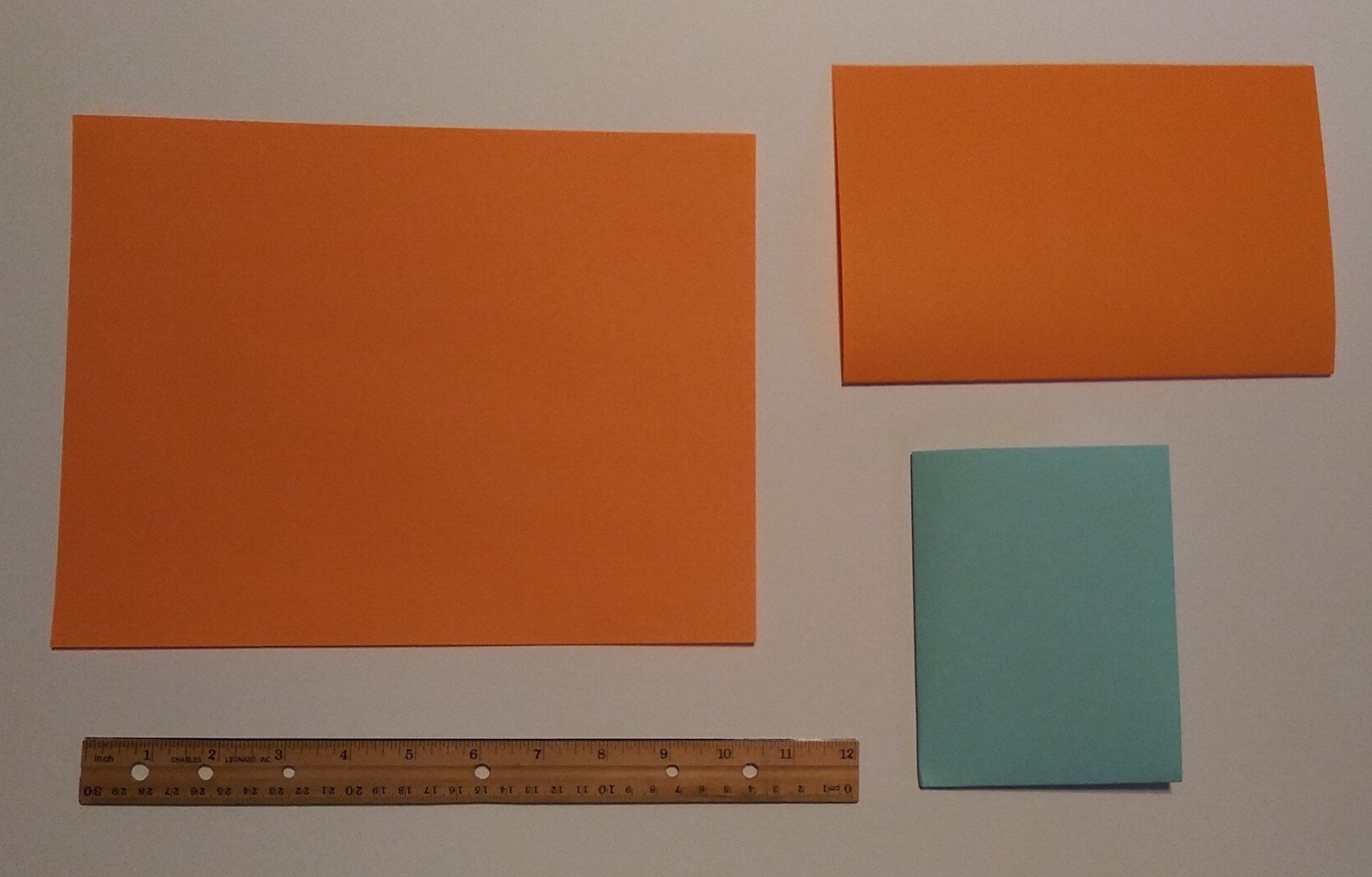
How do we combine that concept with ‘three, three, three?’ Since I am a firm believer in consistency, let’s do it three times in a row. That would make it 3X4. I also think context is important, so let’s put the sheet of paper on a silhouette. Place the silhouette at three yards. Fire three shots at the target. Repeat twice for a total of nine rounds fired in three strings of three. Since it’s a three second Par time exercise, you can use a Par timer app on your phone with your earbuds underneath your hearing protection. I like ‘Dry Fire Par Time Tracker’ but there are others.
If all three strings of three shots hit it, fold another sheet of paper in half. You’ll end up with a target 5.5 x 8.5 inches. Repeat the three strings. You should have nine hits on the half sheet of paper.
Assuming you have all nine hits on the half sheet, fold another sheet of paper in half twice. This time your target will be 4.25 x 5.5 inches. Shoot the three strings again.
Now you’ve done a good 27 round workout that is ‘Reality Based.’
When you get home, put your gun away. Get out your Blue Gun, Nerf gun, or water pistol and do some ‘when to shoot’ exercises.
Click anywhere on the image below to order the book.

Friday Fundamentals 01 – Establishing Your Baseline
Having a solid idea of where you’re starting from is important if you want to get anywhere. Otherwise, you’re just wandering around in the wilderness.

My friend Mark Luell, the author of Growing Up Guns suggested I provide a ‘Friday Fundamentals’ post weekly. We got the idea from my colleague Cecil Burch who wrote a blog post about Fundamentals. It’s a great idea to stay in touch with the basics.
The first installment is Session 01 of my Pistol Practice Program – Establishing Your Baseline. As in any journey, you have to know where you’re starting from before you can get to where you want to go.
The objective of this drill is to determine what distance you can make 100 percent hits on the vital area of a silhouette target. My feeling is that we need to work on achieving 100 percent accuracy because errant rounds in our homes or neighborhoods could be a major problem. Since I also think the first shot is the most important, I structured the session with a…
View original post 643 more words
Goal Setting for 2021
The book The Practicing Mind https://www.amazon.com/dp/B007C8NRSA/ was written by an accomplished musician and concert piano renovator. It contains the following story about when he started playing golf as an adult. The lesson in the story is well worth considering.
even though they had played golf weekly for many years, they still couldn’t accomplish basic things, such as getting the ball up in the air.
…
What I learned from golf was that all my failures in music had stemmed from my lack of understanding the proper mechanics of practicing, of the process of picking a goal, whatever that may be, and applying a steady effort toward achieving it.

The passage about ‘picking a goal, whatever that may be’ is particularly important in developing competency with firearms. The ‘whatever that may be’ part should be well considered as part of the goal setting process. It’s not uncommon for gunowners to place a high priority on marksmanship tasks. However, in the context of using firearms for Personal Protection, there are many implied tasks that complement or even surpass marksmanship in importance.
- Being aware
- Verbalization
- Accessing a weapon
- Moving from place to place safely (e.g. without having an Unintentional Discharge)
- Making reasonable and appropriate decisions
- Coordinating with friends and loved ones
- Etc.
The ammunition deficit will give us all time to work on non-shooting tasks and skills that are, or at least should be, an integral part of our Personal Protection plan. For those who place a priority on their safety and their loved ones’ safety, range time can be re-prioritized to time to practice other skills. Some of those complementary skills do not even involve handling firearms. Others are easily accomplished with an inert or even toy gun.
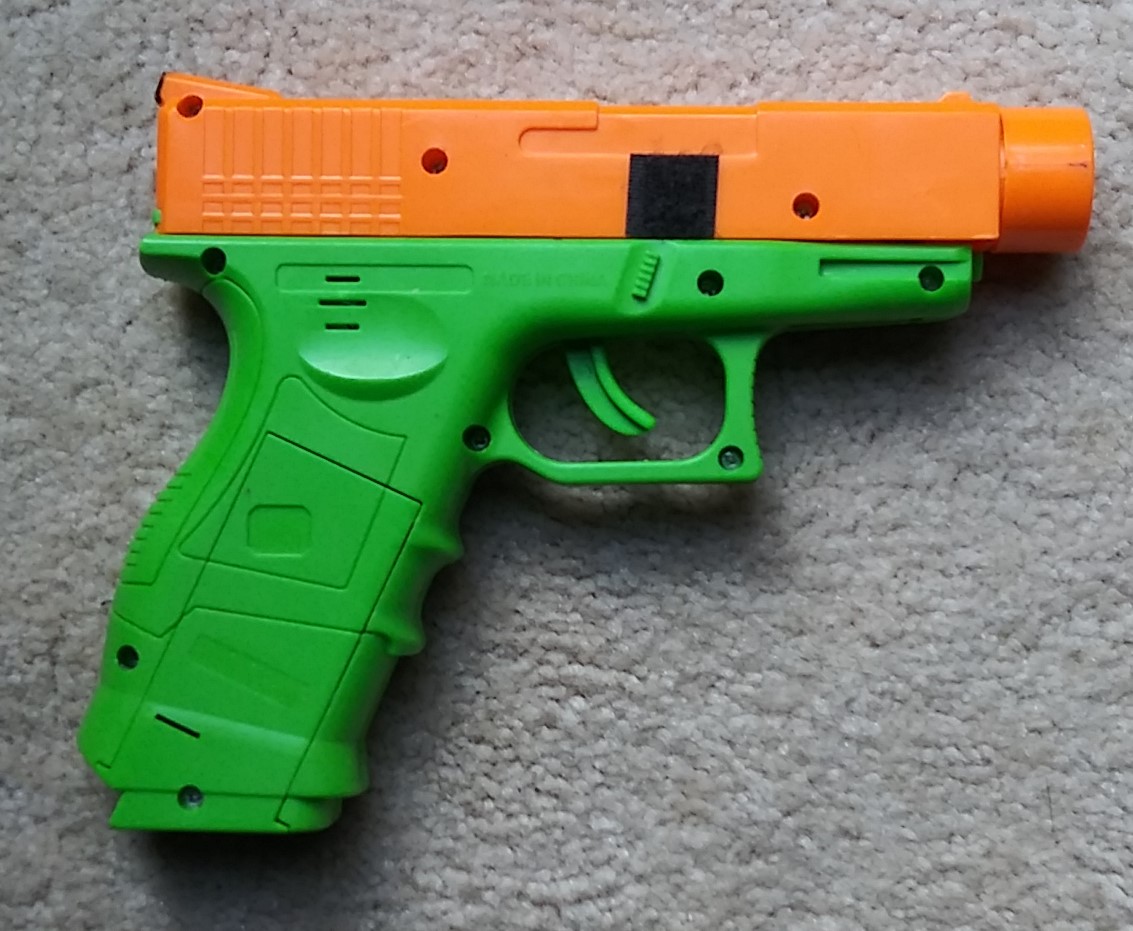
The enjoyment aspect of the shooting sports is another worthwhile goal. My shooting goal this year is to achieve my Distinguished Expert rating in Shotgun from the NRA. Since I already hold two DE ratings, I will become one of the few Triple Distinguished Experts. My gun club is rebuilding our rimfire range, so I’ll also be able to get back into smallbore rifle shooting, a highly disciplined activity.

On the other hand, my interest in ‘Boyd’s Process,’ of which the ‘O-O-D-A Loop’ is part, has been rekindled. I am going to make a concerted effort to delve deeply into the entire process and produce a written piece and presentation for my Patrons about integrating all the parts of Boyd’s thinking into a cohesive paradigm. That falls into the ‘making reasonable and appropriate decisions’ and is only peripherally concerned with firearms, other than as a backup tool.
Think about what your goals are for 2021 for firearms and Personal Protection. Decide what a measurable indicator for reaching each of your goals would be and then make a plan for getting there. That is a different process than ‘New Year’s resolutions,’ which generally are ephemeral and therefore more easily dismissed than a goal with a concrete plan.
FTC notice: I receive no commission for any links mentioned in this post.
Riding Shotgun With Charlie
#mindsetmonday
I almost never listen to podcasts I’ve been a guest on, which is probably a mistake. Since Charlie put the clip of me with my long gun (Zombie MP5) in his intro, I had to listen to this one, though.
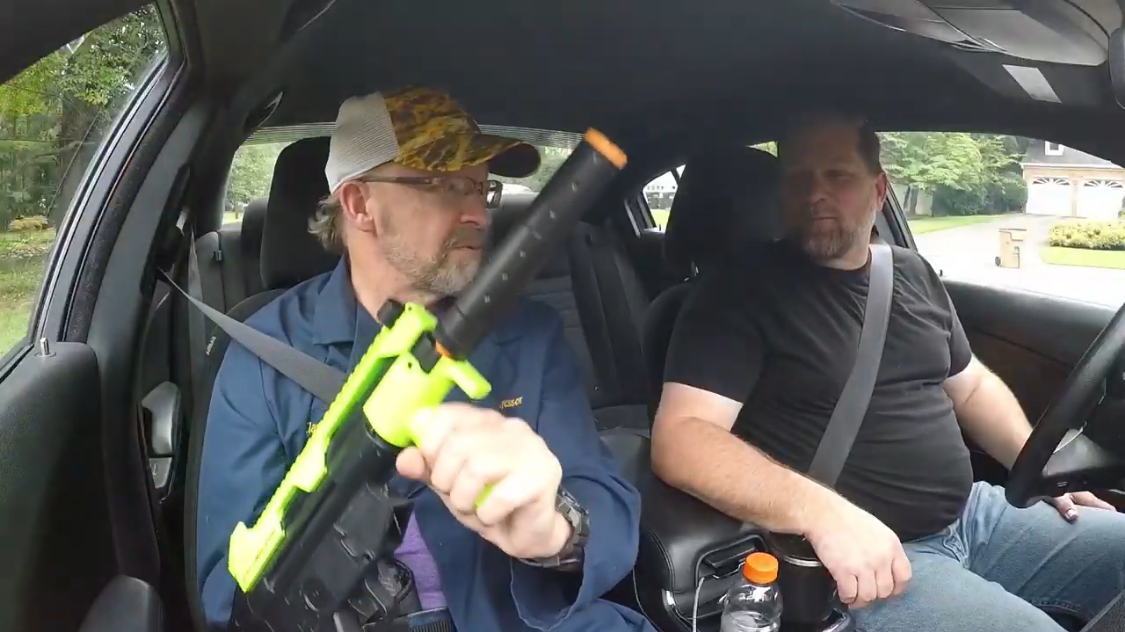
There’s a lot of good information in this episode that doesn’t usually get touched on in the industry. I’m very happy that Charlie gave me the opportunity to share it with the community.
e.g. My father used to say to me ‘son, you’re much more sophisticated about this than I am’ and I want my clients eventually to be more sophisticated about this than I am.
The Negative Outcomes mentioned are detailed extensively in my book Serious Mistakes Gunowners Make http://seriousgunownermistakes.com/ .
The LAPD Retired Officer Course and numerous other courses that can be practiced at both indoor and outdoor ranges is in my book Indoor Range Practice Sessions http://indoorrangepracticesessions.com
What does effective Dry Practice actually look like?
#fridayfundamentals
Since many people have never seen a structured Dry Practice session, here’s an example.
This session uses a State’s (Louisiana) Concealed Handgun Permit Qualification Course as the basis for structuring the session. Having a structured Dry Practice session accomplishes several objectives. Among them are safety, avoiding “grabasstic gun clicking,” and effective time management, among others.
Although the session seems simplistic, the way it is structured provides multiple repetitions of at least 10 different skills that are common in Defensive Gun Uses. In his groundbreaking book How to Win Friends and Influence People, https://www.amazon.com/gp/product/B003WEAI4E/ Dale Carnegie wrote,
“Remember that the use of these principles can be made habitual only by a constant and vigorous campaign of review and application.”
Those words are every bit as true for physical skills as they are for human relations skills. The way we learn to do things competently by practicing them repetitively. As an aside, human relation skills can be very useful in defusing bad situations and Carnegie’s book is well worth reading for general interest.
Skills practiced in the session
- 36 Good First Round Hits.
- Good, for my purposes, means creating a serious enough wound that the shootee has to go to a hospital to seek medical treatment. At that point, the POlice will start asking those uncomfortable questions about how he got the wound. More about that definition in the next #mindsetmonday.
- There are several subsets of getting ‘Good First Round Hits’.
- 36 Presentations into the Eye-Target line
- 36 Sight Acquisitions
- 36 Smooth enough trigger presses
- 36 Follow-throughs
- 33 repetitions of Forming the Grip quickly
- 36 repetitions of Racking the slide in a safe (muzzle downrange) manner.
- 3 Draws to Ready
- 3 ‘Draw but DON’T SHOOT YET’ Decisions
- 3 Safe Re-holsters
- 33 repetitions of Return to Ready
- 3 magazine exchanges
- 1 Reload with Retention
- 2 Tactical Reloads
- 36 Deliberate SHOOT Decisions
- 36 Shot Analyses (Read the Sights)
- 3 Spatial Analyses (6 feet is in the Close Phase of Social space, 10 feet is in the Far Phase of Social space, and 15 feet is in the Close Phase of Public space) https://en.wikipedia.org/wiki/Proxemics and how they affect your shooting.
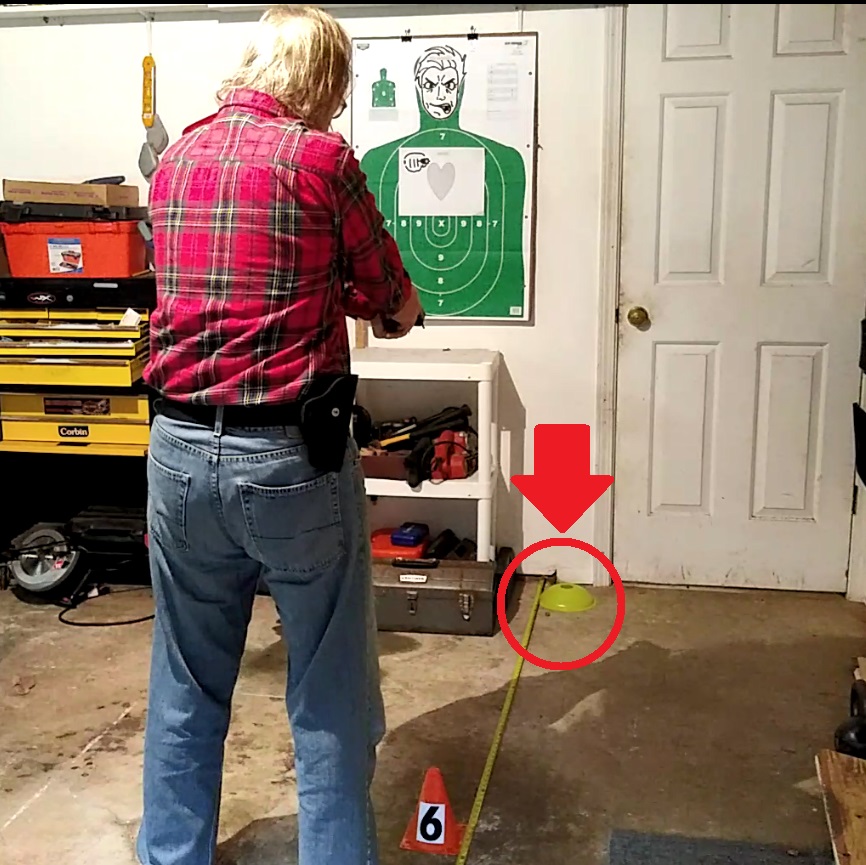
The TRT (Tap-Rack-Training aid) mentioned is available on Amazon https://www.amazon.com/Pack-Safety-Training-Pistol-Magazine/dp/B07CNBDHSB Using it is much easier the making the UN (inert and doesn’t work) magazines that were its inspiration.
Image Based Decisional Drills https://www.imagebaseddecisionaldrills.com/ provided the face on the target. A face is available for download in the Downloadables section of their website.
Using a Qualification Course as the basis for a Dry Practice Session and Regimen is an effective way of maximizing the value of your effort. For those who plan to obtain a Weapons Carry License in a State that has a Qualification requirement, it is also useful as an introduction to the structure of pistol qualification, even if the Course used is not the same.
Today’s Patreon https://www.patreon.com/TacticalProfessor post will go into more detail about structuring Dry Practice for maximum effectiveness.
FTC note: I receive no compensation for the product links in this post.
Fundamentals of dry practice
Although dry practice (aka dry fire) is often recommended, many shooters are unclear about the specifics of dry practice. Here is a short video, first in a series, to get gunowners started.
This series will include a video about safety procedures and a few sessions. I hope it will be useful to my readers and clients.
If you enjoy my content, please consider supporting me on Patreon. I post more in-depth material there for serious students of Self-Defense and Personal Protection.
Have a plan
As the late William Aprill was fond of saying,
Spontaneity is overrated.
“That’s what heart surgery is,” he said with a soft laugh. “It’s a script. To you, it probably looked like I was just sewing those collars into Meeko’s chest any old way. But every motion was planned, tested, practiced. Turn my hand eight degrees and poke the needle through; swivel my hand back 22 degrees and draw the needle up four inches; turn my hand back just so and bring it to the left a half inch: a precise number of stitches, pulled just so tight and no tighter. What heart surgery takes is remembering an incredibly long and complicated script and following it exactly, step by step.”
https://getpocket.com/explore/item/no-pulse-how-doctors-reinvented-the-human-heart

The idea of having a script, i.e., a very specific game plan, doesn’t just apply to heart surgery. One of the learned aspects of firearms competition is to develop a plan ahead of time and then follow it through.
The quaint Google translate version of the story’s precis reads:
That’s what it’s about
* On Friday [note that the incident actually occurred the previous Wednesday] night there was an exchange of fire between the owner of a gun shop and burglars who had tried to gain access to his shop in Wallbach AG [Switzerland].
* What the perpetrators did not expect: The owner is a marksman and former Swiss champion in dynamic shooting [IPSC].
* One person was injured in the shooting. The POlice assume that this is one of the perpetrators, as no injuries were found on site.

Whether it’s IPSC, IDPA, GSSF, ICORE or some other form of competition is largely irrelevant. What is important is the concept of having a game plan ahead of time and then putting it into action when you get the ‘GO’ signal.


You must be logged in to post a comment.