Worst Possible Case and 100 percent Standards
#Fridayfundamentals
Last night, I had an interesting conversation with John Daub of KR Training about the new NRA CCW Course. KR Training is one of, if not the, premier provider of firearms training in Texas, so his thoughts about the CCW Instructor Course he and Karl recently completed were something I wanted to hear. One of the most interesting items of the conversation was that the NRA has adopted a 100 percent hit standard for the NRA’s Qualification Course, if instructors choose to use the NRA’s Qual Course.
I’ve been a big believer in 100 percent standards for a long time. The importance of an exacting standard was emphasized by a recent Incident where a woman in Oroville, California shot and paralyzed her husband as a result of taking a Hostage Rescue shot on a home invader. Although she killed the home invader when she “emptied the clip” at him, her husband is now paralyzed for life. That incident reminded me of how imprecisely we use the term Worst Possible Case.
‘Worst Possible Case’ discussions inevitably devolve to one of two possibilities; TODD, the heavily armed criminal who is as impervious to gunfire as Superman or becoming involved in an entangled fight. However, there are numerous possibilities of what could be the Worst Possible Case as listed in Serious Mistakes Gunowners Make. So there actually is no single Worst Possible Case, there are various Negative Outcomes; it’s situationally dependent. The situation will dictate which of the possible Negative Outcomes is the ‘worst.’
It’s very important for us to understand our capabilities. The CAN, MAY, SHOULD, MUST paradigm developed by Steve Harris, Esq. puts CAN first for a reason. CAN, what are you able to accomplish at that moment?, has two components – Mental and physical. The Oroville woman had the mental part of CAN but not the physical. Let’s compare and contrast her incident with that of Meghan Brown, who also shot and killed a home invader during a struggle. Ms. Brown had been to the range with her pink Taurus revolver and knew she was not a very good shot. As a result her strategy was to close with the struggle and take the shot at a point where she was sure she could make her hits.
The ‘Downrange problem,’ in which an innocent person is downrange of the shooter, is far more common than we think. Those who keep a firearm for Personal Protection need to keep in mind that the situation may not be ‘self-defense’ but rather protecting another person.
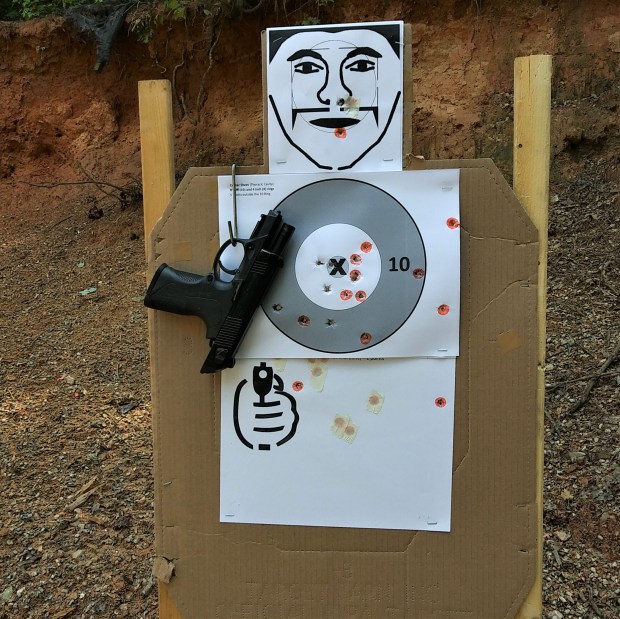
How to put this into practice becomes the question. The Decisional Exercise Family taken hostage from Concealed Carry Skills and Drills is one example. Simply use two sheets of paper as the hostage. Put them on the same side as your Support Hand so you maximize your opportunity to hit them if you jerk the trigger. If you hit those two sheets of paper, assume you seriously wounded or killed a member of your family.

To add some realism, you can put a facial photo of a family member above the printed sheets or just draw a face above them. Here’s a Non-threat PDF Printable Non threat Silhouette torso that is included in Advanced Pistol Practice and Shooting Your Black Rifle. When practicing on an indoor range, you probably won’t be able to set up the full scenario but you can still do the individual strings.
What’s the Worst Possible Case? It’s a situationally dependent individual decision. Using a little forethought and doing some practice may help you solve it without a Negative Outcome. Going to the range and figuring what distance YOU can make 100 percent hits will give you a very important piece of information in the context of Personal Protection.
Personal Performance Class Announcement
By popular demand, we’ve opened up our biannual Personal Performance Class to men as well as women. It will be held October 20, 2019 in Dahlonega, Georgia.
The focus of this class is a little different than most. There will be some coaching but the class is more about giving our clients a benchmark of where their shooting is at. From that benchmark, our clients will have a program they can follow after leaving the class to measure their ongoing performance level.
This is probably the only group class I will be teaching for the rest of the year. It is a joint effort between myself and Brian and Shelley Hill of The Complete Combatant.
The NRA Defensive Pistol I Marksmanship Qualification Program is the standard we use for the class. I’ve run hundreds of people through the program over the past six years. Having to shoot a Course of Fire that has a 100% hit standard is a quite a surprise for many (90%) of the shooters.
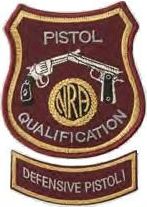
All participants will receive a Patch and rocker at the class. In addition, you will receive Rating rockers for the skill level(s) you achieve during the class. You will also receive a takeaway booklet to help you practice and advance in the Program after you’ve finished this class.
Whether you’re a newer shooter or a more experienced shooter, I think you will find this class to be an eye-opener.
I’m back
As some of you know, I have had some very serious health problems this year. The near death experience has taken some time for me to recover from.
I’m doing much better now and I’ll be back to posting.
For those who ordered Advanced Pistol Practice, I completely rewrote it during my convalescence and turned it into a downloadable format. I think the 2.0 version is much better than 1.0.
Everyone who ordered it should have received the download link. If not, please let me know and I will resend it to you. For those who ordered the USB version, I will be refunding you the $3.00 surcharge shortly.
For anyone who didn’t order it but would like some instant gratification, the download is available here http://store.payloadz.com/go?id=2613612 .
Thanks to everyone for your patience and understanding. I’m looking forward to putting out some interesting material in the near future. As the Romulans said in The Neutral Zone, “We are back.”
Scaled target rifle qualification
One of the challenges with rifles is evaluating proficiency with limited resources. One approach is the US Army Scaled Target Alternate Qualification Course. The Course is found in Field Manual 3-22.9 . It can be shot on any range that has 25 meters (28 yards) of space. Even if your range only has 25 yards, it’s still a good course; just recognize that the targets are 10 percent closer than the values on the target.
There are three Tables (stages) totaling 40 rounds.

Downrange Failure
As [the Officer] struggled with Villalon, [the homeowner] drew a handgun and fired in their direction, striking the officer on his right arm, according to police.
Homeowner shoots McAllen officer who responded to burglary
This is the Negative Outcome I categorize as ‘Downrange Failure,’ i.e., hit someone downrange who wasn’t the criminal. It’s the smallest category of Negative Outcomes but the consequences tend to be high.
Black Friday sale
I’m running a Black Friday weekend special on both my eBooks – Concealed Carry Skills and Drills and Indoor Range Practice Sessions. Through Sunday, they’re 20% off. Ordinarily, priced at $9.95 but for the weekend, $7.96.
http://concealedcarryskillsanddrills.com
http://indoorrangepracticesessions.com
Too quick on the trigger?
Every month, Tamara Keel pens a page called Good Guys Win https://www.swatmag.com/articles/more-articles/good-guys-win/ in SWAT magazine. It’s similar to The Armed Citizen from the NRA Official Journals in that the stories are based on real life incidents rather than ‘Ninjas Coming from the Ceiling’ fantasies. One of her stories this month came from this incident.
Cable man opens fire during robbery attempt while working in north Houston
Police say one of the suspects was shot in the leg.
Whenever I see an incident in which the Good Guy shoots the Bad Guy in the leg, which happens on a regular basis, I wonder if it’s because GG got on the trigger too quickly. While ‘shoot him in the leg’ is a rather popular meme, I doubt it’s something that people do instinctively. We’ve got to practice getting the gun into the eye-target line before putting our finger into the trigger guard. Another possibility was some serious trigger jerking, which is why we need to learn to press the trigger smoothly, even when we’re stressed.
Consistency
Consistent. Merriam-Webster defines it as:
marked by harmony, regularity, or steady continuity: free from variation or contradiction
During his Technical Handgun: Tests and Standards class last weekend, John Johnston of Ballistic Radio commented to me that the class had been heavily influenced by two conversations he and I had. In one, I said
You’re a good shooter but your consistency sucks.
He took that to heart and developed a personal program to increase his consistency. Technical Handgun is his road show about how shooters can use a personal program to increase their consistency and competency. Good shooting, even decent shooting, is the result of consistency. By that I mean the ability to perform at some level with a high degree of regularity. As we develop our consistency, the level we are able to perform at ‘on demand’ increases. Many shooters are perfectly content with being incompetent. Many others are not but don’t know how to go about increasing their competency.
Measuring your capabilities
Last Sunday, The Complete Combatant hosted a class for which I was the Guest Instructor. The Class is called Personal Performance; this particular class is for Ladies Only. This is the third iteration of the class we have done, the first having been in October of 2017.
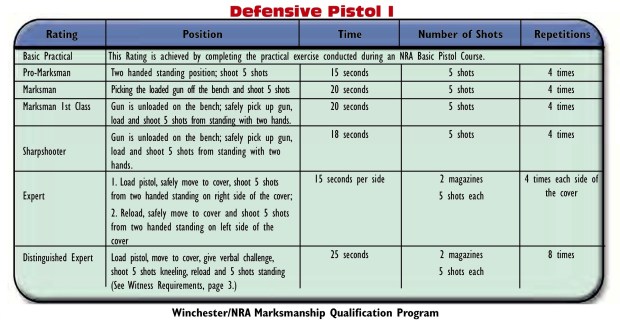
The class is based on the NRA Marksmanship Qualification Program Course of Fire called Defensive Pistol I. The MQP has numerous Courses of Fire for a variety of different firearms and shooting disciplines. Unfortunately, it’s probably the NRA’s best kept secret.
The Defensive Pistol I Course of Fire is described as “designed to supplement the Personal Protection In The Home courses.” Since PPITH does not include doing any work from the holster, neither does DP I. This is a good place to start measuring one’s performance capabilities because the variable of drawing from the holster is eliminated. The Course of Fire consists of six levels of increasing task complexity and decreasing time limits.
Since its addition to the MQP in December 2012, I’ve put nearly 200 people through Defensive Pistol I, both men and women. The results have been both surprising and informative, to say the least.
The value of a college degree
A Facebook friend commented about the fact that some major corporations had dropped the requirement for a college degree. She agreed with the change because her experience was that her education had no apparent value to her current employment.
There’s a lot of validity in her comments although she may not be considering the totality of what she learned in college. This is especially true given the amount of subsequent education, in different forms, she has undertaken. In the words of the motivational speaker, Steve Chandler, she clearly has emotionally left High School behind, which many people never do.

For many years, employers valued a college degree for a number of reasons. Some of them, STEM and professional related degrees, related to an entry level understanding of material necessary for job performance. In a broader sense, a college degree had value in that it demonstrated the ability to think clearly about a myriad of subjects, communicate effectively, do research, and to have a goal and stick to the tasks required to achieve it for an extended period of time. These values also applied to getting a High School Diploma. The system involved both Process and Performance.
 tacticalprofessor
You must be logged in to post a comment.