Get Ready
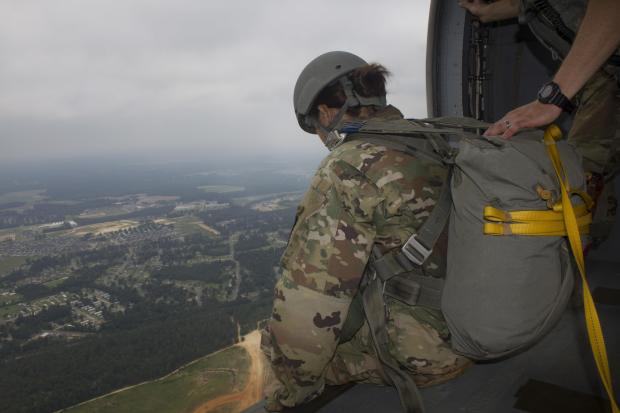
It’s often apparent in classes how much time it takes people to switch gears and ‘Get Ready.’ Transitioning our Defense Condition, both mentally and physically, from Not Ready to Ready may be the most important skill we develop. We don’t necessarily have to deal with the Tueller Principle but even if a criminal is moving at a brisk walk, we seldom have 12 seconds to ‘Get Ready.’
U.S. Army photo by Staff Sgt. Felix Fimbres
Ten to 12 seconds is a common response time to a Ready command during firing squad practice on the firing line during classes. That’s a luxury of time we will seldom have prior to a criminal attack. Often people will look around to see what others are doing before Getting Ready. When a criminal comes for you, others will seldom even notice, much do anything to give you an Alert.
Get Ready is actually what Jeff Cooper’s Color Codes are about. They describe a state of mental readiness to act.
Mental condition comes first and can be followed by increasing our physical Readiness status.
- Ready positions worth practicing
- Hands in front
- Hand on gun
- Transition from OC (OC canister at arm’s length)
- Low Ready
When is Low Ready appropriate? Avoiding Aggravated Assault charges is just as important as avoiding the assault itself. Either can change our lives forever. A good guideline comes from the Los Angeles POlice Department.
Capable v. Likely
What are we capable of versus what are we likely to do?
John Johnston of Citizens Defense Research and I have been discussing this topic in relation to standards in a class. He and I are both believers in having standards and being able to demonstrate competent execution of those standards. Being able to demonstrate means both the instructor and the client.
One of the things I do in private sessions is to have the client take a hostage rescue shot. The target is a complete head next to and not obscured by the hostage head. Only one shot is allowed. The client gets to pick the distance. Most clients, even competent shooters, will close to 3 yards (9 feet) or less. That’s always interesting because the boundary between the near and far phases of Social Space in proxemics is 7 feet for North Americans.
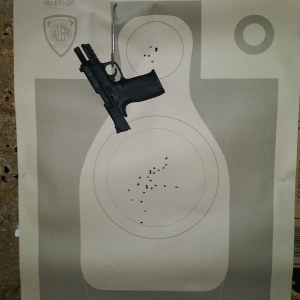
Our technical capabilities are limited by what is within our own heads. What we think we can do represents ‘likely,’ regardless of what we’re actually capable of.
As Ken Hackathorn has said for many years:
You are unlikely to do something in a stressful situation that you’re not reasonably sure you can do competently.
The real value of training and practice isn’t gaining technical competence, it’s achieving confidence in your abilities.
If you are interested in bringing your Strategies, Tactics, and Options for Personal Protection to a higher level, please subscribe to my Patreon account for $5 per month. It’s an investment in yourself. https://www.patreon.com/TacticalProfessor
If you are interested in bringing your skill level higher, please purchase one of my books about how to practice effectively. https://store.payloadz.com/results/337896-tactical-professor
Informal Instruction
A colleague of mine had the opportunity to give a short (15 minute) informal block of instruction to a friend of hers. Most firearms instruction in the US is informally done between friends or relatives.
Their session didn’t involve any live fire and was conducted in their office. It was simply a short briefing on basic safety rules, gun handling, and model specific instructions on how to operate her handgun.
An interesting comment came up in our discussion about the session. It’s worth keeping in mind any time we teach somebody something, whether the subject is firearms related or not.
I talked with her not at her.
When we teach an adult, it’s always worth remembering to approach it that way. Even if we are a Subject Matter Authority, the person is one of our peers and deserves to be treated respectfully. They should be treated like a client in an Adult-Adult relationship, not a grade school student in a Parent-Child relationship.
Mutual respect will garner the rapport necessary for the instruction to be effective and add value to the person’s life.
Thinking about what’s important
Man shot in neighbor’s home charged after allegedly undressing in 12-year-old’s bedroom during break-in
Although this incident occurred in April, it recently re-surfaced as an example of a Defensive Gun Use. As is frequently the case, Internet common taters had numerous things to say about it.
- Needs more practice.
- Only six? Should have emptied the magazine!
- Too bad the dirtbag’s not in the morgue.
- Etc.
It’s easy to focus on the unimportant aspects of an incident. All of the commentary focused on feelings, which are unimportant, instead of Lessons to be Learned (LTBL), which are important.
How do we focus on what’s important? One way to start is to identify who was involved by role rather than name. Most the time, news stories use last names but that tends to obscure who did what. Substituting a role for names in the story leads to more clarity about the actions of the participants. For this incident, it would look as follows.
Cast of characters in the drama
Donald Oliver – Intruder
Tina Burton – female of household (Female)
Ali Bracey – male of household (Male)
Daughter
Important aspects of the incident
- The Male knew there was an actual intruder because of the Daughter’s text.
- Despite knowing it wasn’t just a ‘bump in the night,’ the Male went to confront the intruder unarmed.
- The confrontation between the Male and Intruder started verbally and then turned physical.
- It was either an entangled fight or within arm’s length.
- When it went physical, the male employed an improvised weapon, to wit: a broom.
- The broom was apparently ineffective in the confrontation, so the male continued using unspecified improvised weapons.
- They had a gun but didn’t think initially to bring it to the fight.
- The Female eventually brought the gun to the Male to use.
- There was a weapon handoff from the Female to the Male.
- Shooting the gun caused the Intruder to flee.
Unimportant aspects of the incident
- The intruder wasn’t killed.
- The householder didn’t practice enough at the gun range.
Lessons To Be Learned (LBTL) and other important aspects
Guns are not useful if you don’t bring them to the fight. Have a plan ahead of time about how to handle an intrusion.
You can’t practice appropriately for an entangled or close range fight at a gun range anyway. This would most likely have been best handled as a retention shooting situation. Retention shooting is a skill best learned by taking a class from someone who knows what they’re doing. Few instructors are qualified to teach this task. I can recommend Brian Hill of The Complete Combatant, Greg Ellifritz of Active Response Training, and Craig Douglas of Shivworks.
Males of the household will often confront an intruder unarmed. It’s not uncommon for another family member to have to access the firearm and bring it to the fight. A handoff to the Male periodically occurs at that point. This means that several implied Personal Protection tasks for the other family member come into play.
- Know where the gun is.
- Be able to access the gun. Is it in a safe and can the family member open it?
- If the gun is not stored Ready to Fire, be able to place the gun into Ready to Fire condition.
- Move safely from the storage location to the fight location. Having an Unintentional Discharge en route will probably be a Tactical Disaster.
- Either be able to engage the Intruder with the firearm, or
- Safely hand off the firearm to the Male engaged in the confrontation. If the confrontation is physically entangled, a handoff may not be safely possible.
Whether the Intruder is killed or not is completely irrelevant. Let’s keep in mind The Cost of Killing. Achieving a Break In Contact is our objective as Non-Sworn Citizens. Note that in this incident, the Intruder had to be taken to court in a wheelchair. That probably means that he has some serious injuries, perhaps debilitating for his entire life.
We need to focus on the important tasks in Personal Protection incident analysis and not our feelings, which are unimportant. That is what I will be doing in the monthly incident analysis on my Patreon page.
Training Opportunity
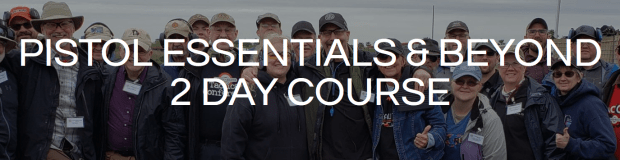
Brian Hill of The Complete Combatant will be conducting Pistol Essentials and Beyond in Raymond MS on Saturday, October 26 & Sunday, October 27, 2019. Raymond is just west of Jackson, MS.
As a Rangemaster Certified Instructor, Brian is one of the up and coming trainers in the firearms community. His block of instruction at the 2019 Rangemaster Tactical Conference was well received by all 20 clients who took it. He is a very thorough and patient trainer; a teacher of my own style.
More information about the format and goals of the class is available here. Note that this particular class is in Raymond MS not in Dahlonega GA.
Registration information is available here. https://www.eventbrite.com/e/boondocks-october-26-27-2019-pistol-essentials-beyond-in-raymond-ms-tickets-59855488377
For those interested in moving to the next level in your skill development, I highly recommend this class.
Civilian Carry Radio Podcast Tonight
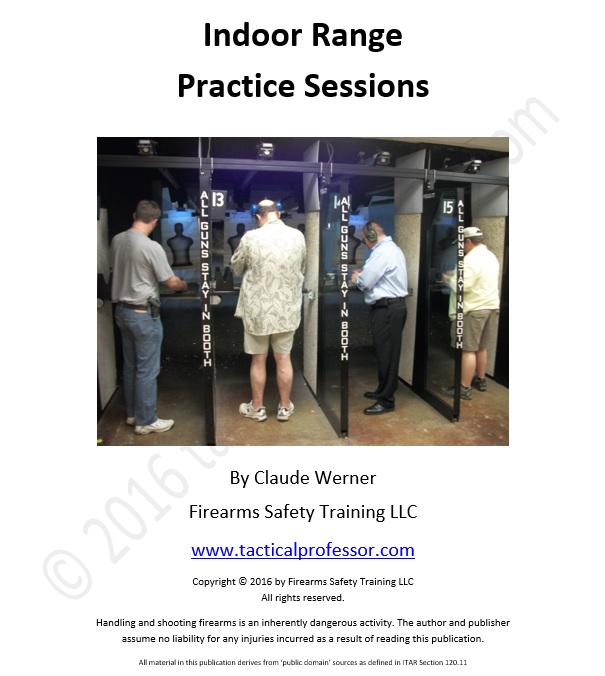
I will be the guest on Civilian Carry Radio tonight. The co-hosts for the show will be Brian Hill of The Complete Combatant and Lee Weems of First Person Safety. Our topic is Effective Practice on an Indoor Range.
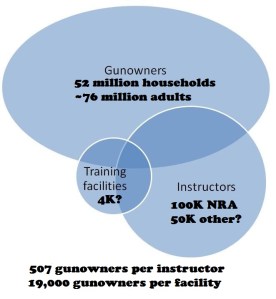
Some of the things we may be discussing include some of Claude’s Numbery Things. Data is frequently better understood in a visual way so here are some infographics and pictures that may help.
Size of the training base.
Access to outdoor ranges in the Atlanta Metro area.

Nature of the indoor range environment.
Ability to do low light shooting.

I think my readers will find it to be an informative discussion.
Straight talk about Incident Research
Mickey Schuch, of Carry Trainer, was kind enough to do an interview with me. We talked quite a bit about incident research, among other things.
We also talked a little about my My eBooks.
Indoor Range Practice Sessions http://indoorrangepracticesessions.com
Concealed Carry Skills and Drills http://concealedcarryskillsanddrills.com
Shooting Your Black Rifle http://shootingyourblackrifle.com
Let’s Get Real About Active Shooters
It’s all hype by the media to boost their ratings. The active shooter possibility is so small it wouldn’t even be worth talking about if the media didn’t stir up such a (you-know-what) storm about it. Look at the breakout for 2017, the latest year exact numbers are available. Note that the mass shootings number for 2017 includes the Las Vegas concert incident so it’s higher than other years.
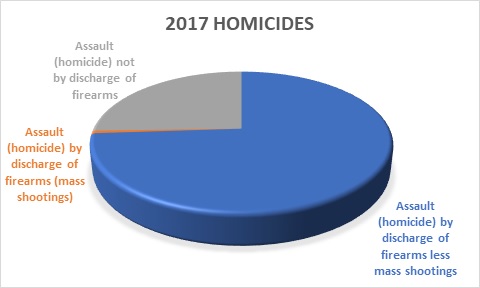
Source: CDC and Time
In comparison, how often do you hear about multiple fatality car crashes on the news? They rate one minute, once. Then they’re out of sight and out of mind. In 2017, the CDC figure for car fatalities is 40,231. Dead is dead, period. Run an internet search for “multiple fatality car crash” and limit the search period to the past month. The number you’ll find is shocking.
A Well Regulated Militia
The Bill of Rights
Amendment II
A well regulated militia, being necessary to the security of a free state, the right of the people to keep and bear arms, shall not be infringed.
There continues to be controversy about the meaning of the Second Amendment. Advocates of Gun Control maintain that it only refers to the National Guard. On occasion, even firearms owners will say that regulated means ‘trained.’
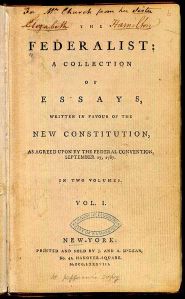
The Federalist Papers (#29 by Alexander Hamilton) gives this interpretation of a ‘well regulated militia.’
“Little more can reasonably be aimed at, with respect to the people at large, than to have them properly armed and equipped; [emphasis mine] and in order to see that this be not neglected, it will be necessary to assemble them once or twice in the course of a year.”
I.e., everyone should own an assault rifle, a basic load of ammunition and be required to show up for an inspection thereof at least annually.
Hamilton alludes to the difficulty of having the entire citizenry participate in military maneuvers sufficient to develop proficiency at a unit level. Any soldier who has been on a Field Training Exercise (FTX) can understand this. But having military weapons in the hands of the People seems to be a viable solution to him. Maintaining individual proficiency with those weapons isn’t something he speaks about.
James Madison wrote in Federalist No. 46:
“Besides the advantage of being armed, which the Americans possess over the people of almost every other nation … Notwithstanding the military establishments in the several kingdoms of Europe, which are carried as far as the public resources will bear, the governments are afraid to trust the people with arms.”
Yet another reference to the value of citizens owning arms.
Madison also makes reference to “that the traitors [emphasis mine] should, throughout this period, uniformly and systematically pursue some fixed plan for the extension of the military establishment.” In a time when a member of Congress talks about using nuclear weapons against the American people, it’s even more important that the people at large possess military weapons.
Professor Eugene Volokh of the UCLA Law School provides some References to the Militia in The Federalist.
The Second Amendment has never been about hunting. That has always been a fiction. The intent of the Founding Fathers was for the people to able to resist a tyrannical central government.
Shooting Your Black Rifle book
http://shootingyourblackrifle.com
Online Firearms Safety Course
I just completed the Washington, D.C. Metropolitan POlice Department Online Firearms Safety Training Course. It’s actually well done and informative. There are a few parts particular to D.C. laws but other than that, nothing odious. The animations are generally well done and informative for newcomers to firearms ownership. The course took me about half an hour to complete.
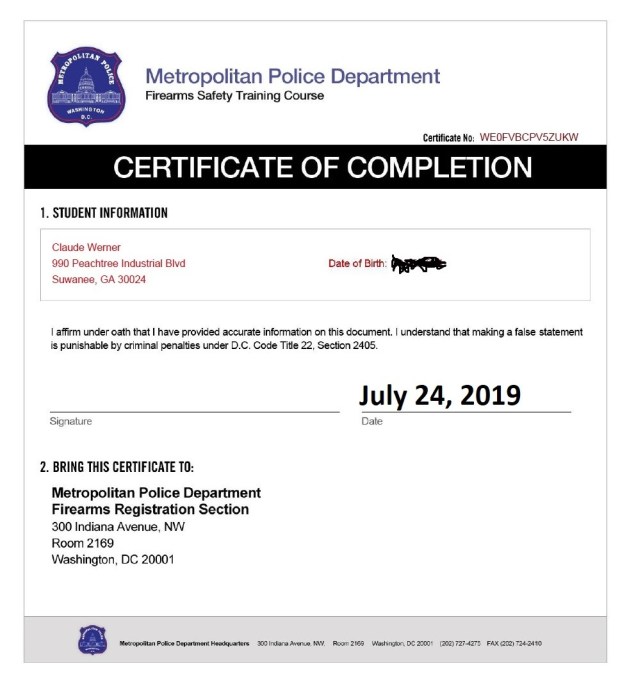
There were only two errors noticeable to me, one technical and one typographical. I’ll let the webmaster know about them.
 tacticalprofessor
You must be logged in to post a comment.