‘Good Guys’ is a relative term in this video
From my Strategies, Tactics, and Options for Personal Protection Class:
Triumvirate of Success in Decision-Making (adapted from David Brin’s The Uplift War).
In no particular order:
• Consequences [nee Cost and Caution] – financial, political, and physical.
• Decency or Civility [nee Propriety] – honor and nobility. Actually being ‘the good guy.’
• Courage [nee Beam and Talon] – Aggressive spirit, daring and seeking out opportunities.
Failure to achieve some balance of the three factors significantly increases the possibility of a catastrophic failure to achieve the objective. In this incident, there was no sense of decency or civility among the ‘Good Guys.’
Unintentional Discharge (causing the death of an innocent) – Serious Mistake
Mistaken Identity Shootings – Serious Mistake
After the fact beatdown of an innocent party – Serious Mistake
Most likely spending a long time in a Brazilian prison – Negative Outcome.
What gets people in trouble is usually not marksmanship but instead Serious Mistakes in the Decision-Making process. There are exceptions but that’s the general rule. The reason we become proficient with firearms is not because the marksmanship problem is likely to be difficult but rather to avoid having the tool (firearm) become our focus in the moment instead of the situation.
Tactical Professor books (all PDF)
Serious Mistakes Gunowners Make http://seriousgunownermistakes.com
Indoor Range Practice Sessions http://indoorrangepracticesessions.com
Concealed Carry Skills and Drills http://concealedcarryskillsanddrills.com
Advanced Pistol Practice http://bit.ly/advancedpistolpractice
Shooting Your Black Rifle http://shootingyourblackrifle.com
Worst Possible Case and 100 percent Standards
#Fridayfundamentals
Last night, I had an interesting conversation with John Daub of KR Training about the new NRA CCW Course. KR Training is one of, if not the, premier provider of firearms training in Texas, so his thoughts about the CCW Instructor Course he and Karl recently completed were something I wanted to hear. One of the most interesting items of the conversation was that the NRA has adopted a 100 percent hit standard for the NRA’s Qualification Course, if instructors choose to use the NRA’s Qual Course.
I’ve been a big believer in 100 percent standards for a long time. The importance of an exacting standard was emphasized by a recent Incident where a woman in Oroville, California shot and paralyzed her husband as a result of taking a Hostage Rescue shot on a home invader. Although she killed the home invader when she “emptied the clip” at him, her husband is now paralyzed for life. That incident reminded me of how imprecisely we use the term Worst Possible Case.
‘Worst Possible Case’ discussions inevitably devolve to one of two possibilities; TODD, the heavily armed criminal who is as impervious to gunfire as Superman or becoming involved in an entangled fight. However, there are numerous possibilities of what could be the Worst Possible Case as listed in Serious Mistakes Gunowners Make. So there actually is no single Worst Possible Case, there are various Negative Outcomes; it’s situationally dependent. The situation will dictate which of the possible Negative Outcomes is the ‘worst.’
It’s very important for us to understand our capabilities. The CAN, MAY, SHOULD, MUST paradigm developed by Steve Harris, Esq. puts CAN first for a reason. CAN, what are you able to accomplish at that moment?, has two components – Mental and physical. The Oroville woman had the mental part of CAN but not the physical. Let’s compare and contrast her incident with that of Meghan Brown, who also shot and killed a home invader during a struggle. Ms. Brown had been to the range with her pink Taurus revolver and knew she was not a very good shot. As a result her strategy was to close with the struggle and take the shot at a point where she was sure she could make her hits.
The ‘Downrange problem,’ in which an innocent person is downrange of the shooter, is far more common than we think. Those who keep a firearm for Personal Protection need to keep in mind that the situation may not be ‘self-defense’ but rather protecting another person.
How to put this into practice becomes the question. The Decisional Exercise Family taken hostage from Concealed Carry Skills and Drills is one example. Simply use two sheets of paper as the hostage. Put them on the same side as your Support Hand so you maximize your opportunity to hit them if you jerk the trigger. If you hit those two sheets of paper, assume you seriously wounded or killed a member of your family.

To add some realism, you can put a facial photo of a family member above the printed sheets or just draw a face above them. Here’s a Non-threat PDF Printable Non threat Silhouette torso that is included in Advanced Pistol Practice and Shooting Your Black Rifle. When practicing on an indoor range, you probably won’t be able to set up the full scenario but you can still do the individual strings.
What’s the Worst Possible Case? It’s a situationally dependent individual decision. Using a little forethought and doing some practice may help you solve it without a Negative Outcome. Going to the range and figuring what distance YOU can make 100 percent hits will give you a very important piece of information in the context of Personal Protection.
Personal Performance Class Announcement
By popular demand, we’ve opened up our biannual Personal Performance Class to men as well as women. It will be held October 20, 2019 in Dahlonega, Georgia.
The focus of this class is a little different than most. There will be some coaching but the class is more about giving our clients a benchmark of where their shooting is at. From that benchmark, our clients will have a program they can follow after leaving the class to measure their ongoing performance level.
This is probably the only group class I will be teaching for the rest of the year. It is a joint effort between myself and Brian and Shelley Hill of The Complete Combatant.
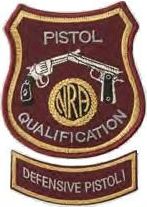
The NRA Defensive Pistol I Marksmanship Qualification Program is the standard we use for the class. I’ve run hundreds of people through the program over the past six years. Having to shoot a Course of Fire that has a 100% hit standard is a quite a surprise for many (90%) of the shooters.
All participants will receive a Patch and rocker at the class. In addition, you will receive Rating rockers for the skill level(s) you achieve during the class. You will also receive a takeaway booklet to help you practice and advance in the Program after you’ve finished this class.
Whether you’re a newer shooter or a more experienced shooter, I think you will find this class to be an eye-opener.
Defense in Depth
#Fridayfundamentals
Stolen pistol leads to reckless endangerment charge for Stamford man
By John Nickerson Published 4:28 pm EDT, Wednesday, October 2, 2019
When I posted the story on my Tactical Professor Facebook page as a Negative Outcome, the following question came up.
Which reminds me: this question is probably been addressed here before but for those of us who haven’t caught it are there any vehicle storage lock boxes that have good non shitty locks that we can buy on Amazon or a brick and mortar store?
I use a lockbox that I bought at Academy Sports for 10 bucks. Any defense can be defeated. Just as in the military, defense in depth is how we prevent a defense from being easily defeated. By using multiple barriers, we encourage a thief to move on before he gets our gun. It’s the opposite of leaving a gun in the door pocket of an unlocked car left outside at night. Here’s how I do it:
1. Think ‘be discreet.’ Visually inspect the area to see who is around.
2. Have your pistol box in the trunk, already secured by its cable to the hinge of the trunk lid. If your vehicle doesn’t have a trunk, place the box in some spot that is accessible to you and out of sight of casual passers-by and has a solid attachment point for the cable.
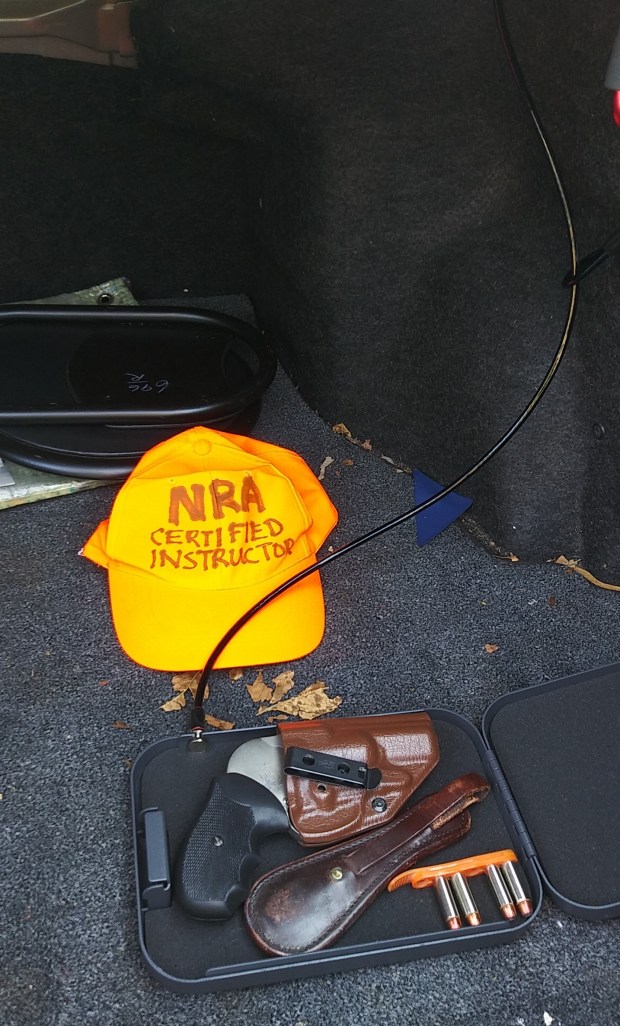
3. Open the trunk.
4. Quickly palm your pistol and put your hand with the pistol into the trunk. This is where having a small pistol really helps.
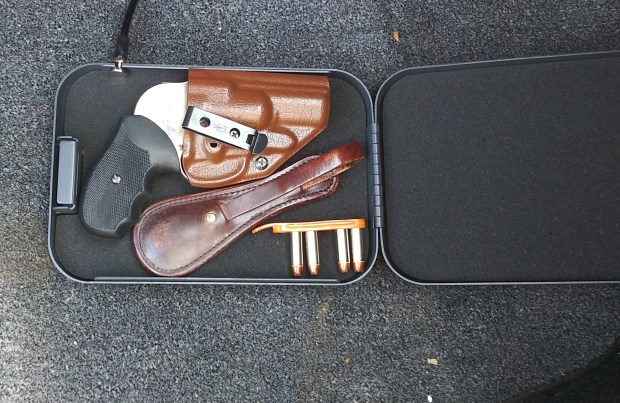
5. Place pistol and any other weapons into the lockbox.
6. Lock the box.
7. If your holster doesn’t fit in the box, place it near the box.
8. Close the trunk.
9. Lock the car doors.
For years, I used a box with a combination lock but I’ve come to the conclusion that, for me, a key lock was faster and more convenient. The key is permanently on my keyring. I’m good at maintaining possession of my keys so I’m not concerned about not having the key to the box.
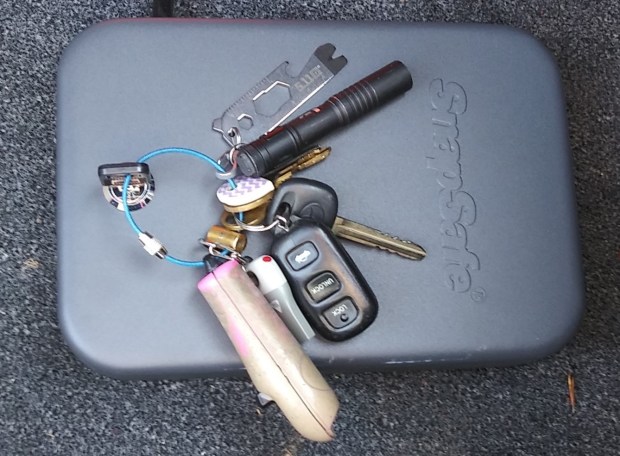
I only leave my revolver in the car when I have a good reason to; going into my home at night is not a good reason. Going into non-permissive environments or perhaps to the doctor are good reasons.
My thanks to the gentleman who asked about the topic. That was a good suggestion for a blog post. He wins free copies of Serious Mistakes Gunowners Make and Concealed Carry Skills and Drills.
Tactical Professor books (all PDF)
Serious Mistakes Gunowners Make http://seriousgunownermistakes.com
Indoor Range Practice Sessions http://indoorrangepracticesessions.com
Concealed Carry Skills and Drills http://concealedcarryskillsanddrills.com
Advanced Pistol Practice http://bit.ly/advancedpistolpractice
Shooting Your Black Rifle http://shootingyourblackrifle.com
What snubs can do
#Smith&WessonSunday
I shot the I’m With Roscoe 2019 Internet Match Friday at a local indoor range. The Match is modeled on the Pocket Revolver Championship of the US Revolver Association, as described in the 1915 edition of the book Pistol and Revolver Shooting by A.L.A. Himmelwright. This Match is an Internet enabled version of Postal Matches that were commonly shot in the 20th Century. The Course of Fire is five strings of five shots each at 50 feet. The time limit for each string is 30 seconds and the shooting is done Primary (Strong) Hand Only.
To time it, I used the Dry Fire Par Timer app, available on Google Play, on my phone with ear buds underneath my muffs. That’s a very workable setup for indoor range work.

The outer 4 Ring of the target measures 7 5/16 inches in diameter. Only two shots went outside the 4 ring, so that’s 23 hits in the largest circle out of 25 shots. I think Inspector Erskine would be satisfied with that.
There’s a common misconception that snubs are “arm’s length guns.” As I periodically remind people, that’s only true for the incompetent. Dry practice can go a long way toward improving our skills.
Tactical Professor books (all PDF)
Serious Mistakes Gunowners Make http://seriousgunownermistakes.com
Indoor Range Practice Sessions http://indoorrangepracticesessions.com
Concealed Carry Skills and Drills http://concealedcarryskillsanddrills.com
Advanced Pistol Practice http://bit.ly/advancedpistolpractice
Shooting Your Black Rifle http://shootingyourblackrifle.com
Tactical Professor goes to Burger King
#fridayfundamentals
I had lunch at Burger King yesterday. Say what you will but I enjoy the BK Lounge. Their fries are the best IMO and a Whopper with cheese is pretty tasty.
While I was there, a bum (aka ne’er do well) came in, went to the drink dispenser, and refilled four empty Coke bottles he took out of his backpack. Then he left. I.e., he stole about four liters of Coke and then took off.
His brazenness about it was interesting to watch. So was either the apathy or completely unawareness of the employees. I was tempted to not intervene so I didn’t. Not my circus, not my monkeys.

Getting stabbed for 50 cents worth of Coke was not on my To Do list for the day. I assume all bums carry a knife and that they are likely to act irrationally. As John Hall, former head of the FBI Firearms Training Unit said:
Every encounter carries with it an element of chance.
Another interesting aspect of the BK visit related to PERSEC (Personal Security).
This particular BK asks for your name for the order. A lot of places do that, for instance Starbucks. I never give my right name.
An attractive woman was in front of me. She had walked in with her son but left him in a booth to order their meals. Of course, she gave her right name when asked. Being behind her, now I know her name.
When her order was ready, the cashier called her name loudly and she got up to get the food. Once again, her son was left alone in the booth.
I was tempted to do a little Sport MUC with them just to see how much personal information I could get out of her and the boy just by knowing her name. I had other things to do so I didn’t.
Not all fundamentals concern establishing grip, seeing the sights, trigger manipulation, and follow‑through.
Tactical Professor books
Serious Mistakes Gunowners Make http://seriousgunownermistakes.com
Indoor Range Practice Sessions http://indoorrangepracticesessions.com
Concealed Carry Skills and Drills http://concealedcarryskillsanddrills.com
Advanced Pistol Practice http://bit.ly/advancedpistolpractice
Shooting Your Black Rifle http://shootingyourblackrifle.com
Training Opportunity
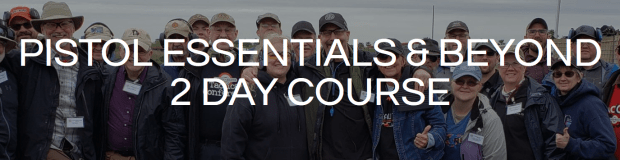
Brian Hill of The Complete Combatant will be conducting Pistol Essentials and Beyond in Raymond MS on Saturday, October 26 & Sunday, October 27, 2019. Raymond is just west of Jackson, MS.
As a Rangemaster Certified Instructor, Brian is one of the up and coming trainers in the firearms community. His block of instruction at the 2019 Rangemaster Tactical Conference was well received by all 20 clients who took it. He is a very thorough and patient trainer; a teacher of my own style.
More information about the format and goals of the class is available here. Note that this particular class is in Raymond MS not in Dahlonega GA.
Registration information is available here. https://www.eventbrite.com/e/boondocks-october-26-27-2019-pistol-essentials-beyond-in-raymond-ms-tickets-59855488377
For those interested in moving to the next level in your skill development, I highly recommend this class.
The Paseo Massacre – 1948
The Paseo Massacre took place September 20, 1948 in Kansas City Missouri. Its name comes from the location, Paseo Boulevard and 14th Street. Three POlice officers were killed that day by two offenders. A week later, another officer subsequently died of his wounds. An innocent bystander was also killed by POlice gunfire during the shootout. One offender was killed by POlice gunfire that day and the other was executed in the gas chamber 15 months later.

Sequence of events
- Saturday, September 18, 1948 – William Bell is arrested at 1334 Paseo Boulevard in Kansas City, Missouri by POlice officers Charles Neaves and Sandy Washington for disturbing the peace. Bell is required to post a Peace Bond.
- Monday, September 20 – the same officers are dispatched to the same address for a disturbance call.
- They find a drinking party in progress, which was a violation of Bell’s Peace Bond. Neaves and Washington inform Bell that they are taking him into custody.
- Bell’s brother, George, protests the arrest and is also placed under arrest.
- Making a pretext, George Bell produces a shotgun and shoots Officer Neaves in the stomach.
- William Bell then takes the shotgun from his brother and shoots Officer Washington as he tries to escape. Officer Washington is killed by the shotgun blast.
- William Bell then takes Officer Neaves’ revolver and executes him with it by shooting him behind the ear.
- Neighbors call the POlice requesting additional Officers.
- William Bell exits the apartment and takes a shotgun from the POlice vehicle Officers Neaves and Washington arrived in. He establishes an ambush position outside the building for responding Officers
- George Bell and his girlfriend flee the apartment and go to his apartment.
- Officers Charles Perrine and Officer Langley arrive and immediately come under fire from Bell.
- Officer Perrine is killed and Officer Langley takes cover.
- Sergeant William Wells and Officer Keiffer Burris arrive. They also come under fire from William Bell, firing the shotgun, and are both wounded.
- Officers Earl Scott and Rodney Knight arrive in a fourth POlice car and open fire on William Bell.
- Bell is killed by the gunfire. He dies with Neaves’ revolver in hand and falls on top of the shotgun he took from the POlice vehicle.
- Edwin Burton Warren, an innocent bystander, is shot and killed by Officer William Smith as he attempts to escape the shootout by running north on Paseo Boulevard.
- George Bell is later arrested at his apartment. Bell admits that he had served part of a 10 year sentence for killing a soldier while he served in Algeria during World War II.
- Seven days later, Sergeant Wells, who had seven wounds and been shot through the right lung, dies of pneumonia in hospital.
- December 8, 1948, George Bell is tried and found guilty of Officer Neaves’ Murder by a Circuit Court Jury. The jury deliberates only a little over four hours. Bell is sentenced to die in the gas chamber.
- Bell’s execution is set for March 25, 1949.
- His execution is stayed pending an appeal to the Missouri Supreme Court. After his appeal is rejected, George Bell is executed on December 2, 1949 at 12:01 a.m. at the Missouri State Penitentiary.
- Officer Burris survives his wounds. He is later promoted to Sergeant. Unfortunately, he dies 12 years later in a training accident.
The Kansas City POlice Memorial page is located here. https://www.kcpolicememorial.com/pages/paseomass/
Tactical Professor books
Indoor Range Practice Sessions http://indoorrangepracticesessions.com
Concealed Carry Skills and Drills http://concealedcarryskillsanddrills.com
Advanced Pistol Practice http://bit.ly/advancedpistolpractice
Shooting Your Black Rifle http://shootingyourblackrifle.com/
Serious Mistakes Gunowners Make http://seriousgunownermistakes.com
Civilian Carry Radio Podcast Tonight
I will be the guest on Civilian Carry Radio tonight. The co-hosts for the show will be Brian Hill of The Complete Combatant and Lee Weems of First Person Safety. Our topic is Effective Practice on an Indoor Range.
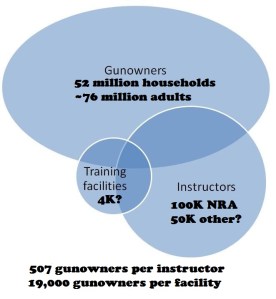
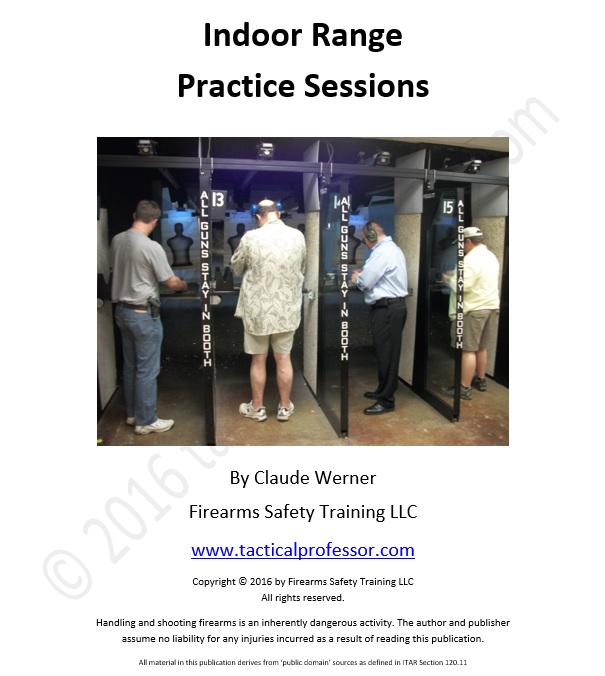
Some of the things we may be discussing include some of Claude’s Numbery Things. Data is frequently better understood in a visual way so here are some infographics and pictures that may help.
Size of the training base.
Access to outdoor ranges in the Atlanta Metro area.

Nature of the indoor range environment.
Ability to do low light shooting.

I think my readers will find it to be an informative discussion.
Bloody weekend in Texas
Five children in North Texas shot themselves or another child this past weekend in four separate incidents. A 4-year-old boy in Fort Worth died and another is in grave condition.
https://dfw.cbslocal.com/2019/09/16/5-children-shot-north-texas-weekend/
In another case being investigated by Arlington Police, an eight year old girl shot in the buttocks continues to recover.
Police say the family told them that the weapon, a nine millimeter semi-automatic Uzi-Mach 10, fired after she sat on it.
Authorities say the weapon was reported stolen in Bastrop near Austin.
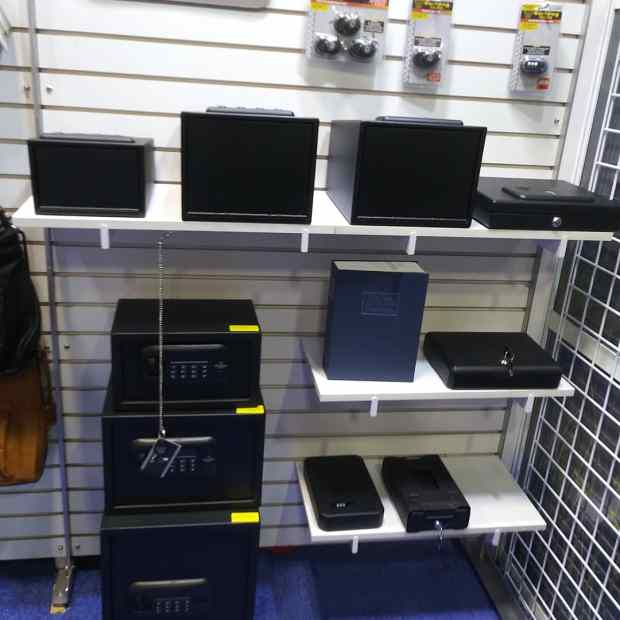
Let’s try to keep weapons out of the hands of kids. Not taking steps to prevent their access is a Serious Mistake. I’m not much for trigger locks or cables but a lockbox or even a toolbox that can be locked isn’t that expensive.
Tactical Professor books
Serious Mistakes Gunowners Make http://seriousgunownermistakes.com
Indoor Range Practice Sessions http://indoorrangepracticesessions.com
Concealed Carry Skills and Drills http://concealedcarryskillsanddrills.com
Advanced Pistol Practice http://bit.ly/advancedpistolpractice
Shooting Your Black Rifle http://shootingyourblackrifle.com/
 tacticalprofessor
You must be logged in to post a comment.