The odds and stakes of home protection
The discussion of shooting someone in your home without warning or identification has reared its ugly head again. “I’ll shoot anyone in my home” is probably the second most foolish and ill-considered dogma among gun owners today; “It’s not loaded” being the first.
During the Sack of Béziers in 1209 AD, the Abbot of Citeaux, Arnaud Amalric, head of the Crusaders, is reputed to have said: “Kill them. For the Lord knows those that are His own [Caedite eos. Novit enim Dominus qui sunt eius].” Although it is disputed whether the Abbot actually said this, it is the source of the quip, “Kill them all and let God sort them out.” If you consider it for just a few seconds, “I’ll kill anyone in my house” is philosophically not very far from this. Hopefully, we’ve gotten a little smarter and humane over the course of nine Centuries.
Children sneak in and out of the house, spouses get up to go to the bathroom, friends try to surprise you, and people who are mentally challenged, either permanently or temporarily by intoxicants, enter into homes without malicious intent.
I now have close to a hundred Negative Outcome mistaken identity shootings in my database in which someone shot their spouse or child. Those people will never get another good night’s sleep as long as they live. For the ones where the shootee survived, I doubt the relationship will ever be the same. For those who think they’ll check to make sure all their family members are in bed first, that doesn’t always work, either.
Tragedy: Florida Man Shoots, Kills Fiancée Day Before Wedding
And shooting some poor old geezer who has Alzheimer’s isn’t any better, just because he’s not a member of your family. In that particular case, there was no prosecution but the Cost of Killing was still enormous.
On average, my research indicates that someone mistakenly shoots their spouse, child, or other innocent person in their home every single week in the United States. Two words, “Who’s there?” and a flashlight would go a long way to prevent these tragedies. “Challenging will give my position away,” “The flashlight draws fire,” “blah-blah-blah;” that’s all foolishness parroted by people who have no understanding of METT-TC. Mission, Enemy, Terrain and weather, Troops and support available, Time available, and Civil considerations.

Veterans who should have learned about METT-TC, but didn’t, annoy me greatly when they prattle this kind of foolishness. To be fair, I really didn’t understand it until I was a Staff Sergeant and even then only vaguely. This is another reason not to listen to opinions from people whose only real claim to fame is that they qualified Expert with some weapon in the military. Someone’s ability to Qualify with a rifle has ZERO to do with their understanding of any tactics at all, much less tactics about highly ambiguous situations. A better criterion than Qualification would be “How many Operations Orders have you written?” If the answer is Less than ten or especially None, then the person’s ability to plan any operation is questionable.

The odds that the bump in the night are an intruder are low. I’ve calculated them at three percent but I can accept other numbers. More likely, it’s an innocent party. How many of us have investigated a bump in the night as compared to how many of us have then found someone who needed shooting? The stakes are very high, the life of a loved one or innocent party. Some localities are now prosecuting Mistaken Identity shootings as Manslaughter or Second Degree Murder. Even when there are no legal consequences, the psychological toll will most likely be for a lifetime.
The Flashlight chapter of Indoor Range Practice Sessions is a FREE download. https://store.payloadz.com/details/2505573-ebooks-law-indoor-range-session-11-flashlight.html Please get it, practice using your light, learn to speak while holding your gun, and think about identifying people before shooting at them.
You could even buy the whole book, if you want to learn something about shooting. https://store.payloadz.com/details/2501143-ebooks-education-indoor-range-practice-sessions.html
Practicing under adverse conditions
Testing the effect of adverse weather on our shooting ability is useful. This year is already starting out with a colder winter than usual and it’s not even officially winter yet. That may be the ‘climate change’ trend for a while. The temperature today is 36 degrees and there’s a very light mist. Wearing a zipped up down jacket with a sweatshirt underneath and gloves may be the uniform for a while.
A good test for starters is the NRA Basics Of Pistol Shooting test. It consists of firing five shots into each of four circles, four inches in diameter at three increasing distances. Red Level is fired at 10 feet, White Level is shot at 15 feet, and Blue Level finishes the test at 20 feet for a total of 60 rounds. There is no time limit.
Deliberate Practice
This is a great article. It contains many useful tidbits that can be applied to those want to improve their proficiency not only with firearms but also to a broad array of personal protection skills.
https://getpocket.com/explore/item/the-beginner-s-guide-to-deliberate-practice-1576022377
Deliberate practice refers to a special type of practice that is purposeful and systematic. While regular practice might include mindless repetitions, deliberate practice requires focused attention and is conducted with the specific goal of improving performance.
Revolver practice
Question from a reader:
I bought your ebook/pdf “Concealed skills and Drills”. I like the book a lot and am working my way through it.
I have a couple of questions about the drills which feature a magazine to simulate a dryfire trigger press. I am a revolver user and I am using the cylinder spin method from your PDN dvd. It seems to me that that should work as well or am I missing something?
Answer:
The cylinder spin method is ideal and that’s what I use. I had to come up with a solution for the autoloaders because they can’t do this type of exercise as well as wheelguns. Keep doing what you’re doing.
Black Friday sale
I’m running a Black Friday weekend special on both my eBooks – Concealed Carry Skills and Drills and Indoor Range Practice Sessions. Through Sunday, they’re 20% off. Ordinarily, priced at $9.95 but for the weekend, $7.96.
http://concealedcarryskillsanddrills.com
http://indoorrangepracticesessions.com
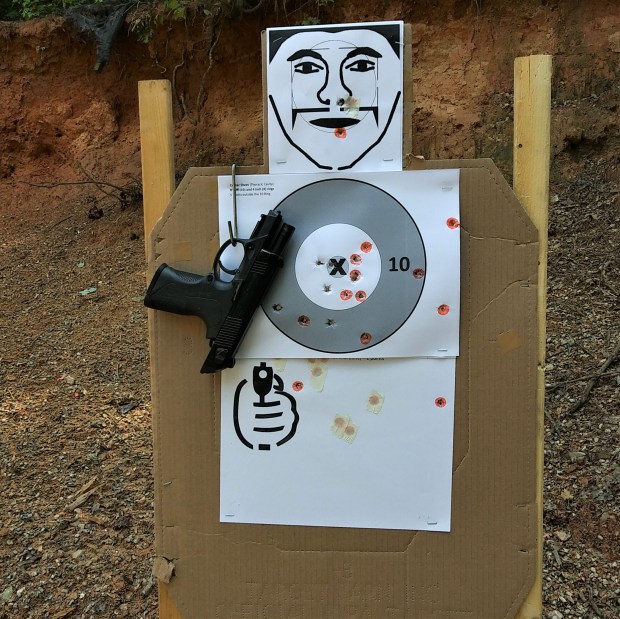
Revisiting Negative Outcomes
http://www.thetacticalwire.com/features/229266
Complacency Kills. It can happen to any of us.
Press the trigger smoothly
#fridayfundamentals
One of the components of NOT producing buckshot targets with a pistol is pressing the trigger smoothly and straight to the rear. With Double Action handguns, either revolvers or autoloaders, this is especially true but it applies to any handgun or rifle. Revolver shooters must master this skill if they want the wheelgun to be anything more than an “arm’s length gun.”
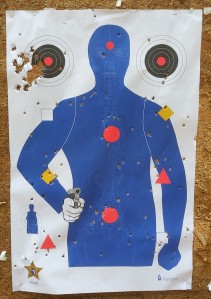
Buckshot with a handgun
Now that the weather is turning colder and, for some folks, snowy, we have the opportunity to work on our trigger press in dry practice. Here are two drills that can dramatically increase your ability to manipulate the trigger correctly.
Followup on Negative Outcome (Part I)
It’s useful to track a Negative Outcome incident from start to finish. In this case, the Negative Outcome was an Unjustifiable Shooting.
Man who killed teens trespassing on property sentenced to prison
A quick summary of the events is:
- Two individuals were on a Michigan man’s property, early in the morning.
- Most likely their intent was to steal. They were on a ‘crime spree.’
- The man heard them and came out on his porch with a .22 semi-automatic rifle.
- He challenged them.
- At least one of them began to run away.
- He shot both of them and killed them.
- An investigation followed.
- Months later, he was arrested and charged with two counts of second degree murder.
- More than two years later, he was convicted and sentenced to a long prison term.
Equipment is not a proxy for skill
Yesterday, this article showed up in the search that I continually have running for personal protection incidents and I shared it on Facebook.
Prosecutor: 13 bullet holes showed self-defense for man cleared of murder charge https://www.victoriaadvocate.com/counties/dewitt/prosecutor-bullet-holes-showed-self-defense-for-man-cleared-of/article_def55934-d637-11e8-9546-637075a1ed02.html
When I share things, I often quote what I consider an important point of the story. For this incident, I thought this was important.
The number of bullets fired by Martinez [27] stood in stark contrast to the single, fatal shot from Kirkman’s antique, bolt-action .22-caliber rifle.
 Someone immediately took me to task about the .22 caliber aspect. Apparently, they thought I was advocating carrying a single shot .22 rifle for personal protection. I don’t recall saying that, I merely used the quote as an illustration of the difference between being a spray and pray artist vis-à-vis aiming and getting a good hit. Perhaps that wasn’t clear from the quote.

Too quick on the trigger?
Every month, Tamara Keel pens a page called Good Guys Win https://www.swatmag.com/articles/more-articles/good-guys-win/ in SWAT magazine. It’s similar to The Armed Citizen from the NRA Official Journals in that the stories are based on real life incidents rather than ‘Ninjas Coming from the Ceiling’ fantasies. One of her stories this month came from this incident.
Cable man opens fire during robbery attempt while working in north Houston
Police say one of the suspects was shot in the leg.
Whenever I see an incident in which the Good Guy shoots the Bad Guy in the leg, which happens on a regular basis, I wonder if it’s because GG got on the trigger too quickly. While ‘shoot him in the leg’ is a rather popular meme, I doubt it’s something that people do instinctively. We’ve got to practice getting the gun into the eye-target line before putting our finger into the trigger guard. Another possibility was some serious trigger jerking, which is why we need to learn to press the trigger smoothly, even when we’re stressed.
 tacticalprofessor
You must be logged in to post a comment.