Serious mistakes gunowners make
UPDATE: The recording is now available as a download for $9.95. Link
In the wake of the San Bernardino massacre, there have been increasing calls, even by the police, for legally authorized people to carry their guns wherever and whenever they can. In addition, the FBI recently reported a record number of gun sales on Black Friday.
While I firmly believe that Armed Citizens and off-duty police officers can make a difference in preventing and stopping such massacres, there’s no such thing as a free lunch. Gunowners, whether carrying a gun or keeping a gun at home, can and do make mistakes, sometimes very serious ones. I have some concern about brand new gunowners carrying their guns with them everywhere without some education about how to do it safely. That may not be a popular view but that’s the way I see it.
I have often chastised the training community for failing to create non-traditional educational materials that can reach a broader array of gunowners. As a step toward alleviating that, I have created a new audio CD called:
Serious Mistakes Gunowners Make – Real life examples of how they get into trouble and how to prevent it

This audio CD is a refined version of my Negative Outcomes with Firearms presentation at the 2015 Rangemaster Tactical Conference. My Rangemaster presentation was very well received as groundbreaking about issues that are rarely discussed openly in the gun community.
The ‘Concealed Carry Mistakes’ lists I frequently see usually revolve around simplistic issues, such as:
- Equipment issues; gun, holster, clothing, etc.
- Not getting enough training
- Not ‘knowing’ the law
But the really serious Mistakes that gunowners make are things like:
- Shooting yourself
- Shooting someone you shouldn’t have, either intentionally or unintentionally
- Getting needlessly arrested
- Getting shot by the police
- Leaving guns where unauthorized persons can access them, resulting in tragedies
- Frightening innocent people around you
- Endangering innocent people needlessly
The 12 tracks, over 1 hour, on the CD are:
- Introduction
- Brandishing/threatening
- Chasing after the end of a confrontation
- Downrange failures (shot an innocent while shooting at a threat)
- Intervention
- Lost/stolen guns
- Mistaken identity shootings
- Negligent discharges, including self-inflicted gunshot wounds and Unintentional shootings
- Police Involvement
- Poor judgement
- Unauthorized access (generally by small children)
- Unjustifiable shootings, including warning shots
Each track explains the topic and the issue, provides a real life example of an occurrence and the consequence, and gives some thoughts about how to prevent it. My object is to provoke thinking about the fact that firearms are deadly weapons and can be terribly unforgiving of carelessness, incompetence, and stupidity.
Note that I can’t possibly explain nor control every way to avoid the Mistakes so I don’t assume any liability for those who listen to the recording and still end up having an issue. Life is not fair; if you want guarantees, buy a toaster.
This could be your most important purchase of the year. Making any one of the Mistakes almost inevitably leads to tragedy or significant legal expense. The price of the CD is miniscule in comparison.
The CD is available on my mobile friendly webstore.
Final note: Because I want this information to be widely distributed, I am granting a limited re-distribution license to anyone who purchases the CD. People do it anyway but I will make it formal and encourage it.
Purchase of the CD includes a license to reproduce five (5) copies of the CD for distribution to fellow gunowners. This is a limited license. It does NOT include posting copies of the CD or any of its tracks on the Internet in a downloadable format. Nor does the license include widely broadcasting the CD nor its tracks via email.
Please be safe and encourage fellow gunowners to do the same. I hope I can make a contribution to that with this CD.
Passing a gun to someone else
A discussion developed on Facebook about carrying a gun for another person. I have done this in the past for a girlfriend who was a proficient shooter but didn’t carry because her tight and skimpy clothing didn’t permit it. The gun I carried for her was a small auto or J frame in an ankle holster.
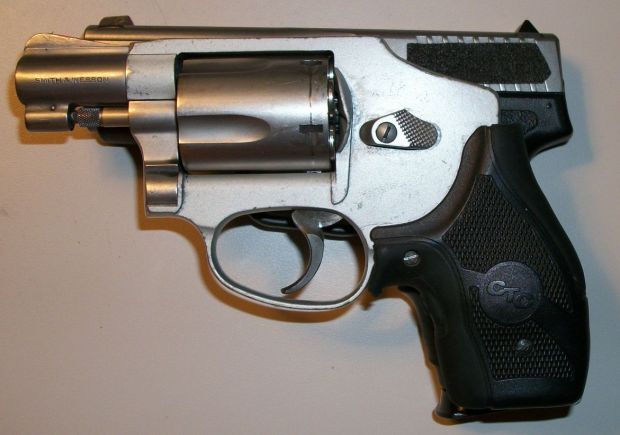
However, an implied task of this situation is developing and practicing a protocol to make sure there isn’t a negligent discharge while the weapon is being passed to them or they are accessing it from the carrier. This implied task is not as cut and dried as it might seem.
My colleague Greg Ellifritz thought this was a good enough topic to put on his blog. Since I respect Greg’s opinion, I will reproduce my thoughts here.
My protocol when carrying a gun for another person and then passing it off to them is as follows:
- Draw weapon with right hand (I’m right handed).
- Place weapon into palm of left hand with fingers of left hand around fingers of right hand, fingers running perpendicular to each other.
- Release weapon with right hand into left hand. Barrel/slide is now in palm of left hand with fingers wrapped around trigger guard from top to bottom. This protects the trigger guard from having the other person’s finger getting into it, assuming they are right handed.
- Pass it toward the person with the muzzle pointed forward, i.e., away from both of us.
- The other person takes hold of the butt of the weapon with trigger finger on top of my fingers, approximating the register position.
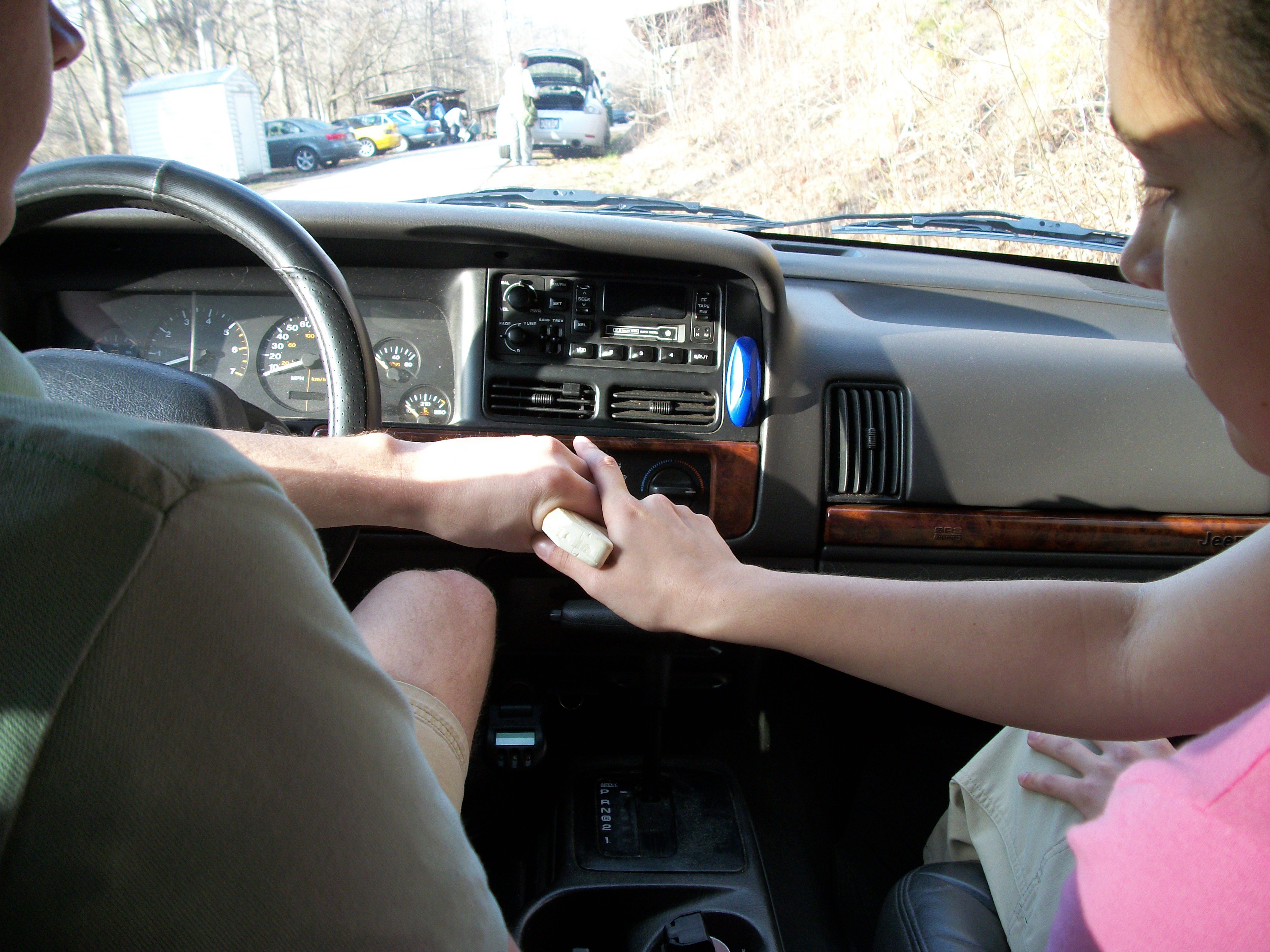
Handing off the gun.
6. Time permitting, I will ask “Got it?”
7. If she feels she has a good grip, she will respond “Got it.”
8. I then release my hold on the weapon and then pull my hand straight up from it so I do not sweep my hand over the muzzle.
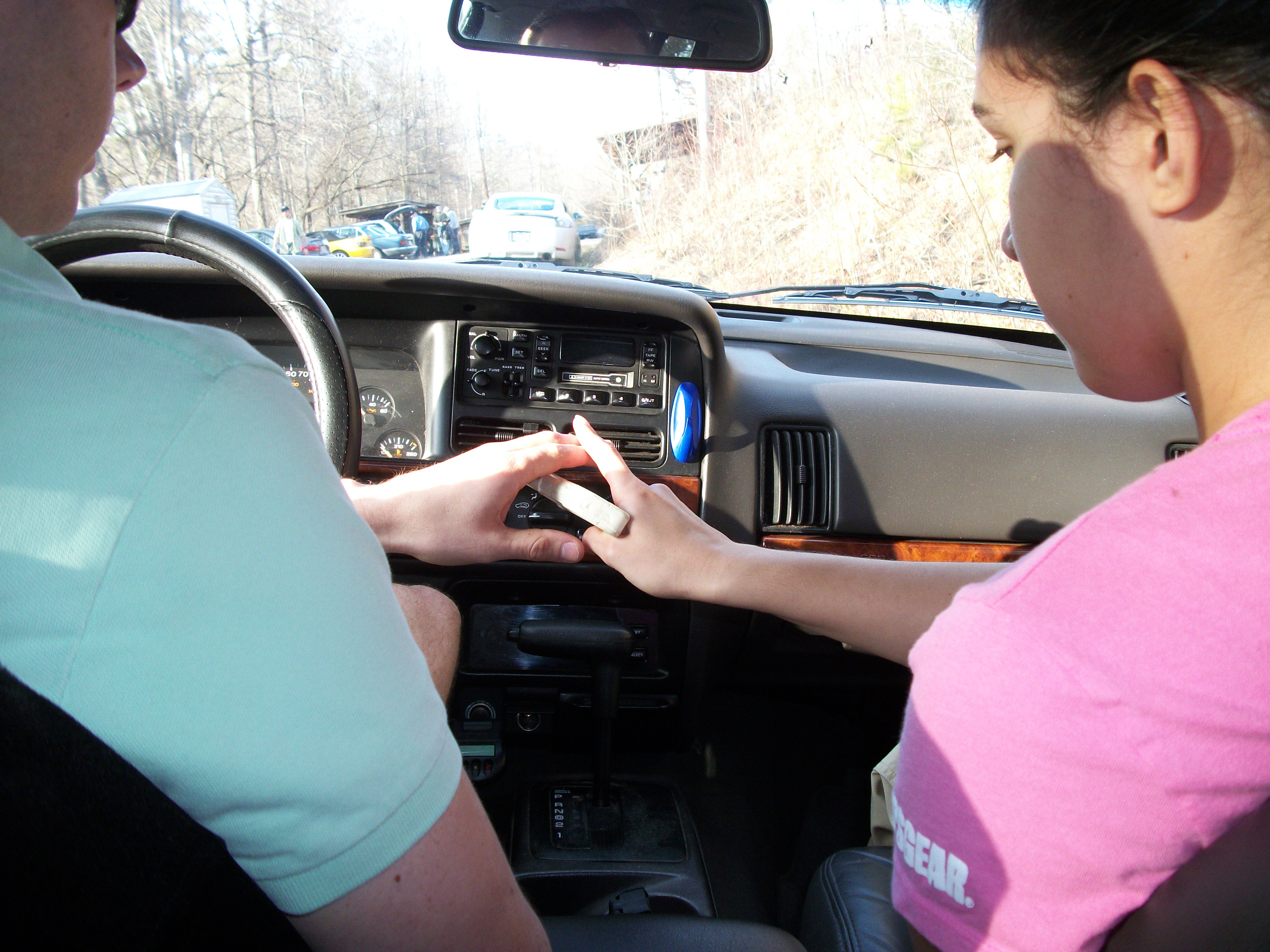
Releasing the gun
This is also how I hand guns to other people in general and how I teach gun passing in my classes. The muzzle may be oriented in a different direction for safety.
I believe Scott Reitz teaches something similar to this with regard to gun passing. That may have been the origin of the idea, I don’t recall.
Some folks objected to the idea of carrying a gun for someone else who “isn’t serious enough to carry on their own.” The decision is based on a personal assessment of METT-TC (Mission, Enemy, Terrain, Troops, Time, Civil Considerations). In this case, I was satisfied that her attitude toward the enemy and proficiency with a handgun justified the tradeoffs involved. Would I rather she carried her own gun? Certainly. Would I prefer she was unarmed in a precarious situation? Certainly not.
Friday Fundamentals – Biases and Changes
My colleague Grant Cunningham posed two interesting questions on his blog, which led to a lengthy Facebook discussion.
Question #1: “what are your biases or preconceptions?”
Question #2: “what have you changed your mind about in the last year?”
I gave a brief answer to #2 but I think they both deserve some elaboration.
Question #1: “what are your biases or preconceptions?”
I am very reluctant to design training for myself or others that is rooted purely in hypothesis or conjecture. I.e., I am very biased toward following the scientific method, as much as possible, when developing training paradigms.
The overall process of the scientific method involves making conjectures (hypotheses), deriving predictions from them as logical consequences, and then carrying out experiments based on those predictions. — https://en.wikipedia.org/wiki/Scientific_method

It’s important to note that testing is an inherent part of the scientific method. Testing implies some form of measurement. As a result, I believe that having performance standards is an important part of training. I think of training as ‘outcomes based’ rather than ‘input based.’
We have at our fingertips, via the Internet, an enormous amount of data available to us. At the top of this blog are links to a number of sources that I regularly read to gather information about armed encounters, shootings, gunfights, and gunbattles. I use each of those terms in a very defined way because I consider many terms used in the training community to be fuzzy and ill-defined. Fuzzy and ill-defined terminology does not fit particularly well in the scientific method.
One of the often parroted phrases I hear about gathering information from the Internet is “The plural of anecdote is not data.” I rebut this with the words of one of my accounting professors, “Accounting information is expensive to gather and is sometimes not worth it.” What he meant was that, at some point, you have to accept whatever information you have been able to collect and work with it to form an opinion.
Something I try to avoid is ‘cherry picking’ data that supports my hypotheses. Cherry picking is not always an intentional process, either; it can require a significant amount of intellectual rigor to avoid. I learned this years ago when I was Research Director of a large commercial real estate brokerage company. The brokers all worked specific geographical areas and the Vice President asked me to analyze the Zip Codes of their contact lists. As it turned out, only about 20 percent of the brokers actually had the majority of their contacts in their assigned areas, even though they thought they did. That was when I became a believer in writing things down and checking them periodically to eliminate unconscious errors. A while later, I created a database of five years of data from the Armed Citizen and found some patterns and trends I hadn’t anticipated.
To sum up my bias, I might say:
I’m not interested in conjecture. Tell me where your hypothesis originated, what data supports it, and how you measure the outcome(s) you expect your students to achieve as a result of this training.
Question #2: “what have you changed your mind about in the last year?”
My short answer to this question on Facebook was “The importance of manipulation skills vis–à–vis decision-making.”
I’ve been thinking about this for many years. In 2011, my presentation at the Rangemaster Tactical Conference was entitled The Myth of the Lone Gunman: Working with Family, Friends, and Significant Others.
At the Conference in 2014, my colleague Craig Douglas made the suggestion that I do a presentation about ‘Bad Shootings’ for the 2015 Conference. The results of my research changed me forever.
As many people know, I was part of the Rogers Shooting School for ten years, culminating with being Chief Instructor for five years. Rogers is the most elite and difficult shooting school in the world. Many police and military special units go there to train every year and get to eat a piece of Humble Pie every day of the five day Course. “We’re the best shooters in our Department, by far. Then we come here and find out we suck!” The Handgun Testing Program has no peer for difficulty in the entire training community. It is training on a level that only a select few shooters will ever get to experience. I am enormously proud of my association with the School and maintain a relationship to Bill and Ronnie to this day.
That being said, once I started doing my research on ‘Bad Shootings,’ which eventually morphed into ‘Negative Outcomes,’ I saw a vastly different set of priorities were important. Although I still believe performance standards are important, the level of those standards has changed in my mind. The NRA Defensive Pistol standards, probably at the Sharpshooter level, will suffice to solve almost every confrontation I have been able to find between an Armed Private Citizen and a marauding criminal. Truth be told, those standards would work for most police shootings also. The kicker about the NRA standards is twofold; 1) competence must be demonstrated repetitively and 2) the standard is 100 percent hits.
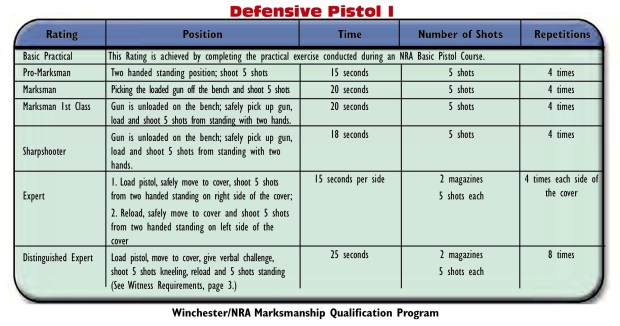
Once a person can shoot a pistol to a reasonable standard, it’s time to move on to thinking about the circumstances of personal protection and becoming proficient at decision making in that context. Decision making can be a very difficult task, especially when we are armed. Lack of proficiency, not just at marksmanship, but at gunhandling under stress, complicates this. Persons who are not Unconsciously Competent can easily become focused on the firearm rather the situation. Focusing on the wrong thing can lead to Bad Decisions, which in turn can result in Negative Outcomes.
These are the Negative Outcome categories I identified in my research. There are probably more.
- Brandishing/showing
- Chasing and shooting
- Downrange failures (shot an innocent while shooting at a threat)
- Intervention
- Lost/stolen guns
- Mistaken identity shootings
- Negligent discharges
- Self-inflicted GSW
- Unintentional shootings
- Police Involvement (arrests for non-shooting related incidents)
- Poor judgement
- Unauthorized access (generally by small children)
- Unjustifiable shootings
- Warning shots
As an example of one category, Unintentional Shootings, here’s a screencap of some of the stories I have collected.
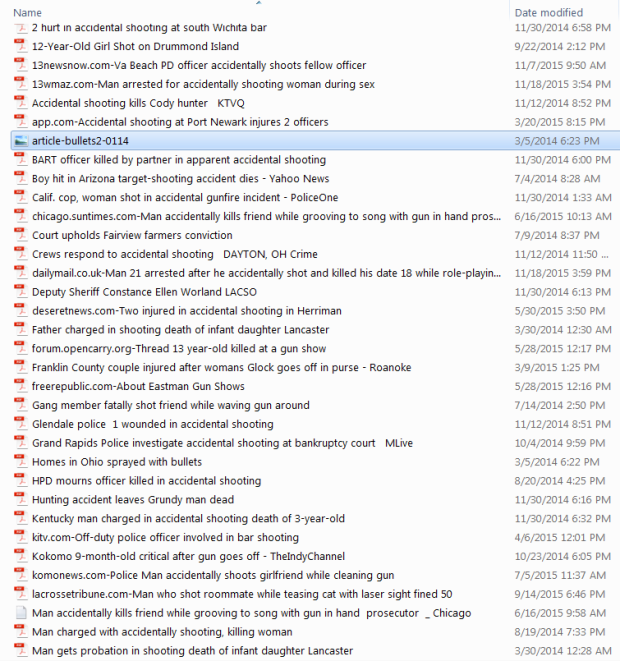
Bad decisions have serious consequences and end up being punished in a variety of ways, some legal and some social. The legal consequences are obvious; the shooter goes to court and sometimes thence to prison. The social consequences of Negative Outcomes are less obvious. If a person accidentally shoots a family member, whether the criminal justice system gets involved or not, I doubt that family relationship will ever be the same. The particular incident I am thinking of occurred when a police officer shot his daughter, thinking she was an intruder.
Decision making has many aspects to it that people don’t often consider. Where you point a gun anytime you handle it is a decision that has to be made. Consider that the next time you’re in a gun shop; where are you going to point the gun as you pick it up to ensure that you don’t muzzle anyone? This relates to another reason I am not fond of the overhand method of slide manipulation. During administrative gunhandling, which happens far more than shooting, the overhand method simply does not give the same level of muzzle control that the slingshot method does. I regularly have to correct students about muzzling themselves when using the overhand method. Using the slingshot technique, not at all.
Note that the Decision Making Process starts long before an incident. For instance, having a flashlight and then practicing with it is a decision. Not having one and/or not practicing with it is a Bad Decision. There are many other possibilities too. Failing to devise emergency plans and then discuss them with your family is a Bad Decision.
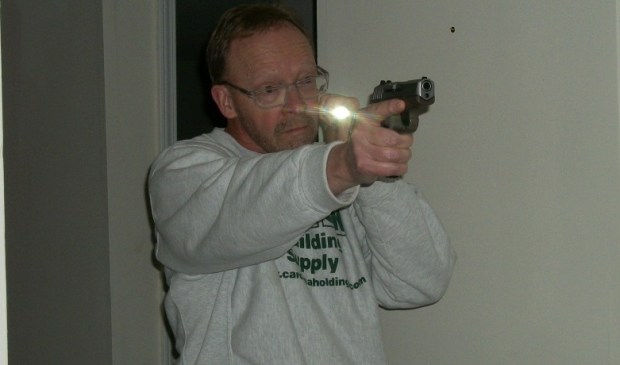
Look at the list of Negative Outcomes. The category ‘Downrange Failures’ is the only one that is marksmanship driven. All the rest relate to Decision Making and gunhandling. That’s why I changed my mind.
Friday Fundamentals – Getting our priorities straight
The attacks in Paris by Radical Islamists have captured the attention of the world and obviously people in the United States. Over 100 people were killed and several hundred more were wounded. Along with many people, I mourn for the casualties of these horrific and barbaric events.
In the aftermath, numerous articles are being written about surviving active shooter events, etc. In addition, some folks are saying they’re going to make some massive changes in the way they socialize. It’s always good to examine our vulnerabilities. However, let’s look at things in perspective.
In 2014, the estimated number of murders in the [United States] was 14,249.
In 2014, there were an estimated 741,291 aggravated assaults in the [United States].
There were an estimated 84,041 rapes (legacy definition) reported to law enforcement in 2014.
The FBI definition of Aggravated assault is:
An unlawful attack by one person upon another for the purpose of inflicting severe or aggravated bodily injury. This type of assault usually is accompanied by the use of a weapon or by means likely to produce death or great bodily harm. Simple assaults are excluded.
As my colleague Tom Givens has mentioned, one reason the murder rate has declined in the past few years is because of the advancement of emergency medicine. People who would have been murder statistics a few years ago are often aggravated assault statistics now. That doesn’t mean their bodies and lives haven’t been changed forever because of the assault.
While it’s popular to believe that most murders are committed by gangbangers killing each other and we should just say ‘good riddance,’ that’s not necessarily the case. Where the data is available, the Bureau statics indicate that strangers or unknown persons accounted for 57 percent of murders.
When considering clearances of violent crimes, 64.5 percent of murder offenses, 39.3 percent of rape offenses (legacy definition), 38.5 percent of rape offenses (revised definition), 29.6 percent of robbery offenses, and 56.3 percent of aggravated assault offenses were cleared.
‘Cleared’ means someone was arrested for the crime, not necessarily even convicted. Fully one-third of murders in this country don’t even result in an arrest. Nearly half of aggravated assaults don’t even result in an arrest. Almost two-thirds of the reported rapes don’t result in an arrest. If you become the victim of a violent crime, there’s a good chance the only ones affected will be you and your loved ones.
Relatively speaking, our chances of being criminally victimized are massively higher than becoming a casualty of a terroristic attack. Over 800,000 people in this country had their lives changed forever last year by ‘ordinary’ crime. That’s what we need to maintain our focus on.
For instance:
- Are all your doors and windows locked at night and do you keep your security system on all the time?
- Do you always make people aware you’re in the house when they knock?
- Have you ever opened your door to someone without checking the peephole to see who it is?
- Do you walk or run with your earphones in while listening to music?
- Is there a safe or lockbox in your car to put your pistol in when you can’t take it in with you to the courthouse?
- Do you make a short security halt to observe the parking lot when you come out of a store?
- How often do you text or check Facebook on your phone while you’re in a transitional environment like a parking lot?
- Do you ever park your car in the closest spot to the door of a store without regard to who’s around or what kind of vehicle you’re parking next to?
- You know all the little security violations that you make. Eliminating them is probably more useful than starting to carry an another magazine of ammo.
Another thing to consider is our usage of automobiles and just how much danger we place ourselves in when we drive. Being in a motor vehicle may well be the second most statistically significant voluntary danger we face, exceeded only by going to the hospital.
According to the National Highway Transportation Safety Administration, US car crashes killed 22,383 vehicle occupants in 2013 and injured 2,099,000.
Tactical firearms training is a lot of fun. Tactical medicine classes are very informative and might be more useful than a firearms course. But when was the last time you took a Defensive Driving Course? Some insurance companies offer online versions for free. Most insurance companies lower your premium for taking the DDC. In my state of Georgia, the class is 6 hours and costs less than $40 if you don’t have to take it because of getting a ticket. You put your life in danger every time you get in your vehicle. Don’t you owe it to yourself and your family to become a safer driver? The Situational Awareness tuneup will carry over into other areas of your life, as well.
It’s easy to get caught up in the latest horror of the week that the Lame Stream Media shoves down our throats and we then propagate among ourselves. Let’s use it as a reminder to examine all the safety risks we face. The latest event is probably way down the priority list if we dispassionately look at the many dangers we face every day.
Friday Fundamentals – Boundaries
Up until now, Friday Fundamentals has focused on mechanical issues. This issue is going to focus on mental processes. An incident that was in the news recently drives the discussion.
“It scared me absolutely to death,” said Sherry McLain. She was loading groceries into her car this past Saturday in the crowded Walmart parking lot on Old Fort Parkway in Murfreesboro.
That’s when a strange man approached, surprising her, and she pulled her revolver. “I have never been so afraid of anything in my whole life I don’t think,”
Woman Arrested After She Said She Pulled Gun In Self-Defense
There are a number of problems here that led to her arrest.
- Her level of fear was irrational. Witnesses and surveillance cameras confirmed that the man simply spoke to her from 10 feet away.
- Being startled and being legitimately rationally afraid are two entirely different things.
- She doesn’t understand the difference between setting boundaries and enforcing boundaries.
- Because she doesn’t understand the difference, she didn’t comprehend that when we are defending ourselves, there’s a hierarchy involved. First, we set the boundary and then we enforce it, not vice versa.
- As a result, she now has another issue; the criminal justice system. She was arrested for aggravated assault and reckless endangerment. Based on the current information, I doubt that will go well for her.
Let’s make something clear at the outset, when you pull a gun on someone, you’re threatening to kill them. It doesn’t matter whether you say a word or not, you’re threatening to kill them. Some people apparently don’t understand that and the gravitas it carries. You better have a good reason for doing so. Irrational fear is not a good reason. Simply being startled is not a good reason.
The question of how this might have been avoided brings us to the issues of controlling fear, setting boundaries, and enforcing boundaries.
Controlling fear is a complex topic that is not often discussed in the training community. If anything, the community tends to promote fear, “I was in fear for my life” having become almost a mantra. The woman in the incident invoked it but the police were unimpressed. The difference between reasonable fear and irrational fear is frequently left out of that discussion. It’s somewhat pathetic that there’s better literature in the competitive swimming community about how to control fear than there is in the self-defense community. Learning to control fear is a process beyond the scope of a single blog post. It behooves those who carry deadly weapons to do some research on the topic.
The next issue is boundary setting and boundary enforcement. This is a process more easily trained than controlling fear. Boundary setting and enforcement are simply elements of a process. All we need to do is understand the process and practice it.
It’s important to understand that we set boundaries with communication and barriers, not with tools. The communication can be either verbal or non-verbal. The most obvious form of barriers are the homes we live in, assuming the doors and windows are closed and locked. If a criminal fails to respect the boundaries we set, then we use tools, in this case weapons, to enforce the boundaries. We don’t use tools at the outset to set our boundaries.
One of the biggest issues we have as a society is that we have forgotten or gotten out of the habit of saying NO! That can be done either verbally or non-verbally. Training to say NO! should be a primary lesson in every class on personal protection and people should practice it on a regular basis. Simply raising an outstretched hand and shaking the head can accomplish a lot. Keep in mind that a great deal of communication is non-verbal; we can use that fact to our advantage.
A proper sequence that would have kept this woman out of trouble might be as follows:
Recognize that being startled is not the same as being afraid. She was startled because she was task fixated on loading her groceries in the car, i.e., she had not one bit of situational awareness. Most people are like that. In this sort of a situation, looking around before you get to the car, as you arrive at it, and then after loading each bag goes a long way toward avoiding being startled. Positioning the car for safety helps too. In the sense of color or awareness codes, she was in White or Unaware.
If she had been in Yellow or Aware and seen him approach, there’s nothing wrong with being proactive and raising the hand in the ‘stop’ gesture. That’s the first step in setting a boundary. Her mental state at that point could be described as Orange or Alert.
And yes, at this point, we could invoke the boogeyman of ‘The 21 foot rule’ that Dennis Tueller himself says has become terribly misconstrued. But the circumstances where a criminal runs up to someone in a WalMart parking lot and slashes their throat are far less common than ‘incrementing,’ which is a standard way for criminals to operate. Whether those throat slashings are in fact, reality or figbars of overactive imaginations remains to be seen.
If the person continued to advance, a default verbal response of ‘Stop, don’t come any closer’ clearly sets the boundary. Any decent person would stop at that point. If the person doesn’t stop, it’s an indicator that something nefarious is developing. The mental state shifts to Red or Alarm. Once the intent of the other party becomes more clear, then we can make a decision about which tool we want to employ to enforce the boundary. We can also determine what barriers we might employ in the process. That, too, is a discussion for another time. The boundary setting and enforcement decision process is what’s important in this particular case.
Another thing to consider is that any time we get a gun out for defensive purposes; be that from a holster, purse, nightstand, safe, or whatever, there’s a possibility it’s going to be fired, either intentionally or unintentionally. The more scared we are, the higher that possibility. Therein lays one of my chief objections to brandishing, which is what the lady did; the possibility it will culminate in a Negligent Discharge.
Since thinking about the ‘worst case’ is something many people like to do, let’s examine the possibility of a Negligent Discharge in this situation. Say the woman had an ND as she pointed her revolver at the man or the other people present. It’s probably a good thing for all of the parties involved that she had a revolver and not a striker fired autoloader. If her irrational fear had caused her to have an ND, what would be her eventual statement in court? Something to the effect of “He asked me for a light, I was scared so I drew my pistol, I had an Accidental Discharge, which resulted in a death. It was an accident.” Most likely, she’d go up the river for Manslaughter. Fortunately, that particular Negative Outcome didn’t happen. What did happen was the Negative Outcome of ‘Police Involvement,’ to wit, getting arrested.
If this lady had understood the awareness and boundary processes and then used them properly, she probably would have gone home instead of getting arrested. That’s something for all of us to consider.
Snub Revolver DVD Special
Sometimes, you’ll be surprised what you find when you clean.
–my Mother
And she was right. Another box of Secrets of the Snubby turned up. I’m running a package deal on Secrets and Fundamentals as a combo. Only $24.95 for both when purchased as a package.
I like snubs and I like to push the performance envelope with them. Once you know what you’re doing, snubs are a lot more than an “arm’s length gun.”
10 Rules for Being a Safe Gun-Owning Parent
If I never had to make another entry to my ‘Accidental Shootings by Children’ datafile, I would be quite happy.

Rebecca Bahret of SheKnows.com contacted me recently about compiling a list of the top X-number of safety tips for gun storage when kids are present. I was flattered she thought enough of the blog to ask me. I obliged, obviously, and thought of ten items. With word-count limits, deadlines, and so forth, it was trimmed down a good bit.
It was even worthy of an infographic! Legit.
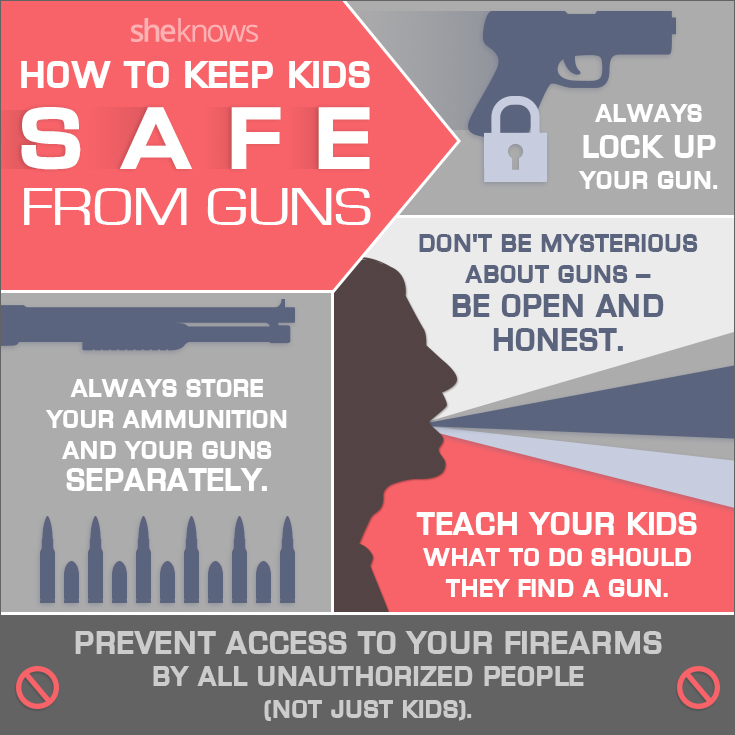 Image: Terese Condella/SheKnows
Here is her final article. It’s a great article for her target audience.
Since I’m not obligated to any word count limits, here’s what I sent her. I hope it makes a good compliment to her article:
- This whole list will share a common theme. I teach it as the *Fifth* fundamental firearms safety rule. Here’s the first four. The rule is, “Prevent access to your firearms by unauthorized people”. Children are on that list of people we don’t…
View original post 429 more words
Friday Fundamentals – Measuring time in your firearms practice
Fast is fine, but accuracy is everything. In a gun fight… You need to take your time in a hurry.
–Wyatt Earp
One of the memes in firearms training is “I’ve never seen a timer in a gunfight.” This is hugely misleading in the way it’s often understood. The timer that is present is your life-clock. Don’t think it isn’t running every nanosecond of a deadly force encounter. While we need to be deliberate and make our hits, as Earp stated, we don’t have all the time in the world to do so, as he also stated. So we need to establish some kind of time standards in our practice, at least for some of our drills. The question is how do we do so, both in principle and in practice?
There are two principal ways of measuring time. One is measuring it directly. For instance, a shooter might be able to draw and fire a pistol in 1.4 seconds. To achieve a meaningful level of accuracy in that measurement, we would use a ‘shot timer.’ Shot timers give an audible or visual signal to the shooter and then record the time taken for the task via a microphone in the timer that hears the shots. Shot timers range from fairly simple push a button types costing around $125 to more complex devices with numerous features than run about $200. They all work fairly well. The choice largely depends on the features you want. One downside is that shot timers cost more money than many people want to spend.

On outdoor ranges, shot timers work really well. On an indoor range, not so much. Measuring time is much more difficult in the indoor environment. Multiple shooters adjacent to each other interfere with using a standard shot timer. If your timer is picking up the sound of someone else’s shots, it’s not doing you any good.
This issue brings us to the second way of measuring time, par time. Par time means that the shooter has a fixed amount of time to accomplish the task. Drawing, reloading, and presenting from ready are all tasks that can be accomplished in par time. For instance, we might say that a police officer is allowed 2.0 seconds to draw from a security holster. Par time lends itself much better to mass training, such as in the police and military than individual measurement, which would be prohibitive for training time-wise.
The times in the NRA Marksmanship Qualification Program and The Tactical Professor’s Pistol Practice Program are par times. So are most police qualification courses. Some ‘proficiency demonstrations’ that private citizens are required to do to obtain a Concealed Handgun License are timed. Those are par times, as well.
Par time can also be an effective way of practicing on an indoor range because we don’t have to be concerned with the effects of other shooters’ gunfire on a shot timer. Most shot timers will also do par time by sounding a second beep at the end of the par time. Unfortunately, the second beep is easily drowned out by nearby gunfire.
The simplest solution is to have a partner time you using a watch or stopwatch. Your partner can tap you on the back once for go and again for stop. It’s not terribly accurate but better than nothing.
If you go by yourself, an interval, or countdown, timer can provide a workable solution, especially if it has a visual signal or vibrates. This is a good way to get around the noise issue of indoor ranges. The vibration is becomes your start/stop signal
The first solution I used is a vibrating wristwatch. It has a countdown timer function.
 Another is the Gymboss that can be clipped to the pants or belt.
 The CED Universal Countdown Timer vibrates and also has a visual signal the form of a blinking light. This is the one I find myself using most.
 Time is a critical component of defensive training that many people don’t work on for a variety of reasons. Adding in time pressure to your shooting practice is a worthwhile way to increase your proficiency. If you are going to get a Concealed Carry License in a state that times the qualification course, it’s a good idea to practice ahead of time to get a feel for the cadence you’ll have to shoot at.

Friday Fundamentals – Performance Standards
Without testing, there has been no training
Shooting a pistol is an athletic activity. Like any athletic endeavor, we need to have some performance measurement standards. Measurement is the operative word here. We need to measure our downrange performance, i.e., how well we can hit the target, if we want to become better at shooting. There are numerous variables that can be called into play for measurement.
As an example of athletic measurement, the current US Army standard for my age cohort is a minimum of 27 sit-ups in one minute. More sit-ups means more points scored. The Army Physical Fitness Test has to be taken twice a year.
In weight training, we might simply measure how many repetitions of lifting a given amount of weight we can do until we can’t lift anymore. Over time, our objective is to be able to lift more weight and/or perform more repetitions.
Police officers have to undergo periodic testing of their shooting ability. The period might be anywhere from once a year (mandated by every state I am aware of) to four times a year (LAPD and FBI).
What might be a set of reasonable standards for the average gun owner? I’ll offer the following as a progression that a gunowner could use to see where their skills stand on a periodic basis. It’s less than 100 rounds, so there is some room for remediation, if necessary. Because firearms skills are perishable, I’m more in favor of the LAPD/FBI approach of doing an evaluation four times a year rather than just once.
1) LAPD Retired Officer Course
Shoot 10 shots at a silhouette at 7 yards with no time limit. The LAPD standard is simply that 7 of the ten have to hit. Our standard should be to have, at a minimum, all 10 rounds hit within the 7 ring of a B-27 or an equivalent.
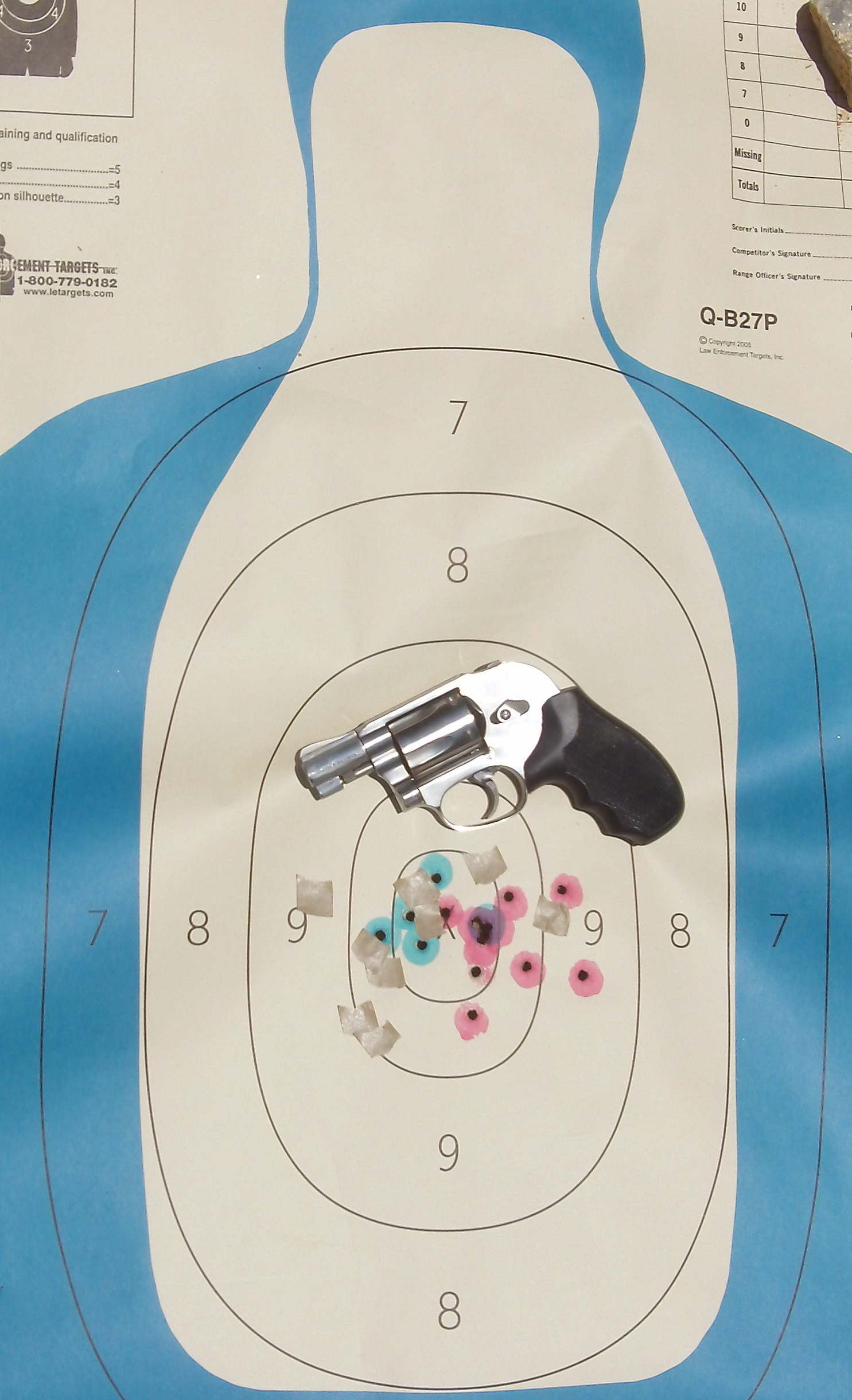 The point of this is to learn how fast we can shoot and still make our hits. Even the LAPD SWAT has learned and trained the cadence they can make consistent hits on a target. It’s not by shooting as fast as they possibly can, it’s by paying attention to what they’re doing while they’re shooting. I got that from Darryl Bolke.
If you meet the standard, then move on to the next component. If not, work on getting your fundamentals in better shape.
2) NRA Basic Pistol
Shoot a five-shot group within a 9-inch diameter circle (paper plate) at 15 feet with no time limit. Repeat twice for a total of three times. All the shots have to hit the plate. My colleague Chuck Haggard commented to me:
I wonder how many people never shoot anything but a full value target [i.e., complete silhouette] at 3-5 yards and call it gtg [Good To Go].
I agree with him completely; assuming that we’ll always have a full body presentation to shoot at in a defensive encounter is a mistake. If you can’t hit a paper plate consistently at five yards, you should work on being able to do that. See the sights and press the trigger smoothly. If you can make the standard, then move on to the next.
3) NRA Defensive Pistol I – Pro-Marksman
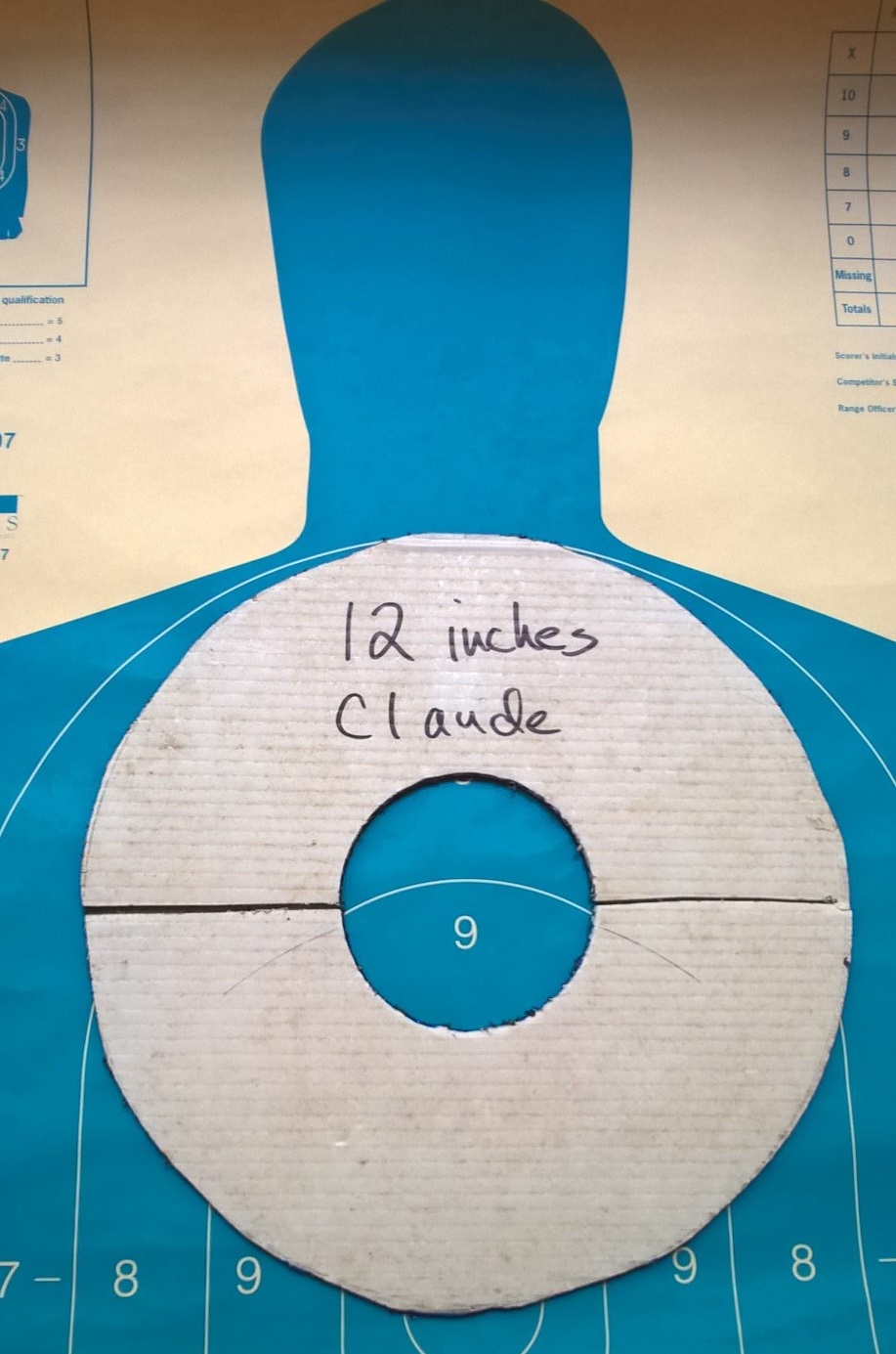
Shoot a five-shot group within a 12-inch diameter circle at 21 feet in fifteen seconds. Repeat until you’ve done it four times. The four times don’t have to be consecutive, however the standard of every shot having to be in the circle is. This drill is a lot more difficult than most people think because of the 100 percent hit requirement. Even though 15 seconds is a very generous time standard, knowing you’re on the clock makes it more difficult. Once you’ve made it four times, move on to the next component.
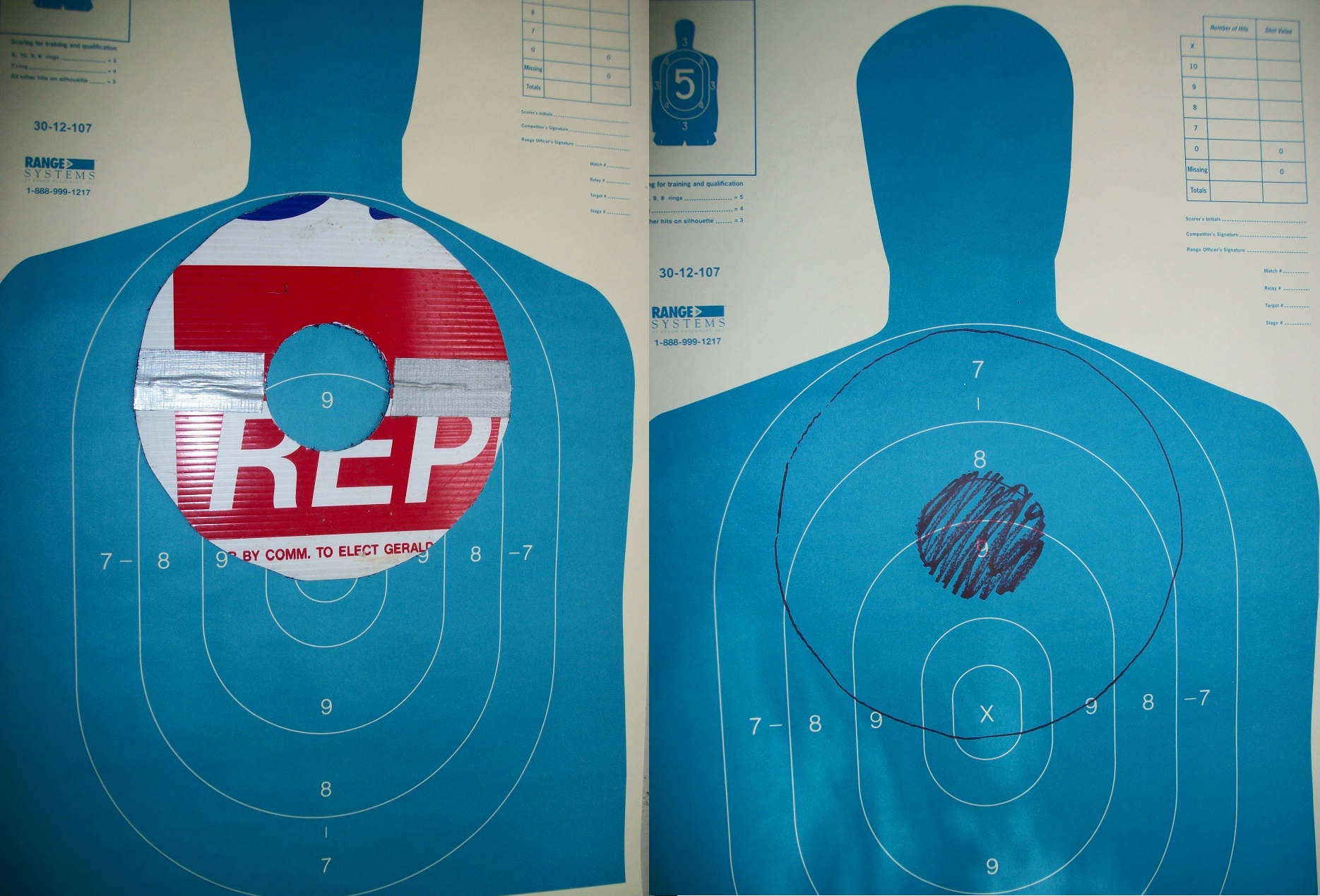 4) 5^5
Shoot five shots into a five inch circle at five yards in five seconds. Do it five times in a row. This is a very difficult drill for most people. Only do it once to get an idea of how well you can shoot it. It’s a good practice drill for other times you shoot. After shooting it once, move on to the final component.
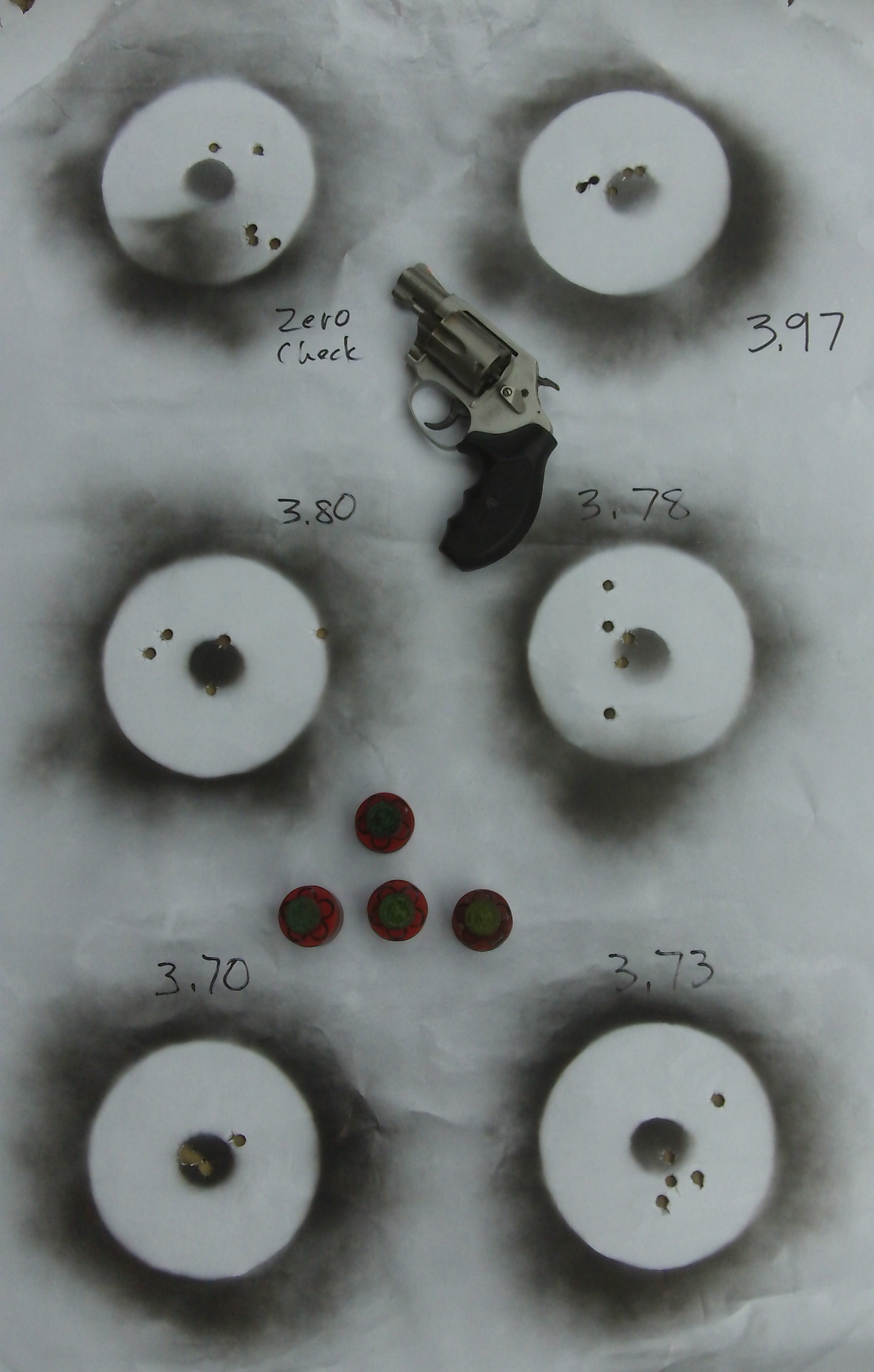 5) NRA Off-Duty Pistol Course – Stage 3
Shot at 15 yards on a B-27 silhouette target. Load with six rounds only; you will need another magazine or speedloader loaded with six rounds also. Start double action if your pistol is so equipped. Fire six shots, reload, and fire another six shots for a total of 12 shots from a standing position, no support from bench or wall allowed. The time limit is 20 seconds, including the reload for the second 6 shot string. Score it based on the number value of the rings. The maximum point value for the string is 120.
Although many people think that a Private Citizen cannot legally justify shooting past seven yards, that is absolutely not true. I have a number of incidents in my database where Private Citizens shot at longer distances and it was completely justified. If a gang banger is shooting at you and your children at 23 yards, you are legally justified in shooting back. That assumes you have the skill and are cognizant of the background.
If you don’t need to do any remedial work during the session, you will fire 82 rounds total. That gives you a little left over to play around with as you please. Using a progression of drills that increase in difficulty gives you the opportunity to evaluate where you need to work on your skills to improve. Keep a record of how you did on each drill. Having a record is key to knowing what you need to work on in your practice sessions.
If it all seems easy, you can do the drills one handed; either dominant hand only or support hand only.
Friday Fundamentals (Segment 4) Shooting with a flashlight
Several Negative Outcomes were brought to my attention this week. One was yet another incident of someone shooting their spouse, thinking it was a burglar. She died as a result of one shot to the chest.
The husband told police it was an accident. He told officers he woke up around 4:15 Saturday morning and heard noises in his house … He told investigators he grabbed his gun and when he saw a light on and someone standing in the distance, he took a shot. He said the person he ended up hitting once in the chest was his wife.
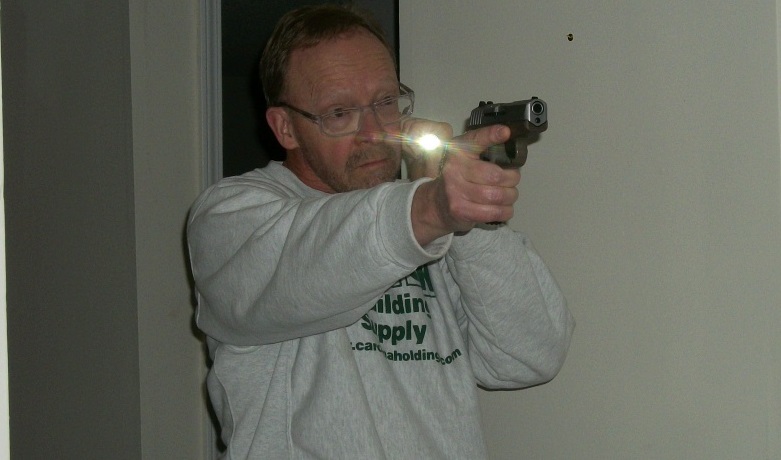
This sad situation bolsters my contention that when we pick up a pistol at home, we have to pick up a flashlight at the same time. That’s why I made flashlight shooting an integral part of The Tactical Professor’s Pistol Practice Program. To get some repetitions in and reinforce the habit for myself, I went to the range this week and shot the entire NRA Defensive Pistol I marksmanship program using a flashlight.
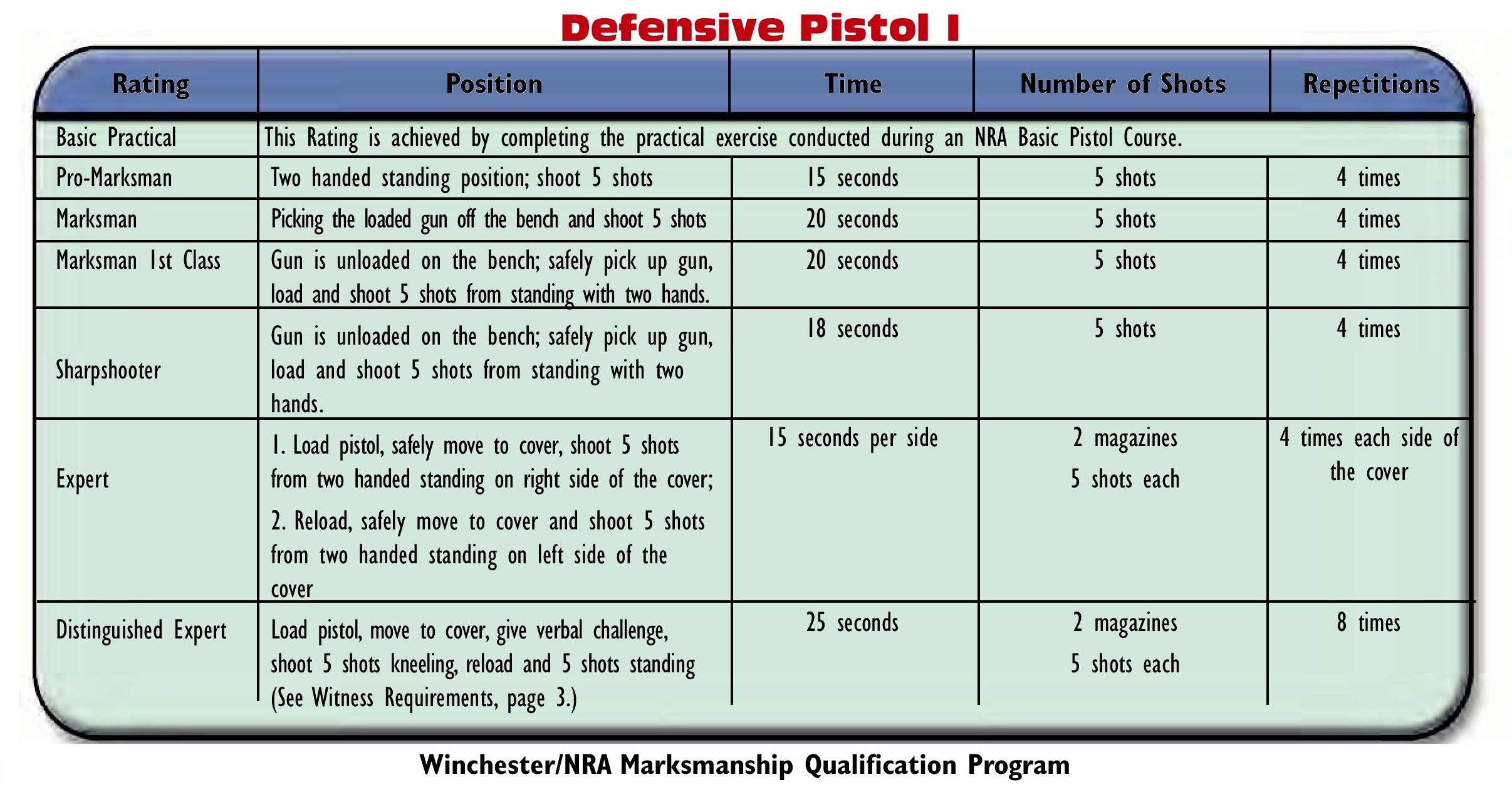 As a curiosity, I also used a timer instead of going by the PAR times in the program. The pistol I used was a Beretta Jaguar in .22 Long Rifle. Many in the industry poo-poo the .22 as a defensive tool but .22s have worked for me. An aspect of .22s I like in the practice context is that shooting several hundred rounds in one session isn’t punishing, either physically or financially. I shot it at my gun club but the way Defensive Pistol I is structured, it can be shot at just about any indoor range. That’s an aspect of the program I really like.
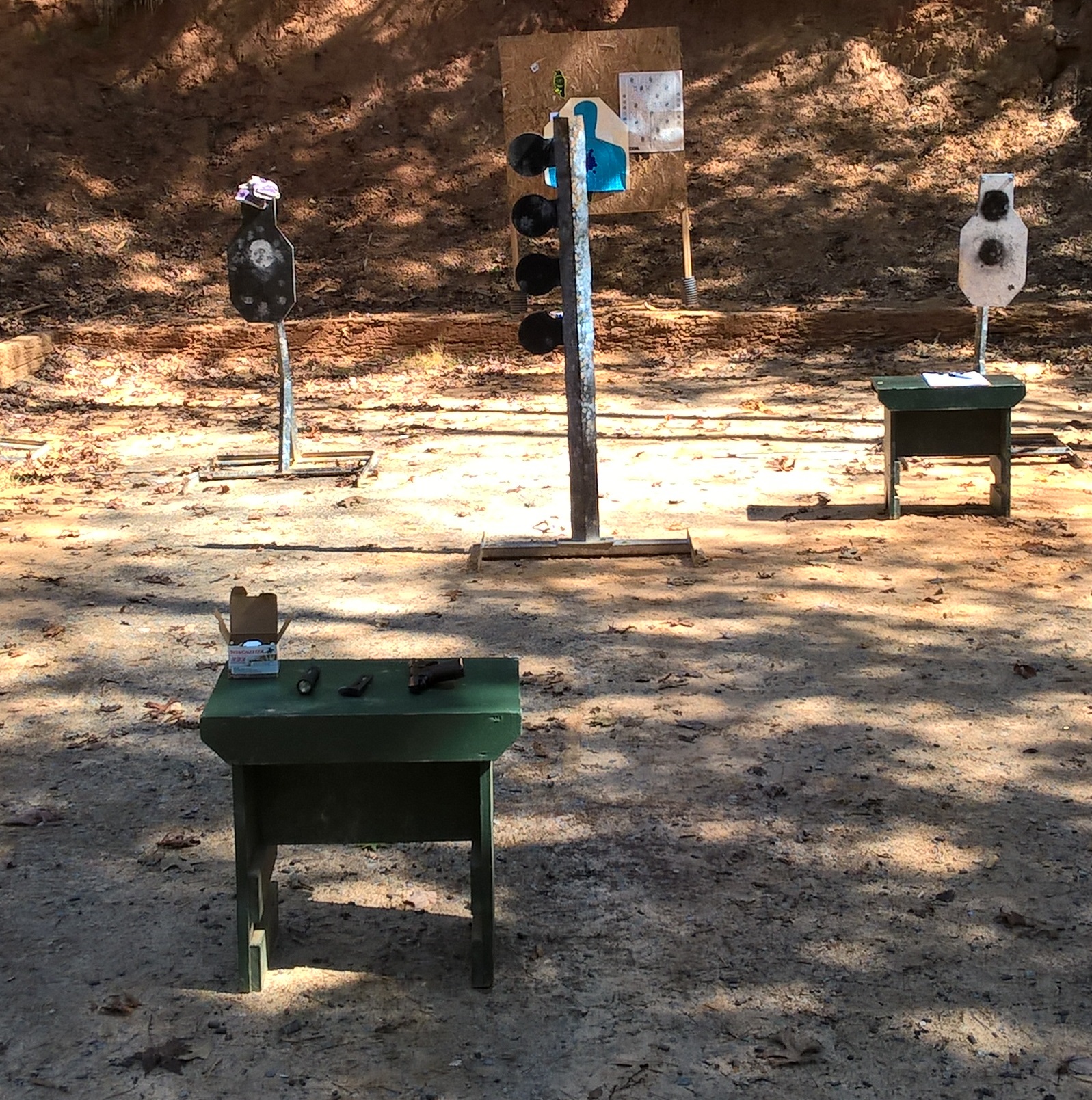
What I did was to have my pistol, my flashlight, and the timer on a stool in front of me. The target was downrange at the specified seven yards.
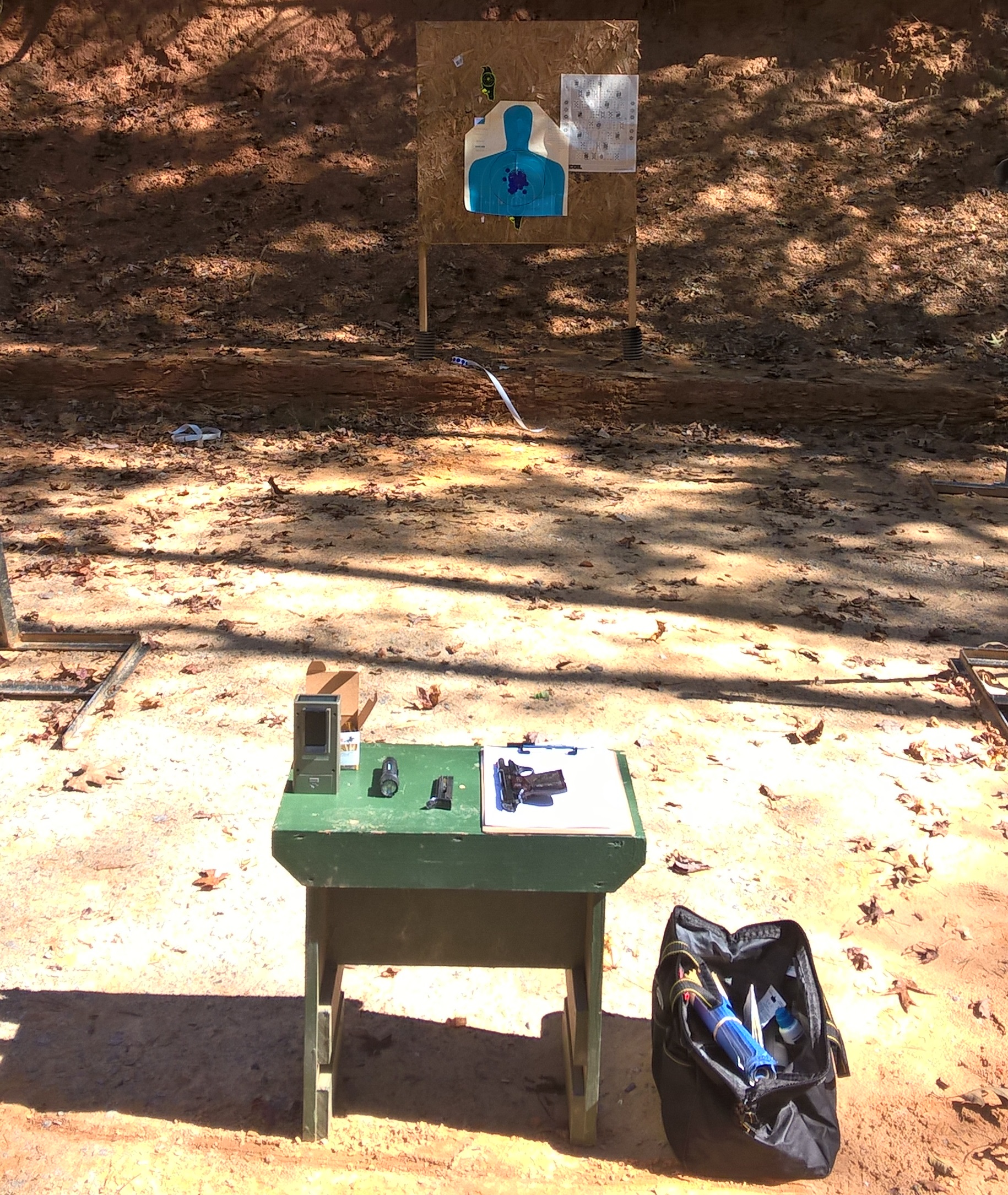 The target was a B-27 with the NRA AP-1 8 ring and X ring marked on it with a template.
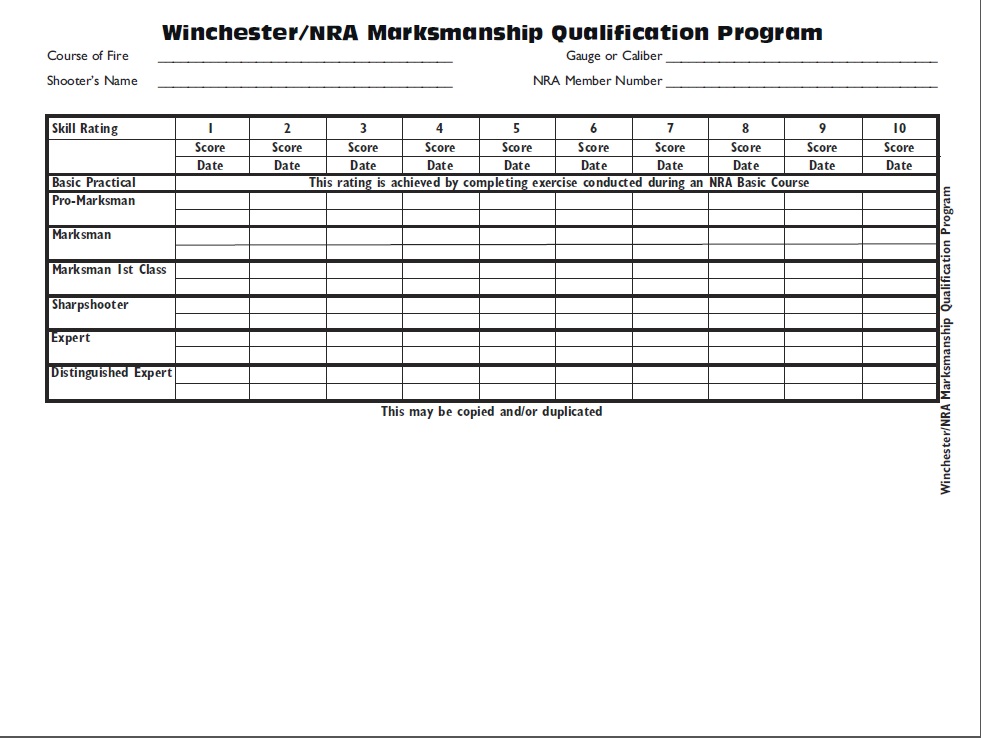
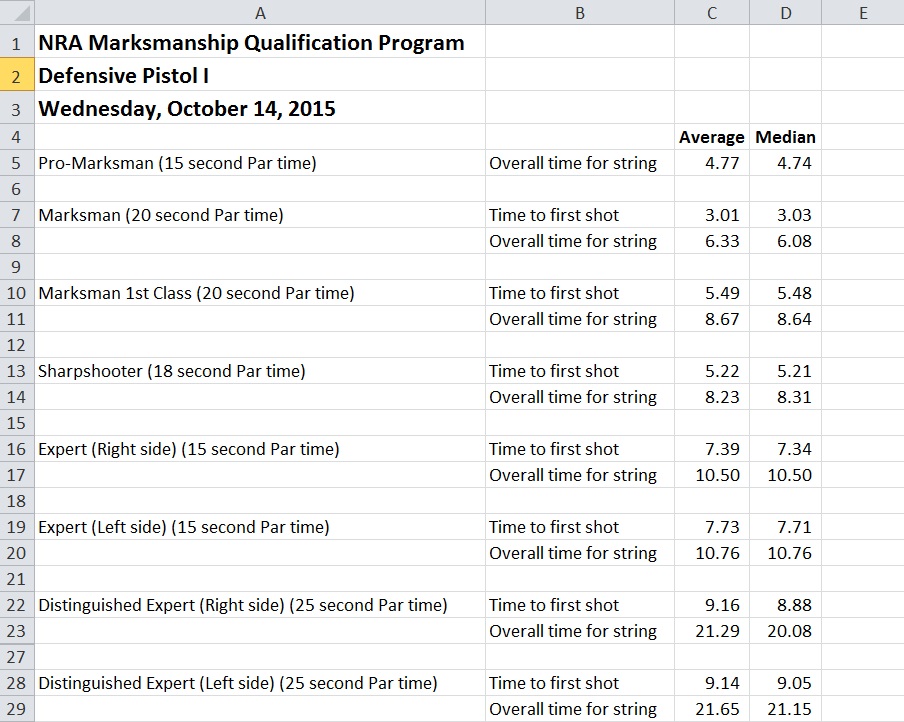
 When the timer went off, I would pick up my pistol and flashlight simultaneously, assume the cheek position, and then shoot the specified string of fire. For the phases requiring loading the pistol on the clock, I picked up the pistol and magazine, loaded it, and then picked up the flashlight. After each string, I recorded my times. The NRA provides a scoresheet but it is set up for Pass/fail scoring, so I made my own scoring matrix.
 I checked the target after each string to make sure that I had the required 100 percent hits. At the end of each phase; Pro-Marksman, Marksman, etc., I marked the target with blue dots to cover my hits.
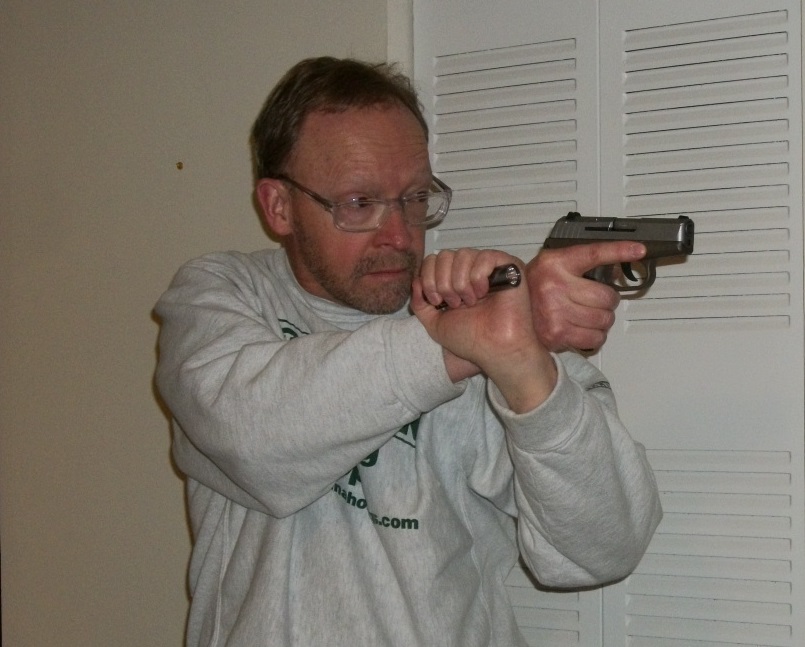
For most of the program, I used the cheek technique.
 The Expert and Distinguished Expert phases require shooting from behind cover. There weren’t any barricades readily available so I used the dueling tree in the bay to simulate cover.
 The Expert phase requires shooting around both sides of the cover. When shooting around the left side, I continued to use the cheek technique. When shooting around the right side, I used the Harries technique.
 The Distinguished Expert phase doesn’t specify shooting around both sides of the cover. However, it does requires eight runs instead of four, so I shot four around the right side and four around the left side.
I was able to maintain the 100 percent standard and got a good idea of my times to accomplish each Phase.
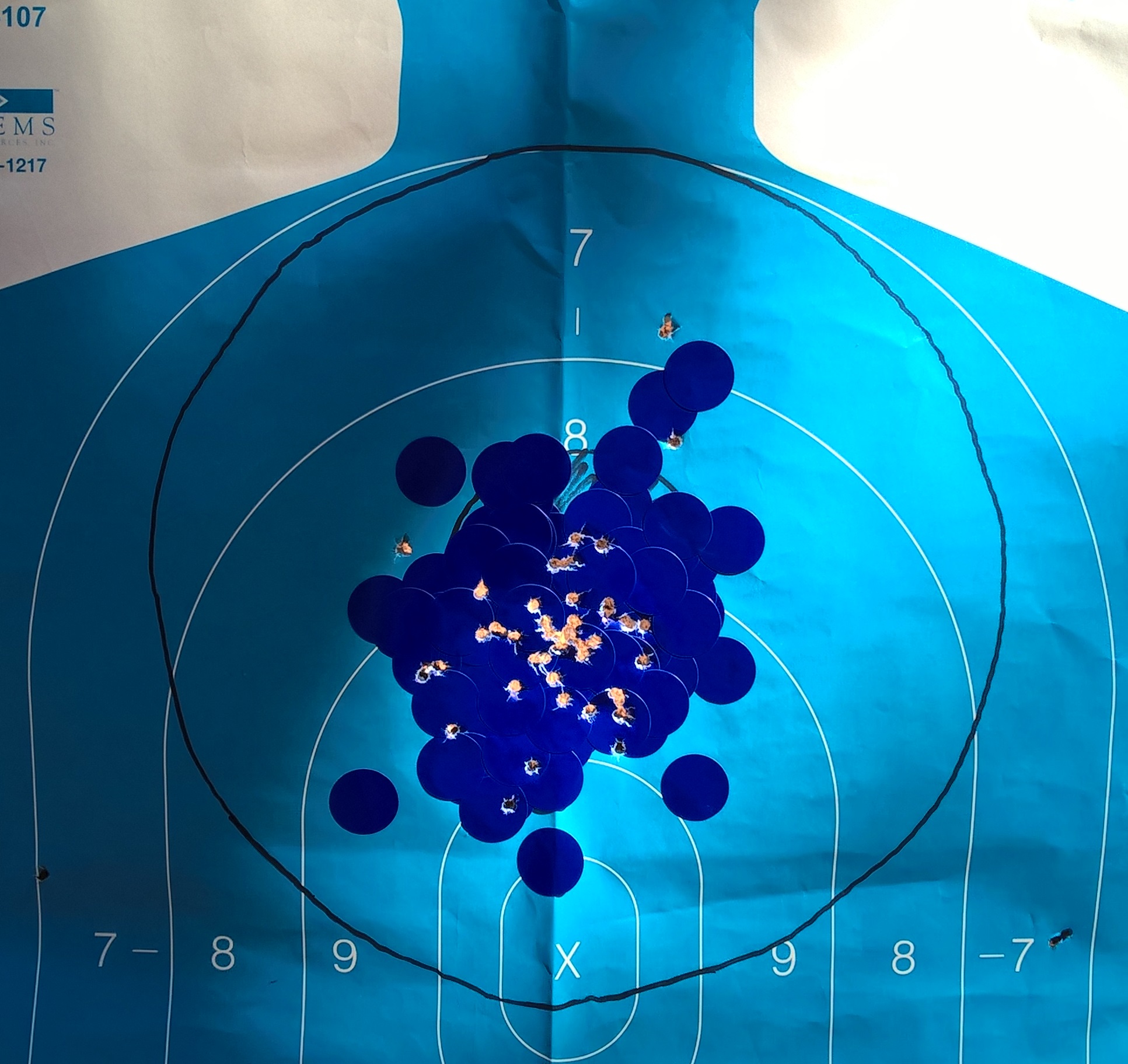
 To finish off the day, I used the dots to create some eyes on the target. Then I shot a couple of groups at five yards.
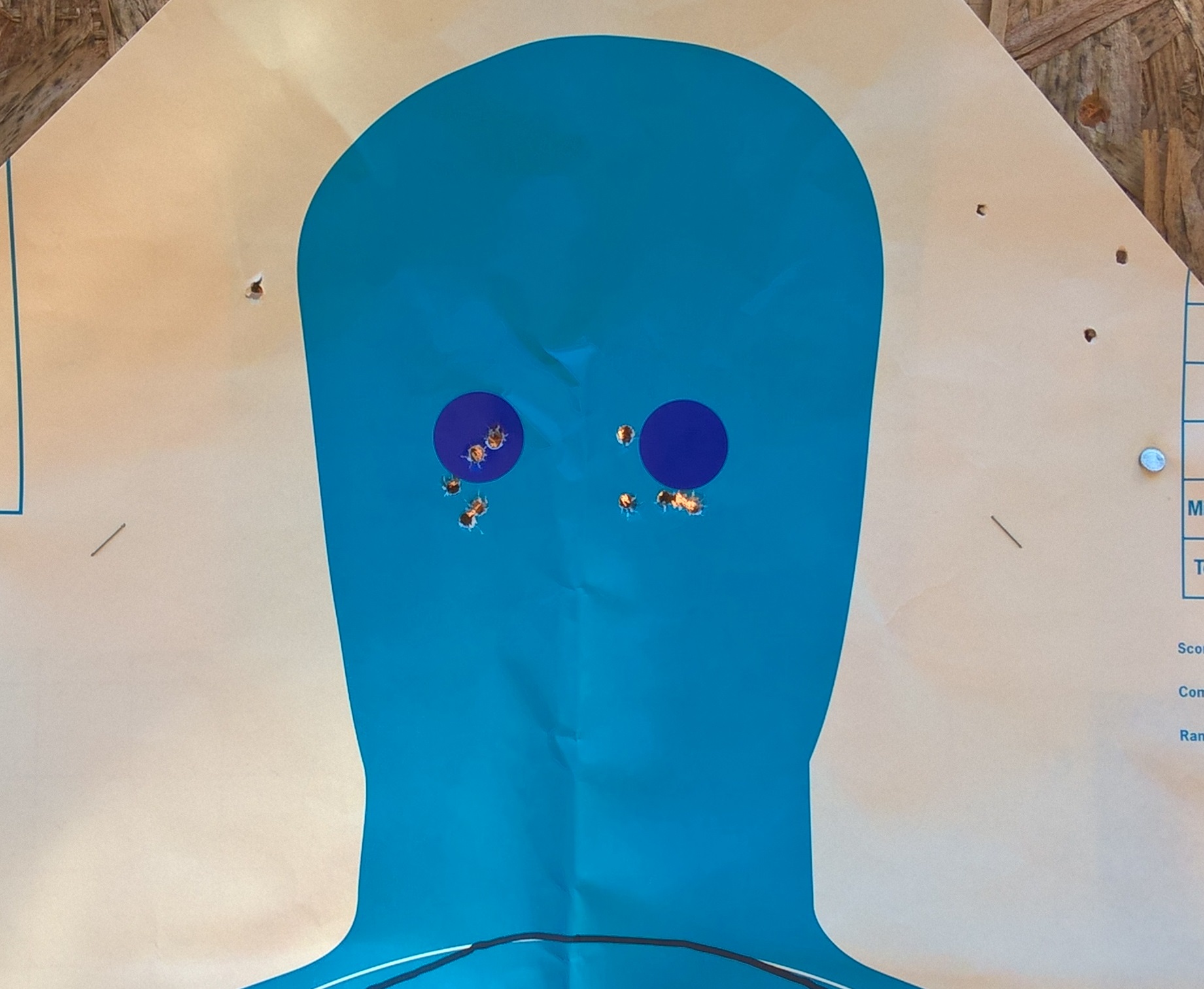 Getting in relevant practice isn’t necessarily hard; it just requires a little creativity and forethought.
 tacticalprofessor
You must be logged in to post a comment.