Sight misalignment, speed, and accuracy
While I was teaching a private lesson last week, my student was struggling with improving his times, while maintaining an acceptable degree of accuracy. I could tell by the size of his groups, which were quite small, relative to the speed he was going, there was a fundamental that he didn’t understand. The front sight does not have to be perfectly aligned in the notch to produce good hits. So, I had him do a drill to demonstrate the acceptable degree of sight misalignment that will still result in hits on target.
The drill is to fire the pistol with the front sight on the target but with the rear notch deliberately misaligned. It is conducted in four parts consisting of two shots each.
- Front sight half way above the top of the rear notch,
- Front sight lowered so that its top edge is half way down in the rear notch,
- Front sight pushed to the right so that its right edge is touching the side of the rear notch, and
- Front sight pushed to the left so that its right edge is touching the side of the rear notch
This is the diagram I drew to show him what it should look like.
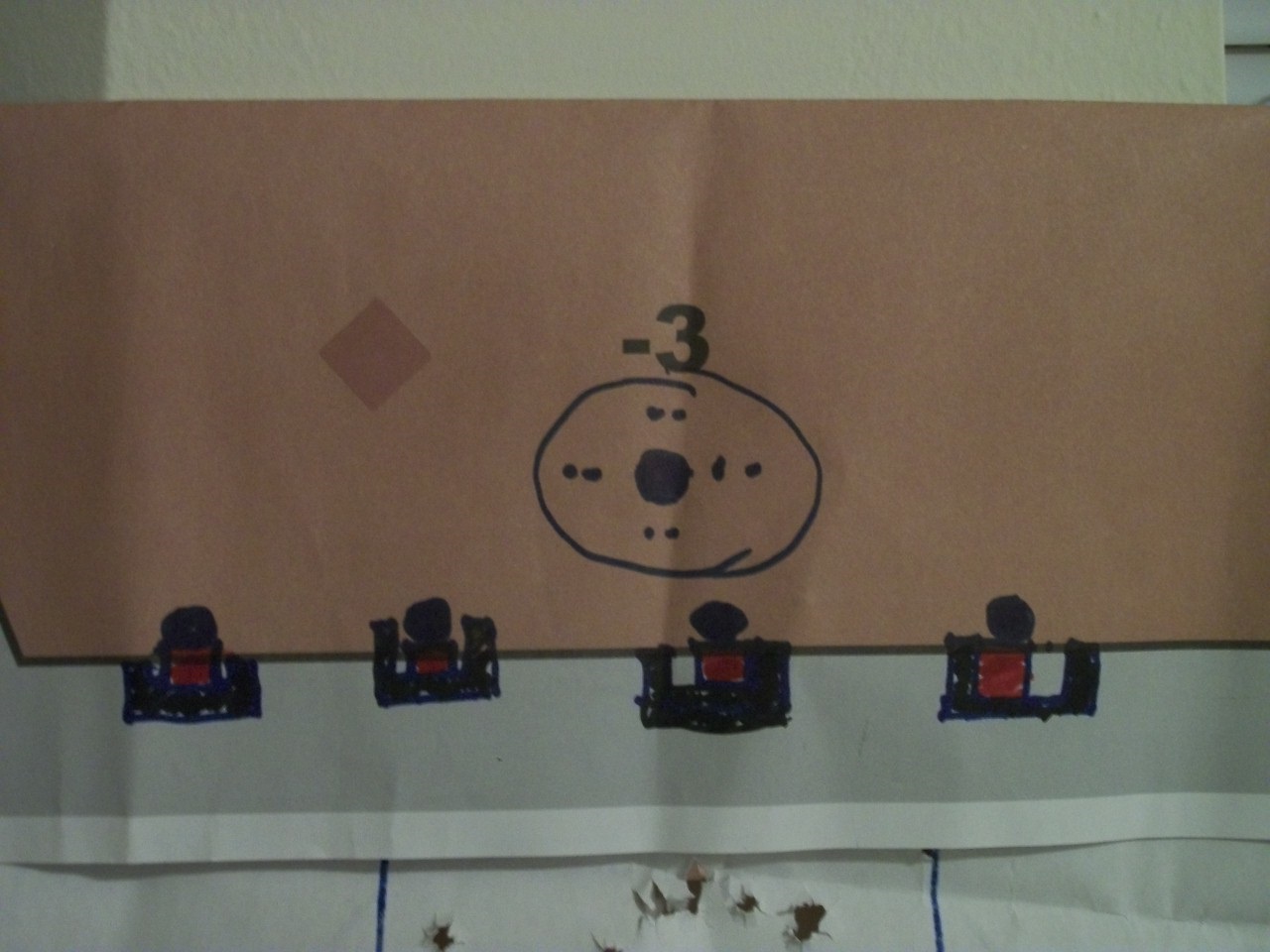
The front sight is aligned correctly on the target with the misalignment done to the rear sight. I prefer to use a dot as the target to get the most graphic result. In this case, I used a 1 ¾ dot. There’s no magic to that number; it just happens to be the size of the template I had.
I had him shoot the drill at seven yards. This was the result. His group measured about four inches at that distance. For many people, trigger manipulation issues will have a greater effect on their accuracy than will sight alignment.
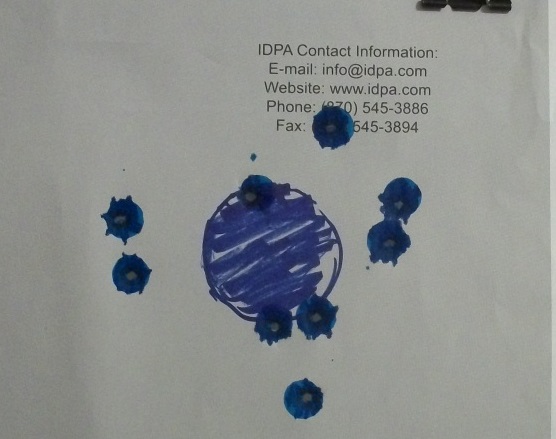
Once he understood that he didn’t need a perfect sight picture, the speed of his shooting picked up and his accuracy remained well within acceptable limits. As long as the front sight is close to the center of the target, a certain degree of misalignment will still produce a good hit. Not worrying about getting a perfect sight picture will result in a noticeable increase in speed.
Incidentally, this drill is a part of the NRA Personal Protection In The Home Course. Experienced shooters like my student usually think they have nothing to learn from NRA Courses. Often, this is a misconception on their part. [Thanks to those who pointed out that I had misremembered the NRA Course the drill is part of.]
Bad habits
My friend, Paul Carlson, posted a link about the new Taurus TCP with wings on Facebook. ETA: this is not Paul handling the gun but rather him commenting on another website.

I withhold comment on the viability of the wings, but the Jose Canseco “shoot your finger off’ hold used in the photos is unforgivable for someone who is supposed to be a firearms semi-professional. People who live in glass houses shouldn’t throw stones.
Oh, but that’s OK because “it’s not loaded.”
No, it’s not OK. That’s how we get into sloppy habits that bite us in the ass.
http://www.guns.com/2015/01/14/former-cop-suing-gun-shop-after-he-accidentally-shoots-himself-video/
Maybe I’m becoming obsessed with ‘negative outcomes,’ but I see a lot of bad gunhandling by people who should know better. Don’t get into habits that can come back to haunt you under a different set of circumstances.
Keeping dryfire interesting
How much you last practiced isn’t as important as when you last practiced.
One of the Facebook groups I’m a member of is called 1000 Days of Dryfire Challenge. It’s a group whose members have committed to doing my ‘1000 consecutive days of dryfire’ concept. What I found the first time I did the 1000 days was that regularly devising new regimens and switching them around was important to keep the program interesting and avoiding boredom with doing a single regimen all the time.
A regimen I’ve been doing the past few days is a dryfire version of the Federal Air Marshal Tactical Pistol Course. The target I made is a reduced scale triple QIT printed on 11×17 paper at FedEx Office. It’s scaled for 2.5 yards. What I do is print the image from a flash drive on 11×17 paper at FedEx office and set the copier to ‘resize to fit page.’ Resizing is one of the menu options when printing from a flash drive. Feel free to download the image and try it yourself.
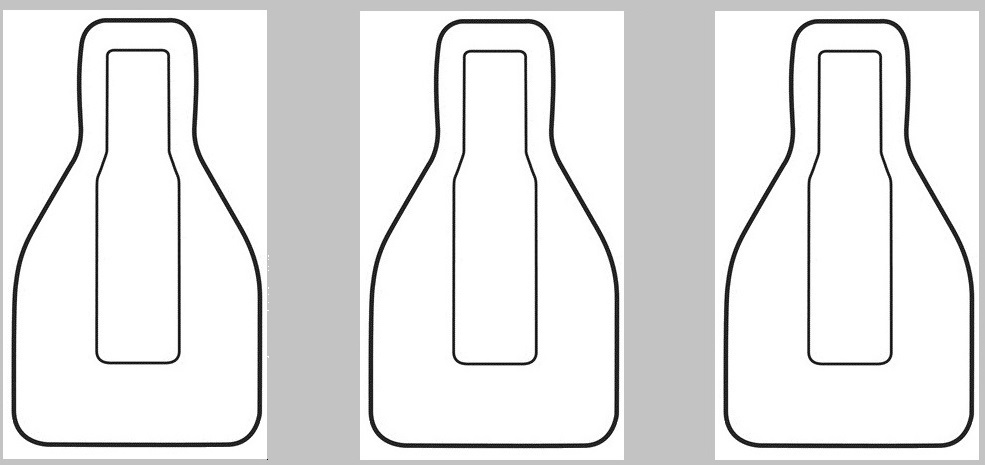 The spacing isn’t quite wide enough on a single piece of paper but nothing is perfect. I punched a hole in the paper at the measured middle point so I can hang it on a picture hanger in the wall. Regular paper tends to sag when hung on the wall, so I stapled it to a piece of cardstock.
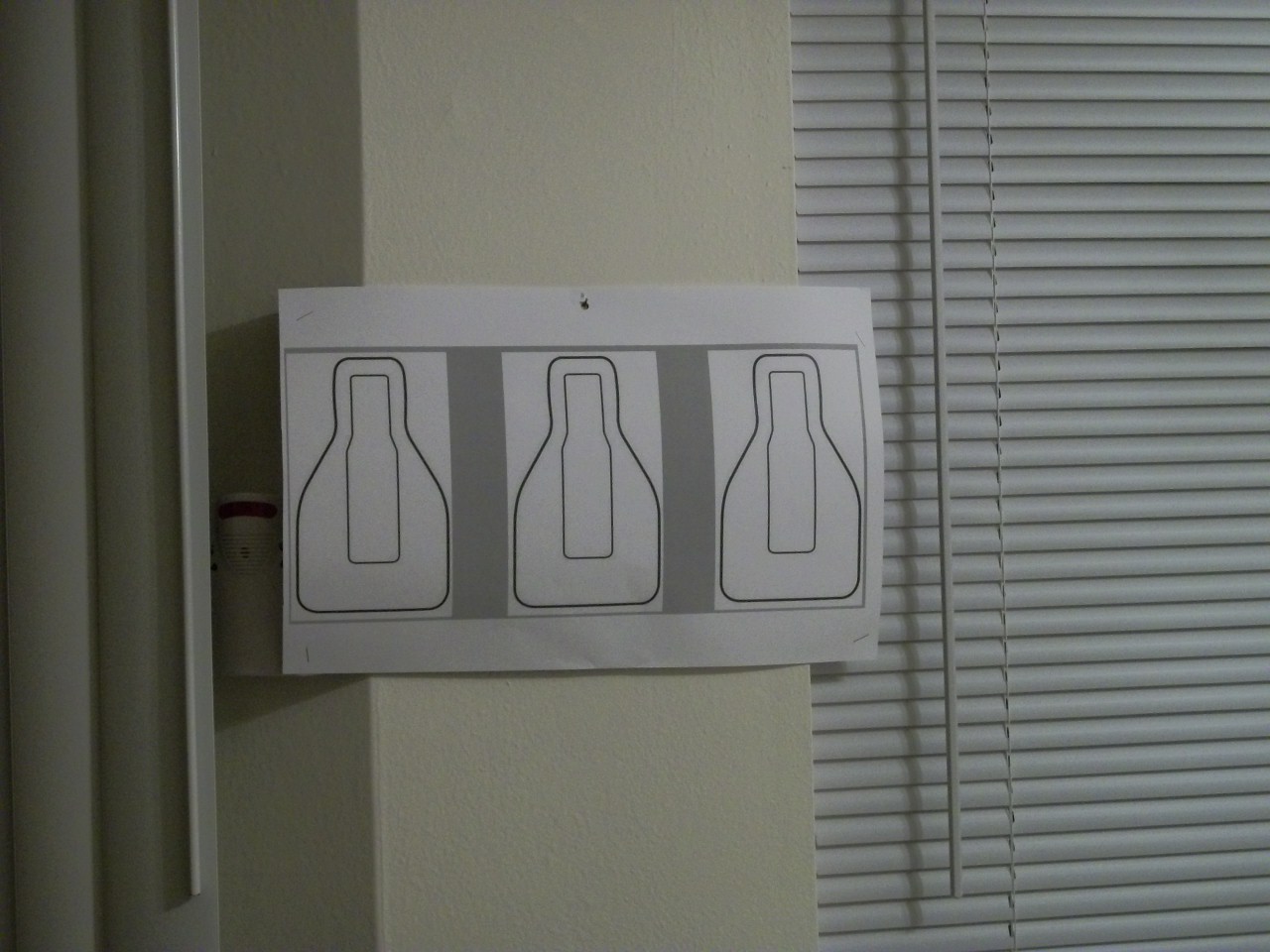 I’m using my SCCY pistol because it’s DAO with second strike capability so I can pull the trigger on almost all the shots. The only one I have to fudge is the final stage because it involves two strings starting with a slide lock reload. I start those strings with the slide locked back, so the first shot is a dead trigger.
Since the TPC is based on Par times, like most police courses, I set the par times on one of my CED 6000 timers. It’s a great training timer, which isn’t made any more, unfortunately. The CED has an option for multiple strings of par time, which makes it easy to set up the multiple string stages. Like most timers, it only sets par times to one tenth of a second, so I round the times down, e.g., 1.65 becomes 1.6 seconds.
Federal Air Marshal Tactical Pistol Course (TPC)
| Drill | Starting Position | Seconds Allowed | Total Rounds |
| One Round (twice). | Concealed Holster | 1.65 (3.30 total) | 2 |
| Double Tap (twice) | Low Ready | 1.35 (2.70 total) | 4 |
| Rhythm; fire 6 rounds at one target; no more than 0.6 between each shot. | Low Ready | 3.00 | 6 |
| One Shot, speed reload, one shot (twice). | Low Ready | 3.25 (6.50 total) | 4 |
| One Round each at two targets 3 yards apart (twice). (Use the outer targets. I go left to right for one string and right to left for the other.) | Low Ready | 1.65 (3.30 total) | 4 |
| 180 degree pivot. One round each at 3 targets (twice). Turn left, then right. | Concealed Holster | 3.50 (7.00 total) | 6 |
| One Round, slide locks back; drop to one knee; reload; fire one round (twice). | Low Ready | 4.00 (8.00 total) | 4 |
QUALIFICATION:
- TIME: Cannot exceed total time for each Drill. Example: Drill #1 – 1st time 1.70 seconds, 2nd time 1.55 seconds; Total = 3.25 seconds = Go. Must achieve a “GO” on each Drill.
- ACCURACY: Target is FBI “QIT” (bottle). Total rounds fired is 30. Point value that hit the inside bottle = 5. Point value touching line or outside bottle = 2. Maximum possible score = 150. Minimum qualifying score = 135.
All stages must equal “GO” to qualify.
This is a fun course that only takes a few minutes to do but tests a number of skills and is fun, at least for me.
Identify before you shoot
The house alarm sounded and the wife shot her husband through a closed bedroom door thinking he was an intruder, according to Fayetteville police.
http://whnt.com/2015/01/09/soldier-shot-while-trying-to-surprise-wife-with-breakfast/
Obviously, that was a ‘negative outcome.’ Therein lays the problem with simply having a gun without doing any scenario training with it. My research has brought me to the point where I am less concerned with the marksmanship aspects of personal protection than I am with 1) proper gunhandling and 2) appropriate decision-making. Those two items are almost completely absent from most gunowners’ repertoire.
There are a competing set of probabilities we have to consider in a home defense situation. If you have anyone else living in your home, the most likely probability is that the 3 a.m. bump you hear or shadow you see is, in fact, a member of your household. For sake of argument, let’s put that probability at nearly 100%. There is, however, a competing probability that it is an intruder. That probability is much lower, somewhat above 0%, depending on where you live. The Bureau of Justice Statistics reports that the burglary rate in the US was 27.6 victimizations per 1,000 households in 2011, or 2.76%, so let’s round it up to 3%. Assuming it’s an either/or situation, which it’s not, that would make the likelihood of encountering a family member, rounded, at 97%. Graphically, this is what those competing probabilities look like.
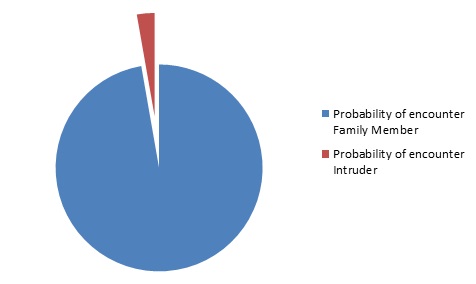
Looking at it this way makes a very strong case for why we have to positively identify before we shoot. It is 32 times more likely that the sound or shadow is a member of the household than it is an intruder. Las Vegas would really like those odds. If we’re going to be the slightest bit responsible, we have to look at ALL the possibilities, not just the ones that scare us the most. Shooting through the door without doing any kind of identification is just plain wrong.
Verbalization is so important in personal protection scenarios. And it’s something very few people practice on the range, or any other time, for that matter. I’ve had female clients tell me “I can’t say that.” Well, you better learn to say something. At home, the verbalization doesn’t have to be complicated. “Who’s there?” will probably suffice. You do have to be able to talk with a gun in your hand, though. Once again, hearing “Honey, it’s me” should immediately trigger a stand-down response on our part.
Stand-down is another thing that’s uncommon for people to practice but really important when you look at the probabilities. In a home defense encounter, ‘Stand-down’ should most likely mean immediately physically placing the gun down and moving away from it to avoid unpleasant after-effects of a startle response. Having to do so brings up those proper gunhandling and muzzle direction issues again.
This also bears on the issue of ‘training for the worst possible case.’ A serious definitional issue has now arisen in my mind regarding that concept. Is ‘the worst possible case’ having a dangerous armed intruder in your house or shooting and killing a family member by mistake? I don’t have an answer for that question but it has now become a relevant issue for me, as it should be for you, too.
The Aftermath – you’re not in it just by yourself
That’s both good and bad. Your family will be intimately involved in the aftermath of any shooting you are in. They will probably support you but they will also suffer just as much as you do. What I call ‘The Myth of the Lone Gunman‘ is about as far from reality as it can be.
Following last weekend’s MAG20 course, taught by Massad Ayoob, that I hosted here in Atlanta, Armed American Radio broadcast its weekly show from the host facility. A surprise call-in came from George Zimmerman. His comments were heartfelt, sobering, and bear listening to by anyone who is armed. They are something to consider in your decision about whether a shooting is absolutely necessary.
Mistaken identity shootings
None of us can imagine the feelings that must occur in the case of a mistaken identity shooting of a family member. We don’t like to talk about this sort of thing in the gun community but it happens on a regular basis. Don’t let it happen to you, on either end.
I’ve written about this before and probably will again. It’s an avoidable tragedy.
Laser sights
I have seen too many people forget the basics and rely on finding the laser dot instead of looking down the sights on pistols. They became much slower with the laser.
So began a Facebook thread in a closed group of ‘operators.’ There’s an antinomy, a form of paradox, in this sort of discussions that I always find interesting.
The paradox arises from the often parroted statement that most armed encounters take place at night or in low light. This premise is less than provable, but let’s accept it at face value for purposes of discussion.

Now, let’s follow up that premise with dismissal of a sighting system because ‘it doesn’t work’ during periods when gunfights are LESS LIKELY to take place.
In this particular FB thread, I will put myself in the category of ‘highly trained,’ since that’s what their membership group supposedly consists of. Years ago, it didn’t take me long to figure out that there were things I could do with a laser on a pistol that I simply couldn’t do without them. That held true even during the day, unless I was on a brightly sunlit ‘square range,’ which is so often said to be a poor and ‘non-realistic’ training environment. In any indoor environment, there is no issue with ‘finding the laser dot,’ even in a well lit room in daylight.
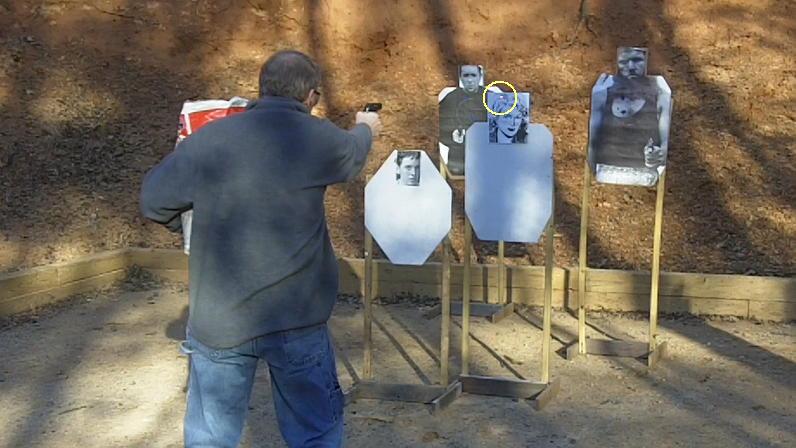
Note visible laser dot.
Once we get into the realm of low light, where the popular mantra says the majority of gunfights occur, most of us will agree that iron sights are fairly useless. We’re largely reduced to point shooting because the sights can’t be seen.
I wondered about the difference between iron sights and lasers during low light. I think of the time frame between sundown and End of Civil Twilight (dusk) as low light. The US Naval Observatory provides specific definitions of these and states
Some outdoor activities may be conducted without artificial illumination during these intervals, and it is useful to have some means to set limits beyond which a certain activity should be assisted by artificial lighting.
Target Acquisition and, to a lesser extent, Target Identification, is still possible during that period. However, between sundown and dusk, night sights aren’t really visible (not bright enough) and neither are the irons (luminous efficacy of the eye’s cones is insufficient).
To establish a quantitative measure for that difference, I chose several parts of the Handgun Testing Program at the elite Rogers Shooting School. The targets were more visible than they show in the video but I couldn’t see the irons. I proceeded to shoot the tests with a laser equipped Beretta. Having taught at Rogers for five years, I’m fairly confident in saying that, without the laser, I would have made the all the body hits (7) and around half of the hits on the number 1 head plate (8) for a score of 15 out of 69 targets. My score with the laser was four missed targets for a score of 65 out of 69.
There’s a reason I have a laser on my house gun.
The issue of parroting something that was heard without questioning, analyzing, or testing is a separate topic that the training community has yet to address adequately. That’s for another time, though.
Grace at Night
[This lady]
“made a list of ten factors that can make an incident traumatic. Eight of the ten happened [in their incident]:1. In your home
2. In the presence of children
3. Prolonged
4. Death and rape threats
5. Guns
6. Theft
7. Beating
8. Shots fired
9. Rape
10. Murder”

One week ago our family went through a harrowing, life-changing experience. This is how my husband described last Tuesday evening in a prayer update:
Last night at about 9:45 pm at our house, Caleb announced to Amy and I as we worked on a paint job in the children’s room that three men had just entered our back door. When I got to the door, I saw two guns brandished among the three criminals. Though we offered all our money and goods to them they beat me and hit Amy twice.
We are praising the Lord that after about 15 minutes wherein they tore the house apart, we were able to chase them away. They took some material possessions, but our lives and honor were spared because of the good hand of our God who placed a wall between our lives and their weapons.
Tomorrow, we are taking a…
View original post 1,710 more words
Negative Outcomes: Unintentionally Shooting Someone Else
It’s a sad fact that people shoot other people unintentionally. I’m not talking about mistaken identity shootings but completely unintentional shootings. Probably the most famous incident was when Vice President Dick Cheney shot his hunting partner. However, that was far from an isolated occurrence. Reading the news reports provides plenty of such incidents.
We absolutely don’t want to shoot someone unintentionally nor let someone get shot unintentionally. A firearm is an instrument of ultimate personal responsibility. It’s not like a car, where sometimes we can blame someone else for negative outcomes. When a firearm we are handling goes off, we have to bear the consequences, period. If we leave it sitting around unsecured and someone else makes it goes off, we have to the bear the consequences, period. Sometimes, the consequences are tragic, in either case.
The Armed Citizen
A writer from Gun Digest contacted me about the Five Year Armed Citizen study TAC 5 year w tables I did a while back. He asked if I would give him a quote about it, so this was my reply.
“Analyzing incidents involving Armed Private Citizens, rather than LE/MIL situations, leads to different conclusions. Common discussion topics among Armed Private Citizens, such as equipment and caliber issues, rarely are the cause of Negative Outcomes. Negative Outcomes result from 1) lack of conceptual understanding leading to poor decision-making, and 2) lack of appropriate and necessary skills, techniques, and tactics.
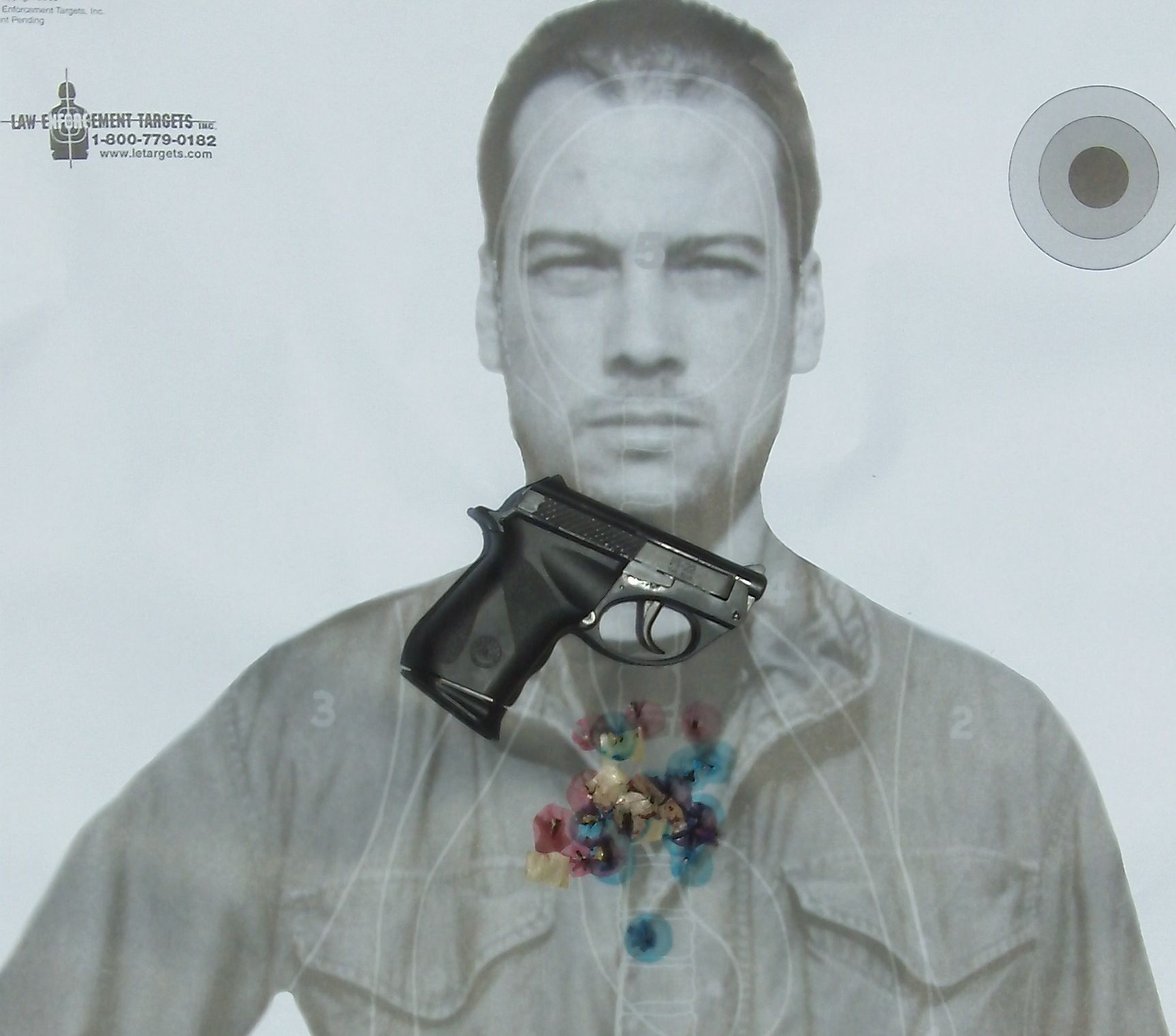
Carrying and being capable of using a small gun adequately will yield much better results than owning a large pistol that isn’t carried or shot well. More criminals have been planted in the ground by .22s that hit than by .45s that miss.”
 tacticalprofessor
You must be logged in to post a comment.