Wheelgunning at the Tactical Conference
This past weekend, Friday through Sunday, was the 20th Anniversary Rangemaster Tactical Conference. I have a long history of wheelgunning at the Conference, having shot it with a revolver in 1999 through 2001.
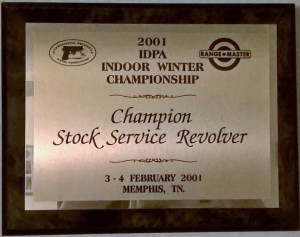
This year was no exception. I’ve also taught for many years at the Conference. This year I decided to re-visit teaching my Intro to Snubby Skills block of instruction. One of the other trainers had to cancel due to a family emergency. This gave me the opportunity to conduct my class on both Friday and Saturday. A total of 37 shooters took the two classes. I kept it to two hours and less than 50 rounds. Shooters sometimes lose their focus if the class is longer or the round count is higher and I want to set them up for success.
The topics I focused on were:
- Grip the snub firmly
- See the sights
- Press the trigger smoothly
- Followthrough
We did all the drills dry first and then live. For the live practice, most included spinning the cylinder after a few shots to create a ball and dummy drill. Revolvers do this much more efficiently than autoloaders. I also emphasize loading with loose rounds because speedloaders are not as secure an ammunition holding device as an autoloader’s magazine.
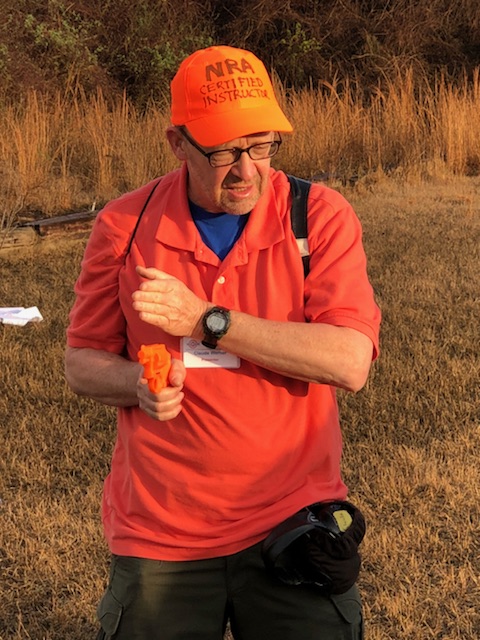
Photo credit: Roka Arms
As the final exercise, the shooters fired all five shots into an eight inch circle, reloaded with two loose rounds and then fired both shots at a facial target 3 inches by 4 inches. This is a good exercise for practicing shooting quickly and then accurately.
After the second class, I then shot the Pistol Match with a Model 65 S&W revolver. Out of 186 people who chose to shoot the Match, two of us used revolvers. The Match featured turning targets, which made it both challenging and fun. The entire match is shot with the shooter’s equipment concealed.
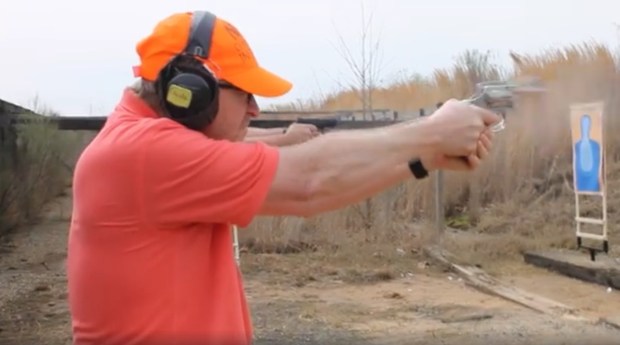
Photo credit: Philip Young III
I’ve been using a Galco Walkabout holster for my J Frame so I used a homemade Kydex centerline speedloader carrier. I’m finding that a speedloader carrier at the centerline is extremely fast. One observer noted that on the Stage that required a mandatory reload, I finished first among my squad.
For each string, we had to shoot a given number of rounds in a fixed amount of time while the target faced. Those who fired a perfect score made it into the Semi-Finals.

The Semi-Finals were held on Sunday morning. Turning targets were used again but this time the Course of Fire was only 10 rounds and was shot on a B-8 25-Yard Timed and Rapid Fire Target. The Course of Fire is revolver neutral but I threw two shots into the 7 ring and that put me out of the running for the Final Shootoff.
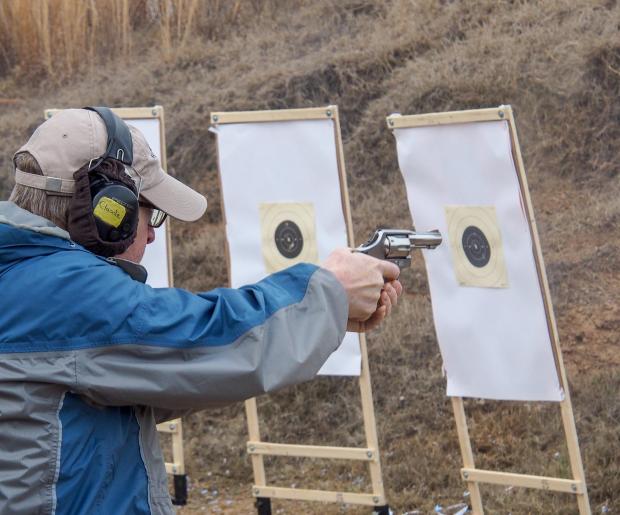
Photo credit: Tamara Keel
The Final Shootoff was a single elimination contest shot on reactive falling targets. Two mannequins with a concealed steel hit area had to be knocked down first. Then a mini Pepper Popper had to be knocked down. Whichever shooter knocked down the Popper first was the winner. The competition was fierce and Mr. Gabe White was the winner.
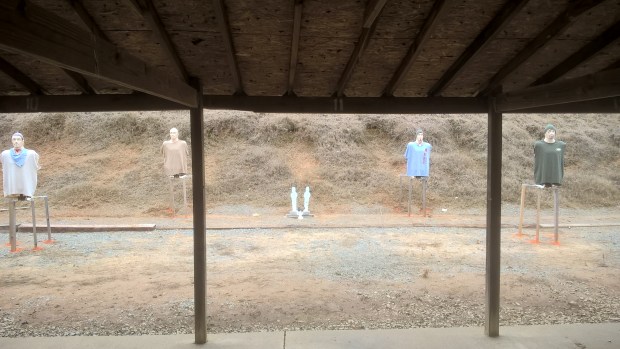
The Ladies did not have a Semi-Final and the top eight Lady shooters of the Match went straight to the Shootoff. It followed the same format as the Men’s Shootoff. Once again, the competition was fierce. Ms. Melody Lauer was the Winner.
Three days of good training was a true pleasure. There were more blocks of instruction, both live fire and lecture, than can be attended. It was a great time and I’m glad I was able to attend and present again.
Next year’s Conference will be held just north of New Orleans on March 15-17, 2019. It is open to all those interested in personal protection.
If you would like to purchase my eBook Concealed Carry Skills and Drills, the link to the downloadable ebook is here. http://concealedcarryskillsanddrills.com
If you would like to purchase my eBook Indoor Range Practice Sessions, the link to the downloadable ebook is here. https://store.payloadz.com/details/2501143-ebooks-education-indoor-range-practice-sessions.html
Wheelgun Wednesday
For some reason, #wheelgunwednesday had never crossed my radar before yesterday. Viewing this as a serious deficiency on my part, I decided to shoot the IDPA 5×5 Classifier with some revolvers. It’s a 25 round Course of Fire shot entirely at 10 yards.
I like the 5×5 because it’s five shot friendly and is a demanding skill drill. As some shooters have observed, the IDPA 5×5 is not as easy as it looks. It shares this in common with the 5^5 drill that I designed.
Whenever a Course of Fire is shot repeatedly, there’s a ‘training effect.’ This means that simply understanding the sequence helps the shooter do better. Since I was shooting service revolvers down to Airweight J Frames, I chose to bias the training effect in favor of the J Frames, which are inherently harder to shoot. The order I chose to shoot the wheelies was:
- Model 66, four inch (.38 Special)
- Model 65, three inch (.38 Special)
- M&P 5 screw, 2 inch (.38 Special)
- Model 640-1, 2 ¼ inch (.38 Special)
- Model 36-1, 3 inch (.38 Special)
- Model 642-2, 2 inch (.38 Special)
- Model 30, 3 inch (.32 S&W Long)
- Model 432PD, 2 inch (.32 S&W Long)
Shooting the guns from heavy to light also helped keep me from getting beaten up by recoil early in the process. I’m glad I approached it that way.
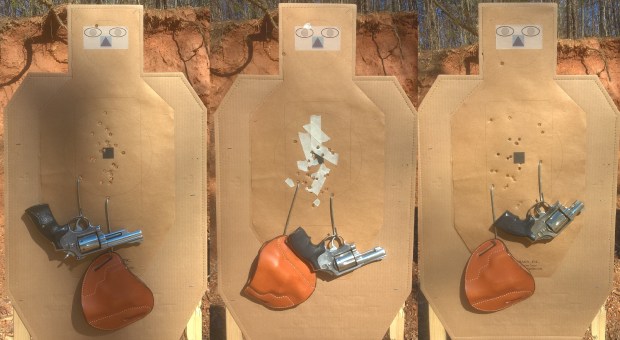
For the K Frames, I used the KIS “Keepin’ It Sippel” holster from Leather Creek holsters. It’s a very comfortable holster that distributes the weight of a service pistol well on the belt and allows a quick presentation. For the reload on String 3, I used a Safariland Comp II speedloader and pouch. When I bought the M&P 5 screw, it had the half moon front sight that was commonly used in the pre-1950s era. This is not an easy sight to see, so I flattened the rear with a file, serrated it, and painted it fluorescent orange with a white undercoat. All of the K frames also have had the rear sight blackened with a Sharpie to provide more contrast and reduce glare.
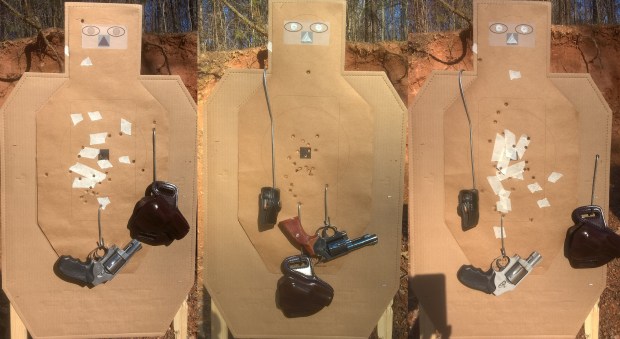
For the J Frame .38s, I used a Galco ‘Concealable’ holster. The forward molded design makes it very comfortable because it doesn’t press on my hip bone at the four o’clock position. Reloading was done with a Safariland Comp I speedloader and pouch.
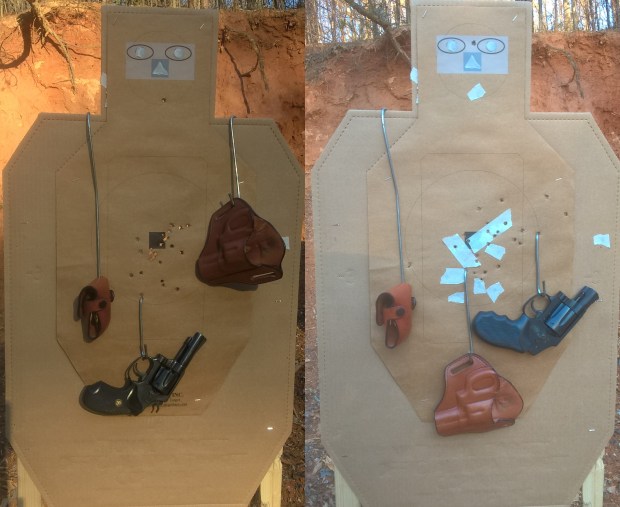
For the J Frame .32s, I used a Bianchi Model 57 ‘Remedy’ holster. This is also a comfortable forward molded design. Reloading was done with an HKS 32-J speedloader and Bianchi pouch.
The ammo used was mostly Tula 130 grain FMJ .38 Special. I can’t recommend this ammo. Probably because of the steel case, it’s very difficult to extract. Most of the time, I have to use a rubber mallet to give the extractor rod a whack to eject the cases. I bought a case of it and when it’s used up, that’s the last I will ever buy. When the stage required a reload, I started with Federal American Eagle 130 grain FMJ, which extracts easily.
In the .32s, I used Georgia Arms .32 S & W Long 85 grain Jacketed Hollow Point and Fiocchi 97 grain FMJ. They both shoot to similar point of impact and proved reliable in the .32s.
#wheelgunwednesday, it’s going to be more of a habit from now on.
Note that the holsters were provided to me at no cost by the manufacturers but I receive no compensation for my evaluation.
Revolvers do break
The two loudest sounds when shooting are:
- A bang when expect a click
- A click when you expect a bang
A click when you expect a bang with centerfire revolvers often means that tools will be involved in fixing the problem. An example is a broken hammer nose on older Smith & Wesson revolvers. Until the 1990s, these revolvers had the ‘firing pin’ integral with the hammer. S&W refers to this part as the ‘hammer nose.’ If it breaks, nothing short of replacing it will make the revolver fire.
Two steel J Frame revolvers are compared in this picture. The tip of the hammer nose circled in red has broken off. It will require replacement before the snub will be functional again.
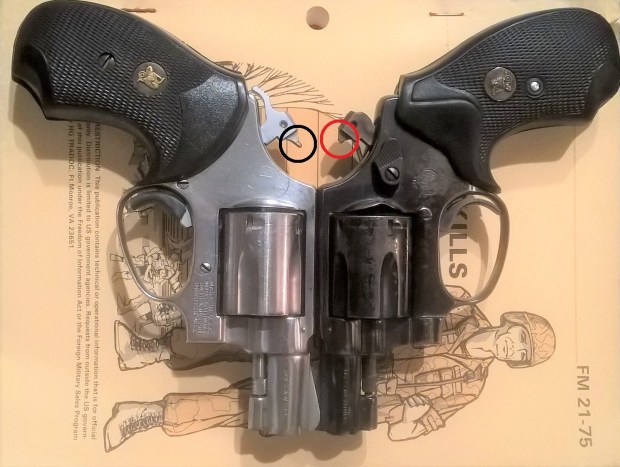
S&W changed the design of its revolvers before the Turn of the Century. The firing pin was moved to the frame from the hammer. But there are millions of older S&W revolvers that have the hammer nose design. Issues have arisen in the past because S&W has not manufactured the part in many years. They were available on the used part market but the supply was spotty. There are now two sources for newly manufactured J Frame hammer noses.
This part is best installed by a qualified gunsmith. It may require minor fitting. The hammer nose rivet that holds it in place may also need to be replaced.
The Model 36 with the broken hammer nose was manufactured sometime before 1975. It has been through considerable live fire and dry practice. When using an older gun, it’s a good idea to inspect them on a regular basis to see if any parts have broken. The hammer nose in particular will not cause an obvious change in function if it breaks but the gun will not fire.
Friday Fundamentals – Understanding Zero for Handguns
Zeroing any firearm is the process of understanding the relationship of Point Of Aim (where the shooter aims the firearm) [POA] to Point Of Impact (where the round actually strikes the target) [POI].
For Soldiers to achieve a high level of accuracy and precision, it is critical they zero their [sighting system] to their weapon correctly. The Soldier must first achieve a consistent grouping of a series of shots, then align the mean point of impact of that grouping to the appropriate point of aim.
–Appendix E – Zeroing, Department of the Army Training Circular 3-22.9 – Rifle and Carbine, May 2016
This is the process most shooters are familiar with regarding zero. However, zeroing a fixed sighted handgun is different than zeroing a rifle.
Bottom Line up front: With rifles, we zero the sights to the ammunition. With fixed sighted handguns, we zero (adjust) the ammunition to the sights.
Snubby recommendation
I was emailed the following question. It’s a good question with an involved answer.
Which snubby do you recommend?
This was my reply:
It depends on the person, their ability, their needs, and their desire to achieve an acceptable standard of performance. The S&W 642 and Ruger LCR .38 Special have become the default purchases for people who want to carry a snub. They work for some people but not everyone.
Determining Your Ability – Friday Fundamentals
The famous Chinese philosopher Lao Tzu is quoted as having said:
The journey of a thousand miles [li] begins with one step.
This is only partially correct. The journey really begins with knowing where you are in the first place. This is also true about the journey to proficiency with firearms. Especially for newer gun owners, it’s important to gain an understanding of what their current capabilities are, if they want to improve. Many people who have purchased handguns made the purchase with the intent of personal protection. In this light, a good first step in gauging proficiency is the Michigan State CCW Basic Pistol Safety Training Assessment Course of Fire. It is a simple course of fire that can easily be done at any indoor or outdoor range. It’s also extremely manageable with a J Frame revolver. The Michigan course of fire is the first evaluation in the Indoor Range Practice Sessions program. It also can serve as the basis for a more challenging evaluation.
The target consists of three 11 inch x 8½ inch letter size pieces of paper stacked vertically. The combined sheets of paper are quite close to the FBI Q target both in area (280.5 square inches v. 275 square inches, respectively) and in general shape (a target much taller than it is wide). The target is placed at 4 yards,
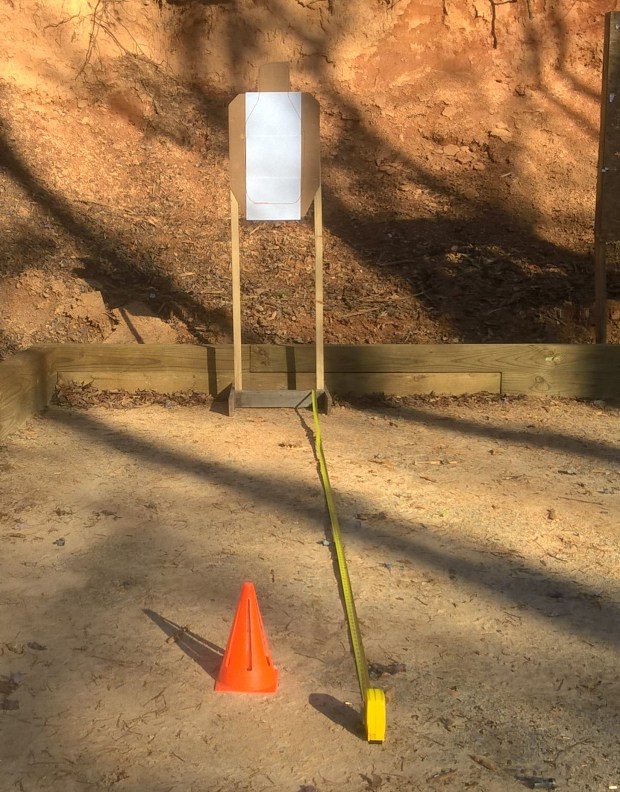
(Note: FBI Q drawn for reference)
Four yards happens to be the boundary between Public Space and Social Space in the study of proxemics. Proxemics is a subject that is worthy of study by anyone interested in the Art of personal protection.

Diagram by WebHamster
There is no time limit. Shooting is done with both hands. You will shoot 5 rounds in three separate sequences. Start with the handgun loaded with five rounds and aimed below the target.
- When ready, aim at the target and fire all 5 rounds.
- Reload with five rounds and repeat the firing sequence.
- Reload with five rounds and repeat the firing sequence one more time.
- At this point, you should have fired five shots at the target three separate times.
- To successfully complete the assessment, at least 2 out of 3 of the sequences must have had five (5) hits within the 25½ inch by 11 inch outline of the three pieces of paper.
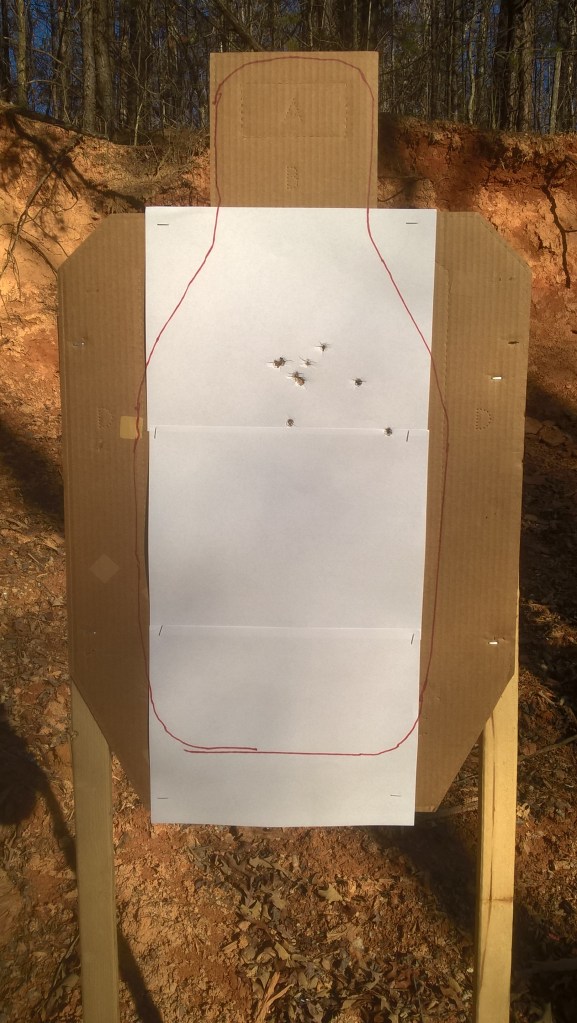
While experienced shooters will consider this course quite easy, for new owners of J Frame revolvers, it frequently is not. This course can also be used as a measure of the effectiveness of Indexed Shooting (shooting without using the sights) by taping up the sights of the gun, in this case a Model 36 S&W snub nose revolver.
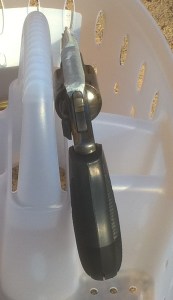
To use this method, bring the gun into the eye-target line and then place the outline of the cylinder or slide on the target. The great NYPD gunfighter Jimmy Cirillo taught this technique to NYPD Officers as a way of effectively using their revolvers at close range in situation where the sights could not be seen. It’s sometimes referred to as ‘metal on meat.’
If the group shot in the first three sequences meets the requirement, then try reshooting the exercise with only one piece of paper. Taking the tape off and using the sights may yield better results.
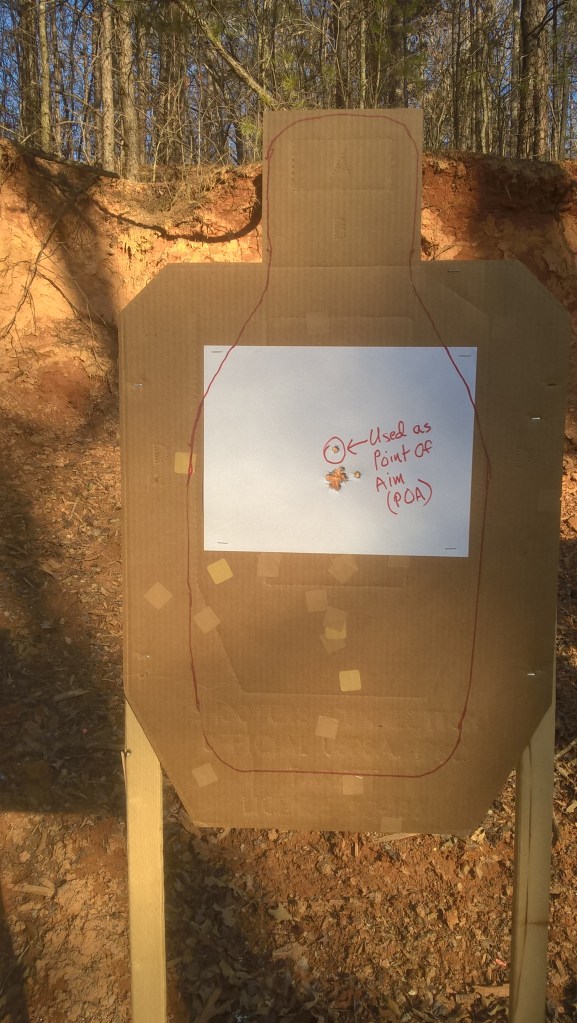
While this course of fire is simple, many newer gun owners may find it challenging. As can be seen in the pictures, the target is smaller than the silhouette target that many Private Citizens and POlice Officers are accustomed to shooting at. It also has the requirement of a 100% standard for the sequences. The 100% standard is the start of having a mindset of being accountable for every round.
Dear Instructors, Get a Real Job
In this Ballistic Radio interview, I offer some opinions about problems and solutions with the firearms training industry. The industry needs to do some real work if it expects to get in touch with normal people.
Dear Instructors, Get a Real Job
The ‘Wizard Drill’ and the J Frame
Ken Hackathorn created a very simple skill evaluation drill that he calls the ‘Wizard Drill.’ It only requires five rounds of ammo and can be shot on any range that allows work from the holster
Take an IDPA or IPSC (USPSA) target and place a 4 inch circle centered in the head of the target. You will shoot 4 strings of fire at 3, 5, 7, and 10 yards. Each string of fire has a time limit of 2.5 seconds with 2.7 allowable because of the length of the buzzer’s beep. The drill is shot from a concealed holster. If you use a pocket holster, you may start with the gun in your pocket and your hand on the gun. Otherwise, hands normal at sides, not touching the gun until the buzzer.
Caveat Emptor
Know what you’re buying. This is even more important when you can’t see it in person. When it’s an intangible, such as information, you must be especially careful.
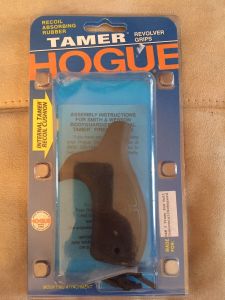
As part of my research for The J Frame Project, I was perusing eBay last night for J Frame stocks. One of the items I came across was a ‘Hogue Tamer‘ for a very low price. It didn’t look quite right (a color I didn’t recognize Hogue ever making) so I czeched into it a bit further. I realized that someone had replaced the stock on their Polymer Bodyguard with the Tamer and then put the Bodyguard stock back in the Tamer package.
 tacticalprofessor
You must be logged in to post a comment.