In Pursuit of Better Practice
Gila Hayes of the Armed Citizens’ Legal Defense Network was kind enough to do an interview with me about Better Practice in this month’s Network Journal. Her interest was piqued because many members of the Network had said that ongoing training wasn’t possible for them due to resource constraints. Gila said that she wanted to give the members an option for maintaining and improving their skills that fit their budgets.
How far, I wondered, could the armed citizen proceed in his or her skill development through self-guided practice alone?
She’s an excellent interviewer. You will probably find it interesting reading.
https://www.armedcitizensnetwork.org/september-2018-front-page
She also did a book review of Concealed Carry Skills and Drills.
https://www.armedcitizensnetwork.org/september-2018-book-review
If you would like to purchase Concealed Carry Skills and Drills, the link to the downloadable ebook is here. http://concealedcarryskillsanddrills.com
If you would like to purchase Indoor Range Practice Sessions, the link to the downloadable ebook is here. https://store.payloadz.com/details/2501143-ebooks-education-indoor-range-practice-sessions.html
Morale patch courtesy of Chris North
Comparative Standards – Double Action Autos
I enjoyed the #wheelgunwednesday Comparative Standards exercise enough to repeat it. This time the test was with Double Action autoloaders. Five different autos, three Double Action Only and two Traditional Double Action were the test subjects. Four were 9mm and one was a .22.
- SCCY CPX-2
- Sig P250
- Smith & Wesson 6906
- Beretta Centurion 92D
- Walther P22 (Remington Golden Bullet bulk ammo)
All the guns were similarly sized enough that I used the same Mister Softy holster for all of them. The Mister Softy is interesting in that the gun sits low enough in the pants that a full firing grip can’t be gained in the holster. I didn’t notice the lack of a full firing grip was an impediment. The need for a full firing grip in an AIWB holster is another one of the industry maxims I have doubts about. Maybe I just have clever hands.
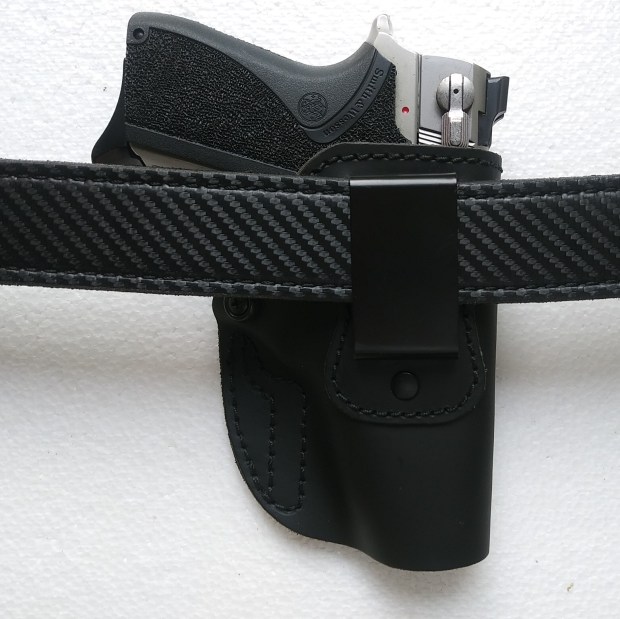
I used the same protocols for shooting and scoring as last time so I won’t reiterate them.
A Clarification
Brian Hill of The Complete Combatant likes to call me ‘The Clarifier.’ However, I apparently have slipped up on that. I received the following question today, via email.
“Comment: Is your “Concealed Carry Skills and Drills” ebook available and downloadable in PDF?”
Yes, it is.
The link to the ebook on my store is Concealedcarryskillsanddrills.com
Clicking on the above link will take you to where the ebook can be purchased. A download link will then be sent to your email. Clicking on the download link will send the PDF of the book to you.
My other ebooks are available by clicking on this link. Claude Werner’s ebooks. The Flashlight practice session of Indoor Range Practice Sessions is available there for FREE because I believe every gunowner should have some familiarity with how to use a flashlight in conjunction with their pistol. It could prevent the Negative Outcome tragedy of shooting a family member or someone else who shouldn’t be shot.
I hope that clarifies things.
Shooting the S&W SD9VE
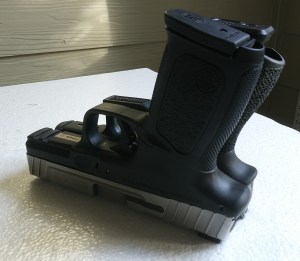
I like inexpensive pistols. Not everyone can afford ‘mid-priced’ ($500-700) pistols, so I like to give those folks some options. Over a year ago, I picked up a S&W SD9VE on sale for about $300. It proved serviceable and reliable but the trigger was a little heavy. It wasn’t unmanageable but it was hard to shoot to the level I like to with it. The three dot sights had to go, so I blacked out the rear dots with a black marker and painted the front sight orange.
Shortly afterward, Apex Tactical Specialties was selling their upgrade kit at the NRA Annual Meeting for half price, so I bought it. It consists of several replacement springs and an ‘Action Enhancement Trigger.’ I didn’t care much for the hinged trigger on the gun, so I bought the kit. After installing just the spring kit, the trigger pull became noticeably easier to use. It lightened up enough that I didn’t even install the trigger.
Yesterday, I decided to install the trigger also. It is a Glock® style trigger with a safety bar that also reduces the length of travel and pull weight. Contrary to what the common taters on the Apex YouTube installation videos said, it was easy to install and didn’t mess up my gun. Some people have no mechanical aptitude and simply should not work on mechanical devices more complicated than a ball point pen, much less firearms kept for personal protection.
Another interesting factoid I discovered was that the SD9VE is actually the Glock 19 sized pistol that people have been clamoring for S&W to make for as long as I can remember. When I put the two pistols side by side, it was obvious they were in the same size class.
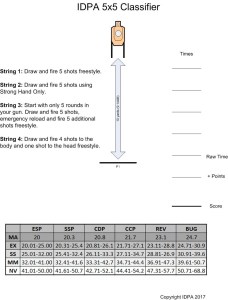
To test out what I could do with it, today I shot the IDPA 5×5 Classifier. The Classifier is a simple yet challenging test of equipment and shooter. It is only 25 rounds, requires only one target, and can be set up and shot in less than five minutes. It’s a little difficult for newer shooters, so I didn’t include it in Concealed Carry Skills and Drills.
I was able to shoot an overall score of 23.37 (3 points down), which put me squarely in the middle of Expert classification. Considering how little centerfire ammunition I’ve shot in the past few months, I think that gives a good indication of the pistol’s potential.
My gun has fired close to 1,000 rounds without a malfunction, so it has proven to be very reliable. Overall, this is a very underrated pistol. I’m looking forward to putting more rounds through it.
Note that I bought the pistol and the upgrade kit with my own money. I get no promotional consideration for writing about it, I just like the gun.
The Origin and Evolution of Dot Torture
Dot Torture is a well known practice regimen among skilled shooters. Its origins and evolution are less well known, however.
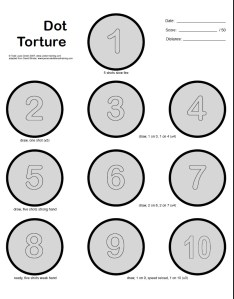
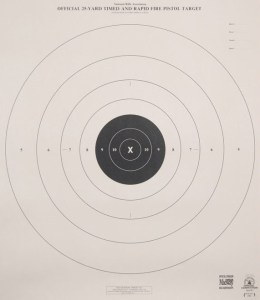
Shooting on dot targets, i.e., small filled in circles from 1.25 to 5.54 inches in diameter, as a speed shooting training and practice exercise, was originated by John Shaw, a World Champion shooter, in the early 1980s. In his book, You Can’t Miss: The Guide to Combat Pistol Shooting, he explains the training standard he established for his students. Until they could consistently hit the black bullseye (5.54 inches) of an NRA B-8 bullseye target from the holster in two seconds at seven yards, he didn’t allow them to move on to more advanced drills.
Shaw’s school, the Mid-South Institute of Self-Defense Shooting evolved the concept of dot shooting to a high level. Combined with shooting at steel targets, as originated by Bill Rogers, founder of the elite Rogers Shooting School, dot shooting became a standard component used in the practice regimens of knowledgeable shooters who aspired to a higher level of competency.
The concept of dot shooting was so effective at teaching shooters to hit the target, it quickly became part of military counter-terrorist pistol training. The US Army Special Forces developed a course called ‘Special Operations Training’ [SOT] during the 1980s to train its personnel to use the 1911 pistol at a level not seen before that time in the military.
Concealed Carry Skills and Drills – The Book
It’s finally done. My new book about Skills and Drills for those who Concealed (or Open) Carry. The book is based on my analysis of over 5,000 incidents involving Armed Citizens who successfully defended themselves and their loved ones.
Concealed Carry Skills and Drills book
Introduction
This book was designed to fill a need. For many gun owners, training is a resource intensive activity that they have difficulty affording in terms of time, money, distance, etc. Introductory Concealed Carry licensing classes generally focus mostly on legal aspects and non-shooting tasks such as situational de‑escalation. The only shooting task, if any, involved in a licensing course will usually be a ‘qualification’ or evaluation of the shooter’s ability to perform to an established standard. In most cases, that standard is quite low but it is still intimidating to many.
The gunowner is thereby placed in an unenviable situation. First, having to learn to shoot prior to attending a licensing course. Even with some instruction, which will often be informal by a friend or relative, this can be a difficult task. Second, assuming the person passes the licensing ‘qualification,’ they often ask the question “What do I do next?” The standard response is “Get more training.” Since spending a day or a weekend at a remote location ‘getting more training’ doesn’t fit into most people’s resource constraints, they simply choose not to unless it’s required at license renewal time.
Gun ranges are not ideal learning environments. Trying to get even informal instruction from someone else when people are shooting on either side of you is rarely productive. The question of what are appropriate tasks to learn and how do we practice them comes next. How do we make the best use of our limited resources at the range is another question. The horrible visualization on TV and in movies of what shooting looks like is non-helpful at best and destructive of proper conceptualization and skill development at worst.
Self-Study is an activity most of us are used to. It is how we often learn to drive a car and perform many other physical and athletic tasks. Not many people who play sports have ever been to a sports training camp. They just go out and practice the activity, play the game, figure out their weaknesses, and then practice some more.
The difficulty of Self-Study with firearms is the question of how to do it safely and properly. Guns are esoteric tools that are not intuitive to use. We have no instincts that prepare us for having explosions repeatedly go off two feet in front of our faces. Few other tools we use have the capability to cause instant death during a moment of ignorance or carelessness.
What this book provides is a guide through the process of improving your shooting skills on your own in the context of Personal Protection. Guided training with a competent instructor is still the best way to improve your skills and will yield the best results. However, an intelligent person who can follow directions can still learn a great deal on his or her own, given a suitable program.
This book is not a guide to becoming a Champion shooter or being able to shoot like a member of an elite military unit. What it can do is help you to become a safer, more competent shooter who can focus your cognitive abilities on the situation, instead of the gun, during a criminal encounter. It is also an excellent reference for more experienced shooters providing informal training to new shooters.
There are 30 different drills in the eBook. They focus on building Concealed Carry skills from the ground up and then refining them. The drills are structured in a stair step approach starting at a level that a new shooter can achieve and then work to a greater degree of difficulty and achievement. Different types of drills are coordinated to build a variety of skills at the same time.
The vast majority of Personal Protection incidents are simple, if rather frightening, events, and are quickly solved by untrained inexperienced persons. The issue is that if an incident goes wrong, it tends to go horribly wrong, a NEGATIVE OUTCOME. The odds are low but the stakes are very high. Helping the Armed Private Citizen stack the deck in their favor is the object of this book.
Negative Outcome – Again
Toddler, 2, dies of self-inflicted gunshot with parents not home
People labor under the illusion that a two year old can’t pull a trigger. What a toddler does is put the gun on the floor, where the kid spends most of its time. Eventually, the gun ends up with the butt down, the muzzle up, both of the kid’s thumbs on the trigger, with the kid pushing down on the trigger as hard as it can. Any toddler weighs more than the trigger pull so it has the mechanical advantage to press the trigger all the way through, even on a double action revolver.
A head shot is almost the inevitable result. That’s why so many of these are fatalities and not just wounded casualties.
Serious Mistakes now available as a download
Myths and Misconceptions
I was privileged to be the Guest Speaker at The Mingle 2018, a firearms community networking event this past Saturday. My topic was Myths, Misconceptions, and Solutions in the Firearms Training World. There is such a myriad of examples that I have decided to start writing #mythsandmisconceptionsmonday. I would like to acknowledge the influence John Farnam, Greg Hamilton, and Craig Douglas have had in the development of my fascination with the topic.
The misconception that resonated the most with the audience was Training is not an event, it’s a process. Too often in the training community, we put on a training event and our clients then leave with the impression they are ‘trained.’ Nothing could be further from the truth. Training is only the preparation for practice.
The Woman’s Gun Pamphlet
The Woman’s Gun Pamphlet came up in conversation during The Mingle yesterday. Since the original source is no more, I’m republishing this post for interested parties.

Through an oblique reference, I recently found a link to The Woman’s Gun Pamphlet.Edit: The link and the server appear to be gone. A PDF of the Pamphlet is available at the edit of this post.
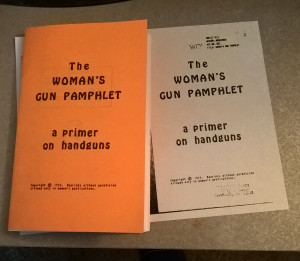
It’s a very interesting publication that was written and published by a colloquium of radical feminists in 1975. The intent was to provide information about both guns themselves and about personal protection attitudes to women of that era who knew nothing about guns or personal protection. As such, I consider it an historically significant document. There’s quite a bit of political rhetoric in it but also a goodly amount of information. Even dry practice is touched on. Some morsels of dry wit are quite entertaining.

Especially interesting to me is that it was written from the perspective of self-taught women of the time with some input from men and by doing primary…
View original post 239 more words
Why we wear caps on the range
The reason we wear caps on the range is to keep brass from hitting our faces. Especially to avoid having brass get behind your glasses and burn your face. I forgot to wear my cap two days ago and a piece of .22 brass got behind my glasses.
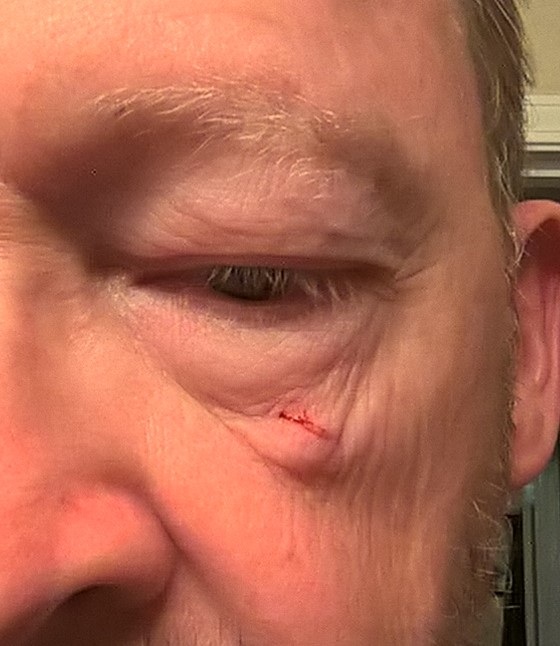
As you might imagine, it was painful. Fortunately, I maintained my composure and didn’t muzzle my friend who was with me. Wear your safety equipment, including a cap. Nonetheless, be mentally prepared to get burned by brass, maintain your composure and your muzzle discipline.


You must be logged in to post a comment.