What do you teach the students?
What do you teach the students in your classes, Claude?
That question was posed to me recently by an older gentleman at my gun club.
I teach them how to handle guns safely and how to hit the target, Ray.
He looked at me quizzically when I said that. He’s a competent shooter who can hit a six inch plate at 50 yards with a handgun. I could tell he didn’t understand so I told him a story.
I received a call a while ago from a range I used to teach at, which has subsequently burned down. The call was from the guy working the counter where they sign people into the range. “Can you come down right now and give a lady with a snub nose revolver a lesson right now? She will pay you and she’s willing to wait for you to get here.” It was 20 minutes away so I grabbed my gear and went.
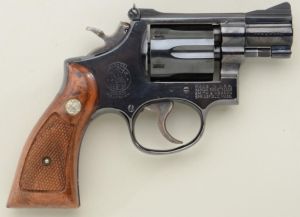
The lady had a very nice 2 inch Model 15 Combat Masterpiece. She had purchased it at a gun shop when her husband died. This was her second visit to the range to ‘practice.’
Sometimes I say the damndest things
I was recently interviewed on Civilian Carry Radio. It was an interesting discussion.
Accidentally
Muzzle direction is the primary safety. Always has been and always will be.
–Bill Rogers
Garland man accidentally fatally shot in head while teaching son to shoot
What’s so sad is how many different recent incidents the search string ‘son accidentally shoots father‘ brings up. Both fathers and sons are on the receiving end.
Firearms are relentlessly unforgiving of the slightest lapse in attention or knowledge of their manuals of arms. The details of this incident aren’t stated but they’re almost irrelevant. Does anyone think that poor boy will ever have a well adjusted life? I doubt it. Who’s fault is that? Certainly not the boy’s.
Just because a person “has been around guns all my life” doesn’t mean they know anything about them. All that frequently parrotted phrase means is that the person has beaten the odds so far. Don’t be ‘that guy.’ It’s not a hair dryer; learn about your firearm(s) and any of the sets of basic safety rules. The number of people who can’t recite, from memory, at least one set of firearms safety rules is astonishing.
There are several sets of safety rules. The NRA Rules are a good start.
ALWAYS Keep The Gun Pointed In A Safe Direction
This is the primary rule of gun safety. Common sense dictates the safest direction, depending on different circumstances.
ALWAYS Keep Your Finger Off The Trigger Until Ready To Shoot
When holding a gun, rest your finger alongside the frame and outside the trigger guard. Until you are actually ready to fire, do not touch the trigger.
ALWAYS Keep The Gun Unloaded Until Ready To Use
If you do not know how to open the action or inspect the chamber(s), leave the gun alone and get help from someone who does.
Let’s be careful out there.
No one is above the rules
One of the students involved in this went up and took the blank gun … from the instructor’s [emphasis mine] waistband and placed that against the instructor’s back and fired
Friday Fundamentals – Ball and Dummy
What is ball and dummy?
Sometimes, we instructors take our subject matter knowledge for granted. A friend posted that she was pulling a few of her shots low and left. She’s right handed. My reply was ‘ball and dummy.’ She then asked me what that meant.
Ball and dummy means interspersing dummy (inert) ammunition among your live ammunition during a practice session. It’s a key training tool at the elite Rogers Shooting School. The dummies can be random, e.g., three or four dummies in a 15-17 round magazine. They can also be alternating; i.e., live, dummy, live, dummy, live, dummy, etc. for the entire magazine.
The purpose of ball and dummy is to watch the sights when the dummy round is clicked on to learn how smoothly, or not, you are pressing the trigger. Ball and dummy for marksmanship training is NOT the same as an Immediate Action Drill. For an IAD, you want to clear the malfunction as quickly as possible. With ball and dummy, you want to observe the sights for at least 300 milliseconds (about 1/3 of a second) after the hammer or striker falls to see what your trigger press was like and THEN clear the malfunction. A useful benchmark is to count ‘One thousand’ after the hammer/striker fall and then clear the malfunction. That’s called ‘followthrough.’
Alternating ball and dummy is both the most soul crushing and, at the same time, the most productive marksmanship drill you can do. You’ll see just exactly how smoothly you’re pressing the trigger when you do this drill. For most people, the answer is about as smoothly as Stephen Hawking, the genius theoretical physicist who has had ALS for decades.
With a revolver, for instance the iconic J frame, this exercise is extremely easy. Load a cylinder of ammo. After each shot, followthrough for one second. After you have completed your followthrough, open the cylinder, spin it, and then close it. Press the trigger smoothly until another round fires. Then open, spin, close, and repeat. Do this until you have fired all the rounds in the cylinder. Continue doing this for about four cylinders.
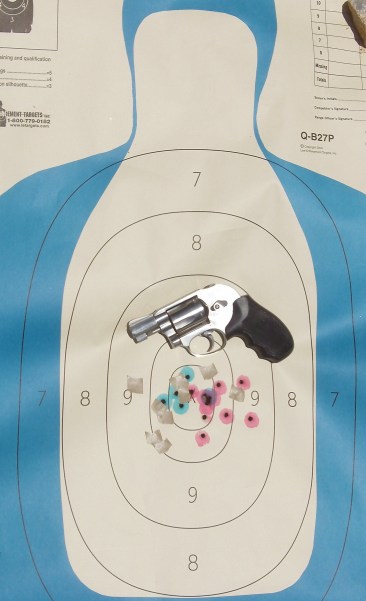
Whether using a revolver or autoloader, you gain useful visual feedback about what a good trigger press feels like. There’s a reason we refer to ‘hand-eye coordination.’ The visual process teaches the tactile process as to what works and what doesn’t. After a while, you will become annoyed with seeing the sights nosedive and begin to press the trigger smoothly. That’s the point where you start to become a marksman.
Tactical Professor Information Products
STOPP Presentation at Rangemaster Tactical Conference
https://tacticalprofessor.wordpress.com/2021/09/14/stopp-presentation-now-available/
https://www.payloadz.com/go?id=3381307
Books (all PDF)
- Thinking Clearly about Self-defense and Personal Protection https://www.payloadz.com/go?id=3377208
- Real Shootouts of the LAPD https://realshootoutsofthelapd.com/
- Serious Mistakes Gunowners Make http://seriousgunownermistakes.com
- Indoor Range Practice Sessions http://indoorrangepracticesessions.com
- Concealed Carry Skills and Drills http://concealedcarryskillsanddrills.com
- Advanced Pistol Practice http://bit.ly/advancedpistolpractice
- Shooting Your Black Rifle http://shootingyourblackrifle.com
- Package deal of Thinking Clearly about Self-defense and Personal Protection, Serious Mistakes, Indoor Sessions, Concealed Carry, and Shooting Your Black Rifle (50% off) https://store.payloadz.com/details/2644448-ebooks-sports-shooting-drills-package.html
Friday Fundamentals – Progression (Part I)
I’ve been encouraged to restart the Friday Fundamentals series and I think that’s a good idea. My upcoming series of articles about the J Frame revolver and how to get the most of it will be a good platform since the J frame can be unforgiving of poor fundamentals. People who learn to shoot a J Frame adequately can usually learn to shoot other handguns well. But first, let’s have a philosophical discussion about learning the fundamentals.
Bottom line up front, as is often said in the business world.
Most training classes are a condensation of much more training, practice, and skill development on the instructor’s part than their students will ever experience or be able to make use of. Only a few instructors use the term “feeding them with a firehose” but that’s what most training usually turns into, whether the instructor understands it or not. That philosophy doesn’t reflect the way adults learn.
Distilling many hours, years, or decades of experience into a single half day, full day, or weekend class isn’t setting the students up for success. That’s especially true when at the end of the class, the instructor gives a certificate to the students and tells them they’re now ‘trained.’ Nothing could be further from the truth. ‘Indoctrinated’ would be a much better term. The lack of follow-on practice curricula is a major weakness in the training industry. It’s one of my major pet peeves about the way training is conducted.
The NRA Training Department progression of Basics Of Pistol Shooting, Personal Protection In The Home, Basic Personal Protection Outside The Home, and Advanced Personal Protection Outside The Home are really the only exception to this situation in the industry. Some instructors will contest this and say they offer a series of classes. My rebuttal is that if the first class requires a holster, the students have already been led to the hydrant and positioned in front of the firehose.
More on this next week.
The hardest part of the drawstroke
I had an interesting philosophical discussion during the Contextual Handgun, The Armed Parent/Guardian class this past weekend. The instructor, John Johnston, is very good about attributing his sources. One of his points was a comment by the late Paul Gomez.
The hardest part of the drawstroke is establishing grip.
I told John that I disagree with that. In my opinion, the hardest part of the drawstroke is gaining an adequate sight picture. Establishing grip is the most time-consuming part of the drawstroke.
A good instructor can usually get students to consistently establish grip in a relatively short period of training time. However, getting them to consistently get an adequate sight picture usually takes quite a while longer.
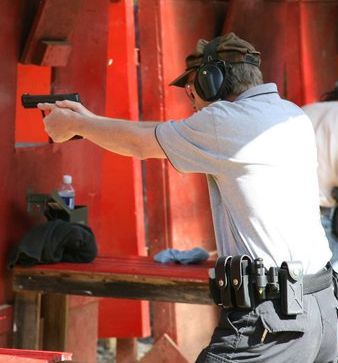
Something to keep in mind during your live and dry practice.
A Day at the Range – I
As always, a good day at the range erases the ennui generated by Internet goofiness.
As I mentioned in my post about Structured Practice (Part II), many people have no plan and use no structure when they go to the range. That’s only because they’ve never been introduced to the concept of structured practice in any activity. I always have two or three objectives in mind for a range trip and I write them down to help me keep on track.
Yesterday, I had two principal themes for the trip.
- Test the CMMG .22 Conversion Unit I bought for my AR.
- Test the functionality of the Model 30 Improved I Frame revolver I bought. It had been abused at one time and subsequently reblued so I wasn’t 100% sure of its mechanicals.
For the CMMG unit, I had three things in mind.
- Zero it.
- Shoot the US Army Alt-C Qualification Course with it.
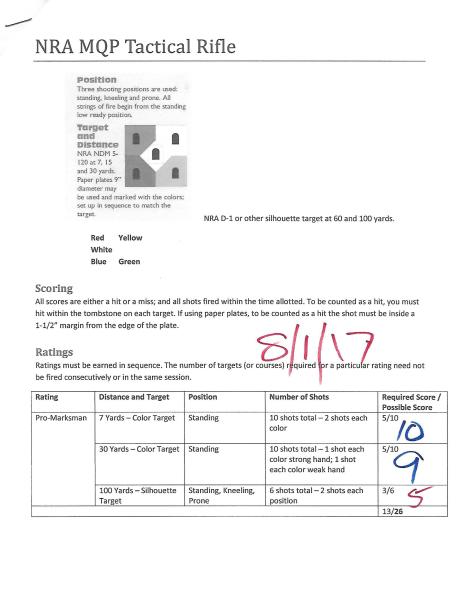
- Shoot the NRA Marksmanship Qualification Program Tactical Rifle Course at the Pro-Marksman level. My gun club rules don’t allow me to shoot the Program with a centerfire rifle caliber so I’m going to use a .22.
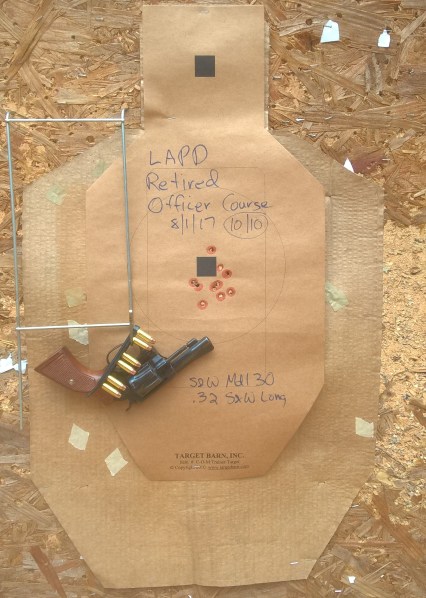
Testing the Model 30 was a little simpler. My plan was to shoot the LAPD Retired Officer Qualification Course. The Course isn’t extensive but it allowed me to test the revolver’s reliability and see if it shot to the sights.
Fortunately, the CMMG shot fairly close to the rifle’s current zero. It just shot a little low, so I fixed that. The Alt-C course is a precision course shot at 25 meters. The targets are scaled from 50 meters to 300 meters.
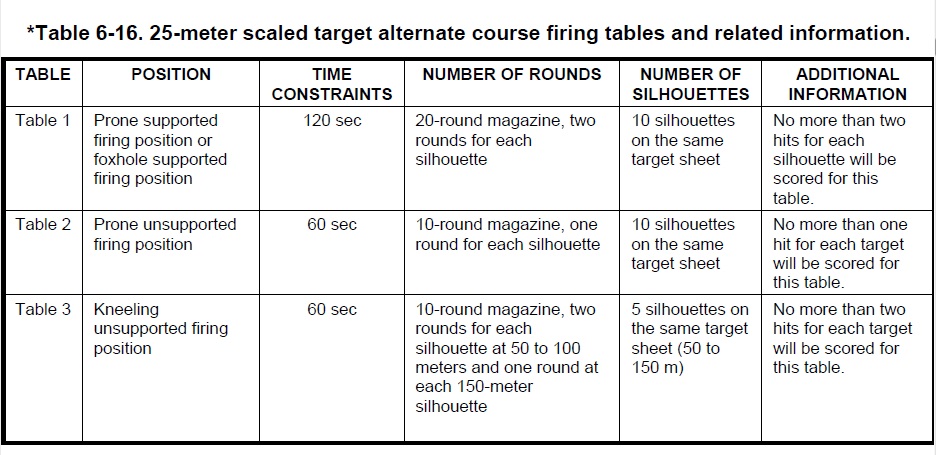
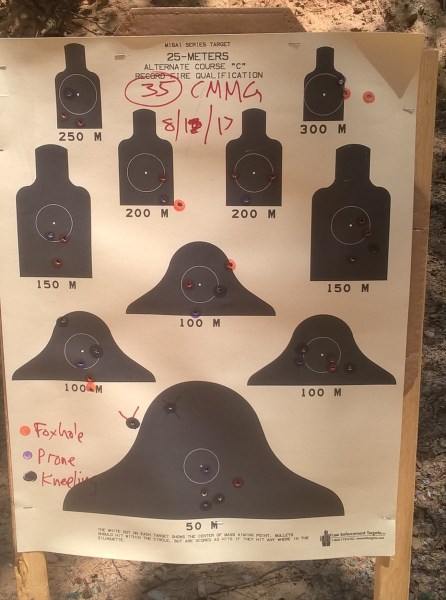
Foxhole supported is simply a benchrest shooting position. There are benchrest positions available at my club so that’s how I shot Table 1. Even though I was using the iron sights, I was still able to shoot Sharpshooter. That made me happy because I haven’t fired a rifle in almost a year.
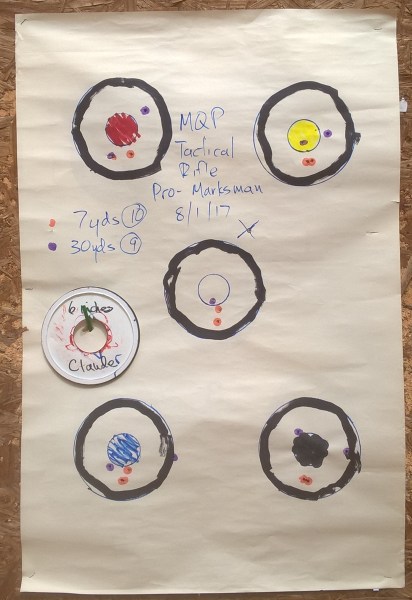
Next, I shot the MQP Tactical Rifle Pro-Marksman. My plan for that is to shoot one level each time I go to the range. Pro-Marksman has three stages; 7, 30, and 100 yards. The targets are expensive and hard to find but six inch circles are an acceptable substitute for the Program. The lid from a Cool Whip container happens to be six inches.
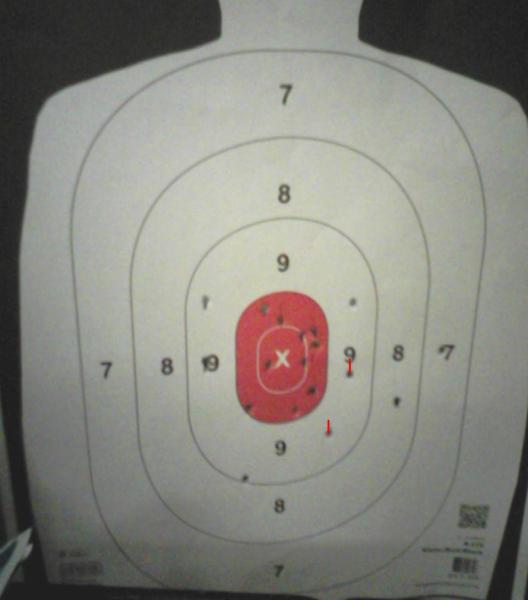
This was my 7 and 30 yard target. I like to mark the hits with different markers for each distance.
This was my 100 yard target. Any silhouette can be used for the 100 yard stage. The sun was in my eyes during the kneeling and prone shots so I was glad I hit as well as I did.
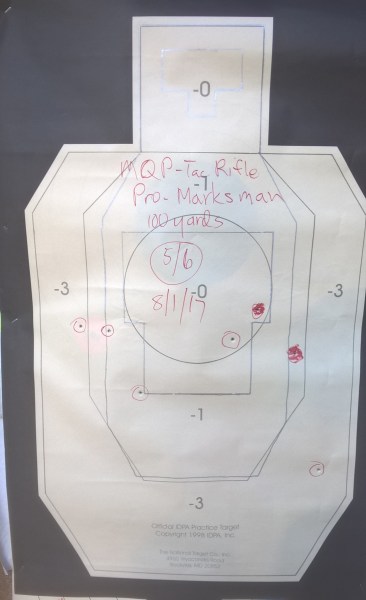
I write my scores on the sheet and scan it for record and future reference.
Finally, I shot the LAPD course with the Model 30.
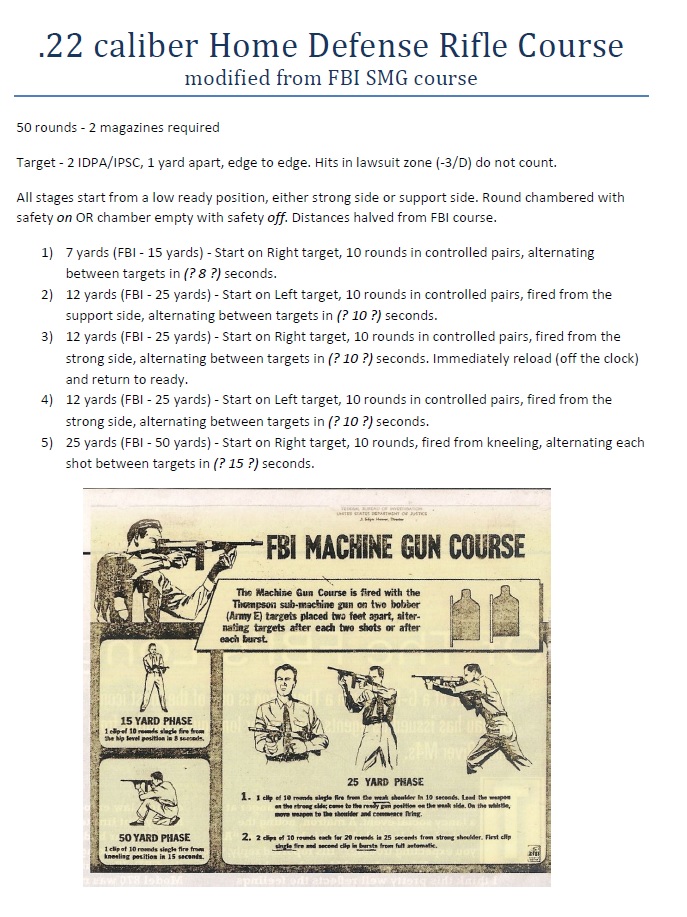
Having a plan when I go to the range helps me stay on task while I’m there. It also gives me a feeling that I’ve accomplished something when I leave. Next time, I’ll probably shoot the MQP Marksman level and the .22 Home Defense Course that I based on the old FBI [Sub]Machine Gun Course.
Stink about NRA Carry Guard
There’s currently a lot of Internet stink about some limitations imposed in the NRA Carry Guard training. I’m not going to comment about Carry Guard in general because as an Instructor certified in numerous disciplines through the NRA Training Department, there’s a possible conflict of interest.
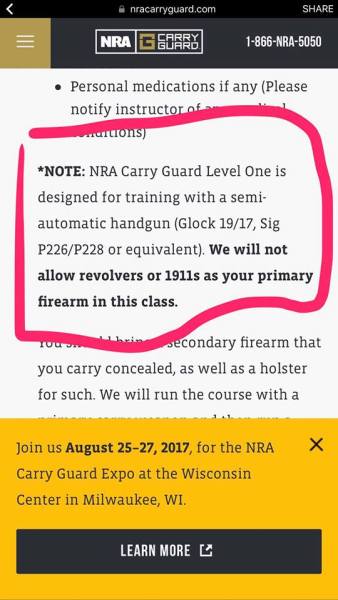
What I will comment about the equipment limitation is:
They’re staying in their lane of competency.
Looking at the background and resumes of the instructors, running a striker fired autoloader or Sig 226 is mostly likely all they’ve ever been trained with, practiced with, or used. Revolvers and 1911s have a different manual of arms and idiosyncrasies that these instructors, with the exception of Jarrett who was briefly with the LAPD decades ago, are probably not familiar with.
They are probably expert with the weapons they have used and the possibility is they are either inexperienced or ignorant of how to operate other weapons at any professional level. I see that a lot now. The number of young police officers who literally cannot open the cylinder of a revolver is stunning. There are numerous firearms trainers who can operate one or two weapons and provide good training, as long as it’s confined to those weapons
Why would we then encourage these Carry Guard instructors to teach students how to use weapons they are not experts in the use of? How often has the meme ‘Stay in your lane’ surfaced lately? To his credit, when Rob Pincus wanted to make a DVD about Snub Revolvers, he brought me in to do it, just as he did with Dryfire. I’m an expert on those topics and he is not.
We can’t have it both ways. If we want instructors to ‘Stay in their lane,’ then we’re going to have to accept that just like lanes on the highway, the lanes have limits. In this case, the limitation is that NRA Carry Guard probably needs to say “Training for a limited subset of weapons but not all.” Describing itself as ‘the Gold Standard’ is probably a bit of a stretch. That is not to say I accept what Carry Guard provides is, in fact, the ‘Gold Standard.’ I mean that if Carry Guard is unwilling to provide training for two extremely common weapons, revolvers and Browning pattern pistols, then, by definition, it can’t be ‘the Gold Standard.’
Perhaps it could be ‘the Silver Standard.’ Without seeing first hand what actually takes place at the training, there’s no way for me, or anyone else, including NRA Carry Guard, to say. What they are going to provide remains a prototype, unlike the training provided by NRA Certified Instructors, which are proven training processes. How well Carry Guard’s training prototype will translate to the Instructor candidates being recruited also remains to be seen. At least as long as you’re not using a revolver or 1911. Then you don’t have to be concerned with it.
Spot shooting (Part II)
Yesterday, I was re-reading The Complete Book of Modern Handgunning published in 1961. It’s interesting to see how much has changed in the world of handgun shooting and how much has not.
The following gem is found in Chapter 11. How to Shoot
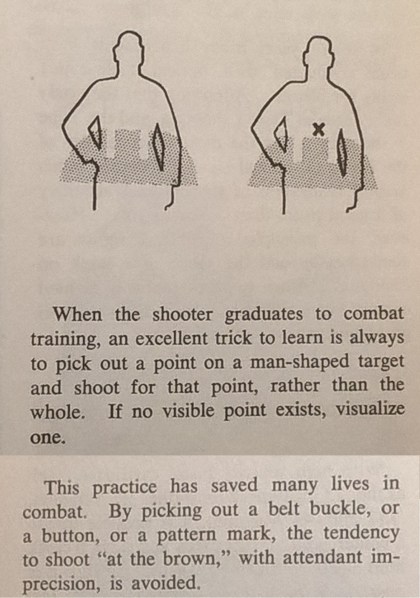
It brought to mind an unintentional laboratory experiment that happened while I was teaching a snub revolver class. In 2012, I taught a short block of instruction on snub nose revolvers at the Northeast Shooters Summit, just as I did in 2011. The same block of instruction was given both Saturday and Sunday to two different groups of shooters totaling about 40. Many of these shooters had almost no experience using any revolver, much less a snub. They fired approximately 40 rounds in two hours of training, followed by a 10 round qualification course at 5 and 10 yards. The way the training was structured was shooting on dot targets until the qualification course. I emphasized the concept of spot shooting that I discussed in my previous blog post.
The target used for the qual was the TQ-21TC(C) target photo target. The value of this particular target is that it has a visible aiming point at the base of the V formed by the open throat of the jacket collar.
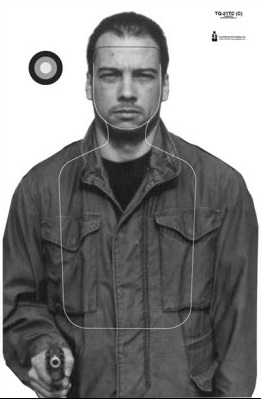
In both years the success rate on the qualification, using that target, was 100 percent. This mirrored my results when teaching other snub revolver classes. On Sunday of 2012, there was a target mixup and my targets were used for a class before mine. The target available for my class was the DST-1A, which has no visible aiming point on it. It is an almost solid black silhouette with a head.
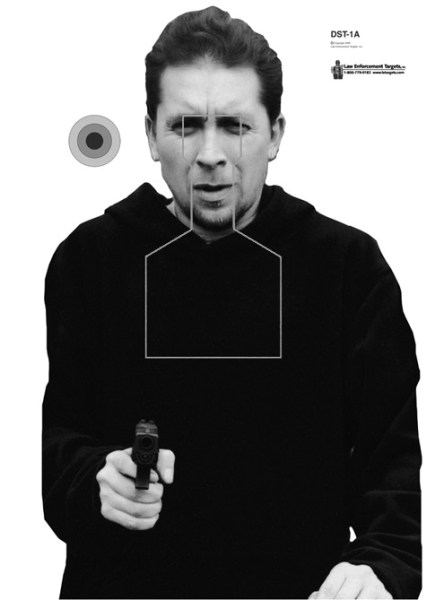
The difference in the students’ success rate from previous classes was stark. Approximately 50 percent of the students failed the qualification course when it was fired on the DST-1A. Their shots were all over the targets with many complete misses. The change from defined point of aim to ‘center of mass’ aiming altered the outcome of the test radically. This occurred despite them being told to try to visualize a spot to shoot at.
As I mentioned in my previous post about Spot Shooting, using blank targets is a poor way to teach people how to shoot. Sadly, the blank target concept has become the norm. Conversely, it is interesting to note that since the Bianchi Cup (NRA Action Pistol) switched to the AP-1 target, which has a defined aiming point, from the D-1, which doesn’t, records have been broken every year.
The ubiquitous original B-27 target at least has an X to aim at, even if it is anatomically misplaced. Something to think about in training, practice, and actual incidents is to pick an aiming point or “Mark your targets before you fire.” as Colour Sergeant Bourne put it.
 tacticalprofessor
You must be logged in to post a comment.