Dry Practice Safety Procedures
The influx of new firearms owners in the past few weeks has generated considerable interest in dry practice. For both new and long time owners, a primer on dry practice is in order.
Dry practice is the process of practicing with a firearm without using ammunition. Generally, this is done at home but can also be done at the range in conjunction with live fire practice. The purpose of dry practice is to become more familiar with the operation of a firearm without the distractions of recoil and the Overpressure Event aka muzzle blast. In times of limited or no availability of ammunition and range resources, dry practice may be the only practice method available to us.
There are very specific safety precautions that should be used to make dry practice as safe as possible. A one page sheet listing safety precautions is available here. dry practice safety procedures Note that no usage of any potentially life-threatening device, such as firearms, automobiles, chain saws, or electric outlets can be considered completely safe.
Using a chamber safety device is highly recommended when dry practicing. A number of commercially available devices are available and they work well. A field expedient device is a pipe cleaner aka ‘craft fuzzy stick’ through the bore and bent over in the ejection port.
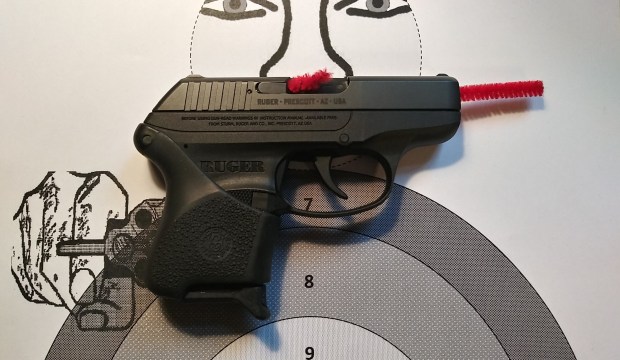 These can be purchased at Wal-Mart for less than one dollar for a large package of them.
Previous articles about dry practice, nee dryfire, can be found by clicking the ‘dryfire’ Category in the right column menu.
Practice and practice safely.
Snub Dry Practice During the Beer Plague
#wheelgunwednesday
We can use our time at home productively during the Beer Plague by doing some dry practice. Here’s a regimen for snub revolvers that’s quick and useful. It’s derived from the LAPD Back Up Firearm Qualification Course. There are two targets at 3 yards.

String 1
From a concealed holster, using two hands, draw and snap twice on the right target, twice on the left target, then one snap on the right head.
String 2
From a concealed holster, using two hands, draw and snap twice on the left target, twice on the right target, then one snap on the left head.
String 3
From a concealed holster, using the Primary hand only, draw and snap twice on the right target, twice on the left target, then one snap on the right head.
String 4
From a concealed holster, using the Primary hand only, draw and snap twice on the left target, twice on the right target, then one snap on the left head.
String 5
From Low Ready, using the Support hand only, snap twice on the right target, twice on the left target, then one snap on the right head.
String 6
From Low Ready, using the Support hand only, snap twice on the left target, twice on the right target, then one snap on the left head.

You can use fired cases as snap caps to protect the hammer nose (firing pin). Marking the case head with a black Sharpie provides a visual indicator that the case is a snap cap and not a wadcutter. Having a specific container for them keeps them easily accessible.

Upcoming Class Announcements
Personal Performance – May 3, 2020 (Dahlonega, Georgia)
$99 class fee, payable in advance. $20 range fee, payable day of class.
This Course is designed to give clients a clear measure of where their skills are at and what they need to do to improve their current skill level. It is based on the NRA Marksmanship Qualification Program and all shooters will receive NRA awards, based on their achievement during the Course. Shooters do not need to be NRA members to receive their awards. Clients will receive a take home program to maintain and improve the skills exercised during the Course.
The Course is taught in conjunction with Brian and Shelley Hill of The Complete Combatant.
To register, visit: https://www.eventbrite.com/e/may-2020-personal-performance-tickets-86377997917
Pocket Pistol 101 and Strategies, Tactics, and Options for Personal Protection (A weekend with the Tactical Professor) – May 30 – 31, 2020 (Weatherford, Texas near Forth Worth)
$300
Join us for two full days of practical skill development, theoretical concepts, and realistic application of both skill and theory to Personal Protection Problem Solving with Claude Werner, AKA “The Tactical Professor”. All instruction is based on twenty years of research and analysis of over 5,000 actual incidents involving Armed Citizens rather than the Police.
Pocket Pistol 101 (Day One): Learn the skills needed to effectively use SMALL handguns for Personal Protection. Pocket Pistols, such as snubnose revolvers and .380 and small 9mm autoloaders, have manuals of arms and performance limitations that differ significantly from service-size handguns. They are very frequently carried for Personal Protection but often not trained with. This course is designed to teach students proven gunhandling techniques unique to Pocket Rockets, increase the students’ understanding of the shooting characteristics associated with handguns that are smaller, shorter, lighter, and often equipped with sub-optimal sights, and how to enhance their ability to make timely and accurate hits. Both firing line drills and scenario-based exercises (NOTE: Man v. Man Drills) are used as skill builders in the course.
Strategy, Tactics, and Options for Personal Protection (STOPP) (Day Two – Morning): This classroom segment focuses on helping clients define the Strategies, Options, and Tactics that are appropriate for them personally in the area of Personal Protection. By defining personal Strategies and being aware of possible Options, the Tactics appropriate to a person’s goals and lifestyle can be chosen. These are unique to each person and no one size fits all. Being aware of a range of possibilities in advance of criminal encounters helps the client avoid Serious Mistakes and achieve Positive Outcomes. All clients taking the class will receive a copy of the book Serious Mistakes and Negative Outcomes by the Tactical Professor.
Scenario Based Live Fire Exercises (Day Two – Afternoon): The ability to perform effectively on an individual basis is a fundamental aspect of Personal Protection. Each client will have the opportunity to individually examine their performance envelope in re-creations of actual incidents that involved Armed Citizens. The re-creations will mirror the conditions and difficulties that Armed Citizens face when protecting themselves and their families from the criminal element.
To register, visit: https://www.ptgtrainingllc.com/store/p48/A_Weekend_with_the_Tactical_Professor.html
Revolver Operator Course – July 11, 2020 (Dahlonega, Georgia)
$149 class fee, payable in advance. $20 range fee
Small revolvers are often carried for Personal Protection. However, their size and light weight make training and practice difficult. This class uses service size revolvers as the principal training tools for learning the general principles of trigger manipulation, reloading, and gunhandling with revolvers.
After learning the general principles for Revolver Operators with service revolvers, small revolvers will be introduced into the curriculum. The differences between using service revolvers and small revolvers will be explained and practiced. An evaluation test will be shot at the end of the course to allow clients to establish a baseline for their own future performance evaluations. Clients will be given a handbook to guide their practice efforts after the course.
To register: email tacticalprofessor@gmail.com You will be invoiced for the class fee. Once the payment is received, your spot is reserved. The range fee will be collected in cash the day of the class.
I have a question …
A friend sent me an email today that I think is very worthy of sharing. He is a twice retired POlice Officer, graduate of the elite Rogers Shooting School, and very seasoned firearms and tactics trainer.
What is your overall opinion of competition preparing you for a real gunfight?
I published my response on my Patreon page, which is generally limited to my subscribers there. It’s an important topic so I decided to make it publicly available. https://www.patreon.com/posts/33975252
More about Refining the drawstroke
An excellent question was posed about Refining the Drawstroke. It’s worthy of repeating and answering in a post of its own because the answer seems counter-intuitive.
Shortest distance between two points is a straight line. He seems to catch with the support hand at the nipple line. We catch just a tad lower. Thoughts?
In this case, the line to follow is the eye-target line not the line from the holster to full extension. The sooner the gun gets into the eye-target line, at least peripherally, the sooner we can begin refining our visual reference of the gun to the target. If the gun is presented straight to extension, the visual refinement cannot begin until the gun reaches extension.
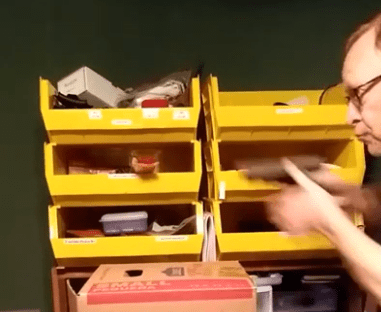
At this point, I am already achieving a coarse visual reference of the pistol to the target.
Refining the drawstroke
One of the most common errors in the drawstroke is allowing the pistol to dip below the holster during the draw; this is called bowling. Another common error is bringing the gun up to the eye-target line like an underhand toss, which is called scooping. Both of these errors increase the time of the drawstroke and increase the difficulty of acquiring the sights.
I’ve created a YouTube channel for videos that I plan to make. Here’s the first, a simple technique to get rid of bowling and scooping.
Tactical Professor books (all PDF)
Serious Mistakes Gunowners Make http://seriousgunownermistakes.com
Indoor Range Practice Sessions http://indoorrangepracticesessions.com
Concealed Carry Skills and Drills http://concealedcarryskillsanddrills.com
Advanced Pistol Practice http://bit.ly/advancedpistolpractice
Shooting Your Black Rifle http://shootingyourblackrifle.com
The Value of Spot shooting
#Fridayfundamentals
A friend of mine asked an excellent question on Facebook. “If you were going to pick a target for general training purposes, which of these nine would it be?” He included a photo array of commonly used silhouette targets.
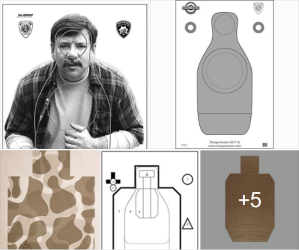
My reply was:
Since I am a believer in and practitioner of spot shooting, there’s [sic] none of these I find particularly appealing.
First shots of the decade
First shots of the decade for me. I was invited to a local indoor range, so I shot the Ill-Annoy POlice qual and the Swiss CCW qual with a .22 revolver and .22 autoloader.
The ammo was Winchester M22. The 43C had one Failure to Fire so I applied Immediate Action, to wit: press the trigger again. That solved the stoppage.


With the M&P 22 Compact I had no Failures to Fire or other stoppages.


The Ill-Annoy qual is 30 rounds and the Swiss qual is 18. The target for the Ill-Annoy qual is a piece of legal size paper in portrait mode, so I used my letter size equivalent. The specified target for the Swiss qual has a hit zone approximately equal to the -1 zone of an IDPA target so I used my letter size target to increase the challenge slightly.
They are both timed courses, which can be problematic on indoor ranges. I used theDry Fire Par Time Tracker phone app and corded the phone to Howard Leight Sync Muffs. That solution worked reasonably well.
It was nice to get out and do some shooting.
Capable v. Likely
What are we capable of versus what are we likely to do?
John Johnston of Citizens Defense Research and I have been discussing this topic in relation to standards in a class. He and I are both believers in having standards and being able to demonstrate competent execution of those standards. Being able to demonstrate means both the instructor and the client.
One of the things I do in private sessions is to have the client take a hostage rescue shot. The target is a complete head next to and not obscured by the hostage head. Only one shot is allowed. The client gets to pick the distance. Most clients, even competent shooters, will close to 3 yards (9 feet) or less. That’s always interesting because the boundary between the near and far phases of Social Space in proxemics is 7 feet for North Americans.
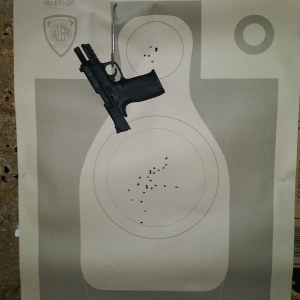
Our technical capabilities are limited by what is within our own heads. What we think we can do represents ‘likely,’ regardless of what we’re actually capable of.
As Ken Hackathorn has said for many years:
You are unlikely to do something in a stressful situation that you’re not reasonably sure you can do competently.
The real value of training and practice isn’t gaining technical competence, it’s achieving confidence in your abilities.
If you are interested in bringing your Strategies, Tactics, and Options for Personal Protection to a higher level, please subscribe to my Patreon account for $5 per month. It’s an investment in yourself. https://www.patreon.com/TacticalProfessor
If you are interested in bringing your skill level higher, please purchase one of my books about how to practice effectively. https://store.payloadz.com/results/337896-tactical-professor
Tactical Reloading
There is still considerable disagreement about the utility of the Tactical Reload. However, whether it has utility or not, it doesn’t have to be a clumsy technique. This is how the Tactical Reload is taught at the elite Rogers Shooting School and Dodd & Associates.
The magazines are handled by the thumb, forefinger, and middle finger. For visual clarity in this photo essay, the partially depleted magazine is depicted by an empty stainless magazine and the full replacement magazine by a blue magazine with a dummy round on top.
- Draw the reload magazine as usual, forefinger along the front.
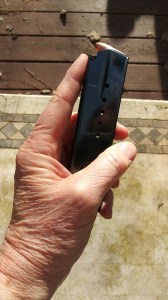
- Slip the forefinger down the magazine so the full magazine is held between the forefinger and middle finger. This leaves the thumb and forefinger available to catch the partially depleted magazine.
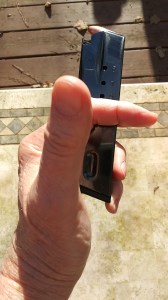
- Eject the partial magazine between the thumb and forefinger and catch it.
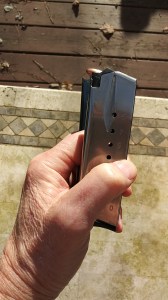
- Insert the full magazine, which is held between the forefinger and middle finger, into the pistol.
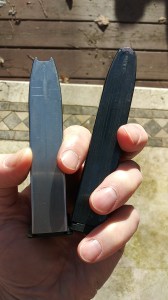
- Stow the partial magazine in a pocket, pouch, or your belt.
This method uses the hand’s two most dexterous digits, the thumb and forefinger, to catch the partially depleted magazine. Using the hand’s most dexterous digits makes it simple to handle even double column magazines.
 tacticalprofessor
You must be logged in to post a comment.