Running the Snub – Recoil Management
First in a series about ‘Running the Snub.’
In a discussion of revolver reloading techniques on my 1000 Days of Dryfire Facebook group, I posted a video of myself shooting the Alabama State IDPA Championship with a snub revolver.
The video generated the following question, which I think is worth some discussion and explanation.
Claude, I watched your video, and to me, you display amazing recoil management – the gun hardly moves. I was under the impression that snubbies are especially hard to shoot and control, particularly in this skill area. Can you share what you are doing to control recoil so well? Maybe details on how you grip the gun, and what kind of load you are firing?
Let’s deal with the simple questions first. I was shooting a two inch K frame at the Championship, which weighs almost twice what an Airweight J Frame does. That has some effect on the recoil management. The load I was using was my IDPA handload, which is ballistically equivalent to 158 grain Round Nose Lead standard pressure. I prefer not to use lead bullets so my load used a plated bullet.
The next issue to deal with is “snubbies are especially hard to shoot and control.” That’s been ‘common knowledge’ among the shooting community for as long as I can remember but how true is it? Like many other aspects of ‘common knowledge’ among gun industry common taters, I’m skeptical about that. So, I decided to do a little more Comparative Testing.
The test I chose was 5^4 (5 rounds in no more than 5 seconds at 5 yards into a 5 inch or less group). The 5^4 protocol was originally developed by Gila Hayes of the Armed Citizens’ Legal Defense Network for her book, Effective Defense: The Woman, the Plan, the Gun and subsequent later editions. .
In Pursuit of Better Practice
Gila Hayes of the Armed Citizens’ Legal Defense Network was kind enough to do an interview with me about Better Practice in this month’s Network Journal. Her interest was piqued because many members of the Network had said that ongoing training wasn’t possible for them due to resource constraints. Gila said that she wanted to give the members an option for maintaining and improving their skills that fit their budgets.
How far, I wondered, could the armed citizen proceed in his or her skill development through self-guided practice alone?
She’s an excellent interviewer. You will probably find it interesting reading.
https://www.armedcitizensnetwork.org/september-2018-front-page
She also did a book review of Concealed Carry Skills and Drills.
https://www.armedcitizensnetwork.org/september-2018-book-review
If you would like to purchase Concealed Carry Skills and Drills, the link to the downloadable ebook is here. http://concealedcarryskillsanddrills.com
If you would like to purchase Indoor Range Practice Sessions, the link to the downloadable ebook is here. https://store.payloadz.com/details/2501143-ebooks-education-indoor-range-practice-sessions.html
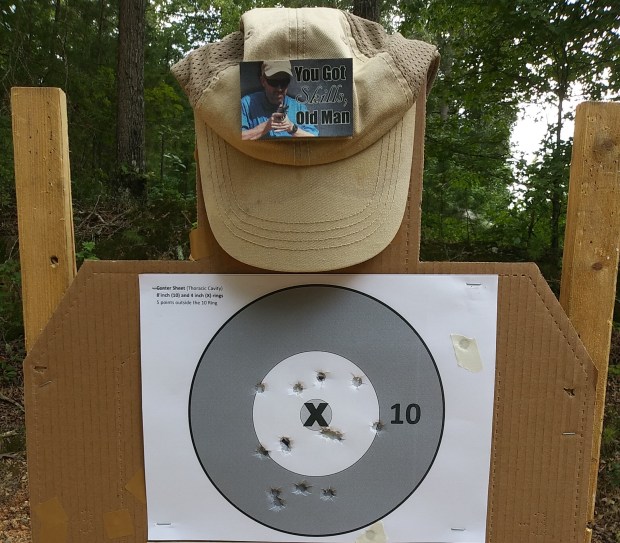
Morale patch courtesy of Chris North
Jacks & Saps and Timing – Part II
Part I of this review gave an overall view of the Jacks and Saps class. Some of the deeper lessons from the class are worthy of further discussion.
Multidisciplinary training (unarmed combat, impact tools, and firearms) doesn’t just mean learning to use different tools and techniques, it also means understanding the overlap of the different disciplines’ concepts. By understanding the overlap, we can reinforce the concepts and lessons of one discipline and apply it to others. Key Concepts in the Jacks and Saps class were Timing, Timing Errors, and Timing Windows. These have parallels in firearms training and practice, as well.
Any tool will do if you will do
Retro posts bring to mind how often the same issues and the same interpretations arise. In this case, someone referenced my post about How many rounds to carry. https://tacticalprofessor.wordpress.com/2016/11/28/how-many-rounds-to-carry/
A comment referenced Tom Givens’ statement “I have never met someone, who has been in a gunfight, tell me they wish they’d had a lot less ammunition”.
My reply to that is something else Tom often says.
“It’s not how much you last practiced, it’s when you last practiced.”
To that, I would add “And how you last practiced and what you got out of it.” It’s easy to pick out one snippet of someone’s philosophy because it fits your purposes and ignore other integral parts of the philosophy. Even if you can’t get to range three times a week, can you spare five minutes those three days to do five draws, five aimed trigger presses with two hands, five with your dominant hand, and five with your support hand? If you can’t be bothered to expend fifteen minutes a week in dry practice, two extra magazines on your person are most likely meaningless.
Another way of looking at it is that it’s not the ammunition on your body that will save your life, it’s the ammunition that you’ve fired in practice that will save you. This is a corollary to something that’s taught in survival training; “It’s not the water in your canteen that will save your life, it’s the water in your body.”
I wish I hadn’t practiced my shooting so much said no one ever.
If you get the ‘go signal,’ you will find that your confidence in your own capabilities is far more important than your confidence in your tools. I am reminded of the police officer who got into a gunfight and had to tell himself “Hey, I need to … shoot better.” Shooting better solved the problem not expending more ammo fruitlessly. But then he drew the wrong lesson and started to carry 133 rounds. I don’t know if he decided to start practicing more and making his practice more meaningful, too. I certainly hope so.
The Miami Massacre is probably the most researched gunfight in history. One of the things that gets glossed over in the analyses was the solution. Ed Mireles pulled out his six shot revolver, used the front sight to aim at his targets, pressed the trigger smoothly, and made six hits that killed Platt and Matix. Ed’s draw was probably not sub-one second, either, but it was fast enough.
The Comparative Standards I’ve been writing about are a good example of “Know your capabilities.”
- What is your gun’s zero at 25 yards?
- What is your ability to hit the -1 zone at that distance?
- What exactly does your front sight look like at that distance?
- How smoothly do you have to press the trigger to make that hit?
- Can you hit the -0 zone (thoracic cavity above the diaphragm) unerringly at 15 yards and in?
I regularly gather metrics about the number of people who are interested in getting a status report of their capability with the handgun they own or carry. The number is extremely small. People would rather place their faith in ‘firepower.’ That’s an incredible mistake because when the firepower is gone, you’ve got nothing left. Your capabilities, if you have them, will solve the problem before your ammo load, whatever it may be, is exhausted. That’s the endgame we’re looking for; solving the problem before our ammunition is gone.
If you would like to purchase my eBook Concealed Carry Skills and Drills, the link to the downloadable ebook is here. http://concealedcarryskillsanddrills.com One of the metrics I gather is how many people are willing to spend the price of a box of ammo to get their personal status report and then increase their personal capability. As I said, it’s not many. Ninety-nine and 44/100ths percent are perfectly comfortable with carrying two spare magazines instead.
Comparative Standards – Double Action Autos
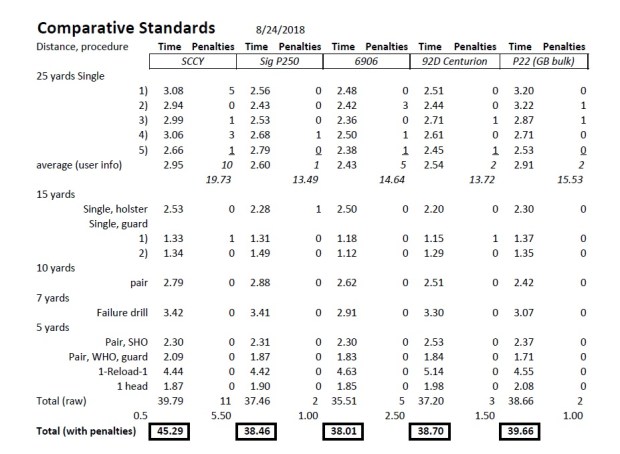
I enjoyed the #wheelgunwednesday Comparative Standards exercise enough to repeat it. This time the test was with Double Action autoloaders. Five different autos, three Double Action Only and two Traditional Double Action were the test subjects. Four were 9mm and one was a .22.
- SCCY CPX-2
- Sig P250
- Smith & Wesson 6906
- Beretta Centurion 92D
- Walther P22 (Remington Golden Bullet bulk ammo)
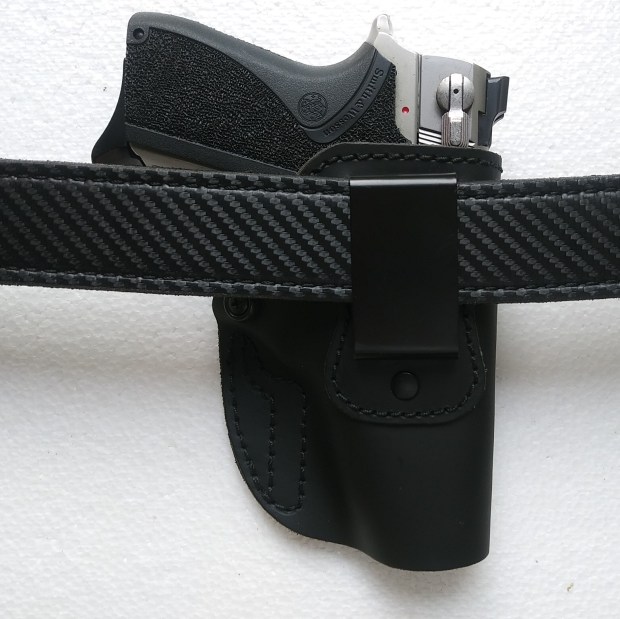
All the guns were similarly sized enough that I used the same Mister Softy holster for all of them. The Mister Softy is interesting in that the gun sits low enough in the pants that a full firing grip can’t be gained in the holster. I didn’t notice the lack of a full firing grip was an impediment. The need for a full firing grip in an AIWB holster is another one of the industry maxims I have doubts about. Maybe I just have clever hands.
I used the same protocols for shooting and scoring as last time so I won’t reiterate them.
#Wheelgunwednesday – Comparative Standards
The Editor of a publication I occasionally write for asked me to participate in a project about comparing different handguns. Being the revolver guy I am, he asked me for some input about how wheelguns fared. His concept is:
[R]each an objective: identifying a short (20-rounds) base of standards for defense handguns to (1) compare similar format guns, one to another, (2) compare formats of handguns (small, single stack or subcompact), (3) “shoot out” duty/defense ammo for replacement while evaluating personal skills, (4) yet another “cold course” of fire to identify skills areas that need attention.
This is the Course of Fire he developed.
- Basis: 3-second strings
- Lots of draws
- Few reloads (on the clock)
- Limited Vickers: use a target, feature .5 second added for 1-down; shortest time “wins.”
- 25 yards – singles from holster – 5x – 5 rounds
- 15 yards – single from holster – 1x
- single from guard – 2 x — 3 rounds
- 10 yards – Pair from holster – 1x 2 – rounds
- 7 yards – Failure from holster – 1x – 3 rounds
- 5 yards – Pair SHO from holster – 1 x – 2 rounds
- Pair WHO from guard – 1x — 2 rounds
- from holster, 1-Reload-1 – 1 x – 2 rounds
- from holster, 1 head – 1 x – 1 round
Total: 20 rounds
The breakdown:
- Draws – 7
- From ‘ready’ (guard) – 3
- Singles – 6, one to ‘brain housing group’
- Weak Hand Only – 2, Strong Hand Only – 2
- Shots to smaller target – 2; one is transition from larger target.
- Pairs – 4
- Reload – 1 (under time)
All in a 20 round box of ammo.
It’s an interesting concept, so I shot it with four different revolvers and two autoloaders.
- Smith & Wesson Model 65 – one of my favorite wheelguns and what I shot at the 2018 Rangemaster Tactical Conference
- Smith & Wesson Model 642– perhaps the most ubiquitous revolver encountered today
- Ruger LCR – another commonly carried wheelgun
- Smith & Wesson SD9VE
- Beretta PX4 Storm Compact, modified to G configuration
- Smith & Wesson 43C – a nice little .22 snub revolver
All were shot from Appendix Inside the Waistband carry except the SD9VE. The centerfire revolvers were reloaded using a speedloader carried in a centerline carrier. The 43C was reloaded using a QuikStrip carried in the watch pocket of my jeans. I used Remington Golden Bullet bulk ammo in the 525 round box for the 43C. Despite it having a 9 pound mainspring, which I have been told will get me ‘kilt in da streetz,’ there were no Failures to Fire.
We were free to use any target we wanted, so I used the printable target from my ebook Concealed Carry Skills and Drills. Per his instructions, the scoring was Vickers Count with ½ second added per point down. I used the Circle as the -0, the paper target as -1, and the balance of an IDPA target backer as -3.
An interesting aspect of the Course is that every shot or two is scored individually. This involves a lot of walking, especially for the five shots at 25 yards but gives a lot of feedback about the efficacy of one’s shooting. In the spirit of the analysis, I marked the target at every distance change to keep track of where the bullets were hitting.
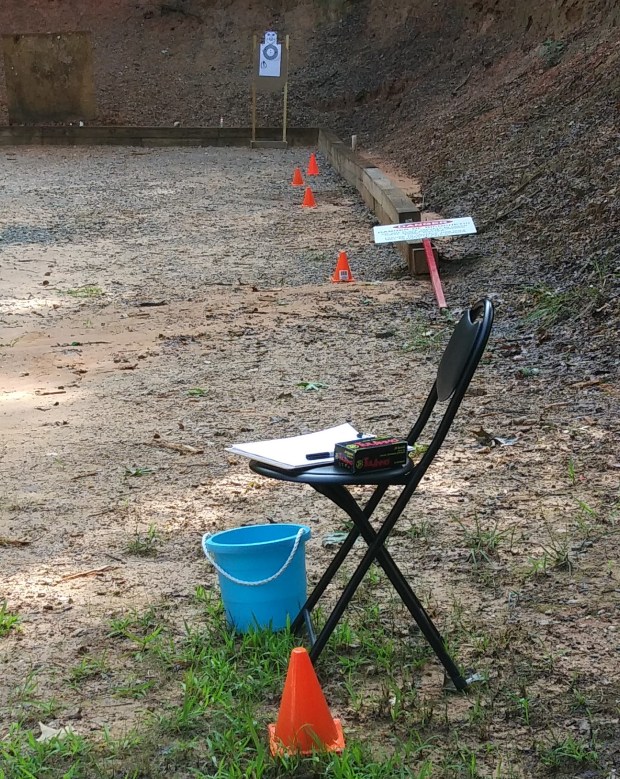
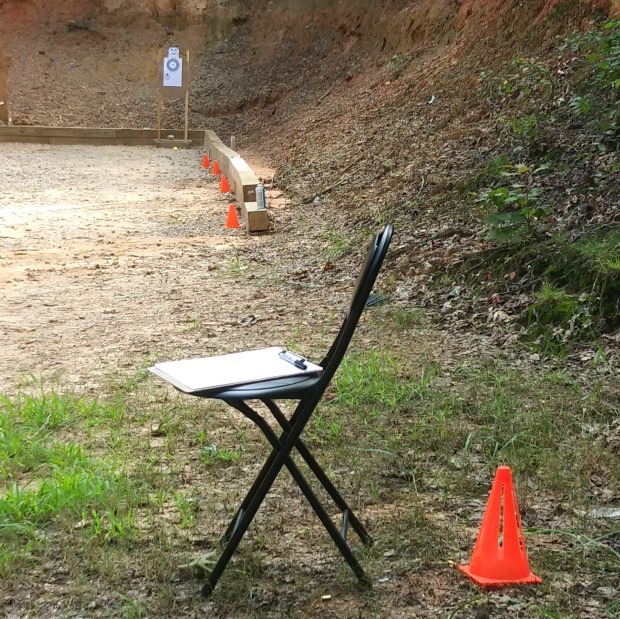
Range setup
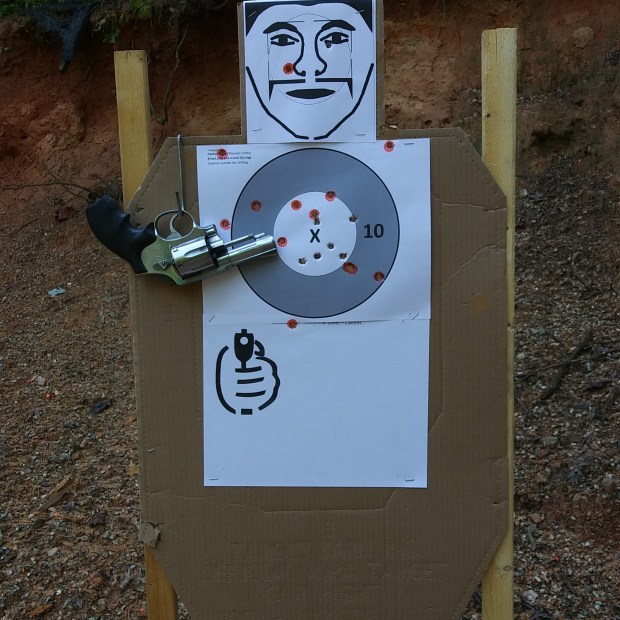
Model 65

Model 642-2
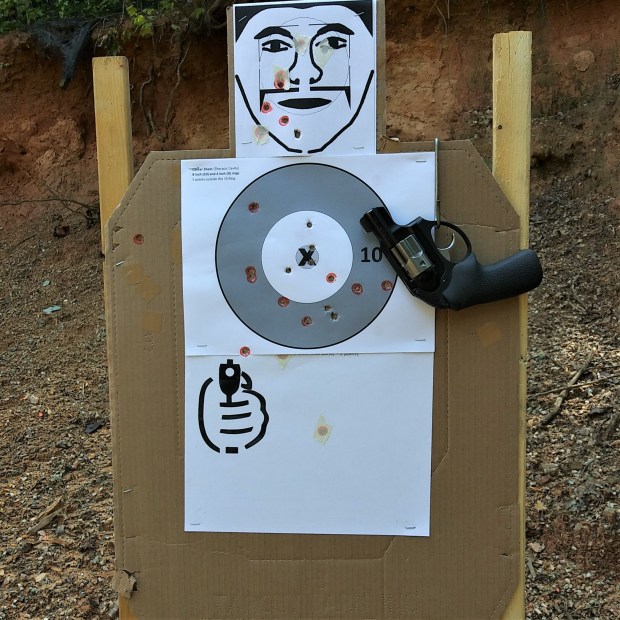
Ruger LCR

SD9VE
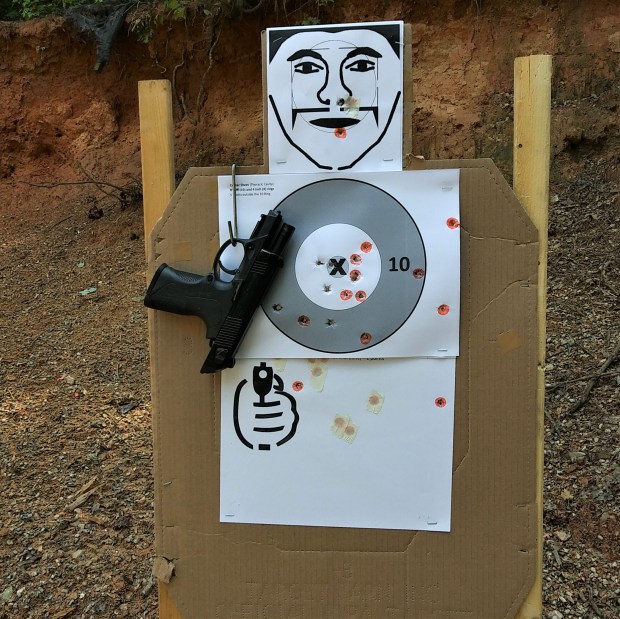
Beretta PX4 Storm Compact
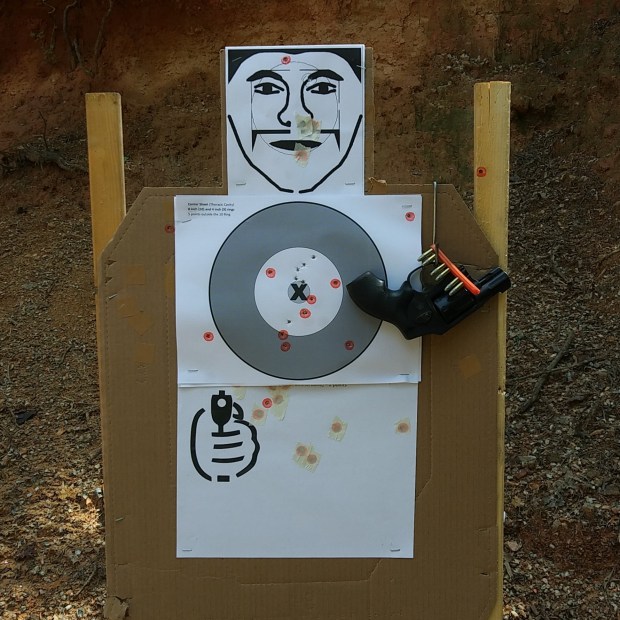
Model 43C
Here’s how the results came out.
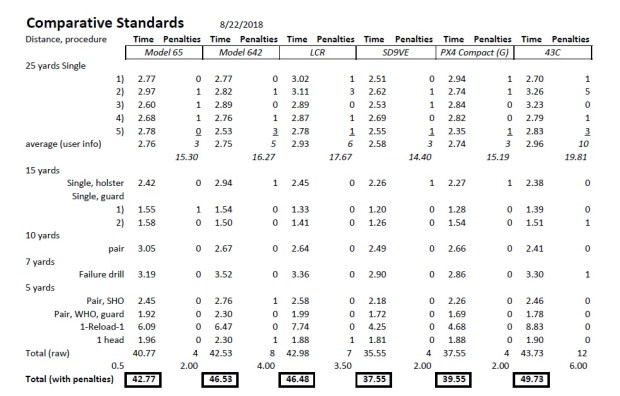
It’s a demanding benchmark analysis. I’m looking forward to seeing the results of the other testers.
If you would like to purchase Concealed Carry Skills and Drills, the link to the downloadable ebook is here. http://concealedcarryskillsanddrills.com
Jacks & Saps and Timing – Part I
Jacks & Saps is a class taught by Larry Lindenman of Point Driven Training. It was hosted in the Atlanta area on August 18 and 19, as two separate one day classes, by The Complete Combatant.
The class objective was described as a:
Small Impact Weapons Skills seminar is designed for people looking for a tool based less than lethal response to criminal attack.
There were ten clients, eight male and two female, on Sunday. They were the overflow from a Sold Out class of 20 clients on Saturday. Since Impact Tools are not regulated in Georgia, it was a very popular class. Note that Impact Tools are not legal to carry in all States even when Licensed to carry a pistol. This makes little sense but logic rarely applies to the law. Readers are advised to be familiar with the laws of their own State and any State they may travel to.
For those unfamiliar, Jacks and Saps are small impact tools [weapons] that are pocket sized. Although ubiquitous in police work at one time, they are now seldom used. Bulkier and less effective collapsible batons have become the standard impact weapons for Law Enforcement now.
Decisions and Drawstrokes – What’s really important?
A recent discussion about a man unintentionally shooting his stepson https://www.panews.com/2018/08/14/man-accidentally-shoots-stepson-12-after-meteor-watching/ got me to wondering “How fast is too fast?” A little research was in order, so I did two experiments. One was a decisional drill that’s an evolution of the Thinking Drills in my Concealed Carry Skills and Drills ebook. The other was a comparison of the times between Cooper’s original Five Count drawstroke and the Four Count drawstroke it has evolved into.
Holster retention systems and sloppy research
Still a great deal of confusion and misinformation about this topic floating around.

A few people drink from the fountain of knowledge but most only gargle.
Gun Digest recently published an online article about holster retention systems. The article begins by referencing Safariland’s retention holster rating system as being the standard. Unfortunately, the author, Corey Graff, should have done a little research and contacted Safariland about their retention rating system before writing about it.
That system, devised by Bill Rogers, the inventor of the modern security holster, has nothing to do with the number of mechanisms that the holster has. Corey’s interpretation is a common misconception in the industry. Safariland’s system is based on a series of hands-on performance tests in which the holster is physically attacked and tested. The holster must pass, in sequential order, each test to achieve a given level of rating. A holster can have several mechanisms on it and still not achieve any rating at all…
View original post 260 more words
Circumstances of a murder
In lieu of #wheelgunwednesday, an interesting and sad case study came up on Facebook. It is a personal experience and something I have never forgotten.
While I was still living in Chicargo, I often took public transit, especially the Elevated trains. One Sunday morning, I was going to play a softball game. However, the POlice had closed the Elevated station. A woman had been raped and murdered and a would-be rescuer stabbed within an inch of his life at 10AM on an otherwise beautiful Sunday morning on the platform.
A rare second cup of coffee kept me out of that situation. I never have a second cup. To this day, I still wonder if I could have done a hip throw (a Hand to Gland Combat technique) on the criminal onto the third rail. Or maybe I would have ended up like the would be rescuer. He was a runner; the paper said if he hadn’t been in such great shape he would have died too.
My Guardian Angel was looking out for me, as is often the case.
The circumstances of the incident were as follows:
 tacticalprofessor
You must be logged in to post a comment.