Why many Americans insist on owning weapons
A friend posted a comment on his Facebook page about police response policies and times today. His post related to the hypocrisy of politicians who are protected by armed guards around the clock but desire to have the populace disarmed and at the mercy of the criminal element.
In the wake of the Umpqua Community College and Northern Arizona University shootings, there have been renewed calls by Mr. Obama for increased gun control, along with other politicians. The implication of these calls is that law enforcement authorities are always available to protect the citizenry at a moment’s notice. If the government will not allow the citizenry to protect itself, as is now the case in Lesser Britain, then that responsibility must fall to the organized government. A frequently validated saying in the Army is
If no one in particular is responsible for something, then no one is responsible for it at all.
There are several problems with making the government responsible for our safety in the United States, two in particular.
First, the Supreme Court ruled in 1989 and again in 2005 that the government does not have the duty to protect us as individuals. Government in general, and the police in particular, only have the duty to preserve a general sense of order in the US. Only society at large is owed a duty of protection.
Second, there are practical considerations. The following was how I responded to my friend’s post:
I have a recording of an actual 911 call by a woman whose home is broken into while she is on the phone with 911. It is not fiction and was used as an exemplar in 911 dispatcher training.
The dispatcher is shocked into silence by the events, which allows hearing the gruesome sounds and screams as the woman is murdered. It is 2 minutes and 51 seconds long from the time she calls when he is outside until the murderer calmly hangs up the phone after the woman is dead. She is screaming “Who are you?” and has no idea of her attacker’s identity. To my knowledge, the murderer has never been identified, much less caught and brought to justice.
The recording is so horrible and shocking that I am very judicious about whom I play it for. I have listened to it many times and it still turns my stomach every time I hear it.
It’s not the only such macabre recording like that in my collection. They range in length from 1 minute 1 second to 3 minutes 3 seconds.
Every scumbag politician, including police chiefs who serve as mouthpieces for their political masters, should be required to play it at the conclusion of their spiels about how they will protect us and a five to eleven minute response time is plenty. It would be the end of that [you know what].
090928-N-1783P-005
(U.S. Navy photo by Machinist’s Mate 3rd Class Juan Pinalez/Released)
Friday Fundamentals (Segment 3) Properly gripping an autoloading pistol
As my colleague Wayne Dobbs of Hardwired Tactical Shooting says, there are three fundamentals of handgun shooting that can make you or break you in a defensive situation; grip, sights, and trigger [manipulation]. I would also add follow through, as a student who came back today from the elite Rogers Shooting School called to mention to me.
For this segment, let’s look at the autoloading pistol grip discussion contained in Advanced Pistol Practice.
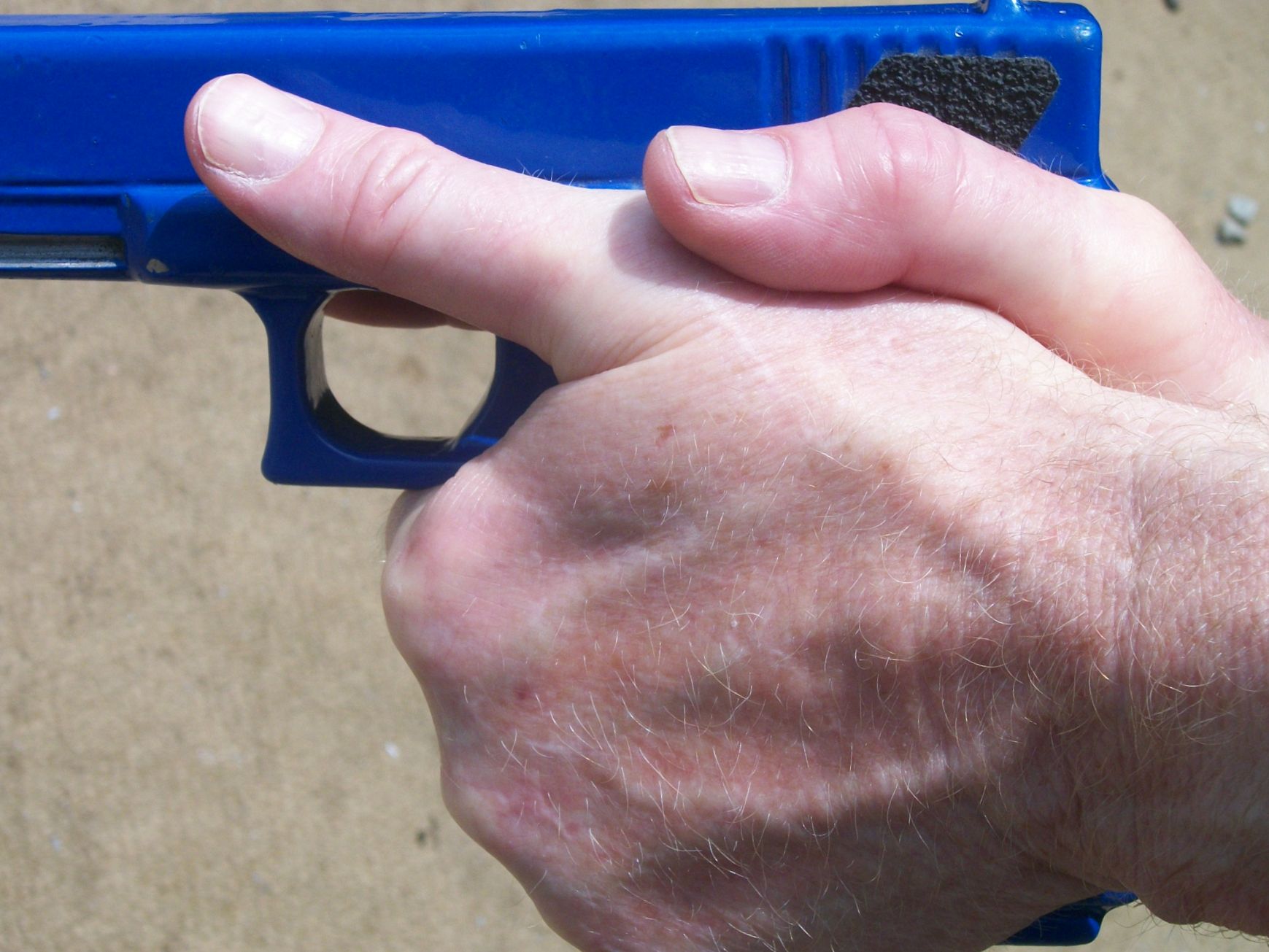 The proper grip for any handgun should accomplish several objectives:
- Maximize our hand friction on the handgun. The way we prevent the handgun from moving around in our hand(s) is simply via friction. Therefore, the more hand surface we have in contact with the gun, the more friction we can achieve.
- Minimize the gun’s motion during recoil by stabilizing the supporting joints, principally the wrists, when the gun fires.
- Reduce the distance between the line of the handgun’s bore and our hands to the smallest amount possible. This diminishes the rotational torque generated by the handgun upon firing.
After establishing the appropriate grip, a series of index points can be used to feel when the grip has been properly achieved. Especially in defensive encounters, there is no time for visually checking whether the proper grip is in place. Having a set of index points allows a shooter to establish a proper firing grip in the holster and during the drawstroke to know that the grip is as it should be.
With an autoloading pistol, this grip is commonly referred to as the ‘thumbs forward grip.’ Being aware of four specific index points will allow a shooter to know that a proper grip has been achieved without having to visually verify it. There are nuances to this grip that sometimes escape even experienced shooters, however. The first three index points are essentially the same for all shooters. The fourth index point may vary among shooters, dependent on individual physiology.
There is still debate as to how hard the fingers of the support hand should grip the firing hand. In any case, they should certainly grip firmly enough to not break free of the firing hand during recoil.
Web of the firing hand
The firing hand should be as high as possible on the back strap of the pistol. Gripping the pistol low increases the rotational torque of the pistol in the hand. So the first index point is the relationship between the tang of the pistol and the web of the hand. For most people, there should be no space between the tang and the web. The shape of a few people’s hands will leave a small space even when the gun is gripped as high as possible but this space should be minimal. Those with large hands may experience contact by the slide on the firing hand when it is held this high. The use of a beavertail or Grip Force Adapter on the Glock pistol can reduce this contact.
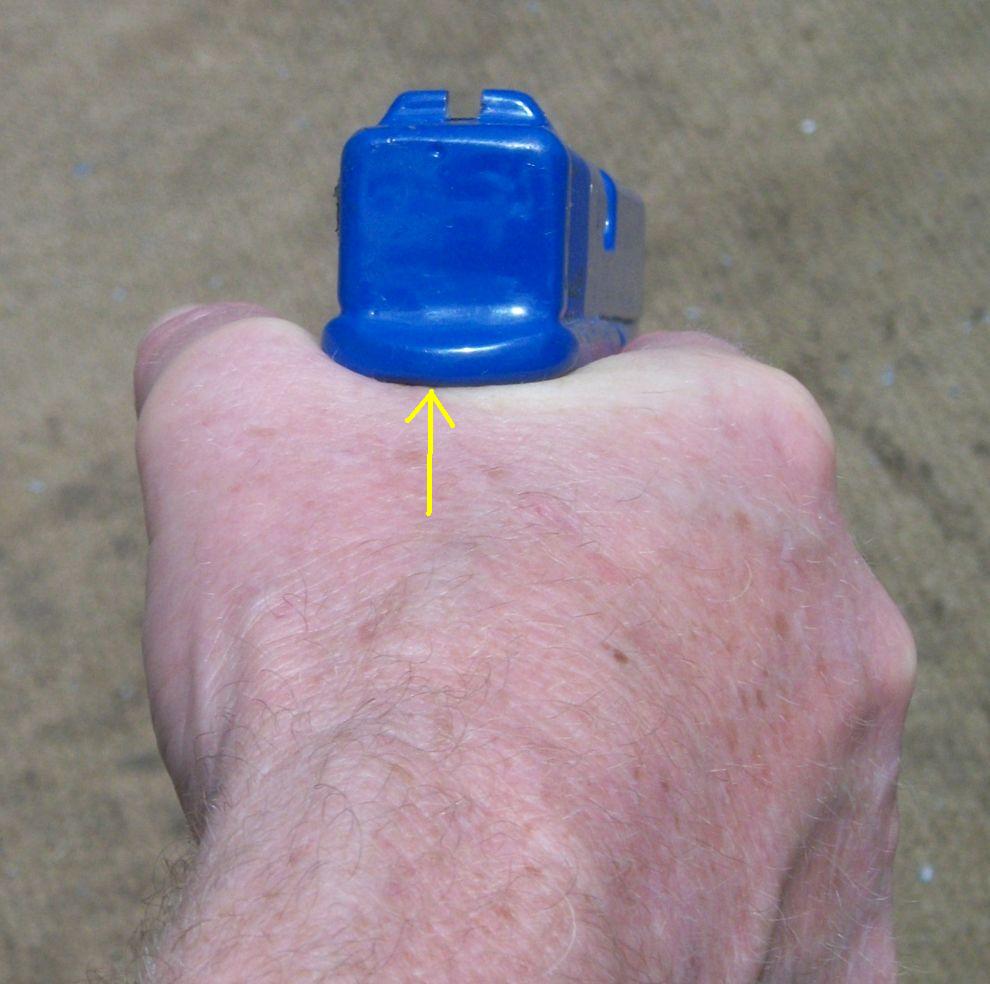 Bases of the thumbs mate
As much of the support hand as possible should make contact with the pistol to maximize the friction the support hand can generate on the pistol. To achieve maximum contact, the bases of both thumbs should make contact firmly. This is the second index point. It is common to see space in shooters’ grips between the bases of the thumbs. This is a clear indicator that the support hand is not making maximum contact with the pistol.
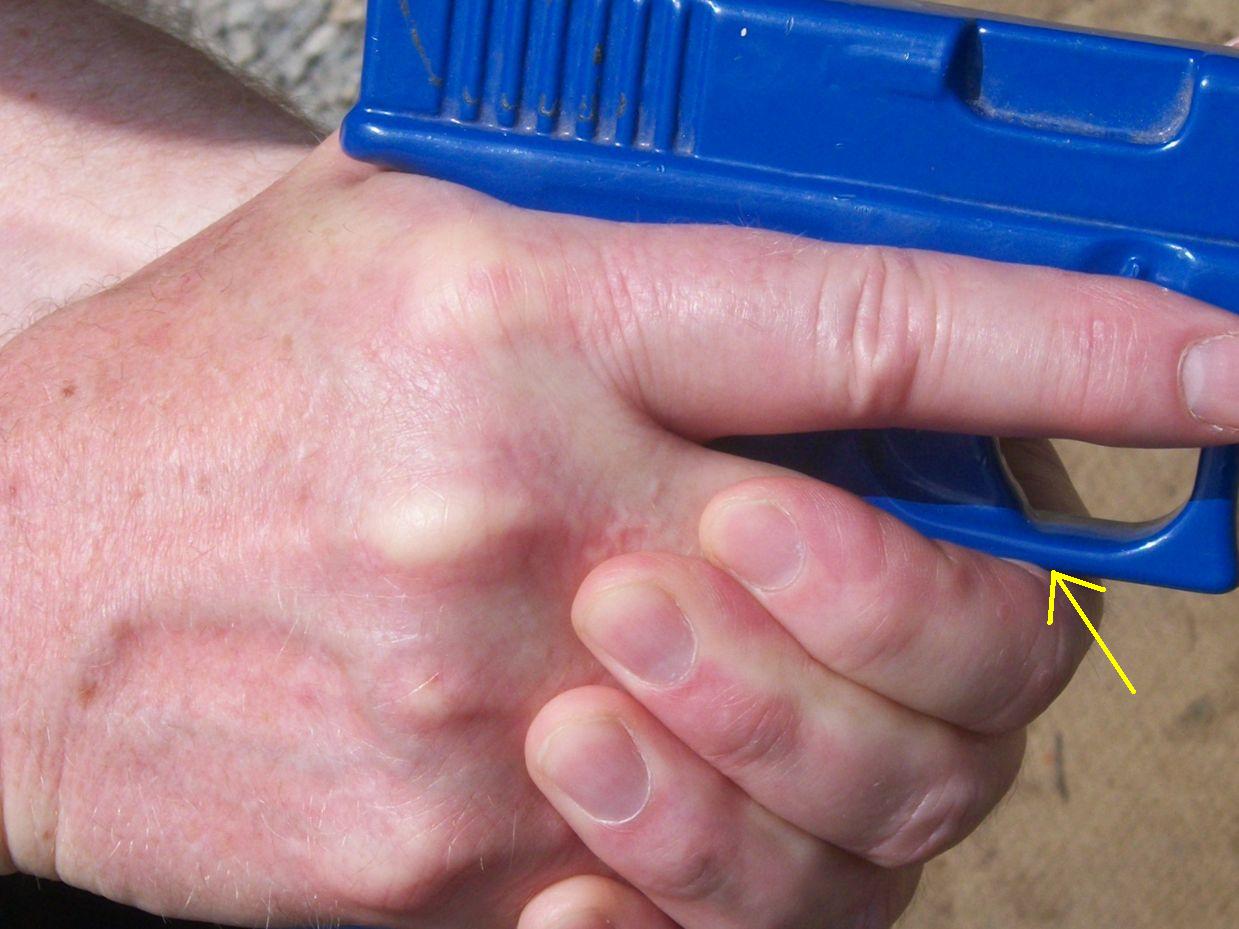
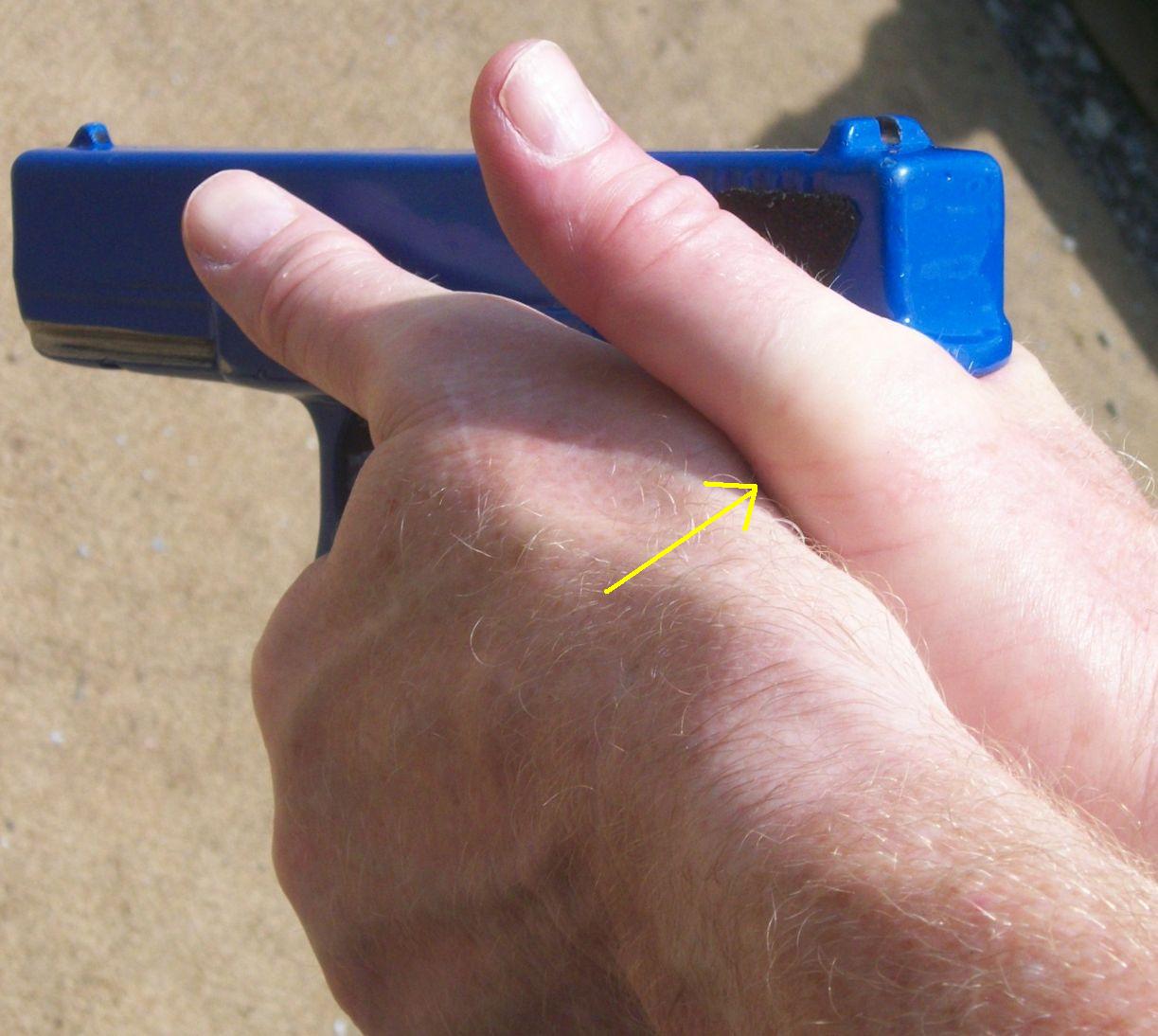 Support trigger finger touches trigger guard
The support hand should be as high as possible on the pistol to reduce rotational torque. Lightly touching the underside of the trigger guard with the side of the support hand trigger finger is the third index point of a proper grip. When the support hand trigger finger touches the trigger guard, the support hand is properly high on the gun. The ‘cup and saucer’ hold used by most TV and movie actors is an excellent demonstration of how NOT to form the grip of the support hand. Because blanks generate no recoil, controlling the handgun is not of importance to them. The ‘cup and saucer’ method does keep the actor’s arms down and allows a better view of the face, which is why it is used so often in that format.
 Wrist is extended downward
Stabilizing the support wrist is a key component of a proper grip to achieve recoil control. This is the element that many people do incorrectly when forming the grip. The wrist is most stable when it is extended downward.
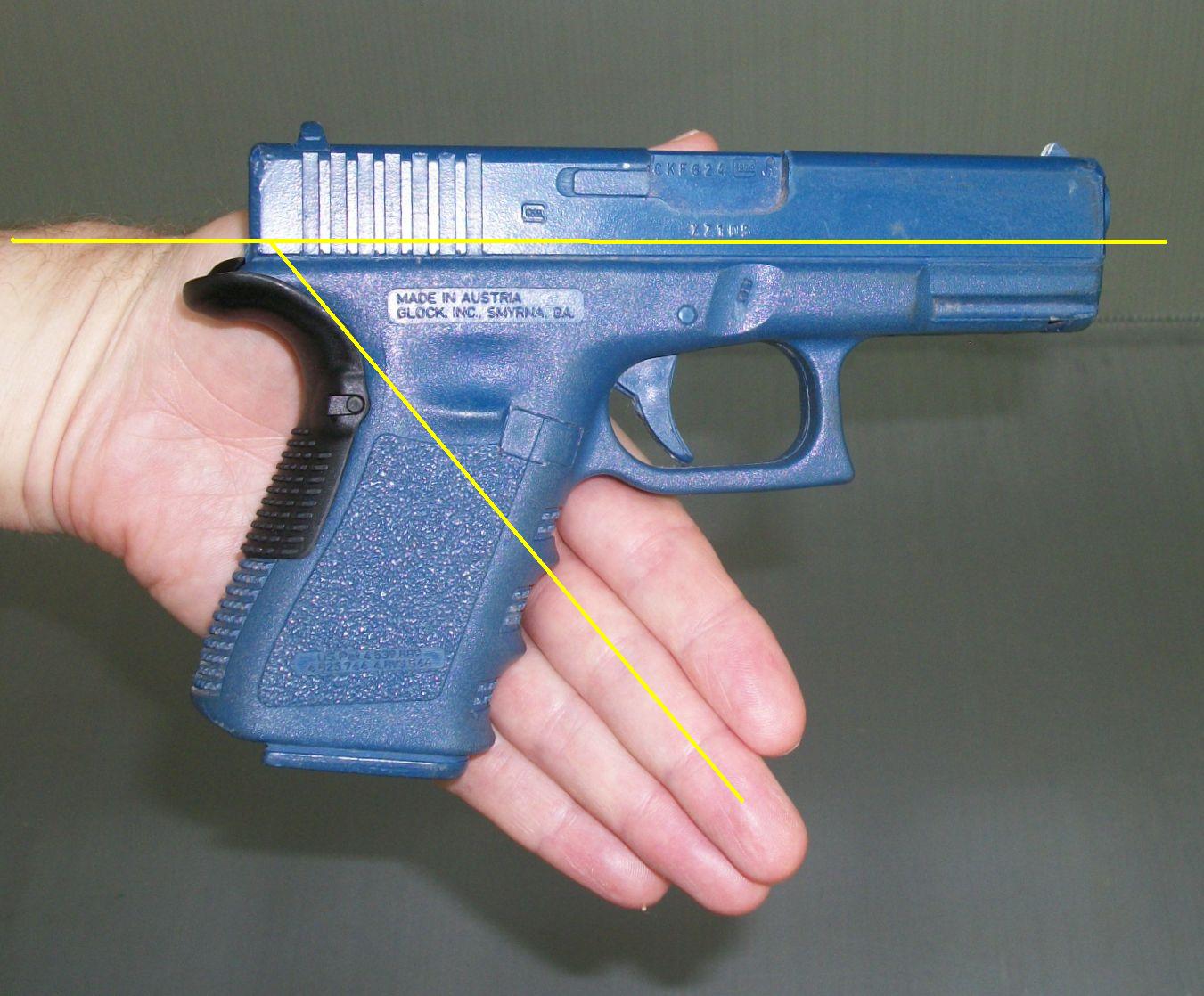
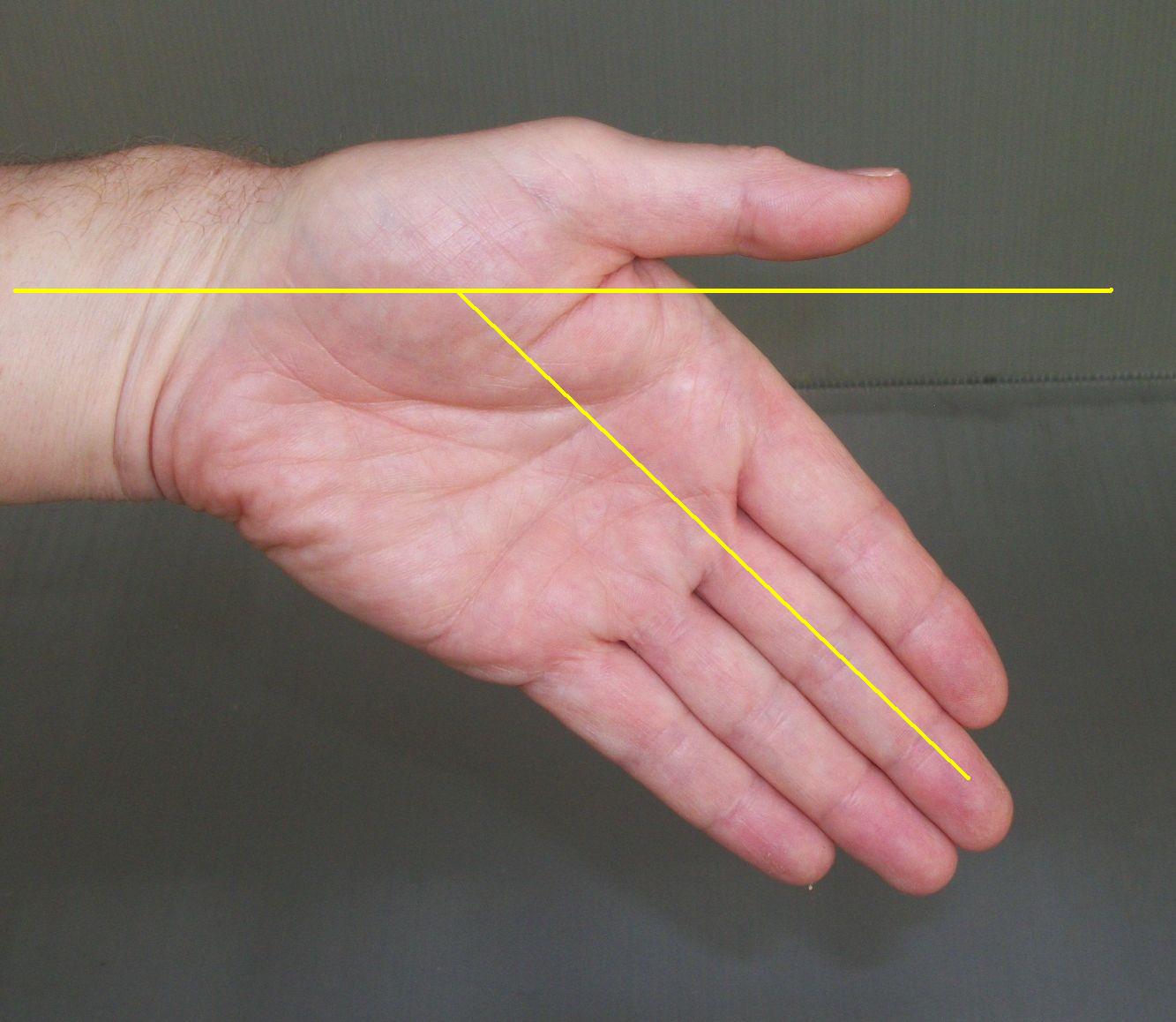 Angled downward in relation to bore
So when the support hand is applied to the pistol to form the grip, it should be angled downward in relation to the line of the pistol’s bore.
 Wrist should not be straight
The downward extension is initially slightly uncomfortable and feels somewhat unnatural. As a result, shooters tend to unconsciously keep the wrist of the support hand straight instead of extending it downward.
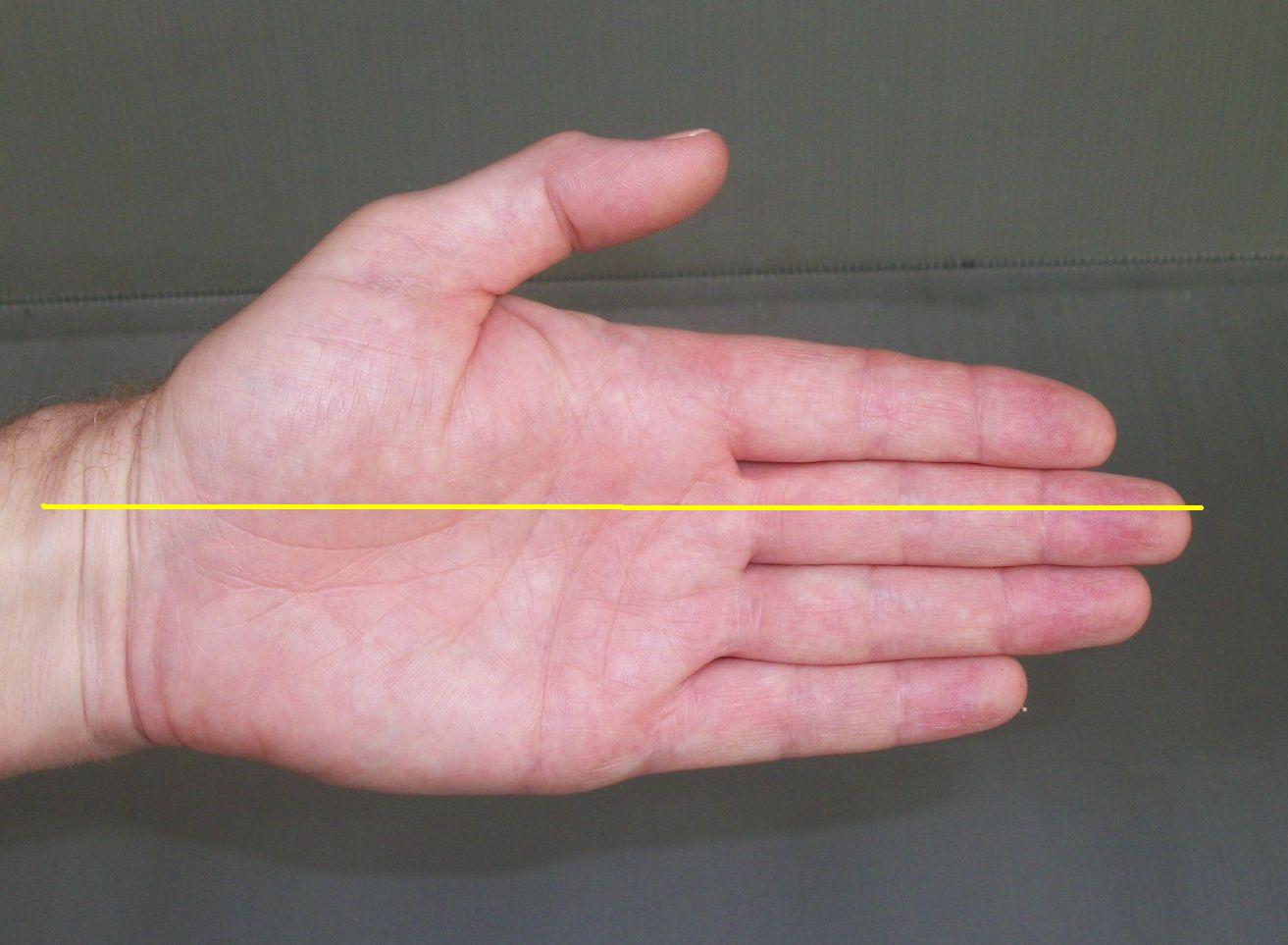 Wrist incorrect
So, it is common to see the wrist held almost straight when the support hand is applied to form the grip. This is incorrect and does not provide much stability to the pistol when it fires.
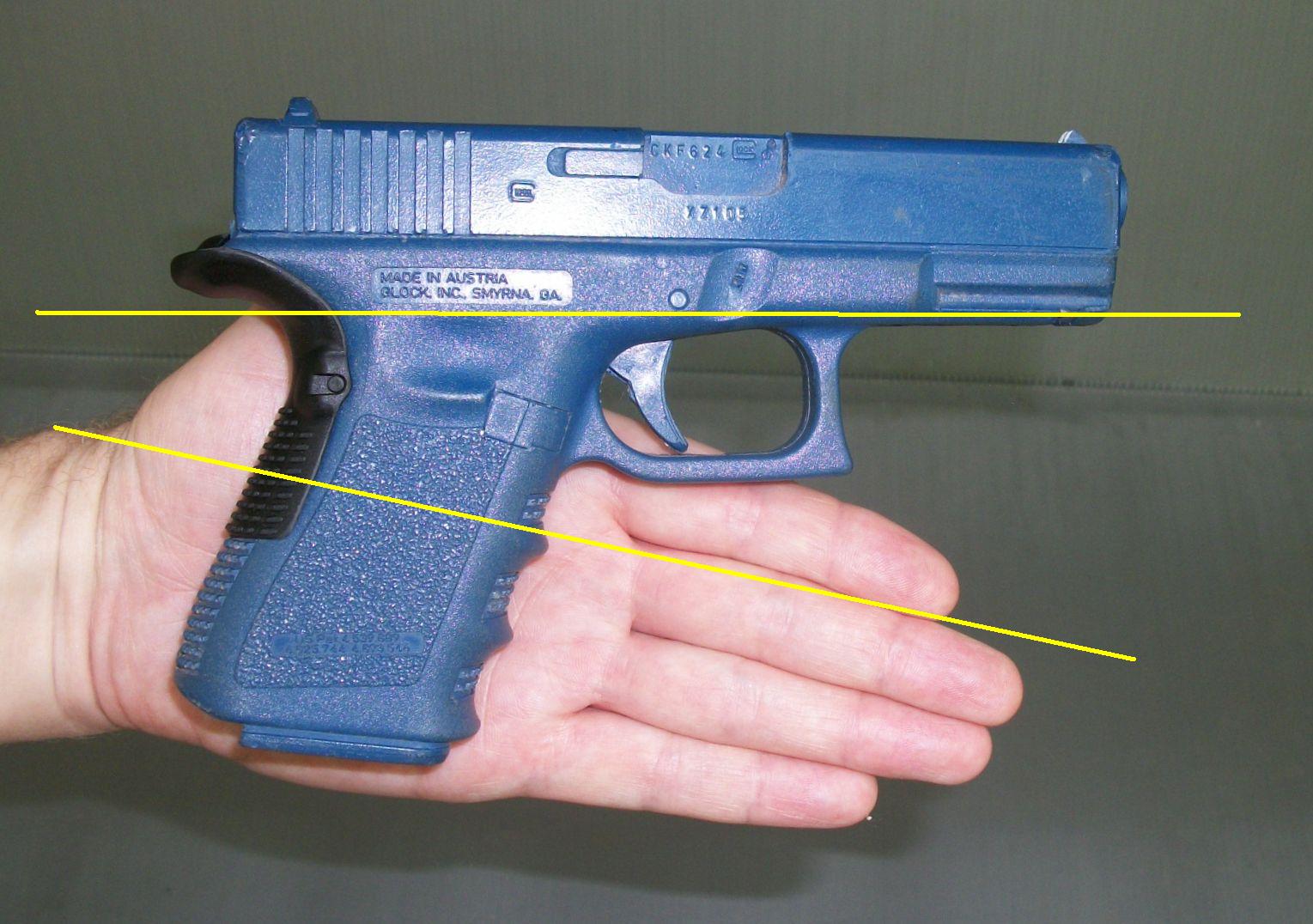 Firing thumb on support thumb
Consequently, the fourth index point is the contact point of the firing thumb on the support thumb. By knowing location of this point when the support wrist is properly extended downward, a shooter can immediately tell whether or not the best grip has been achieved. For most shooters, the tip of the firing hand thumb should be aligned in the area of the base knuckle of the support hand, rather than on top of the knuckle, as is commonly seen. The support hand thumb can either float free or lightly touch the frame of the pistol. It should NOT apply any significant sideways pressure to the pistol frame, as this can create a shift in the pistol’s point of impact.
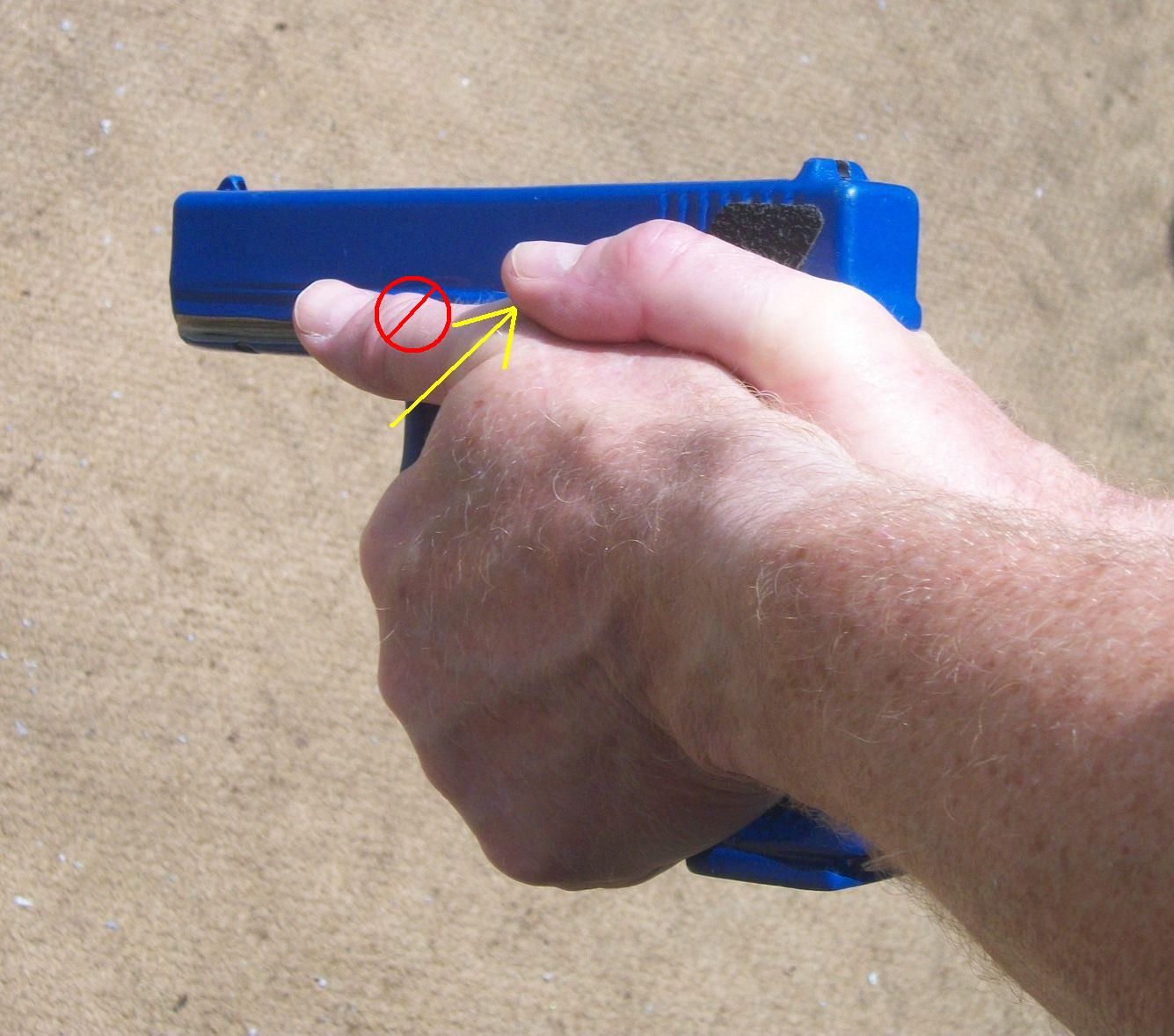 Two components of fourth index point
The fourth index point has two components. First, it verifies that the support wrist is extended downward. Second, it is located such that the firing hand thumb clears the slide stop to the maximum extent possible.
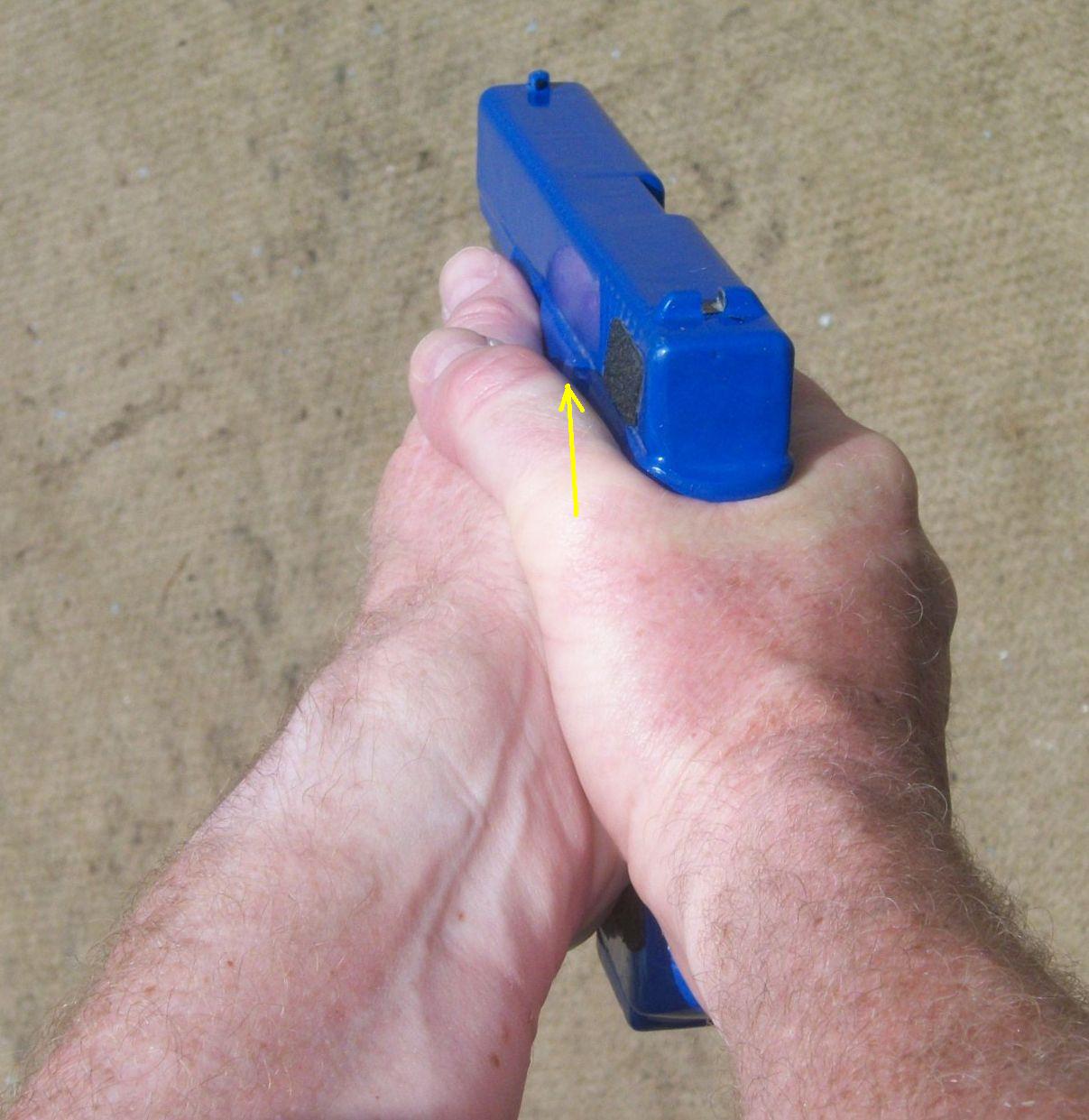 If the firing hand thumb is placed directly alongside the slide of the pistol, it’s easy for that thumb to prevent the slide stop from functioning. This will prevent the slide from locking back after the last shot fires. The subsequent click upon a firing attempt when the slide does not lock back can be either annoying or fatal, depending on circumstance.
For most shooters, the firing thumb should be placed directly in line with the support thumb, as opposed to beside it near the slide. Learning to place the firing thumb in line with the support thumb will minimize the possibility of interfering with the slide stop.
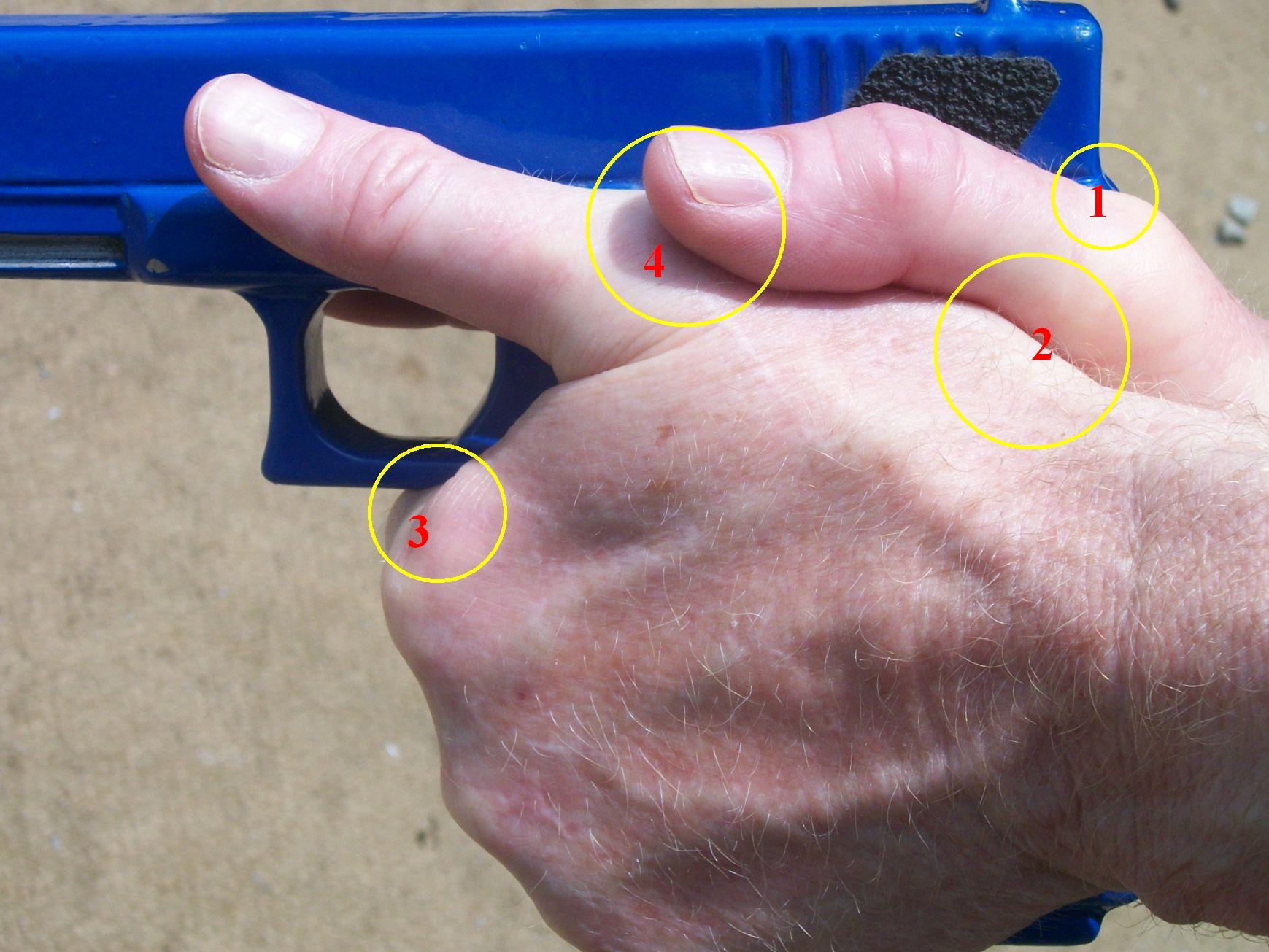
In summary, the four index points of the proper grip on an autoloading pistol are:
- Web of firing hand meets tang of pistol.
- Bases of both thumbs mate closely.
- Support hand trigger finger makes contact with trigger guard.
- Contact point of the firing thumb on the support thumb.
 Developing a proper grip takes some effort and analysis but yields big dividends in terms of your shooting ability. Note that the issue of sights is important enough for me to cut a rear sight notch in my blue guns. I cannot abide a gun without functional sights, even when it is an inert gun. The sights discussion is for another time, however.
Friday Fundamentals (Segment 2)
We’re continuing on with the series of ‘Friday Fundamentals’. I’ve written about Sight misalignment, speed, and accuracy before. It’s a key fundamental to increasing your speed while still maintaining an acceptable degree of accuracy. This drill is part of the second session of my Pistol Practice Program.
Required equipment:
- Any silhouette target; B-27, B-21, Q, IDPA, IPSC, etc. Put a 2-3 inch aiming point on the silhouette in about the center of the target.
- Masking tape (preferred) or magic marker to mark the target.
- Pistol, 24 rounds of ammunition
- Eye and ear protection
Overview
This drill consists of three (3) Sequences of 8 shots each. You are going to deliberately misalign your sights so you can see the effect of this at increasing distances. The drill is to fire the pistol with the front sight on a spot on the target but with the rear notch deliberately misaligned. The Sequences are untimed.
Setup:
Place target at five (5) yards
Procedure:
Sequence 1 (8 rounds at 5 yards)
1) Start with handgun held in both hands. If possible, sit and rest your arms on the bench. You want to be as steady as you can for these three sequences. Do not let the pistol touch the bench; this can change where the bullets hit. Shift your support hand slightly under the pistol, if needed.
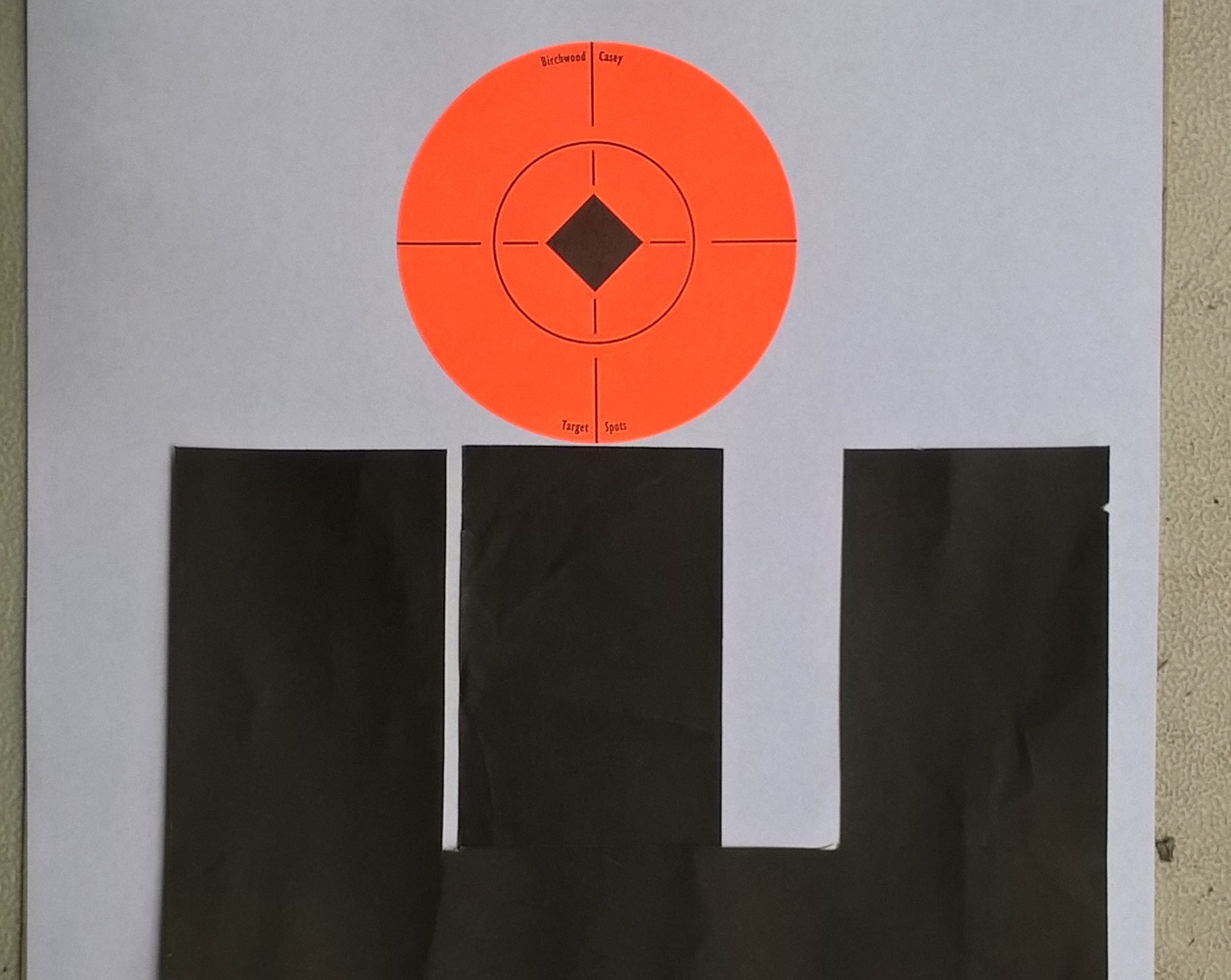
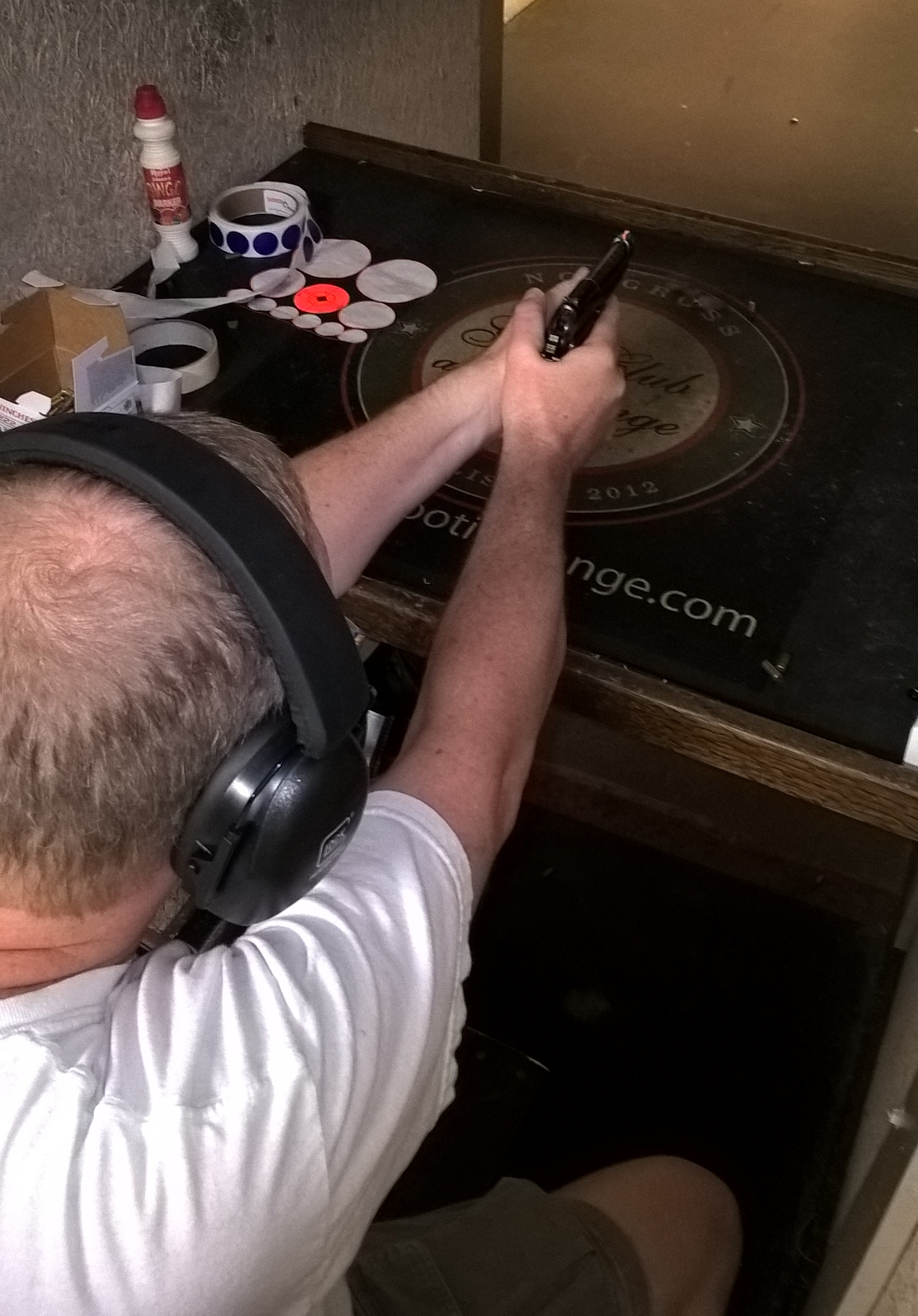 2) Put the front sight just below the aiming spot on the target with the front sight half way above the top of the rear notch. Carefully fire two shots. Your sight picture should look something like this.
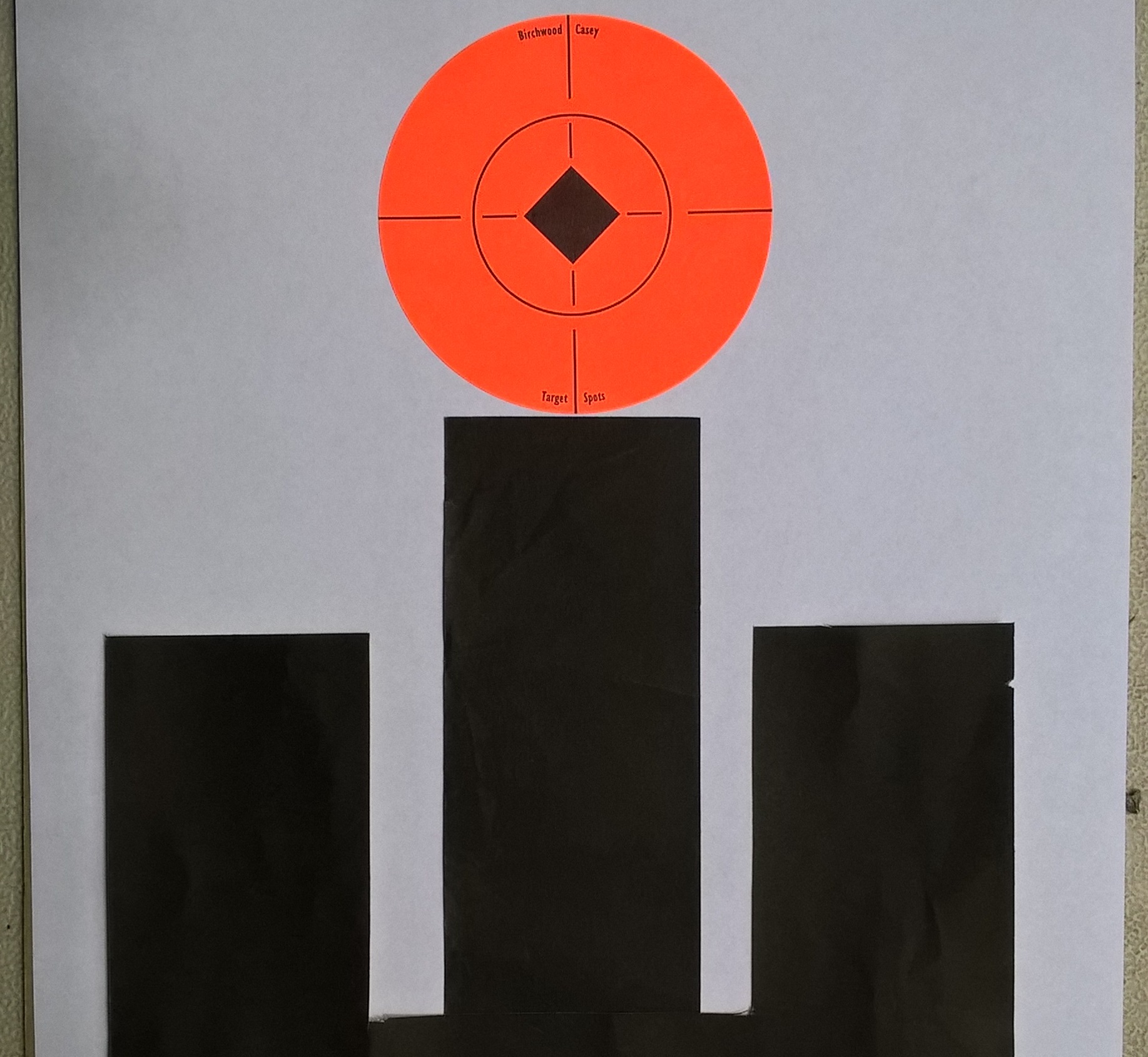
3) Put the front sight just below the aiming spot on the target with the front sight lowered so that its top edge is half way down in the rear notch. Carefully fire two shots. Your sight picture should look something like this.
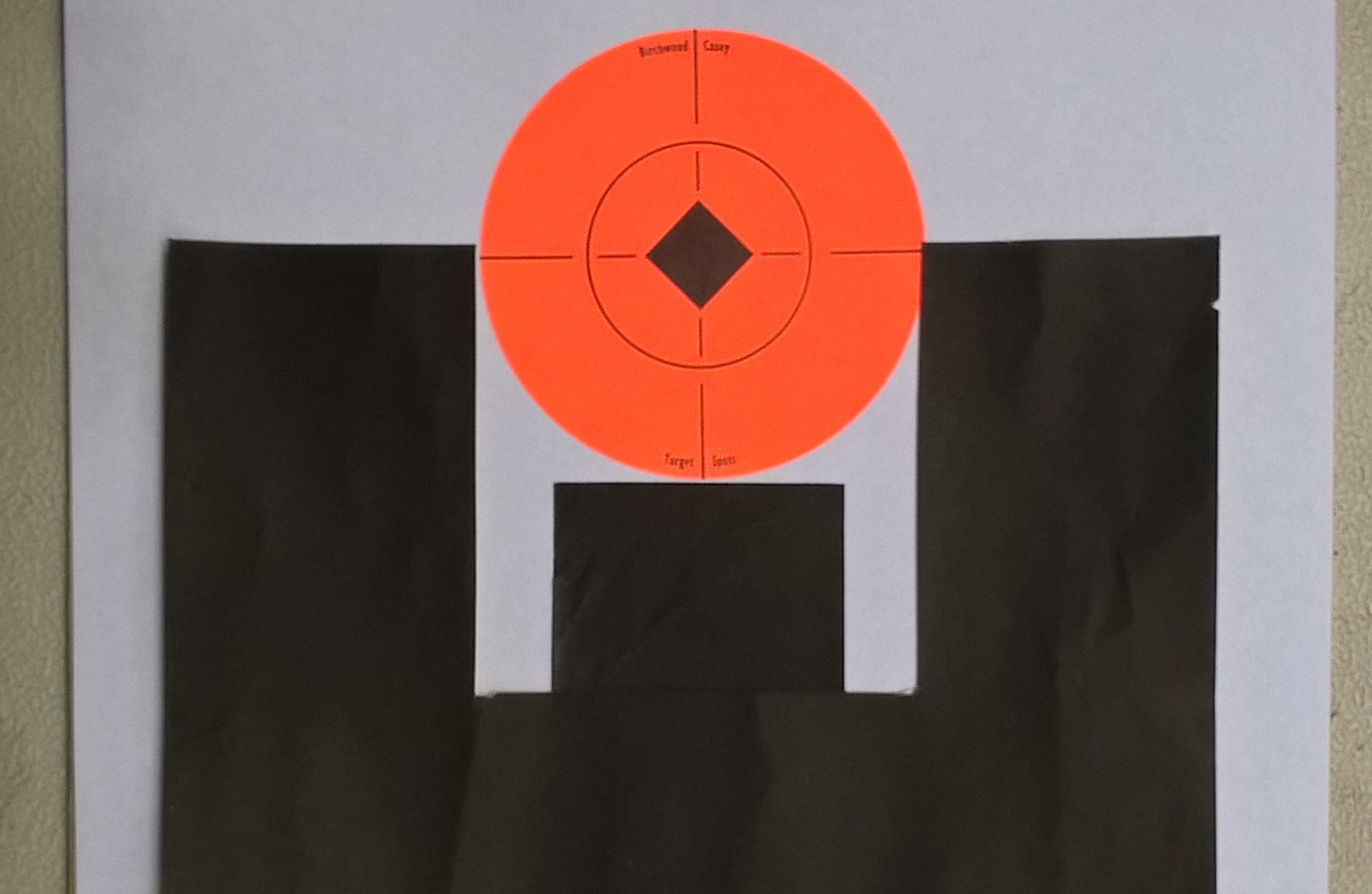
4) Put the front sight just below the aiming spot on the target with the front sight over to the right so that its right edge is touching the right side of the rear notch. Carefully fire two shots. The sight picture should look something like this.
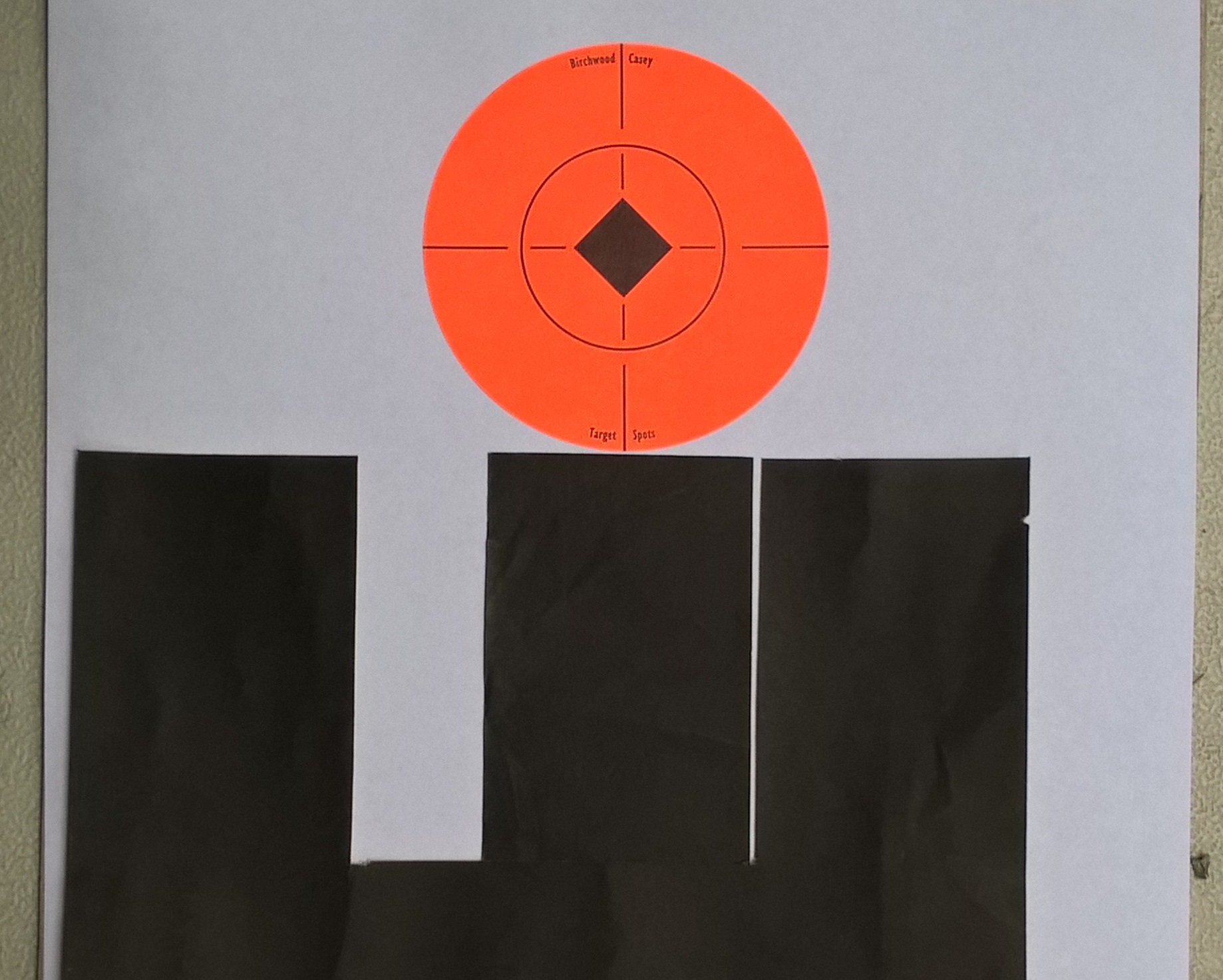 5) Put the front sight just below the aiming spot on the target with the front sight pushed to the left so that its left edge is touching the left side of the rear notch. Carefully fire two shots. Your sight picture should look something like this.
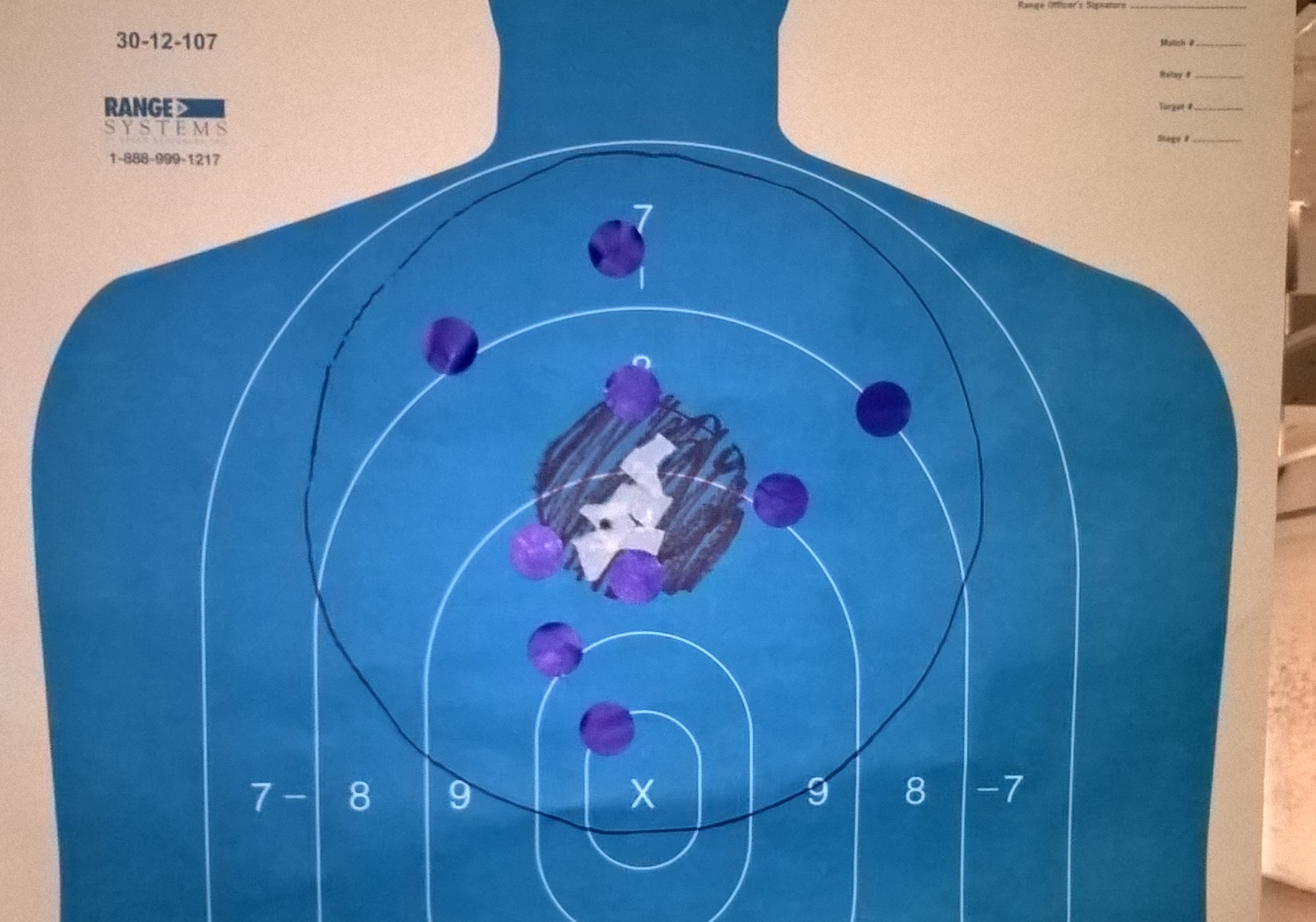
 Bring the target back and mark your shots with masking tape, pasters, or a marker. You will end up with eight shots on the target that will be dispersed up, down, left, and right. The target should look something like this:
 Sequence 2 (8 rounds at 10 yards)
1) Send the target out to 10 yards.
2) Repeat Sequence 1 but with the target at 10 yards.
3) Bring the target back and mark it.
Sequence 3 (8 rounds at 15 yards)
1) Send the target out to 15 yards.
2) Repeat Sequence 1 with the target at 15 yards.
3) Bring the target back and mark it.
Depending on your eyes and the nature of your sights, you may find that even at 15 yards your group stays on the target, despite the slightly misaligned sights.
Objective:
The purpose of this exercise is to demonstrate that the sights do not have to be perfectly aligned to get an acceptable hit on a silhouette size target. Many people waste time trying to get a perfect sight picture when it isn’t necessary. This principle of acceptable misalignment is the basis for what is called the “flash sight picture.” What we are trying to do is to get the front sight close to our aiming point and then refine the sight picture only to the extent we need to in order to get an acceptable hit. As your skill improves, your groups will get smaller and smaller but the principle remains the same.
How much work and practice?
Linda Ronstadt made the following comments [3:22] in an interview about how hard she worked at the process of learning to sing as well as she did.
In order to get good, you really have to spend 6 or 8 hours a day doing it.
You have to spend hours and hours and hours, day after day, year after year.
It took me about 10 years to learn how to sing, even after I was a professional.
It took me 10 years until I really had some control of my instrument and I could deliberately do what I wanted to do.
Sometimes, as I continue on with 1000 Days of Dryfire, going to the range weekly to livefire, or taking training from someone else several times a year, I wonder whether I work at it too much. Then Linda comes along and basically tells me that actually I’m only spending a minimal amount of time and effort at it compared to how hard people who are really good at their craft work. Thanks for that bit of motivation, Linda.
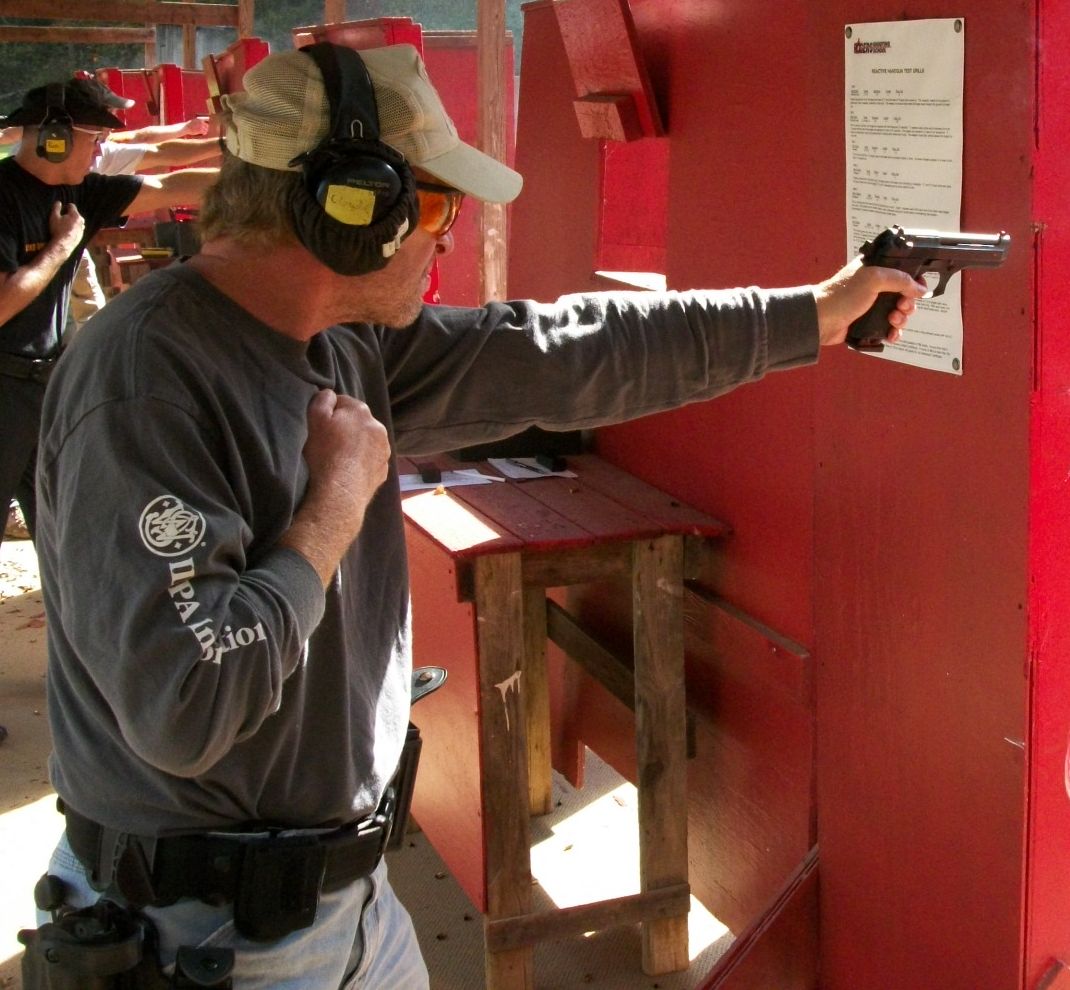
Friday Fundamentals 01 – Establishing Your Baseline
My friend Mark Luell, the author of Growing Up Guns suggested I provide a ‘Friday Fundamentals’ post weekly. We got the idea from my colleague Cecil Burch who wrote a blog post about Fundamentals. It’s a great idea to stay in touch with the basics.
The first installment is Session 01 of my Pistol Practice Program – Establishing Your Baseline. As in any journey, you have to know where you’re starting from before you can get to where you want to go.
The objective of this drill is to determine what distance you can make 100 percent hits on the vital area of a silhouette target. My feeling is that we need to work on achieving 100 percent accuracy because errant rounds in our homes or neighborhoods could be a major problem. Since I also think the first shot is the most important, I structured the session with a lot of first shots but also included multi-shot strings. A lot of people ‘walk their rounds’ into the target even with handguns. This is a huge problem and liability.
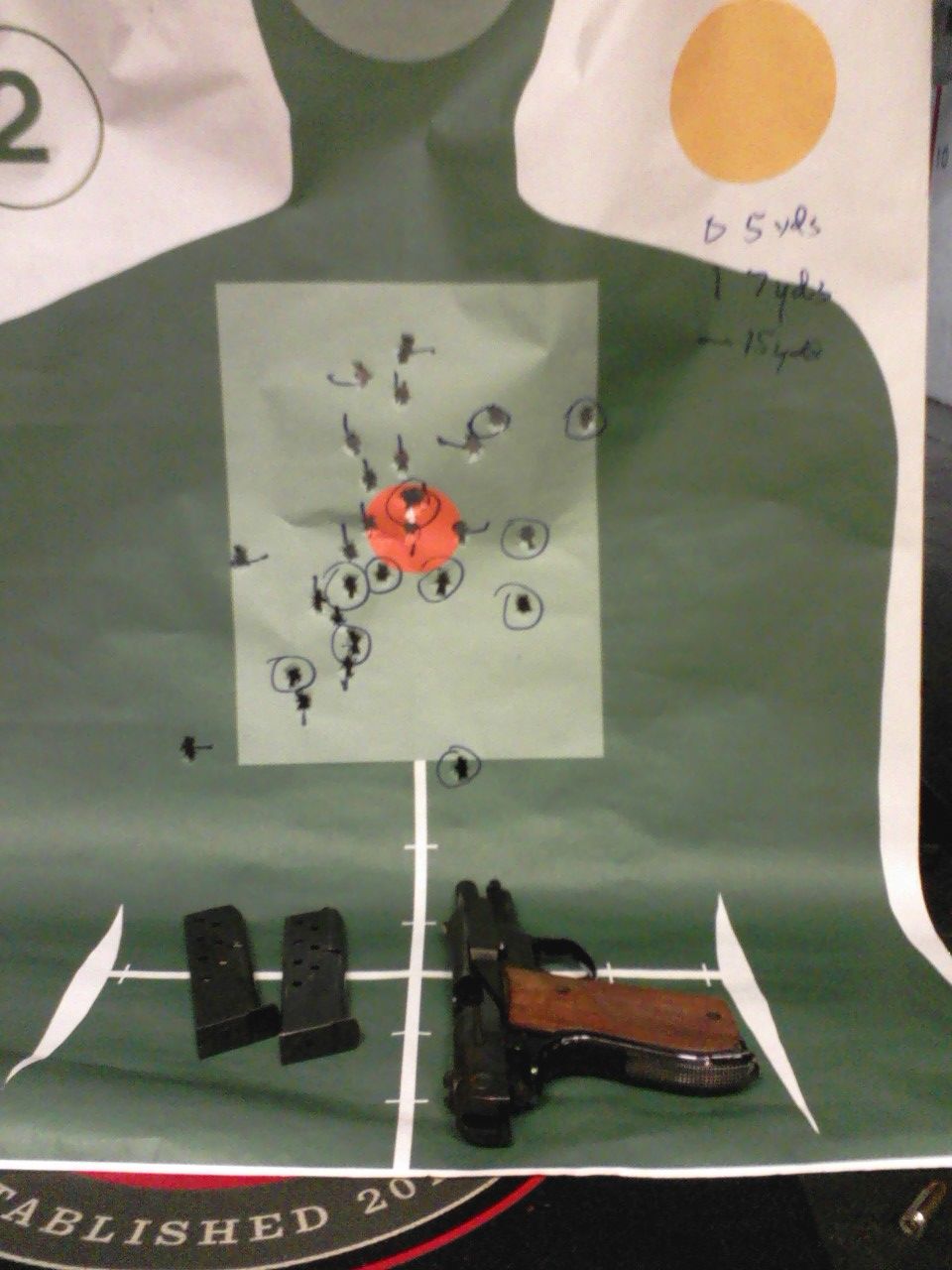 We don’t count hits on the head in this drill because they are actually misses if you are aiming at the body. The head is more than a foot away from the center of the body, if you hit the head when you’re aiming at the body, it’s just a lucky shot and doesn’t count in terms of performance measurement.
Required equipment:
Any silhouette target; B-27, B-21, Q, IDPA, IPSC, etc.
Masking tape (preferred) or magic marker to mark the target.
Pistol, 50 rounds of ammunition
Eye and ear protection
Overview
This drill consists of five (5) Sequences of 10 shots each. The Sequences are untimed.
Setup:
Place target at three (3) yards
Start loaded with five (5) rounds only.
Procedure:
The starting position is Low Ready. This means the pistol is aimed at the floor below the target. For double action pistols, you will decock after each Step.
Sequence 1 (10 rounds)
1) Start with handgun held in both hands, aimed at the floor below the target. Spare magazine loaded with 5 rounds or speedloader with 5 rounds or 5 loose rounds on the bench.
2) Bring the pistol up on target and fire 1 shot at the center of target. Followthrough for one second, then return to low ready. Decock, if appropriate.
3) Bring the pistol up on target and fire 2 shots at the center of target. Followthrough for one second, then return to low ready. Decock.
4) Bring the pistol up on target and fire 3 shots at the center of target. After two shots, the pistol will be out of ammunition. Reload it and fire the third shot. Followthrough for one second, then return to low ready. Decock.
5) Bring the pistol up on target and fire 4 shots at the center of target. After the shots, the pistol will be out of ammunition. Hopefully, the slide has locked back if it’s an autoloader.
6) Place your pistol down on the bench.
7) Bring your target back and mark all the hits, preferably with tape but a marker will do.
8) Write on the target how many hits you made in the body scoring area. I prefer to not count the outer scoring area as I mentioned in Why I hate the -3 zone. Use this format, (3) X/10, X being the number of hits. For this drill, do not count any hits in the head, they are actually misses.
Sequence 2 (10 rounds)
1) Send the target out to 5 yards.
2) Repeat Sequence 1 but with the target at 5 yards instead of 3 yards.
3) When you write on the target how many hits you made in the scoring area, it will be (5) X/10. The number in parenthesis is the distance in yards.
Sequence 3 (10 rounds)
1) Send the target out to 7 yards.
2) Repeat Sequence 1 with the target at 7 yards.
3) Write on the target how many hits you made at 7 yards. (7) X/10
Sequence 4 (10 rounds)
1) Send the target out to 10 yards.
2) Repeat Sequence 1 with the target at 10 yards.
3) Write on the target how many hits you made at 10 yards. (10) X/10
Sequence 5 (10 rounds)
4) Send the target out to 15 yards.
5) Repeat Sequence 1 with the target at 15 yards.
6) Write on the target how many hits you made at 15 yards. (15) X/10
When you finish the drill, record your score for each yardage. Make this a part of your practice record. Shooting this exercise will give you a good idea of what your current proficiency level is. That’s an important starting point.
Double trouble: Media bias and downrange incident
I follow the stories in The Armed Citizen column of the NRA Journals each month. For copyright reasons, the stories have to be re-written. With the more interesting ones, I try to track down the original story to see if there is more detail. A story in the August 2015 issue involves a downrange incident and piqued my interest to find out more about it. The results were interesting. The Armed Citizen entry is as follows:
Breaking up before the big dance carried a price for several people. Two Wisconsin teens had a lovers’ spat before the prom, after the girl’s parents had spent $500 on a dress. The girl’s parents asked the boy to partially reimburse them since he backed out of the date. The Madison boy stewed about the request and became enraged. He returned to his girlfriend’s house in the wee hours of the morning and tried to break in. The girl’s father caught the boy and called him to task, prompting the boy to draw a knife and stab the man seven times. While the two males were grappling, the girl’s mother came out and fired a handgun into the air. The gunfire distracted the youth, and the man wrestled the teen to the ground. The boyfriend faces multiple charges, including attempted homicide. The girl’s father was airlifted to a hospital to have his wounds treated. (Wisconsin State Journal, Madison, Wis., 5/8/15)
One of the first links I found was to the original Wisconsin State Journal article. It did indeed provide more details, such as how the boy attempted to make entry into the house and the fact that he first of all nailed the father with a shovel. Several other links I found, for instance CBS News, referenced the Associated Press edition of the original article. Somehow, the fact that a handgun had been involved in stopping the incident was left out of the AP edition I found at CBS. At first I thought CBS had edited it but I decided to check. I found other outlets carrying the exact same words from AP, so it was the Associated Press that omitted the handgun detail, not CBS. I’m sure that was unintentional due to brevity requirements or somesuch. Yeah, yeah, brevity requirements, that’s the ticket.
There are several things I find worthy of consideration regarding the event itself. First, incidents where there is a family member or other innocent person in between an Armed Citizen and a criminal attacker are what I call downrange incidents. These are much more common than people like to think. The reason is simple. We’re around our families and friends at lot, typically at least half of each day. But the amount of forethought and practice gunowners tend to give this fact tends to be minimal. Part of that represents the way the indoor range practice environment is set up. It doesn’t lend itself well to practicing for downrange incidents. Unless someone is very confident of their skills, downrange incidents are probably going to be resolved at very close range as Meghan Brown did after a man broke into her home and began fighting with her fiance.
The two rolled around, breaking the dining room table and chairs. Planthaber [the fiance] said it lasted about two minutes. Hill [the invader] had a good 80 pounds on him and was winning.
While they were fighting, Brown got her gun from the bottom drawer of her nightstand.
She trained the weapon [a pink .38-caliber revolver] on the man, but was unable to shoot because Planthaber was too close. [I am willing to bet money she positioned herself as close to them as she possibly could.] She followed his movements.
‘I had my gun drawn, focused in on him; as he moved, my gun moved,’ she said. ‘I waited for my shot, and when I saw an opening, I fired.’
Unfortunately, I don’t have a really good answer about how you practice for this, especially in the indoor range environment. If your range will allow you to place a hostage type target at 1 yard, you could practice single shots starting from a ready position off the target. Many ranges will not permit this though, so ask first. You may have to explain what your objectives are and perhaps allow the staff to supervise you.
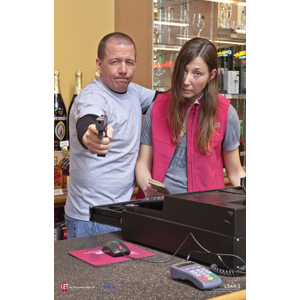
LSAR-2 target from Law Enforcement Targets
At the very least, some mental preparation and mental rehearsal is in order. DO NOT dryfire practice this with a real gun and real people, even if you think the gun is unloaded. That’s a recipe for a Negative Outcome.
If you have access to an outdoor range, here’s a practice drill you could do. If your situation permits it, you could also try this with Airsoft in your backyard.

Another aspect worth considering is the possibility that the male of the household will end up in a physical struggle with a criminal attacker and a female member of the household will end up doing the shooting. Both of the above incidents are examples of that dynamic. I have dozens more in my database. Knowledge of how to operate a firearm and having the will to use it will probably work out better than having a stab a man to death with a butcher knife. Note also that wasp spray didn’t have any effect in this incident.
At some point, ‘the husband was having trouble controlling the suspect and called out to his wife,’ [the Sheriff’s Office spokesperson] said. That’s when the woman ran to the kitchen and retrieved a [butcher] knife, fatally stabbing [the attacking criminal].
For those couples who are serious about personal protection, thinking about it ahead of time may pay off. This is an article I wrote about Protecting Your Family: Training for Mutual Defense.
The Tactical Professor’s Pistol Practice Program
Why a Practice Program and not a training program?
I created the Pistol Practice Program (PPP) to fill a need for many gunowners. Most gunowners are self-taught and generally are not familiar with a structured approach to skill development. There is a great deal of information available now on how to shoot a pistol. However, there is much less information available on how to practice firearms skills over a period of time to achieve greater confidence and proficiency. As Aristotle said:
We are what we repeatedly do. Excellence, then, is not an act, but a habit.
My goal was to create a program that would get gunowners into the habit of shooting well. I created a step by step approach tailored to the needs of the casual shooter but challenging enough to satisfy the enthusiast. Designed as a series of range sessions, you can practice at your own pace as your schedule permits.
In the case of those who have attended training, your instructor probably said that a firearms class only provides a foundation of skills. To maintain those skills and improve, people who own pistols need to practice after training. Having a program also makes shooting more fun because the shooter develops a sense of accomplishment from the practice. This program is not concerned with what particular technique the shooter uses. Over time and by working the PPP, shooters will determine what works best for them.
The vast majority of gunowners only have access to indoor or public ranges where the type of practice they can do is rather restricted. The PPP takes that constraint into account and presents drills that are indoor range friendly and yet relevant to skill development. The livefire range sessions are then supplemented by dryfire sessions that can be done safely at home. Doing so allows you to develop skills that usually cannot be practiced at an indoor range. How to practice at home safely is thoroughly explained.
The PPP is available on CD. Its contents are mobile device friendly so you can copy the drills to your smartphone or tablet. If your device can access a PDF reader, you can easily take the exact drills to the range with you without having to lug along a book or write down the contents of a DVD. You can also put the dryfire audio sessions on your device for maximum convenience.
Those who are teaching a friend or loved one how to shoot a pistol will find the PPP provides a solid structure for their time at the range. For those who have attended a training class, the PPP provides a way to maintain and build the skills they learned in class. Law enforcement officers can use the PPP to keep your shooting skills tuned up in between qualifications and make qualifications less stressful. Put whatever practice ammo you receive from the department to good use instead of frustrating yourself by shooting the qual course over and over.
Contents of the PPP
- A Program Guide to get you started
- A Log Sheet to keep track of your progress
- 12 Primary Livefire Sessions (50 rounds and Indoor range friendly)
- 12 Secondary Livefire Sessions (50 rounds) for those who want more practice activity each time at the range
- 12 Structured scenarios designed to emphasize and train the interactive aspects of personal protection
- 6 audio guided Dryfire sessions (less than five minutes each)
- Tip sheets on firearms safety, interacting with law enforcement, common mistakes, etc.
I have drawn on a wide range of training experience, from teaching NRA Basic Pistol classes to my time as the Chief Instructor of the elite Rogers Shooting School, to create this Program. There is no doubt in my mind that shooters at all levels of skill and experience can benefit from it.
The PPP CD is available on my webstore. At $19.95, it’s about the cost of one box of centerfire ammo. Bonus: the first 100 orders will receive a Rogers Tap-Rack-Training aid, a $5.00 value, at no charge.
Make the first shot count
This is an article I wrote for beginning shooters on the National Shooting Sports Foundation First Shots blog. That doesn’t mean experienced shooters can’t benefit from it, as well.
The shot that is missed most often in pistol shooting is the very first shot of a string of fire. One of the best ways to correct this is to make first shots the majority of your practice.
For this drill, take any large target at your range and turn it over. Make six dots about 3 inches in diameter on it, spaced roughly evenly apart. If your range carries the bright orange Tar-dots, those are ideal but a magic marker works fine, too. You will also need a magic marker for later in the drill. This drill consists of 48 rounds total. Many people will find that 5 yards is a good place to start. It’s deceptively challenging.
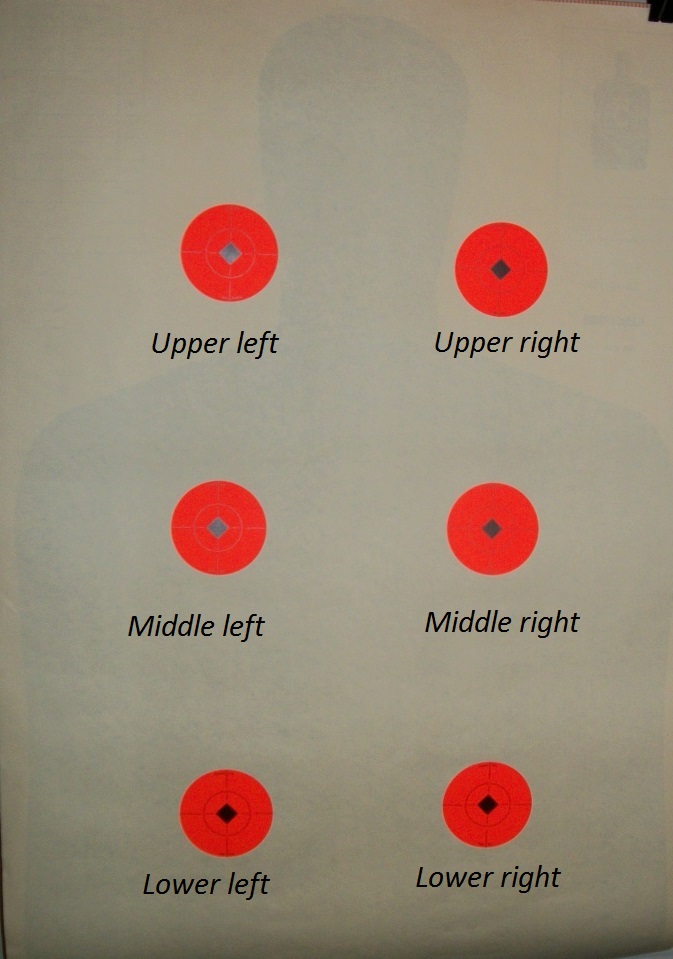
- Starting with pistol aimed at the bottom of target, fire 1 shot on upper left dot. Return to the bottom of target. Decock, if your pistol has a decocker. Repeat five more times for a total of six shots. Starting position for each shot is aimed at the base of the target and you will fire only one shot each time.
- Starting with pistol at a compressed ready, fire 1 shot on upper right dot. Return to compressed ready each time. Decock after every shot, if your pistol has a decocker. Repeat five more times for a total of six shots. Starting position for each shot is compressed ready.
- Starting with pistol aimed at bottom of target, fire 1 shot on middle left dot, then one shot on middle right dot. Return to bottom of target. Decock, if your pistol has a decocker. Repeat twice more for a total of three shots on each dot. Starting position for each string is aimed at the base of the target.
- Starting with pistol aimed at bottom of target, fire 1 shot on middle right dot, then one shot on middle left dot. You are moving in the opposite direction from String 3. Return to bottom of target. Decock, if your pistol has a decocker. Repeat twice more for a total of three shots on each dot. Start position each time is aimed at the base of the target.
- Starting with pistol at compressed ready, fire 1 shot on bottom left dot, then one shot on bottom right dot. Return to compressed ready. Decock, if your pistol has a decocker. Repeat twice more for a total of three shots on each dot. Starting position for each string is compressed ready.
- Starting with pistol at compressed ready, fire 1 shot on bottom right dot, then one shot on bottom left dot. You are moving in the opposite direction from String 5. Return to compressed ready. Decock, if your pistol has a decocker. Repeat twice more for a total of three shots on each dot. Starting position for each string is compressed ready.
- Mark all the hits on your target with a magic marker.
- On the dot where you had the least hits, i.e., your group was the largest/worst, fire six individual aimed shots, resting between each shot.
- On the next worst dot, fire a six shot slow fire group as one string of fire. That concludes the drill.
You will find that your marksmanship improves much faster when you concentrate on your first shot and you can tell where each shot goes.
Here is a PDF of the drill you can take to the range on your SmartPhone.
Law Enforcement Officers Killed Audio CD
Annually, the FBI publishes the Law Enforcement Officers Killed and Assaulted report. A key part of this report is the written Summaries of the circumstances surrounding the death of each Officer Feloniously Killed.The FBI provides a concise account of the individual incidents where an Officer(s) was killed.
One of the things I have been unhappy about when training LEOs is finding out how few read the Summaries. I ask every LEO class how many have read LEOKA and almost all the hands go up. But when I ask how many have read the Summaries, almost all the hands go down. While the tabular data in LEOKA is interesting, the Summaries give much more insight into the circumstances of how Officer deaths occur and provide context on how to avoid becoming a victim Officer.
In order to make these Summaries more accessible to the Law Enforcement community, I’ve recorded the 2013 Summaries as audio narratives on an audio CD. Each Summary is narrated individually for your listening convenience. In addition, audio narratives of a number Officer killings not reported by the FBI are included. For supervisors, playing a few of the Summaries at roll call could be a sobering way to put your Officers in the right state mind for their shift. For individual Officers, listening to a few of them on the way to work may help you get mentally tuned up.
The LEOKA Narrative audio CD can be purchased on my webstore. There’s also a link at the top of my blog.
Lessons from the Pine Ridge Shootout
On June 26, 1975, FBI Special Agents Ronald Williams and Jack Coler were murdered on the Pine Ridge Indian Reservation in South Dakota. While attempting to serve a Federal arrest warrant, a massive gunbattle ensued. The Agents’ cars were hit with 125 bullets and they were severely wounded early on in the gunfight. Eventually, they were overwhelmed and executed.
Details and the sequence of events of the shootout are available in my article on The Tactical Wire.
Be wary of driving or walking into an ambush. The situation the Agents faced in this case was referred to as a ‘firesac’ in Soviet military doctrine. This is an ambush that occurs from multiple simultaneous directions. Initially, they encountered a blocking position. Then, they began to take fire from multiple angles. The only way to escape a situation like that is to retreat as quickly as possible. Retreating is a tactic we don’t practice much but we should.
Look at the pictures of the Agents’ cars. Vehicles are bullet magnets. When rifles are involved, most parts of a vehicle are as bulletproof as a piece of toilet paper. If you’re being shot at while in a vehicle and you can’t drive out of the kill zone, your best bet is probably to get away from it. In a firesac, even if your vehicle is armored, there are no safe angles.

Agent Williams’ car
If you have someone with you, be prepared to drag them away from the car because they may no longer be mobile. Practice this ahead of time because it’s not easy. Wearing flip-flops will make it all the more difficult. Some of my friends weigh 100 pounds more than I do; it’s going to be work for me to move them. Without a decent pair of shoes on, it’s probably not going to happen.
We like to think that reinforcements, aka ‘The Cavalry,’ are always going to be available and quickly. That’s just not always true. At Pine Ridge, approximately five hours passed before the Agents could be reached. This was due to the suppressive fire encountered by the incoming reinforcements. The Agents were long dead before they could be helped. Be mentally prepared for the fact you may have to extricate yourself and anyone with you without any help. You’re not doomed until you give up. Then you’re doomed for sure.
The concept of ‘fight your way to your rifle’ is of dubious worth in actuality. Saying that is probably heresy but it’s true. Once the shooting starts, if all that’s within arm’s reach is a handgun, most likely the handgun is what you will use until the conclusion of the encounter. If you think a fight is coming, better get the long gun out before the first gunshots sound and before you are seen. Notice Coler’s trunk, as soon as you open that trunk, you have targeted yourself. The same thing happened to Gordon McNeil in The Miami Massacre 11 years after Pine Ridge.

Agent Coler’s car trunk
The probability of being stuck with a handgun means that practicing exclusively at zero to seven yards with your sidearm may not be all the practice that you should do. At least know where your pistol hits at extended ranges. Learn to use the prone position with a pistol and practice shooting at 50 yards if you have the facility. A prone target is also a difficult target to hit, even with a rifle. Most indoor ranges are 25 yards, at least practice with a few shots at that distance occasionally.
Williams’ wrapping Coler’s nearly severed arm in an attempt to stop the bleeding underscores the need for medical training such as I took this past weekend from Dark Angel Medical. The nearest law enforcement support to Williams and Coler was 12 minutes away. Any kind of advanced medical care was much further than that. Even if the Agents hadn’t been executed, Agent Coler most likely would have died from a wound generating that much blood loss. Conversely, if the shooters had broken off the attack, had Williams been able to get an effective tourniquet on Coler, he might have lived.
Agent Williams was also wounded. You need to know how to stop your own blood loss. The bad news is you might need to do it one handed, which kind of sucks the first time you try it. Being bloody makes it even harder. It’s another skill you don’t want to have learn On The Job.
The further we are away from a medical facility, the greater our need for the ability to perform self-aid. We need not only the equipment but the knowledge of how to use it. Military personnel on duty will usually have organic medical support; law enforcement and Private Citizens, probably not. The support you are likely to have is in your head and in the med kit you have with you.
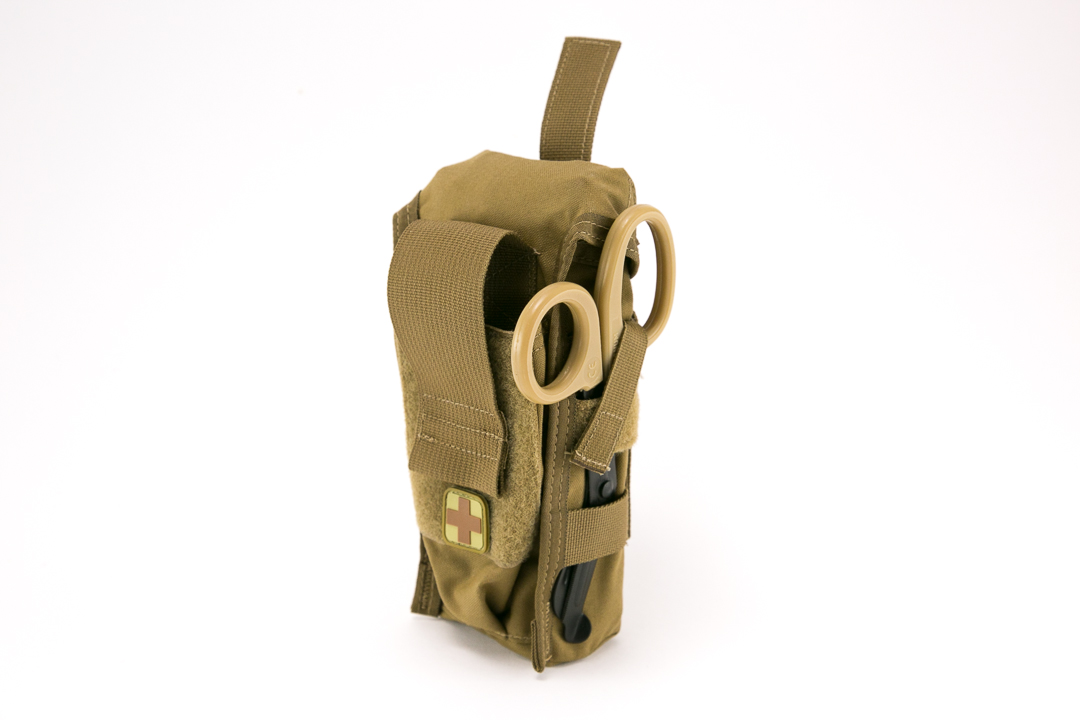
Personal medical kit
Don’t expect people who have fired many magazines of ammunition at you to cut you the slightest bit of slack. If they come for you, they’re coming to finish you off, not to stop your bleeding. If nothing else, play possum and set up an ambush of your own. If all you have is a handgun, wait until they get in range and take someone with you.
That means you have to know what your personal effective range with your weapon is. If you’ve been wounded, assume it’s half or less of what you can usually do on a good day. The good news is that the coup de grâce is usually delivered at close range, so you still might get an opportunity. You’ll probably only have one chance though, so make it good and don’t muck it up.
 tacticalprofessor
You must be logged in to post a comment.