Riding Shotgun with Charlie
Charlie and I had a fun interview.
Tactical Professor books (all PDF) (not Free)
- Serious Mistakes Gunowners Make http://seriousgunownermistakes.com
- Indoor Range Practice Sessions http://indoorrangepracticesessions.com
- Concealed Carry Skills and Drills http://concealedcarryskillsanddrills.com
- Advanced Pistol Practice http://bit.ly/advancedpistolpractice
- Shooting Your Black Rifle http://shootingyourblackrifle.com
- Package deal of Serious Mistakes, Indoor Sessions, Concealed Carry, and Shooting Your Black Rifle (20% off) https://store.payloadz.com/details/2644448-ebooks-sports-shooting-drills-package.html
Fall without breaking things
Learning to make contact with the ground (breakfall) https://www.merriam-webster.com/dictionary/breakfall without becoming a casualty is one of the most important Personal Protection skills we can learn. How to teach that to senior citizens who have no experience is outside my lane but its importance in hand to gland combat is undeniable. It’s also very useful if you live in an area where there is ice in the winter or if your house has any steps, as I can personally testify to.
Police: 80-year-old man dies after being shoved to the ground during mask dispute in New York bar
Another lesson in the incident is that discretion is the better part of valor, especially when you’re a senior citizen. This poor gentleman was concerned about decorum to the bar staff and coronavirus but the cause of his death was a broken skull. According to the District Attorney, the two were familiar with and disliked each other. In all likelihood, this was an example what Rory Miller terms ‘the monkey dance.’ It’s foolish and dangerous.
Note that the person charged with his death is also a senior citizen so don’t think that it’s only ‘White Punks On Dope’ who can cause your demise.
Tactical Professor books (all PDF) (not Free)
- Serious Mistakes Gunowners Make http://seriousgunownermistakes.com
- Indoor Range Practice Sessions http://indoorrangepracticesessions.com
- Concealed Carry Skills and Drills http://concealedcarryskillsanddrills.com
- Advanced Pistol Practice http://bit.ly/advancedpistolpractice
- Shooting Your Black Rifle http://shootingyourblackrifle.com
- Package deal of Serious Mistakes, Indoor Sessions, Concealed Carry, and Shooting Your Black Rifle (20% off) https://store.payloadz.com/details/2644448-ebooks-sports-shooting-drills-package.html
Your Best Defense: Staying Out of Trouble
I was able to spend some time talking with Michael Bane last week about ‘Staying Out of Trouble.’ That means emphasizing the ‘Avoid’ and ‘Escape’ steps in the Avoid, Escape, Confront, Resist paradigm.
We had a great conversation that will be of interest to new gunowners, those who have been at it as long as Michael and I, and everyone in between.
Tactical Professor books (all PDF)
- Serious Mistakes Gunowners Make http://seriousgunownermistakes.com
- Indoor Range Practice Sessions http://indoorrangepracticesessions.com
- Concealed Carry Skills and Drills http://concealedcarryskillsanddrills.com
- Advanced Pistol Practice http://bit.ly/advancedpistolpractice
- Shooting Your Black Rifle http://shootingyourblackrifle.com
- Package deal of Serious Mistakes, Indoor Sessions, Concealed Carry, and Shooting Your Black Rifle (20% off) https://store.payloadz.com/details/2644448-ebooks-sports-shooting-drills-package.html
The Law is what it is
I shared this on my personal Facebook timeline and from there dozens of other people have shared it.
Texas grand jury: No action against killer of church shooter
https://apnews.com/article/fort-worth-shootings-archive-texas-f38e8ef6437e96a9e60fb44662c71494
Several questions and comments have repeatedly been raised as a result.
- He should never have been charged.
- Why did it go to a Grand Jury?
- Why is this even an issue?
He wasn’t charged. The issue went to a Grand Jury because Texas requires homicides, and all potential felonies, to be presented to a Grand Jury.
Another issue to consider is that the incident occurred December 29, 2019. The Grand Jury returned a No-Bill yesterday, September 28, 2020, nine months later. Because all potential felonies have to go to a Grand Jury in Texas, they’re busy. Although in this case there was little doubt of the outcome, Mr. Wilson still had potential legal action hanging over his head for the better part of a year. It is likely that his family thought about this just as much as he did, perhaps more so.
The Law is what it is, not what we think it is, nor what we think it should be. Many people don’t understand the importance of that distinction.
Tactical Professor books are available from the menu at the top of the page.
Downrange drill target
My only question is whether you might have an alternate suggestion for target set up comparable to the one in this post and the one before. I shoot at two restrictive ranges without the ability to shoot targets spaced as indicated in your diagram.
Almost all indoor ranges are restrictive that way. There are still things you can do even if you can’t accomplish everything you’d like.
This is a target from my upcoming Dry Practice book you can print on letter size paper.

Downrange drill target
Tape it to the head of a silhouette target. It is anatomically sized correctly by using the ocular distance indicated by the line with arrows on the male mugshot of Dennis Rader, the notorious BTK Killer. https://www.biography.com/crime-figure/dennis-rader The dashed circle is sized to four inches in diameter. The pretty lady is a mug shot too, unfortunately, but she serves the purpose of occupying the place of a NO SHOOT.
Place the target at 10 feet, which is the mid-point of the far phase of Social Space in Proxemics. The object of the drill is to place one round in the circle as rapidly as you can. Do it five times in a row. If you hit the lady, you’ve shot a loved one; consider that in your evaluation of your abilities. As Dirty Harry said, “A man’s got to know his limitations.”
Even if you don’t have a lot of flexibility at your practice range, there are still things you can do to up your game.
Tactical Professor books (all PDF) (not Free)
- Real Shootouts of the LAPD http://realshootoutsofthelapd.com
- Serious Mistakes Gunowners Make http://seriousgunownermistakes.com
- Indoor Range Practice Sessions http://indoorrangepracticesessions.com
- Concealed Carry Skills and Drills http://concealedcarryskillsanddrills.com
- Advanced Pistol Practice http://bit.ly/advancedpistolpractice
- Shooting Your Black Rifle http://shootingyourblackrifle.com
- Package deal of Serious Mistakes, Indoor Sessions, Concealed Carry, and Shooting Your Black Rifle (20% off) https://store.payloadz.com/details/2644448-ebooks-sports-shooting-drills-package.html
Why we practice marksmanship – number 2
Investigators say Mills walked into the bathroom where the female homeowner was showering. She screamed and her husband ran in to confront Mills. Police say Mills had a knife and stabbed the husband in the face and stomach before running from the home.
A downrange drill including standoff.
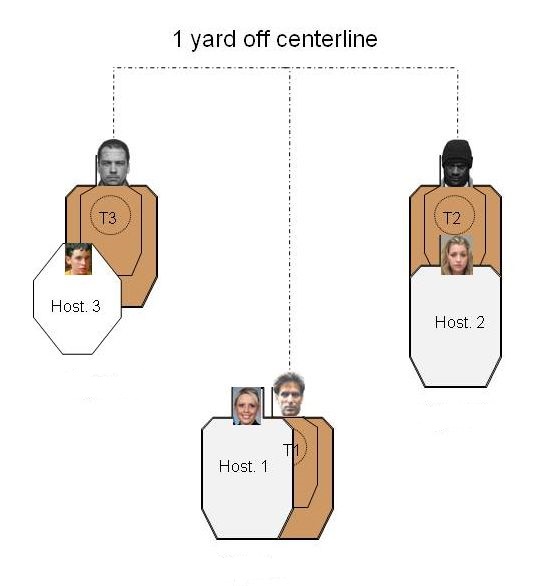
Once again, we’re more likely to need to do a close range precision shot on a predator than a 25 head shot on a terrorist. Let’s use ‘hit a 4 inch circle at 10 feet’ as a definition of ‘close range precision shot.’ That’s the standard to pass the NRA Basics of Pistol Shooting course. Just like BOPS, our standard should be 100% hits for a five shot string.
Why we practice marksmanship
Man shot multiple times while trying to steal couple’s SUV at gas station
“The suspect walked away from his truck and toward a couple that was at a gas pump with their SUV, investigators said. Officers said the suspect then entered the driver’s seat of the SUV while a woman was in the passenger seat.
At some point, police said the man saw the suspect inside of the SUV. He then fired at the suspect sitting in the driver’s seat, striking him multiple times, investigators said.”
Note the position of the bullet holes in the windshield.
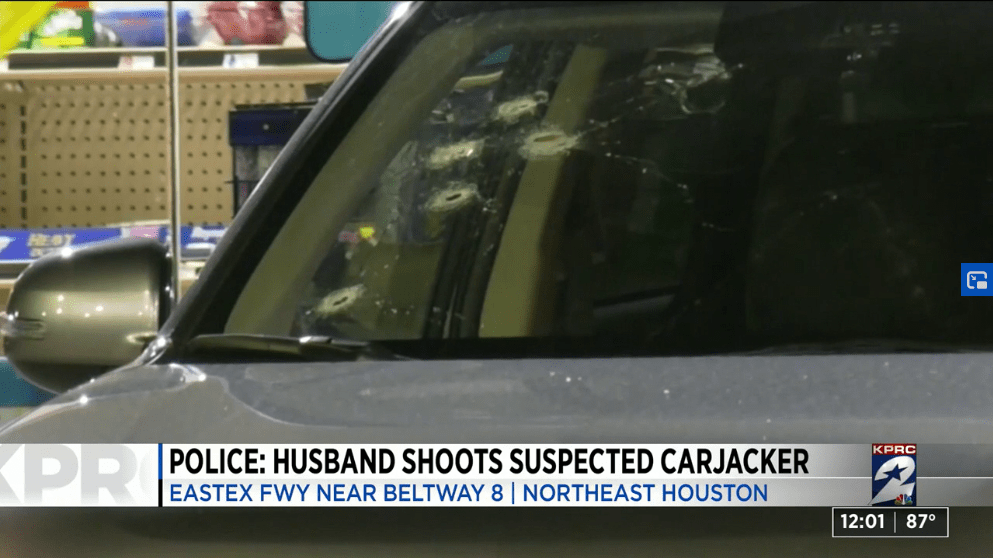
Hopefully, the wife exited the vehicle before the shooting started. If not, that was a scary downrange drill, i.e., friendlies or non-threats somewhere downrange between the defender and the criminal. Scary for both the shooter and the downrange friendly. Consider the position of the shooter when the shots were fired.
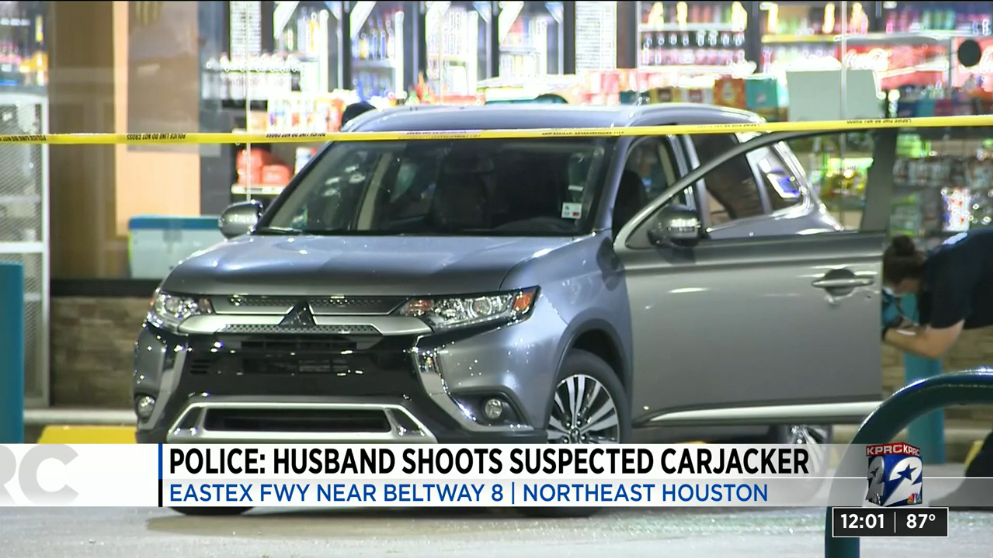
Armed Citizens are far less likely to have to make a 25 yard headshot on a terrorist than we are to need to make a close range precision shot with no-shoots downrange. It’s something that very few gunowners practice but ought to. In this situation, the hit ratio needs to be 100%, not 70% or 20%.
Even during the Beer Plague, we’re often out of our homes with our loved ones and there’s no guarantee that they will be behind us when trouble starts.
Tactical Professor books (all PDF) (not Free)
- Serious Mistakes Gunowners Make http://seriousgunownermistakes.com
- Indoor Range Practice Sessions http://indoorrangepracticesessions.com
- Concealed Carry Skills and Drills http://concealedcarryskillsanddrills.com
- Advanced Pistol Practice http://bit.ly/advancedpistolpractice
- Shooting Your Black Rifle http://shootingyourblackrifle.com
- Package deal of Serious Mistakes, Indoor Sessions, Concealed Carry, and Shooting Your Black Rifle (20% off) https://store.payloadz.com/details/2644448-ebooks-sports-shooting-drills-package.html
Helping or hurting your case
The justifiability of this shooting will be determined in the courtroom. However, it’s fairly safe to say that not reporting a shooting/killing to the POlice and subsequently tampering with evidence, i.e., throwing the spent shell casings in the dumpster and concealing the revolver, is unlikely to help your case.
Win, Lose, or Draw; the cost of this killing will be high, both psychologically and financially.
Also, the optics of two shots to the back of the head are not good.
Tactical Professor books (all PDF) (not Free)
- Serious Mistakes Gunowners Make http://seriousgunownermistakes.com
- Indoor Range Practice Sessions http://indoorrangepracticesessions.com
- Concealed Carry Skills and Drills http://concealedcarryskillsanddrills.com
- Advanced Pistol Practice http://bit.ly/advancedpistolpractice
- Shooting Your Black Rifle http://shootingyourblackrifle.com
- Package deal of Serious Mistakes, Indoor Range Sessions, Concealed Carry, and Shooting Your Black Rifle (20% off) https://store.payloadz.com/details/2644448-ebooks-sports-shooting-drills-package.html

Thinking ahead during the current Insurgency
Part of dealing with the American Insurgency is thinking ahead about what to do when bad things start happening around you. There are no safe places during an insurgency.
Witnesses describe killing of Portland shooter Michael Reinoehl
https://nypost.com/2020/09/04/witnesses-describe-killing-of-portland-shooter-michael-reinoehl/
This was the reaction of one person near the shooting.
“I was sitting in my backyard and all I heard was pop, pop, pop, pop, pop, pop, pop. I was like, oh s–t. I come outside and there’s a million sheriffs out here and there’s a dude laying out here by the mailbox and he’s bleeding. They hit him.”
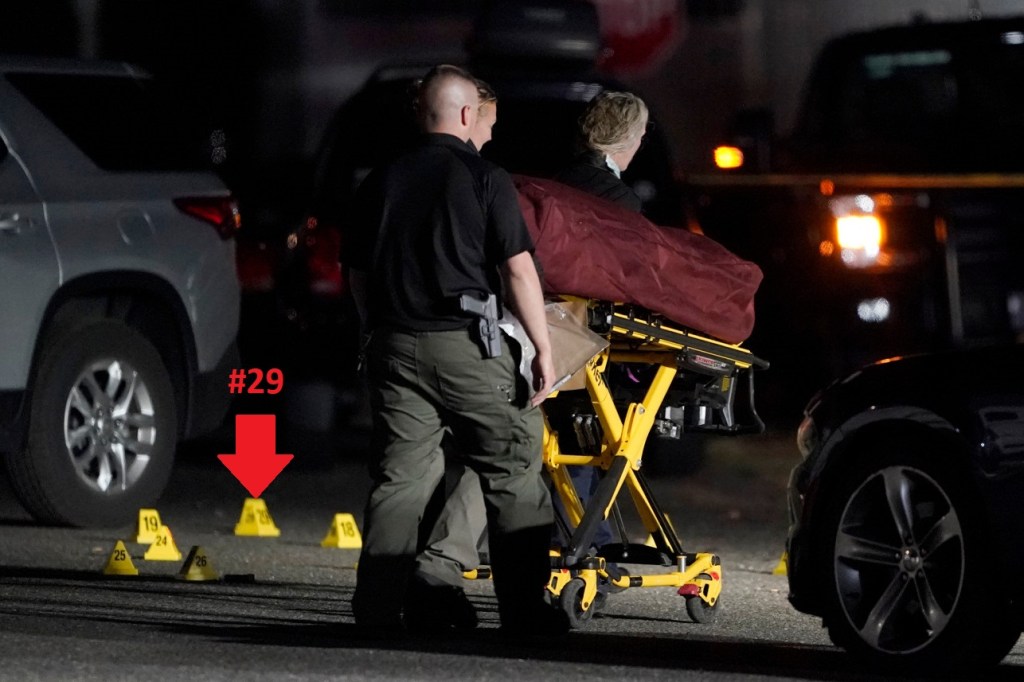
Note that there were at least 29 rounds fired during the incident. So far, it is unstated how many hit Reinoehl but based on general trends, we can assume that the majority did not. That means at least 15 rounds, perhaps some from rifles, were whizzing around the neighborhood.
According to Wikipedia, https://en.wikipedia.org/wiki/Lacey,_Washington “Lacey is a city in Thurston County, Washington, United States. It is a suburb of Olympia with a population of 42,393 at the 2010 census.” Lacey is 120 miles from Portland and another State away from where the original murder took place. One lesson for us in this incident is that any place within driving distance of a well-publicized shooting is a possible location for a secondary incident. Kyle Rittenhouse went back to Ill-Annoy after the Kenosha shootings.
If you hear gunfire, don’t go outside to watch or video it. Think ahead about the most bullet resistant places in your home. The bathtub, which hopefully is iron, is an example. Even if it’s not iron, it is at least surrounded and supported by structural members. Rehearse a sheltering plan ahead of time. Make sure your loved ones understand it; they might have to use it when you’re not there. It might look something like this:
- If and when you hear shooting outside, gather your loved ones and take them to that sheltered place.
- Take your equipment, including your phone, with you when you take shelter.
- Don’t let strangers into your home after an incident.
- Call the POlice and report the gunfire outside.
The most important tool you have during a crisis is the one between your ears. As with almost all tools, it’s better if you sharpen it before you need to use it.
Tactical Professor books are available from the menu at the top of the page.
Priorities of Work
Someone on Instagram asked me about doing 65 yard headshots with a pistol. My response was that it doesn’t really concern me. I’m much more interested in teaching as many gunowners fundamental skills as I can and then integrating decisional training along with those skills. As long as a person can pass an entry level CCW Qual Course, they’re probably ready to start working on the decisional aspects of Personal Protection.
Skip Gochenour, who ran the National Tactical Invitational for many years, and I had a conversation about this years ago. Skip’s opinion was that we need to get training about human dynamics and decision-making into the training sequence much earlier. I agree with him 100 percent. Decision-making is what makes us or breaks us when the situation starts getting dicey.
I’ll be testing my theory at The Mingle 2020 in a couple of months. In the meantime, I’ll be starting a new 3 dollar Patreon tier for teaching marksmanship and manipulation skills early next month (September).
The way it’s going to be structured is by using CCW Qual courses as a baseline and a learning vehicle. The head of the US Army Ranger School once commented that the purpose of Ranger training is to teach leadership under conditions of stress. Patrolling is just the vehicle or method used to teach leadership to Ranger Students. I think we can use qualification courses in the same way. Given the ammo shortage, it will be largely dry practice with an occasional live fire session.
Here’s the first set of videos that show the first Course of the series. There will be demos for both autoloaders and revolvers.
One using the SCCY pistol:
One with a 317 revolver:
As always, Tactical Professor books can be purchased from the menu at the top of the page. They are NOT FREE but if you would be interested in knowing how to better operate the firearms you own during the American Insurgency, they will be useful.
 tacticalprofessor
You must be logged in to post a comment.