Lowlight dryfire practice
- At night, have a flashlight next to your gun.
- Pick them both up at the same time and identify the person before making the shoot decision
- Flashlight usage implies the need for one handed shooting
- Competing probabilities are in favor of it being a family member
- Thinking the light is a ‘lead magnet’ is a problem
I emphasized very strongly about the need for keeping a flashlight next to your ‘nightstand gun’ during my Negative Outcomes presentation at the Rangemaster 2015 Tactical Conference. Although I practice dryfire with a flashlight regularly, it occurred to me that I don’t have a structured regimen for doing so. Tonight, I thought I would work on that a bit.
At first, I started doing my 12 shot drill on my dryfire range with the flashlight. I used the left column to practice with the Harries technique as my ‘outside’ technique. For a general search and ‘inside’ technique, I used the right side column. I just did it this way due to habit because that’s similar to the way I shoot the drill livefire.
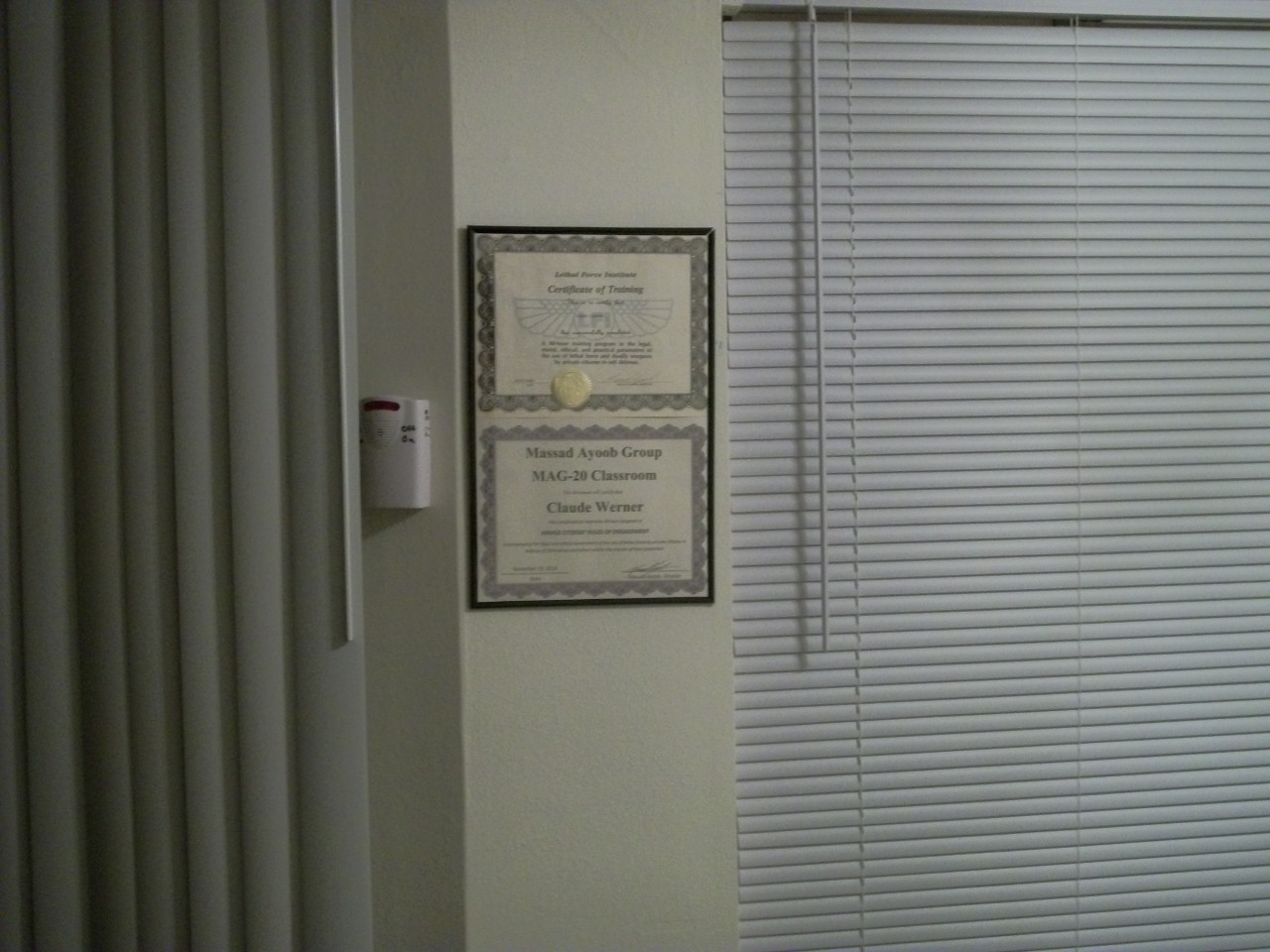
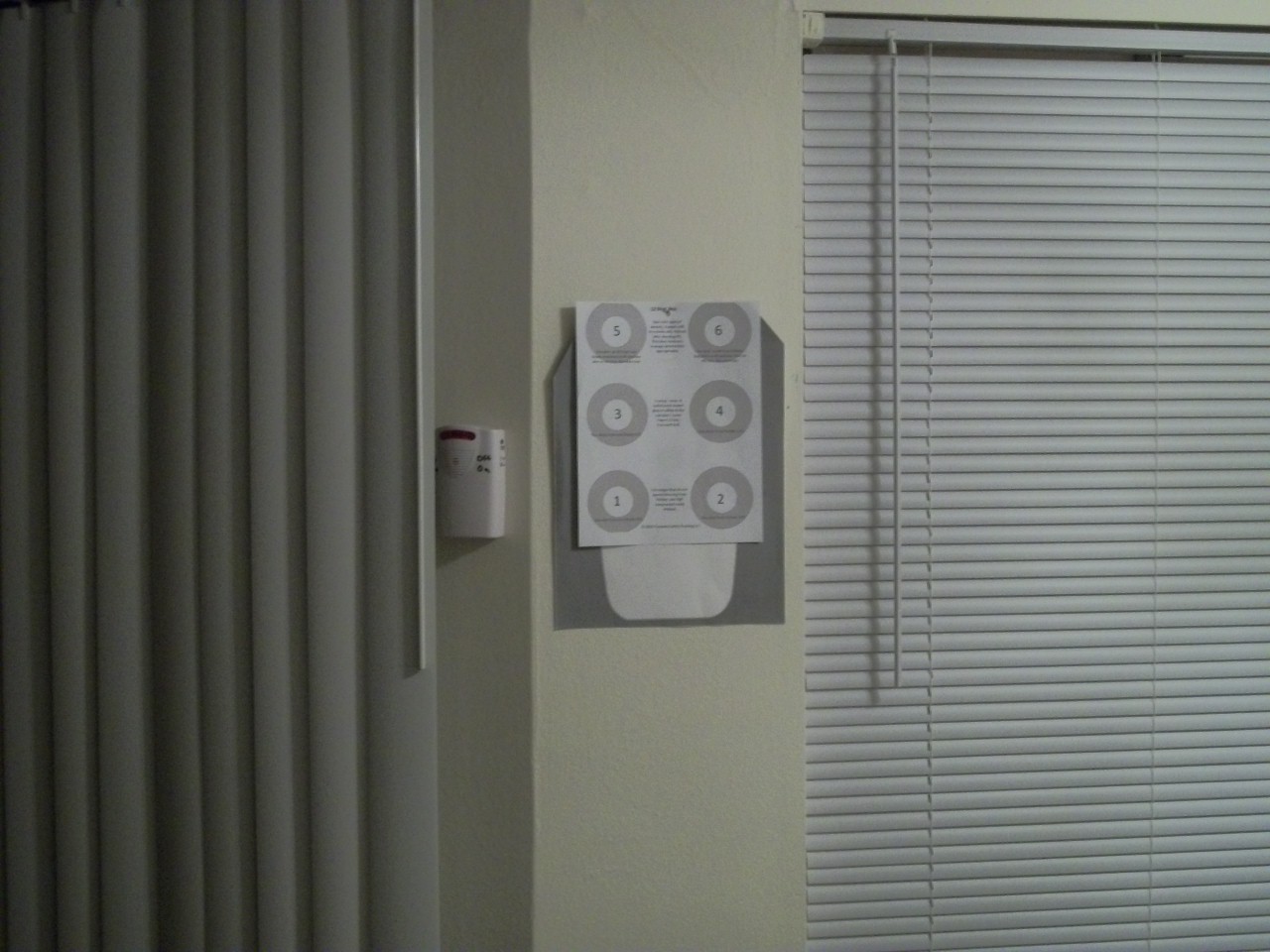 By ‘outside,’ I mean the flashlight is outside both my body and the pistol. ‘Inside’ means the flashlight is inside of the gun and toward my body. It’s necessary to have both an inside and outside technique so that you can use the light on either side of a piece of cover or concealment. For a right hander, the outside technique is used when using the light around the right side of cover and the inside technique is used around the left side. Left handers reverse that.
It occurred to me that I could use the same setup I use for the Air Marshal Tactical Pistol Course. I’ve modified that target setup slightly so I get more traverse on the multiple target strings. My setup also allows me to use both inside and outside techniques because of the arrangement of my apartment.
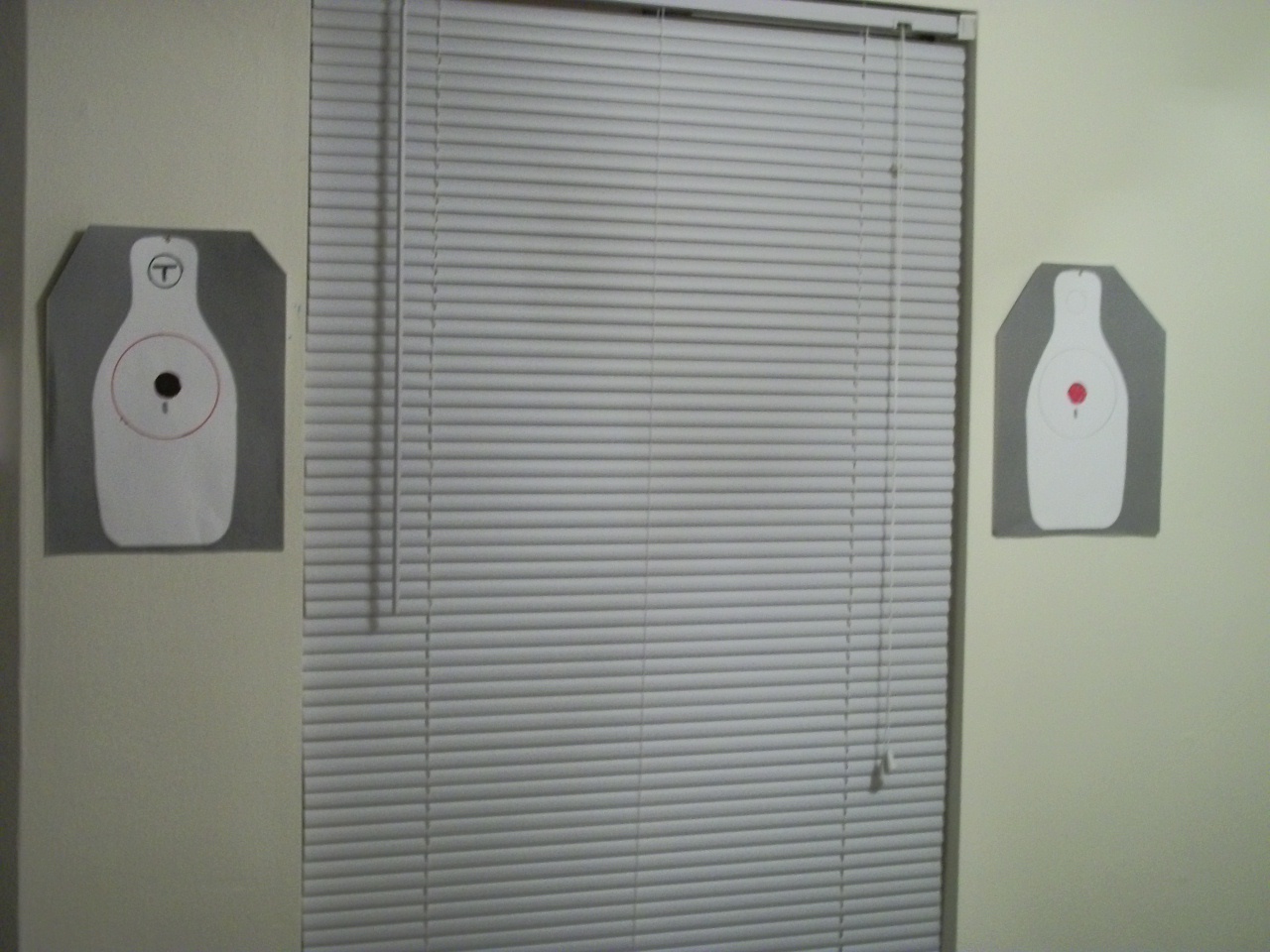
I started the Harries practice with the light pointing toward the target but the pistol down at low ready. Even when we’re identifying a target, we don’t want to muzzle them until the shoot decision is made. Then I practiced bringing the pistol up on target while keeping the light pointed at the target. At first, I did this in the hallway, just to get my mechanical movement correct.
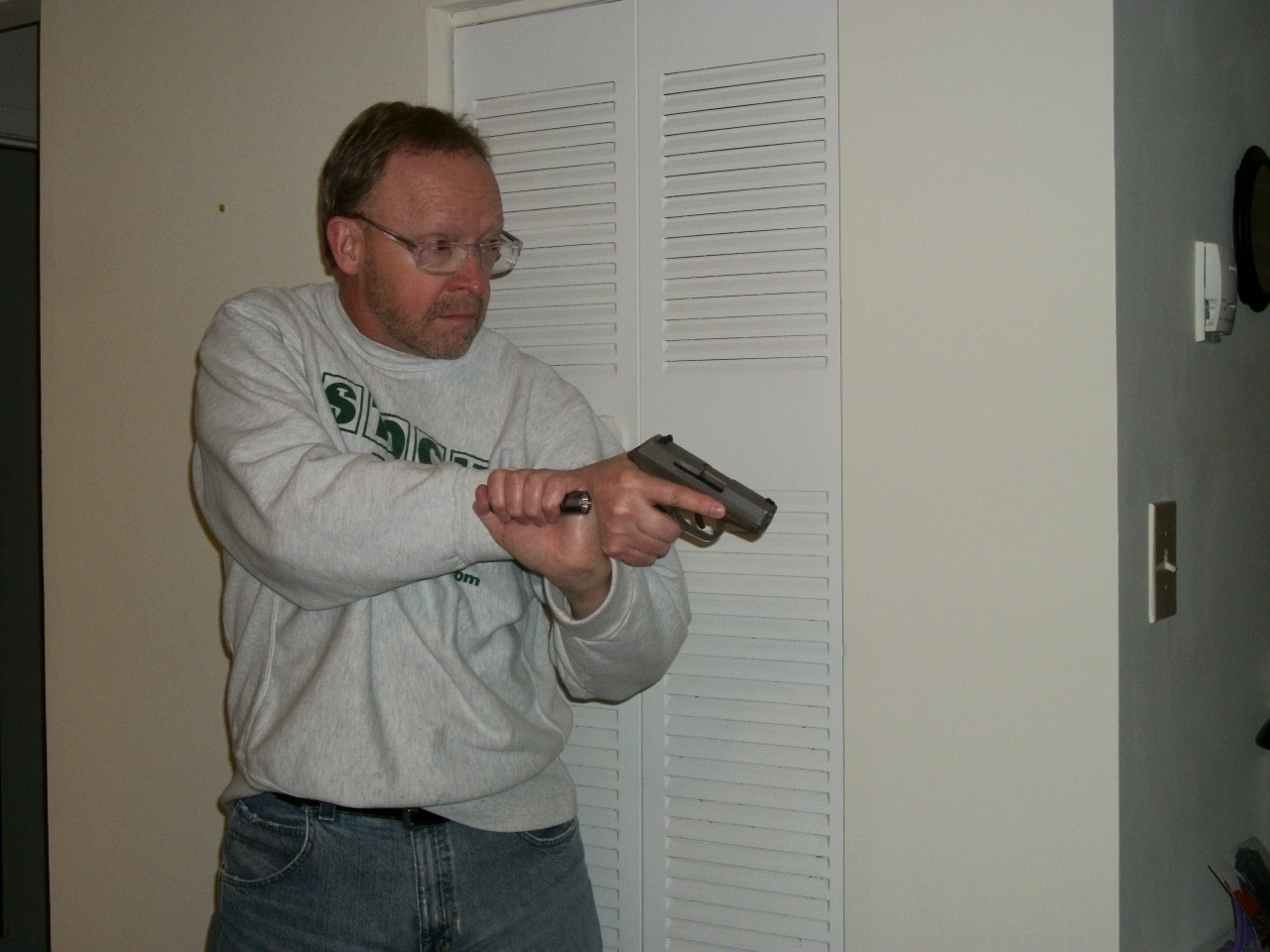
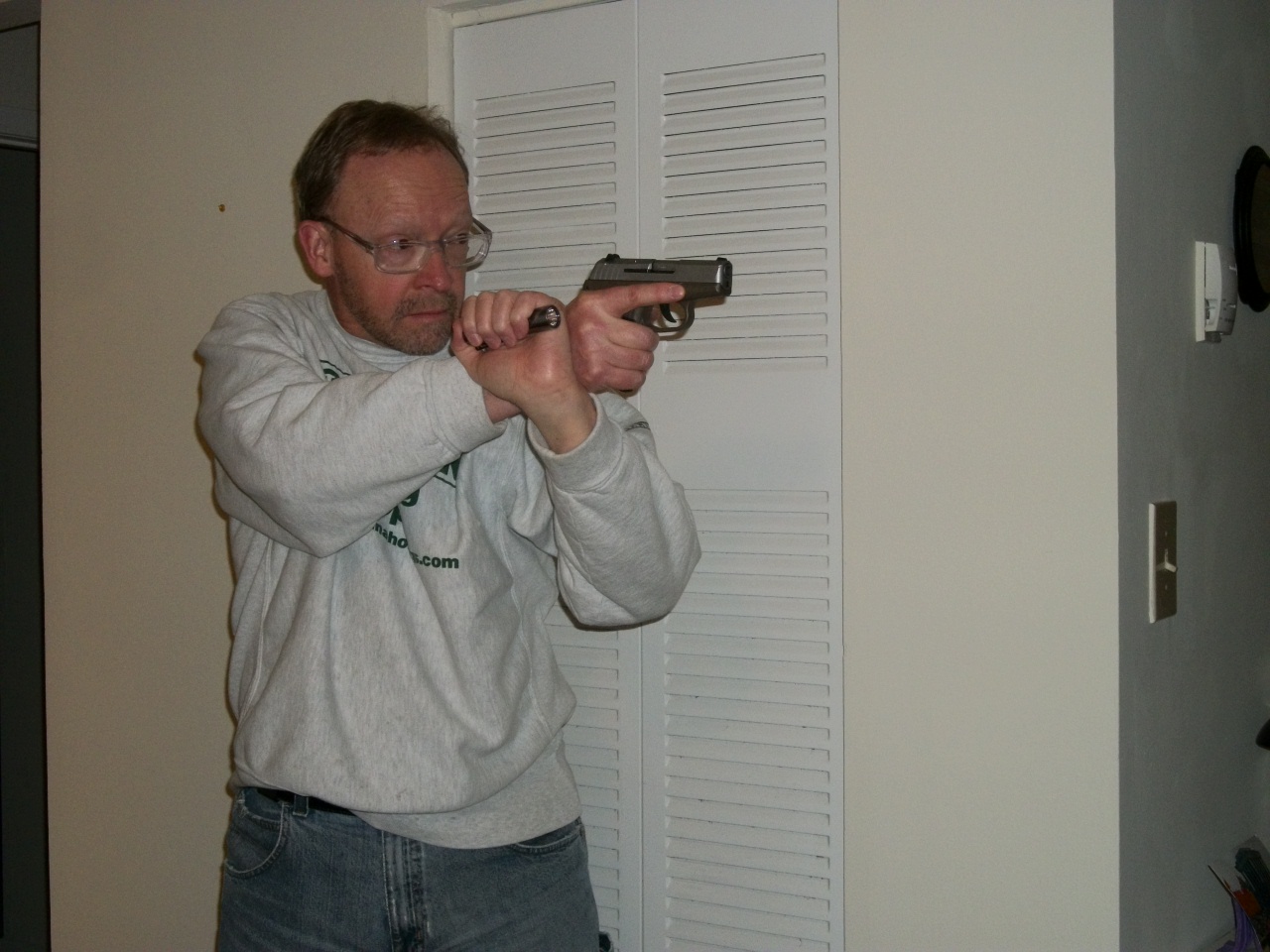
For the cheek practice, once again, I started with the light pointing toward the target but the pistol down at low ready. Since I use the cheek technique as a general search technique, this means I’m going to be shooting one handed, if the shoot decision is made. I like the cheek technique as a general search technique because it allows me to use the light as an impact tool, if necessary. Because there is a possibility during a general search, I would be in a hallway when shooting started, I incorporated turning off the light after the shot and taking a sidestep. But, there’s not much maneuver room in a hallway, so don’t think this is some magic potion that prevents getting shot.
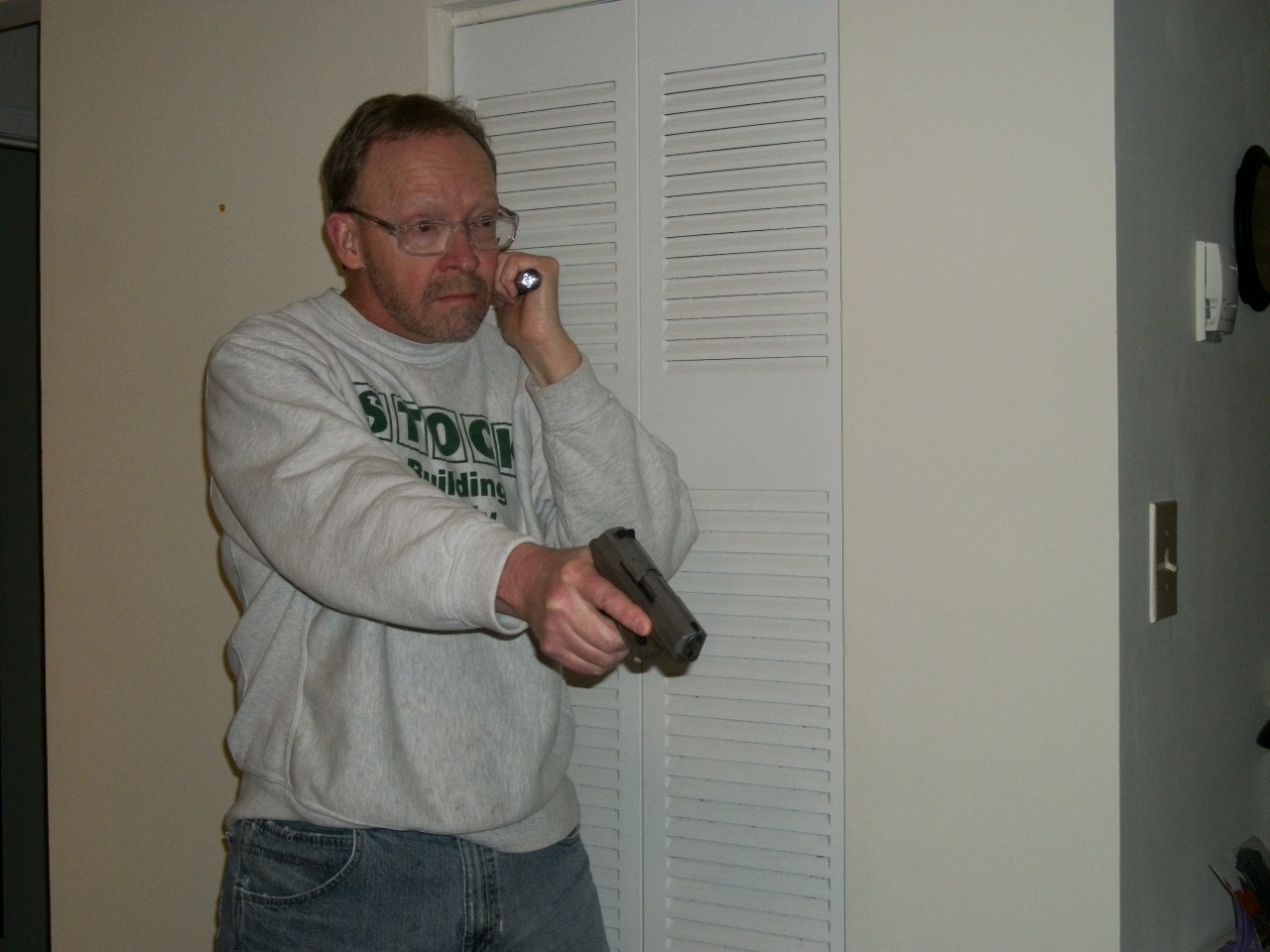
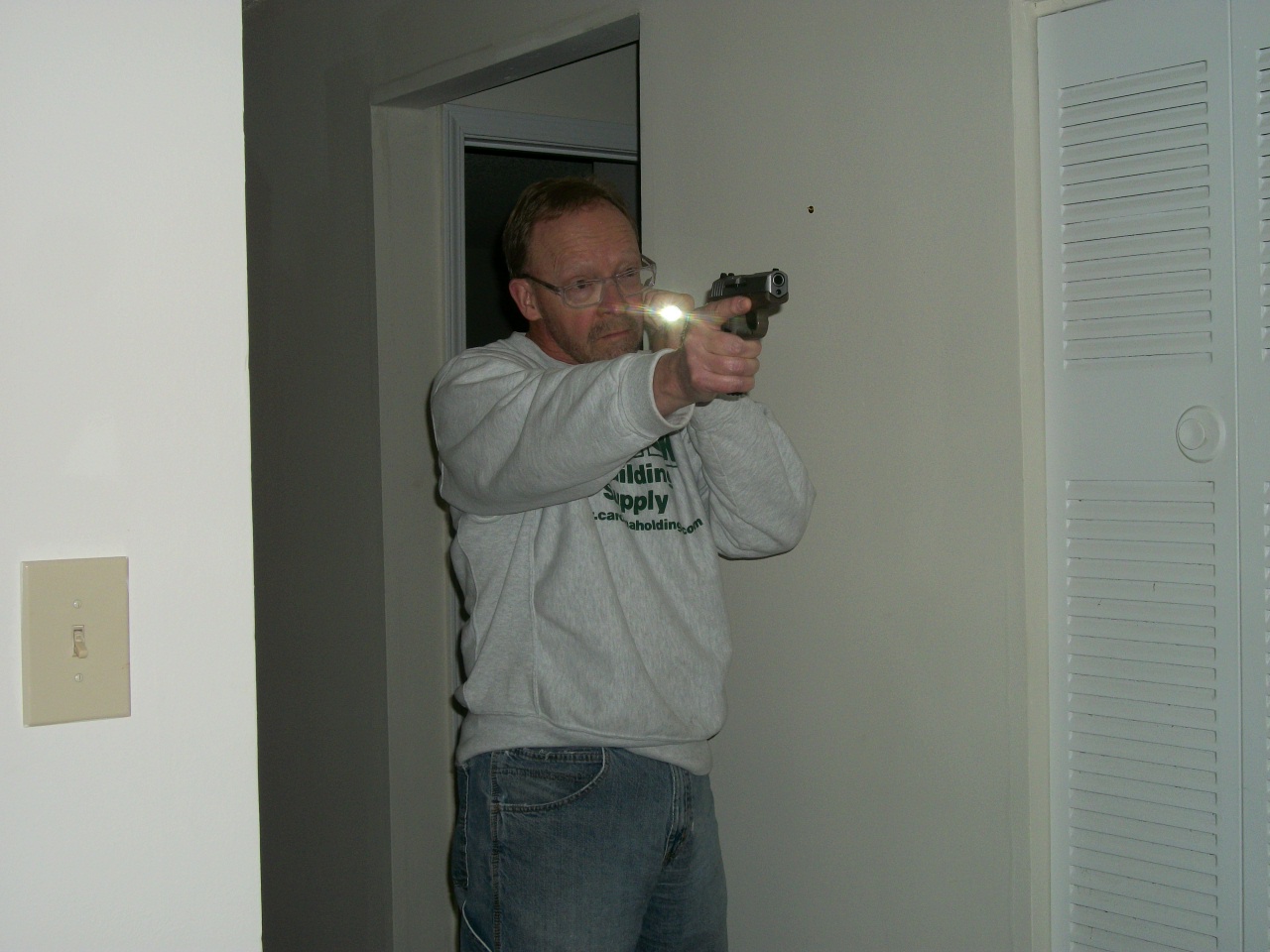
Once I was satisfied I had the mechanicals down pat, I moved to positions of cover, both left side and right side. I practiced on both sides, making sure I didn’t splash the light off the wall and into my face.
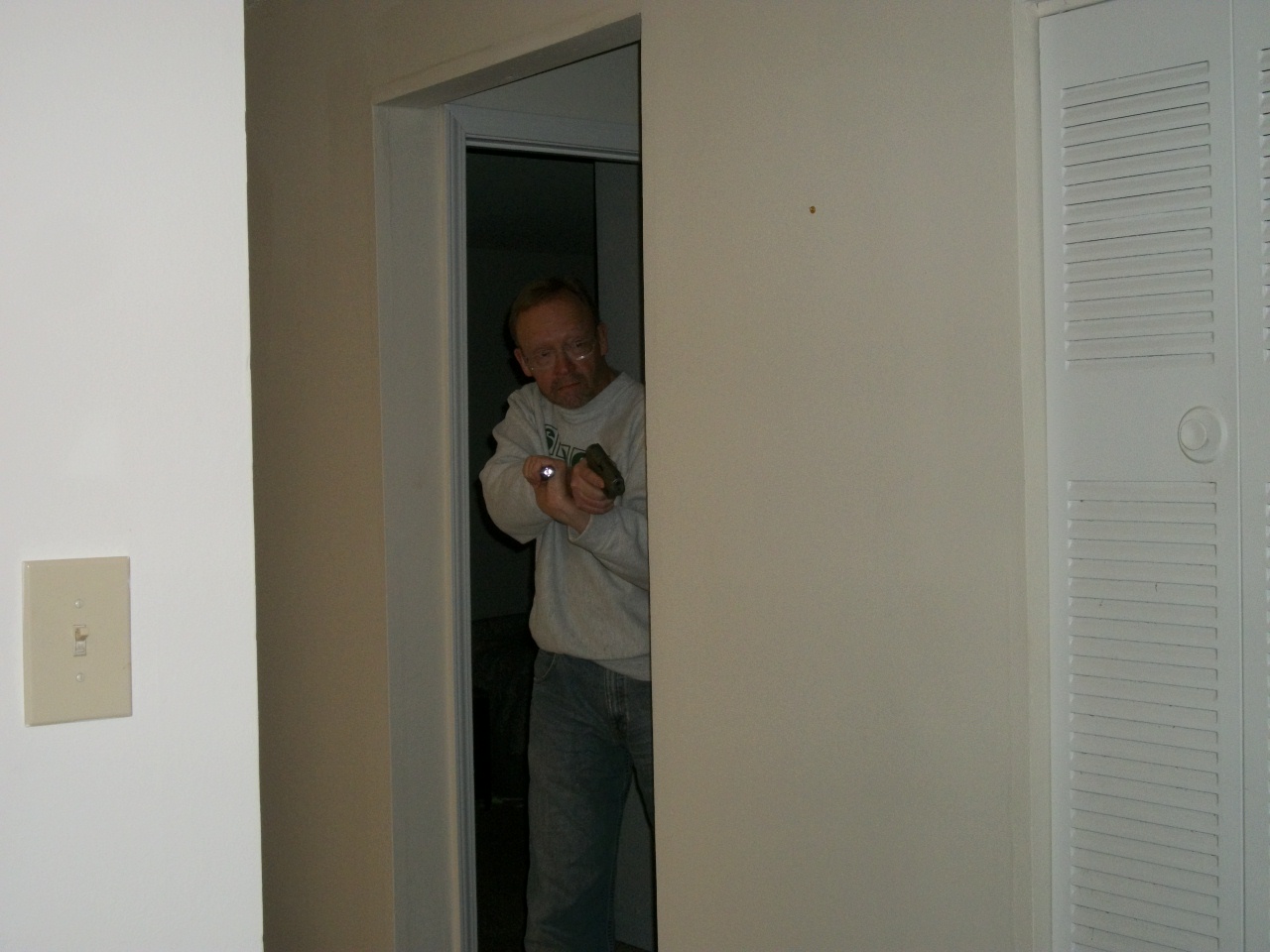
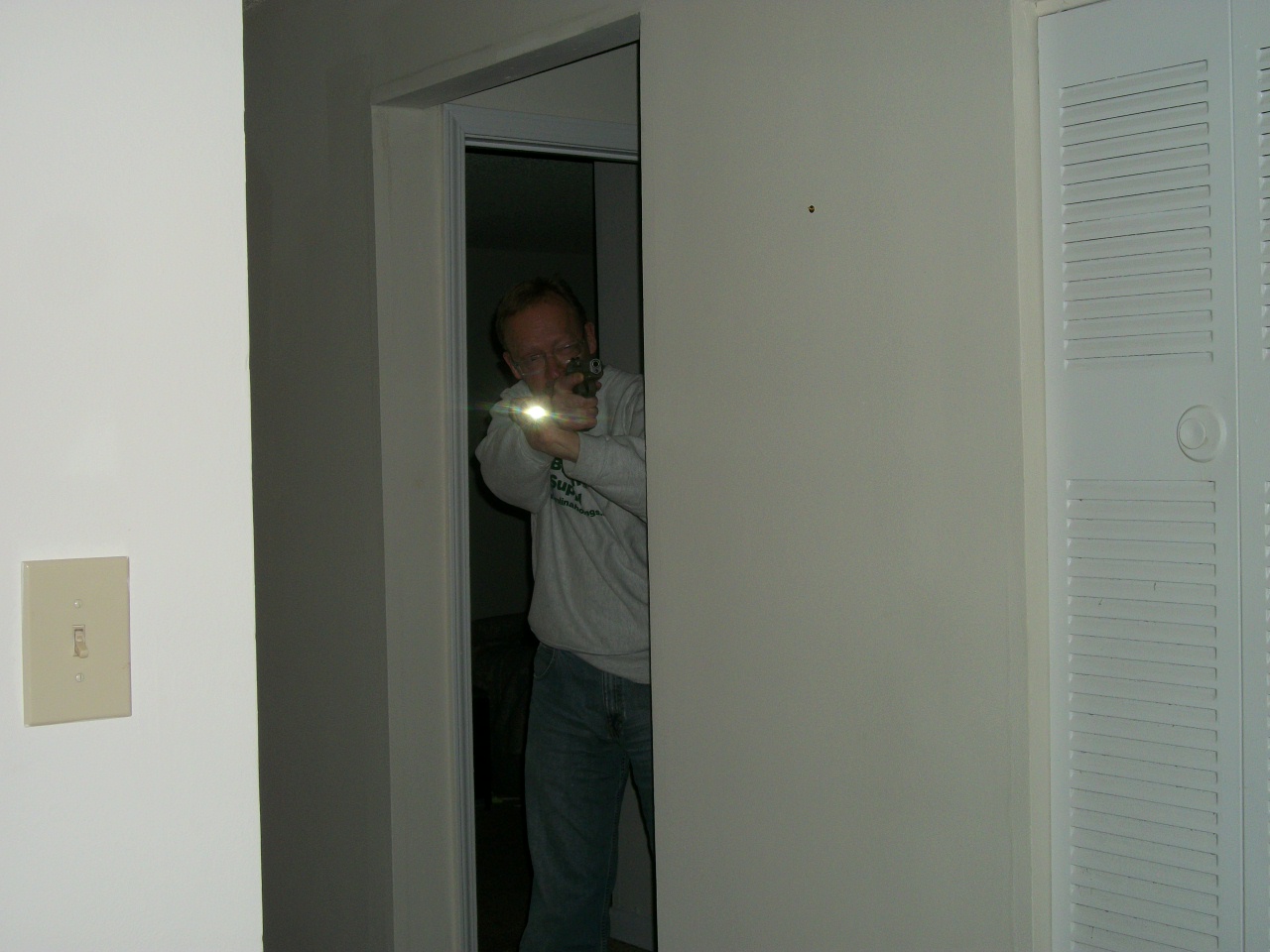
Note that in the photographs I took, I was using a flash or the regular lighting for clarity. When practicing, the place was completely dark. Also note that the camera wasn’t positioned exactly where the target was, so I look more exposed than I actually was.
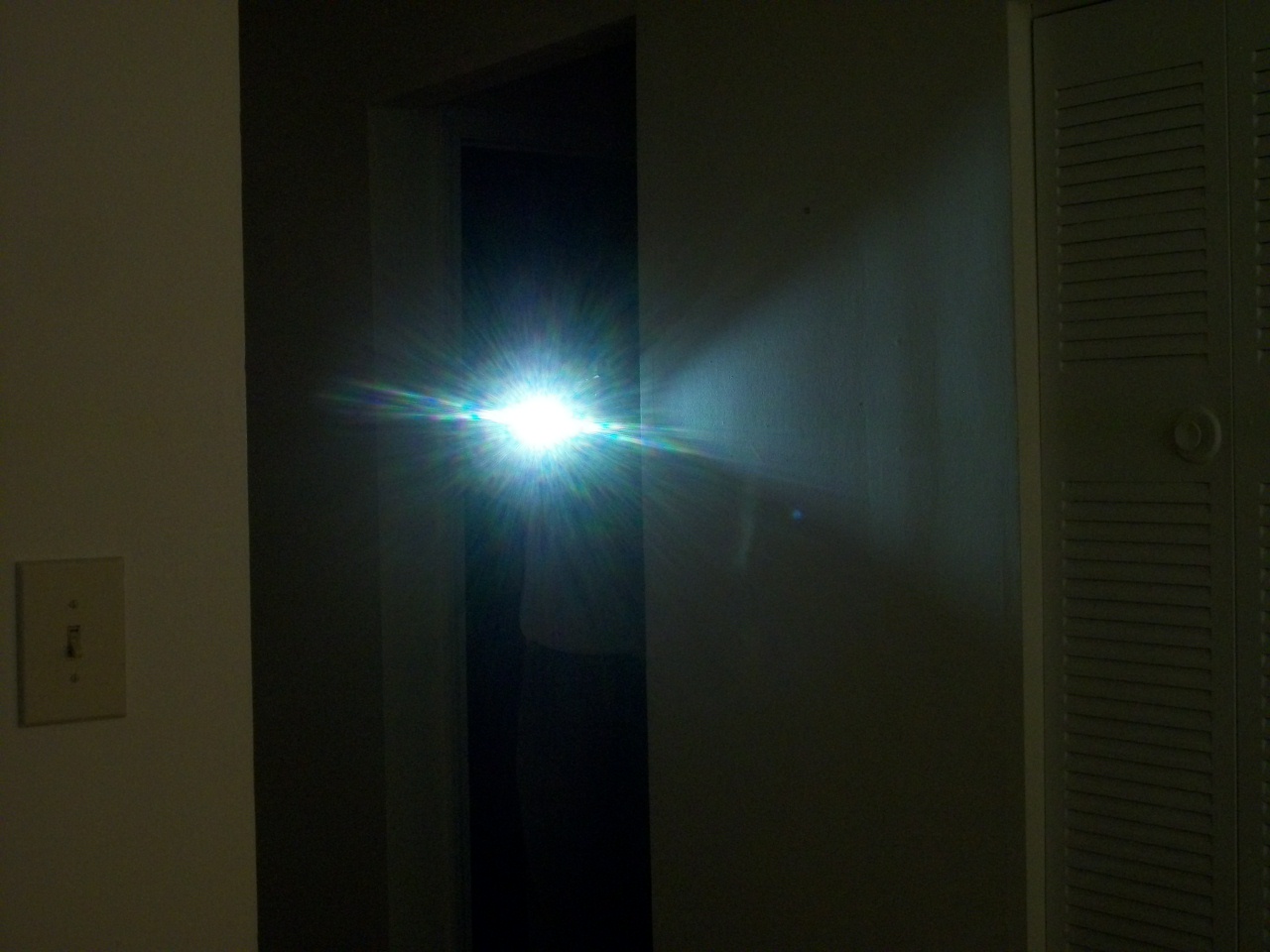
I’m glad I developed this as a more formal program. I’ll be doing it at least once a week from now on as part of my 1000 days of dryfire.
Rangemaster 2015 Tactical Conference (I)
The Rangemaster 2015 Tactical Conference is over and I am processing the things I observed and learned from it. The Conference has a long history, dating back to the early days of IDPA in 1998, when it was a sanctioned IDPA indoor Championship. Over the years, it has evolved into the foremost tactical training conference for private citizens in the United States. It is held annually, early in the year, in the Memphis area. The venue for the 2015 Conference was the Memphis Police Training Academy, a truly fine and modern facility.
This year, three dozen of the top personal protection trainers in the country, many of whom are referred to as “T-Rexes,” came together to present or conduct training blocks of two to six hours over a period of three days. The agenda has grown so large that it’s not possible to take in all the training that is available, since sometimes five blocks are going on simultaneously. Some of the training is classroom lecture, some is hands-on with sterile weapons, and some is livefire. There is also a shooting match, for those who choose to participate.
There were a wide variety of topics, ranging from psychology and communications to contact based skills to firearms manipulation. I was able to attend nine sessions.
- Yes, I Shoot Like a Girl, Would You Like a Lesson?
- Surviving Lethal Encounters
- The Law of Self-Defense
- Practical Small Knife Principles
- Performance Under Fire
- Rehabilitating the Experienced Shooter
- The Training/Reality Mismatch
- Kneeling Positions and Combining Them with the Use of Cover
- Women’s Holsters and Accessories
In addition, I was able to make two classroom presentations.
- Tactical Communications for Couples, with my co-presenter Linda Hoopes, President of the Resilience Alliance.
- Negative Outcomes of Firearms Ownership
Upon my return, several people have asked me what my most significant takeaways were. As usual, I learned a great deal, so it’s difficult to say what were the most significant, but here are a few that stand out in my mind, in no particular order.
- A conversation with a mentor of mine, John Farnam, elicited from both of us the experience that when approached for help in a parking lot, it’s almost always a scam or criminal ambush. Fellow trainer Melody Lauer pointed out that there are a few legitimate exceptions, but John and I both feel they are the exception rather than the rule. This indicates that a default response should be formed to immediately and firmly decline the invitation to be a victim and then rapidly vacate the area. Exceptions to that rule should be based on specific articulable reasons and conscious decision-making, rather than by default.
- The T-Rexes are constantly working along the path to excellence. That path includes attitude, skills development, tactics, and a host of other areas. Recognizing that there is an element of chance in every encounter, we work hard on stacking the deck in our favor. ‘Doing the work’ means training regularly and practicing on a daily basis. ‘Good enough’ is never good enough for us. That’s probably why we’re regarded as T-Rexes.
- There is an enormous amount of erroneous, misapplied, or misinterpreted information floating around in the broad firearms and personal protection community. This is especially true in relation to prioritization, legal issues, and skills development.
- The community has a lot to learn about integrating women into it. There was a record turnout of female attendees and women trainers at the Conference this year, my co-presenter being one. Conversations with them, as well as the presentations, were highly enlightening. Many male paradigms either don’t apply at all or don’t work particularly well when used by women. My own presentation was an eye-opener to me in that regard. The Women’s Holsters and Accessories presentation, which was presented by a woman, gave several good examples. A pet peeve expressed by several T-Rexes is men who have women shoot excessively powerful firearms and then laugh when they fail. Our universal attitude is along the lines of the desire to give such jerks a knee lift in the crotch followed by a crack in the jaw and then laugh when they fall down writhing in pain.
I have several pages of notes but those jump out at me. Undoubtedly, more will occur to me as I reflect on the event. I will have more thoughts on specific topics in the near future. There is a photo gallery of the Conference training blocks available on the Rangemaster website.
Sight misalignment, speed, and accuracy
While I was teaching a private lesson last week, my student was struggling with improving his times, while maintaining an acceptable degree of accuracy. I could tell by the size of his groups, which were quite small, relative to the speed he was going, there was a fundamental that he didn’t understand. The front sight does not have to be perfectly aligned in the notch to produce good hits. So, I had him do a drill to demonstrate the acceptable degree of sight misalignment that will still result in hits on target.
The drill is to fire the pistol with the front sight on the target but with the rear notch deliberately misaligned. It is conducted in four parts consisting of two shots each.
- Front sight half way above the top of the rear notch,
- Front sight lowered so that its top edge is half way down in the rear notch,
- Front sight pushed to the right so that its right edge is touching the side of the rear notch, and
- Front sight pushed to the left so that its right edge is touching the side of the rear notch
This is the diagram I drew to show him what it should look like.
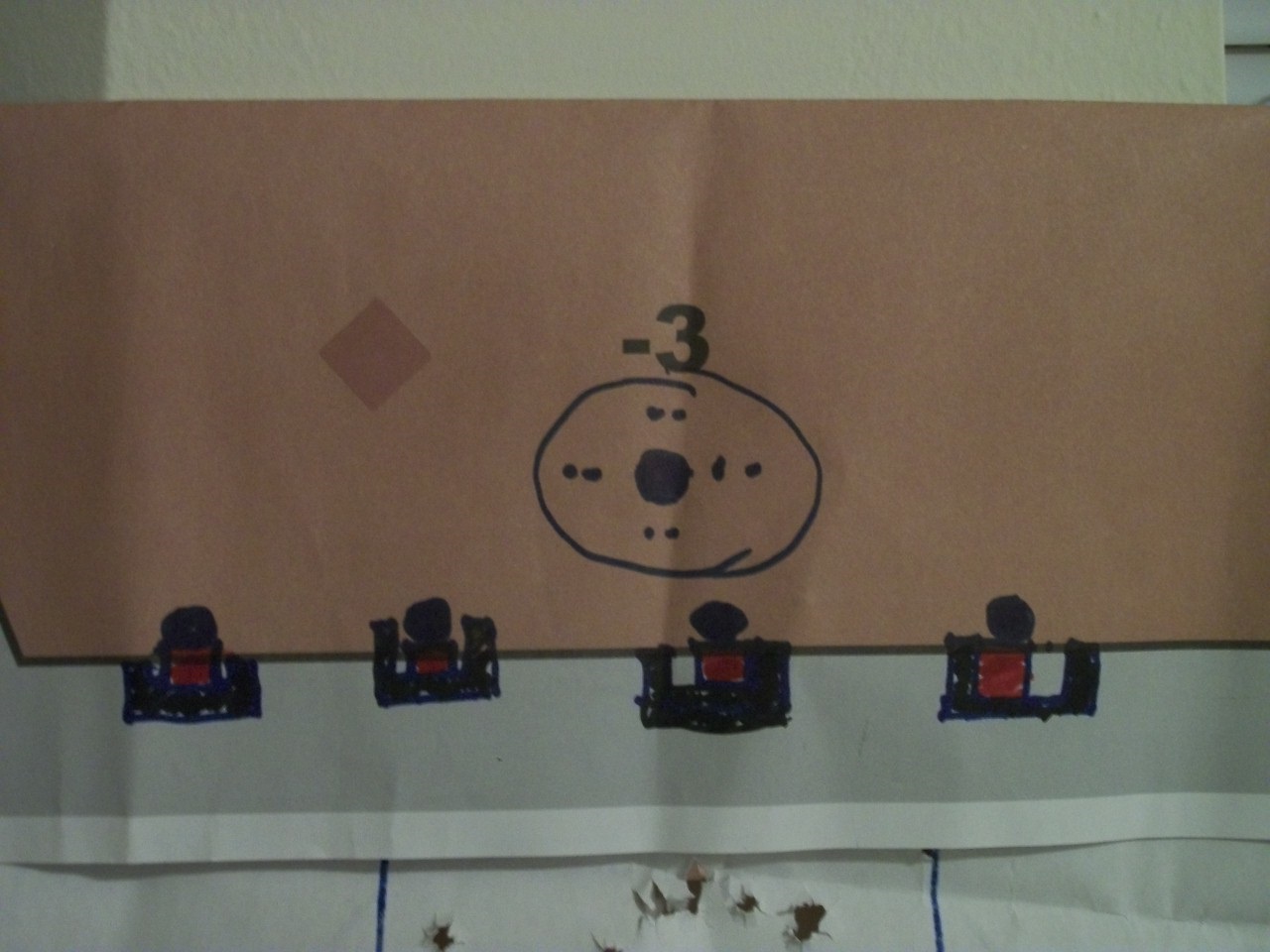
The front sight is aligned correctly on the target with the misalignment done to the rear sight. I prefer to use a dot as the target to get the most graphic result. In this case, I used a 1 ¾ dot. There’s no magic to that number; it just happens to be the size of the template I had.
I had him shoot the drill at seven yards. This was the result. His group measured about four inches at that distance. For many people, trigger manipulation issues will have a greater effect on their accuracy than will sight alignment.
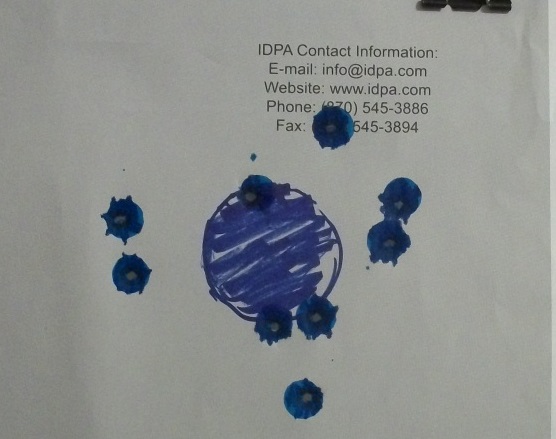
Once he understood that he didn’t need a perfect sight picture, the speed of his shooting picked up and his accuracy remained well within acceptable limits. As long as the front sight is close to the center of the target, a certain degree of misalignment will still produce a good hit. Not worrying about getting a perfect sight picture will result in a noticeable increase in speed.
Incidentally, this drill is a part of the NRA Personal Protection In The Home Course. Experienced shooters like my student usually think they have nothing to learn from NRA Courses. Often, this is a misconception on their part. [Thanks to those who pointed out that I had misremembered the NRA Course the drill is part of.]
Bad habits
My friend, Paul Carlson, posted a link about the new Taurus TCP with wings on Facebook. ETA: this is not Paul handling the gun but rather him commenting on another website.

I withhold comment on the viability of the wings, but the Jose Canseco “shoot your finger off’ hold used in the photos is unforgivable for someone who is supposed to be a firearms semi-professional. People who live in glass houses shouldn’t throw stones.
Oh, but that’s OK because “it’s not loaded.”
No, it’s not OK. That’s how we get into sloppy habits that bite us in the ass.
http://www.guns.com/2015/01/14/former-cop-suing-gun-shop-after-he-accidentally-shoots-himself-video/
Maybe I’m becoming obsessed with ‘negative outcomes,’ but I see a lot of bad gunhandling by people who should know better. Don’t get into habits that can come back to haunt you under a different set of circumstances.
Keeping dryfire interesting
How much you last practiced isn’t as important as when you last practiced.
One of the Facebook groups I’m a member of is called 1000 Days of Dryfire Challenge. It’s a group whose members have committed to doing my ‘1000 consecutive days of dryfire’ concept. What I found the first time I did the 1000 days was that regularly devising new regimens and switching them around was important to keep the program interesting and avoiding boredom with doing a single regimen all the time.
A regimen I’ve been doing the past few days is a dryfire version of the Federal Air Marshal Tactical Pistol Course. The target I made is a reduced scale triple QIT printed on 11×17 paper at FedEx Office. It’s scaled for 2.5 yards. What I do is print the image from a flash drive on 11×17 paper at FedEx office and set the copier to ‘resize to fit page.’ Resizing is one of the menu options when printing from a flash drive. Feel free to download the image and try it yourself.
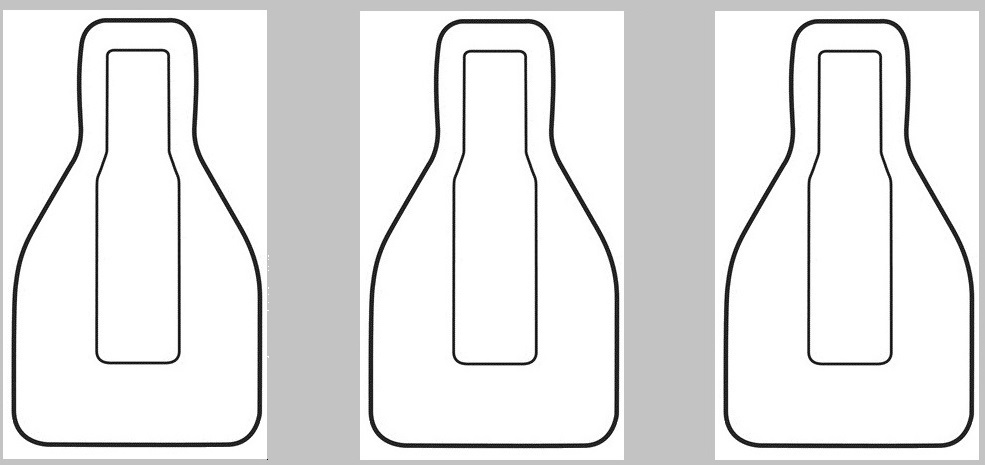 The spacing isn’t quite wide enough on a single piece of paper but nothing is perfect. I punched a hole in the paper at the measured middle point so I can hang it on a picture hanger in the wall. Regular paper tends to sag when hung on the wall, so I stapled it to a piece of cardstock.
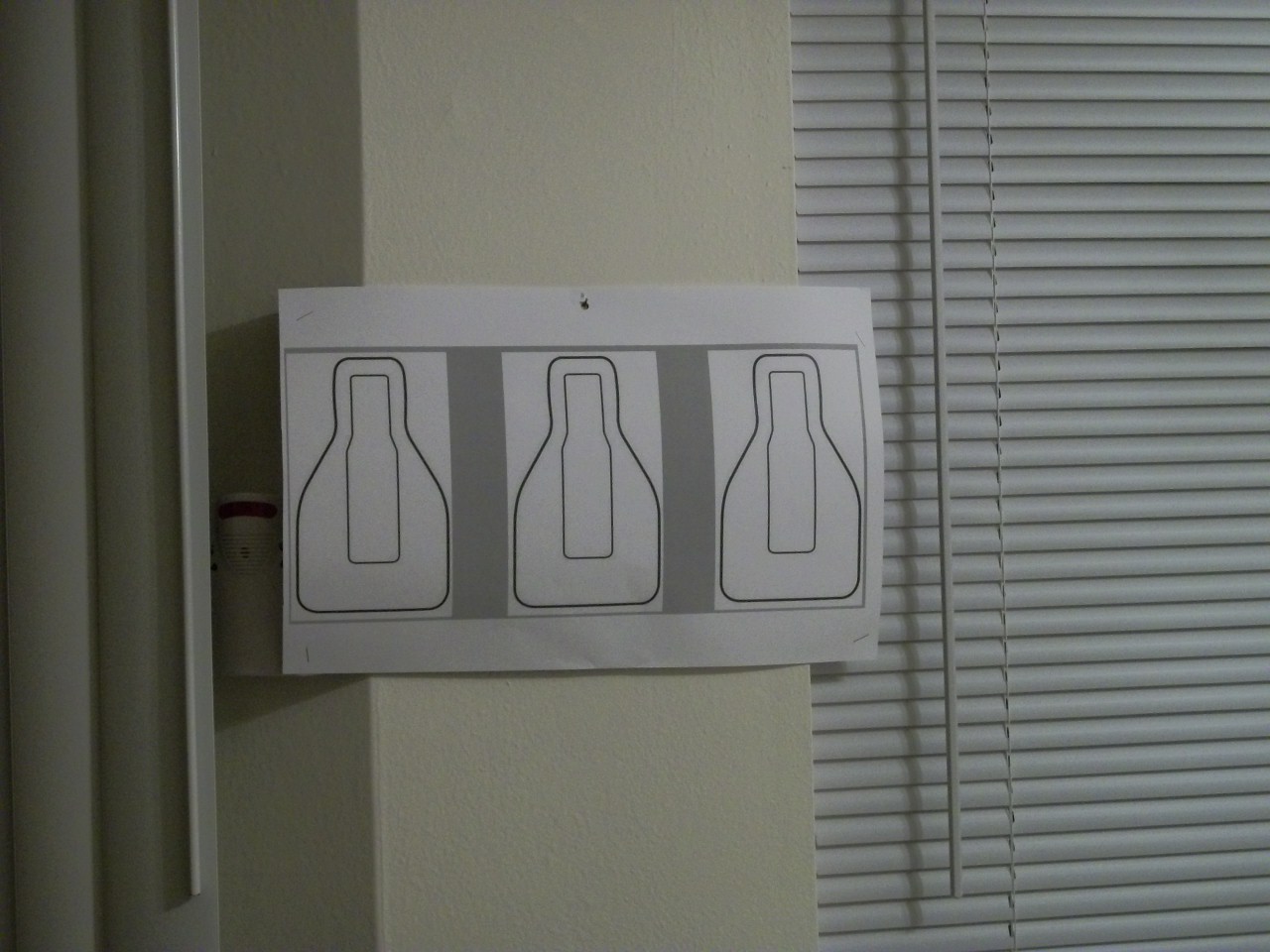 I’m using my SCCY pistol because it’s DAO with second strike capability so I can pull the trigger on almost all the shots. The only one I have to fudge is the final stage because it involves two strings starting with a slide lock reload. I start those strings with the slide locked back, so the first shot is a dead trigger.
Since the TPC is based on Par times, like most police courses, I set the par times on one of my CED 6000 timers. It’s a great training timer, which isn’t made any more, unfortunately. The CED has an option for multiple strings of par time, which makes it easy to set up the multiple string stages. Like most timers, it only sets par times to one tenth of a second, so I round the times down, e.g., 1.65 becomes 1.6 seconds.
Federal Air Marshal Tactical Pistol Course (TPC)
| Drill | Starting Position | Seconds Allowed | Total Rounds |
| One Round (twice). | Concealed Holster | 1.65 (3.30 total) | 2 |
| Double Tap (twice) | Low Ready | 1.35 (2.70 total) | 4 |
| Rhythm; fire 6 rounds at one target; no more than 0.6 between each shot. | Low Ready | 3.00 | 6 |
| One Shot, speed reload, one shot (twice). | Low Ready | 3.25 (6.50 total) | 4 |
| One Round each at two targets 3 yards apart (twice). (Use the outer targets. I go left to right for one string and right to left for the other.) | Low Ready | 1.65 (3.30 total) | 4 |
| 180 degree pivot. One round each at 3 targets (twice). Turn left, then right. | Concealed Holster | 3.50 (7.00 total) | 6 |
| One Round, slide locks back; drop to one knee; reload; fire one round (twice). | Low Ready | 4.00 (8.00 total) | 4 |
QUALIFICATION:
- TIME: Cannot exceed total time for each Drill. Example: Drill #1 – 1st time 1.70 seconds, 2nd time 1.55 seconds; Total = 3.25 seconds = Go. Must achieve a “GO” on each Drill.
- ACCURACY: Target is FBI “QIT” (bottle). Total rounds fired is 30. Point value that hit the inside bottle = 5. Point value touching line or outside bottle = 2. Maximum possible score = 150. Minimum qualifying score = 135.
All stages must equal “GO” to qualify.
This is a fun course that only takes a few minutes to do but tests a number of skills and is fun, at least for me.
Laser sights
I have seen too many people forget the basics and rely on finding the laser dot instead of looking down the sights on pistols. They became much slower with the laser.
So began a Facebook thread in a closed group of ‘operators.’ There’s an antinomy, a form of paradox, in this sort of discussions that I always find interesting.
The paradox arises from the often parroted statement that most armed encounters take place at night or in low light. This premise is less than provable, but let’s accept it at face value for purposes of discussion.

Now, let’s follow up that premise with dismissal of a sighting system because ‘it doesn’t work’ during periods when gunfights are LESS LIKELY to take place.
In this particular FB thread, I will put myself in the category of ‘highly trained,’ since that’s what their membership group supposedly consists of. Years ago, it didn’t take me long to figure out that there were things I could do with a laser on a pistol that I simply couldn’t do without them. That held true even during the day, unless I was on a brightly sunlit ‘square range,’ which is so often said to be a poor and ‘non-realistic’ training environment. In any indoor environment, there is no issue with ‘finding the laser dot,’ even in a well lit room in daylight.
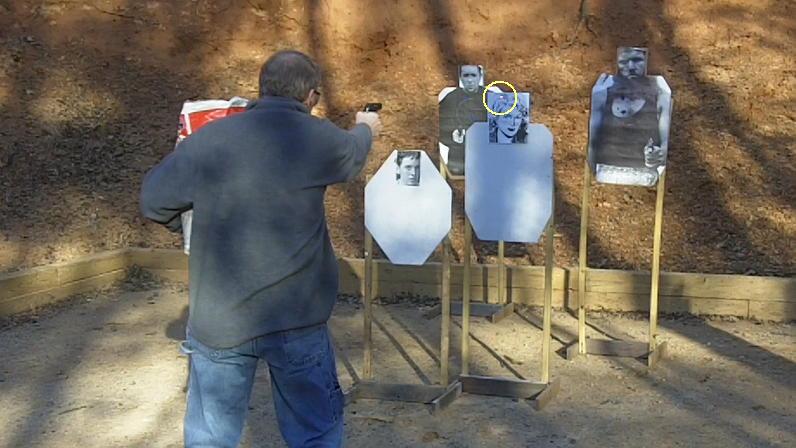
Note visible laser dot.
Once we get into the realm of low light, where the popular mantra says the majority of gunfights occur, most of us will agree that iron sights are fairly useless. We’re largely reduced to point shooting because the sights can’t be seen.
I wondered about the difference between iron sights and lasers during low light. I think of the time frame between sundown and End of Civil Twilight (dusk) as low light. The US Naval Observatory provides specific definitions of these and states
Some outdoor activities may be conducted without artificial illumination during these intervals, and it is useful to have some means to set limits beyond which a certain activity should be assisted by artificial lighting.
Target Acquisition and, to a lesser extent, Target Identification, is still possible during that period. However, between sundown and dusk, night sights aren’t really visible (not bright enough) and neither are the irons (luminous efficacy of the eye’s cones is insufficient).
To establish a quantitative measure for that difference, I chose several parts of the Handgun Testing Program at the elite Rogers Shooting School. The targets were more visible than they show in the video but I couldn’t see the irons. I proceeded to shoot the tests with a laser equipped Beretta. Having taught at Rogers for five years, I’m fairly confident in saying that, without the laser, I would have made the all the body hits (7) and around half of the hits on the number 1 head plate (8) for a score of 15 out of 69 targets. My score with the laser was four missed targets for a score of 65 out of 69.
There’s a reason I have a laser on my house gun.
The issue of parroting something that was heard without questioning, analyzing, or testing is a separate topic that the training community has yet to address adequately. That’s for another time, though.
Grace at Night
[This lady]
“made a list of ten factors that can make an incident traumatic. Eight of the ten happened [in their incident]:1. In your home
2. In the presence of children
3. Prolonged
4. Death and rape threats
5. Guns
6. Theft
7. Beating
8. Shots fired
9. Rape
10. Murder”

One week ago our family went through a harrowing, life-changing experience. This is how my husband described last Tuesday evening in a prayer update:
Last night at about 9:45 pm at our house, Caleb announced to Amy and I as we worked on a paint job in the children’s room that three men had just entered our back door. When I got to the door, I saw two guns brandished among the three criminals. Though we offered all our money and goods to them they beat me and hit Amy twice.
We are praising the Lord that after about 15 minutes wherein they tore the house apart, we were able to chase them away. They took some material possessions, but our lives and honor were spared because of the good hand of our God who placed a wall between our lives and their weapons.
Tomorrow, we are taking a…
View original post 1,710 more words
The Armed Citizen
A writer from Gun Digest contacted me about the Five Year Armed Citizen study TAC 5 year w tables I did a while back. He asked if I would give him a quote about it, so this was my reply.
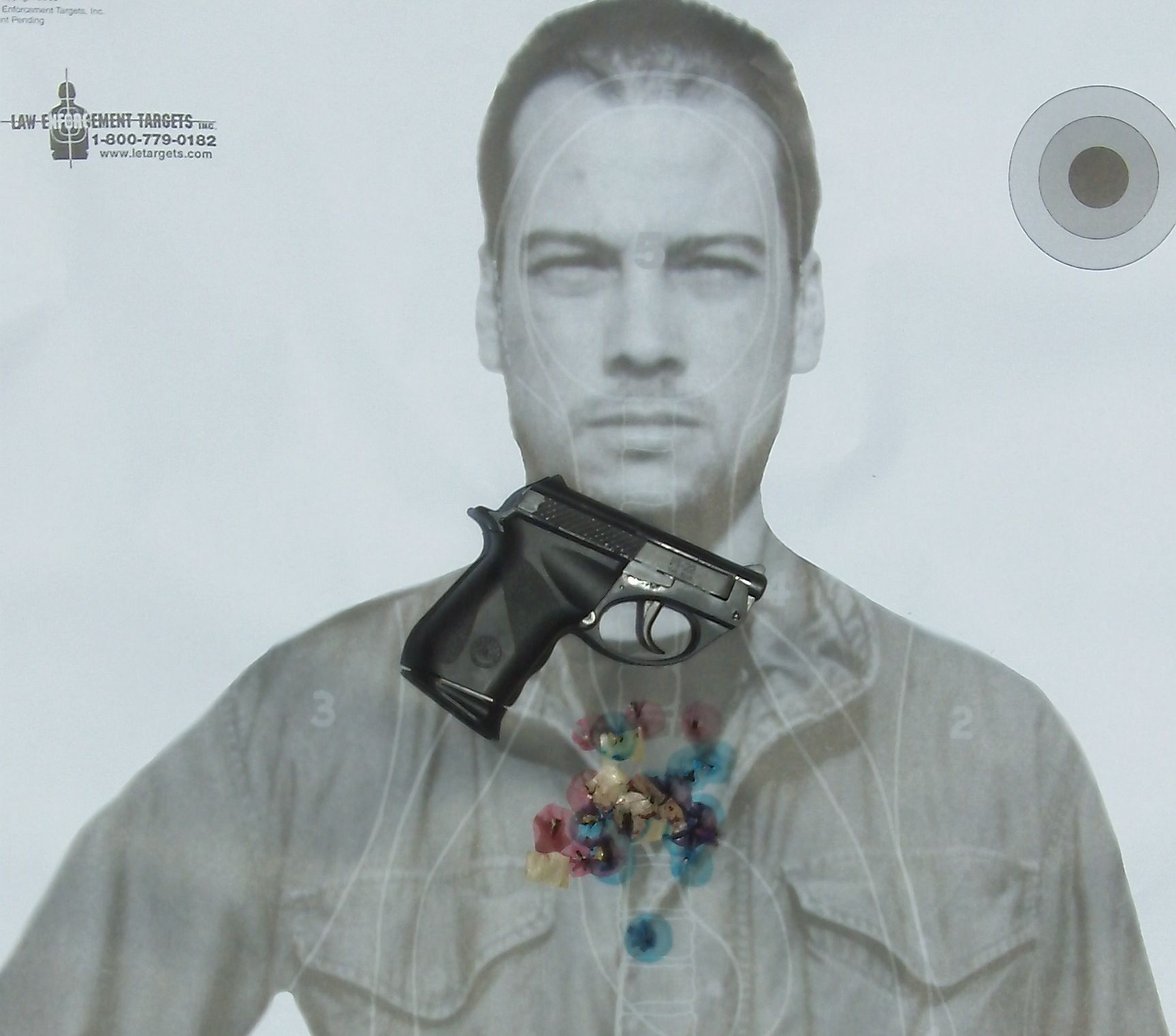
“Analyzing incidents involving Armed Private Citizens, rather than LE/MIL situations, leads to different conclusions. Common discussion topics among Armed Private Citizens, such as equipment and caliber issues, rarely are the cause of Negative Outcomes. Negative Outcomes result from 1) lack of conceptual understanding leading to poor decision-making, and 2) lack of appropriate and necessary skills, techniques, and tactics.
Carrying and being capable of using a small gun adequately will yield much better results than owning a large pistol that isn’t carried or shot well. More criminals have been planted in the ground by .22s that hit than by .45s that miss.”
Negative Outcomes: Self-Inflicted Gun Shot Wounds (Part II)
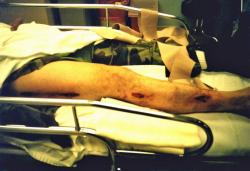
Unfortunately, once we covered up the trigger guard, the path was paved for negligent discharges going back into the holster. Carelessly leaving the finger inside the trigger guard when reholstering will result in the holster helping the finger press the trigger. That’s not the holster’s fault, it’s the user’s.
Be a good instructor
Claude, I really like your blog, I have been a fan and a reader, since I saw it linked over at georgiapacking.org
I’m scheduled to get my NRA certification as a firearms instructor for basic pistol next month.
Do you have any advice for me, in starting out as an instructor?
My main recommendation would be to continuously improve your knowledge and skills. I can’t tell you how many NRA Instructors I know who haven’t
read a single gun book beyond the NRA manuals, have never taken another
class, and who don’t do anything to measure and improve their skills.
My personal library has over 400 books about guns, shooting, tactics, police work, and military history. The subjects run the gamut from appropriate rifles for African hunting in the early 20th century to analyses of the effects of using deadly force by the shooter. My collection has over 100 DVDs in it too. Granted that took me over 40 years to accumulate but it’s indicative of what I try to know about the subject. Many instructors have neither depth nor breadth to their repertoire. They learn one set of skills at a mediocre level and stop there. I see it time and again. That’s a mistake; never stop learning.
I take classes from others regularly, frequently just short evening courses. Those short evening courses are how we are going to begin to reach the majority of new gunowners. And, even if someone else’s class is terrible, like one I took at an indoor range last week, you get important insight about how NOT to do things. Learn from others’ mistakes as well as your own.
With regard to measuring one’s skills, I think it’s important for everyone to benchmark where you are and try to improve that continuously. For an instructor, it’s doubly important. There are a lot of different benchmarks you can use, just having one is the important thing. Shoot it periodically and try to get better at it. You may find that the benchmark you use changes over time to something more challenging and that you have multiple benchmarks that measure different aspects of shooting. One of the main advantages of shooting in competition is that you find out you’re not as good as you think you are. Ego is the Achilles heel of many shooters and instructors.
I also think it’s important to demonstrate drills for the class. Time dependent, it doesn’t have to be all of them, but the first drill and any complex drills should be demonstrated. People are visual learners, for the most part. Telling people how to perform a physical skill is simply not as effective as showing them, IMO. And don’t take your subject matter knowledge for granted about what constitutes a ‘complex’ drill. I have had very intelligent students who couldn’t figure out what the NRA MQP drills were until I demonstrated for them.
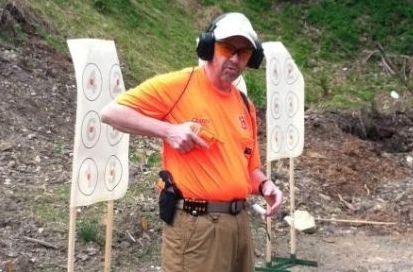
Have an inert gun to do this, where it’s appropriate. If it’s livefire, I use a live gun. If I’m demonstrating gunhandling or tactics, the inert gun comes out. I have both of them on me when I’m teaching.
Most importantly, don’t get complacent about anything. Your skills, safety, communication, etc. need to be at the forefront of your mind whenever you’re teaching. Every story we hear about an instructor having a Negligent Discharge or shooting a student in class has complacency as its root. Complacency is a killer, don’t go there.
Structured shooting is a whole new world for most people. Help them understand it in every way you can.


You must be logged in to post a comment.