Comparative Standards – Double Action Autos
I enjoyed the #wheelgunwednesday Comparative Standards exercise enough to repeat it. This time the test was with Double Action autoloaders. Five different autos, three Double Action Only and two Traditional Double Action were the test subjects. Four were 9mm and one was a .22.
- SCCY CPX-2
- Sig P250
- Smith & Wesson 6906
- Beretta Centurion 92D
- Walther P22 (Remington Golden Bullet bulk ammo)
All the guns were similarly sized enough that I used the same Mister Softy holster for all of them. The Mister Softy is interesting in that the gun sits low enough in the pants that a full firing grip can’t be gained in the holster. I didn’t notice the lack of a full firing grip was an impediment. The need for a full firing grip in an AIWB holster is another one of the industry maxims I have doubts about. Maybe I just have clever hands.
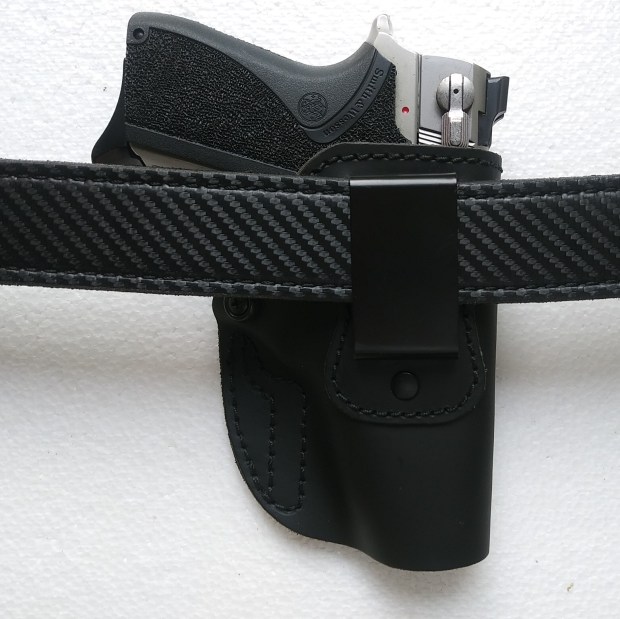
I used the same protocols for shooting and scoring as last time so I won’t reiterate them.
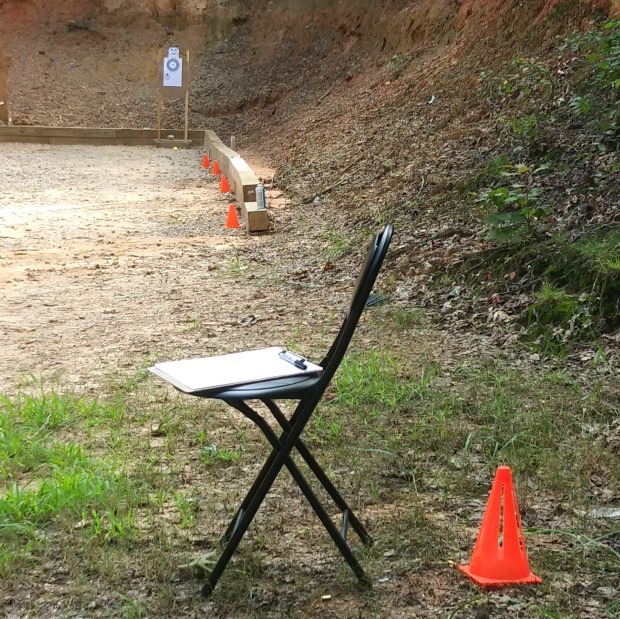
#Wheelgunwednesday – Comparative Standards
The Editor of a publication I occasionally write for asked me to participate in a project about comparing different handguns. Being the revolver guy I am, he asked me for some input about how wheelguns fared. His concept is:
[R]each an objective: identifying a short (20-rounds) base of standards for defense handguns to (1) compare similar format guns, one to another, (2) compare formats of handguns (small, single stack or subcompact), (3) “shoot out” duty/defense ammo for replacement while evaluating personal skills, (4) yet another “cold course” of fire to identify skills areas that need attention.
This is the Course of Fire he developed.
- Basis: 3-second strings
- Lots of draws
- Few reloads (on the clock)
- Limited Vickers: use a target, feature .5 second added for 1-down; shortest time “wins.”
- 25 yards – singles from holster – 5x – 5 rounds
- 15 yards – single from holster – 1x
- single from guard – 2 x — 3 rounds
- 10 yards – Pair from holster – 1x 2 – rounds
- 7 yards – Failure from holster – 1x – 3 rounds
- 5 yards – Pair SHO from holster – 1 x – 2 rounds
- Pair WHO from guard – 1x — 2 rounds
- from holster, 1-Reload-1 – 1 x – 2 rounds
- from holster, 1 head – 1 x – 1 round
Total: 20 rounds
The breakdown:
- Draws – 7
- From ‘ready’ (guard) – 3
- Singles – 6, one to ‘brain housing group’
- Weak Hand Only – 2, Strong Hand Only – 2
- Shots to smaller target – 2; one is transition from larger target.
- Pairs – 4
- Reload – 1 (under time)
All in a 20 round box of ammo.
It’s an interesting concept, so I shot it with four different revolvers and two autoloaders.
- Smith & Wesson Model 65 – one of my favorite wheelguns and what I shot at the 2018 Rangemaster Tactical Conference
- Smith & Wesson Model 642– perhaps the most ubiquitous revolver encountered today
- Ruger LCR – another commonly carried wheelgun
- Smith & Wesson SD9VE
- Beretta PX4 Storm Compact, modified to G configuration
- Smith & Wesson 43C – a nice little .22 snub revolver
All were shot from Appendix Inside the Waistband carry except the SD9VE. The centerfire revolvers were reloaded using a speedloader carried in a centerline carrier. The 43C was reloaded using a QuikStrip carried in the watch pocket of my jeans. I used Remington Golden Bullet bulk ammo in the 525 round box for the 43C. Despite it having a 9 pound mainspring, which I have been told will get me ‘kilt in da streetz,’ there were no Failures to Fire.
We were free to use any target we wanted, so I used the printable target from my ebook Concealed Carry Skills and Drills. Per his instructions, the scoring was Vickers Count with ½ second added per point down. I used the Circle as the -0, the paper target as -1, and the balance of an IDPA target backer as -3.
An interesting aspect of the Course is that every shot or two is scored individually. This involves a lot of walking, especially for the five shots at 25 yards but gives a lot of feedback about the efficacy of one’s shooting. In the spirit of the analysis, I marked the target at every distance change to keep track of where the bullets were hitting.
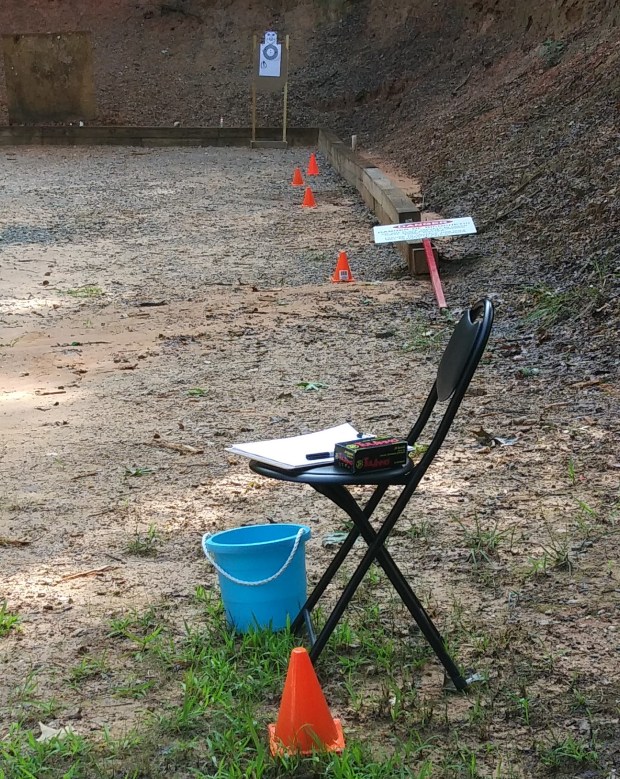
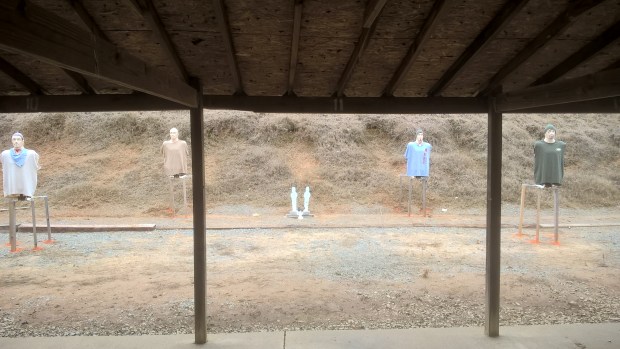
Range setup
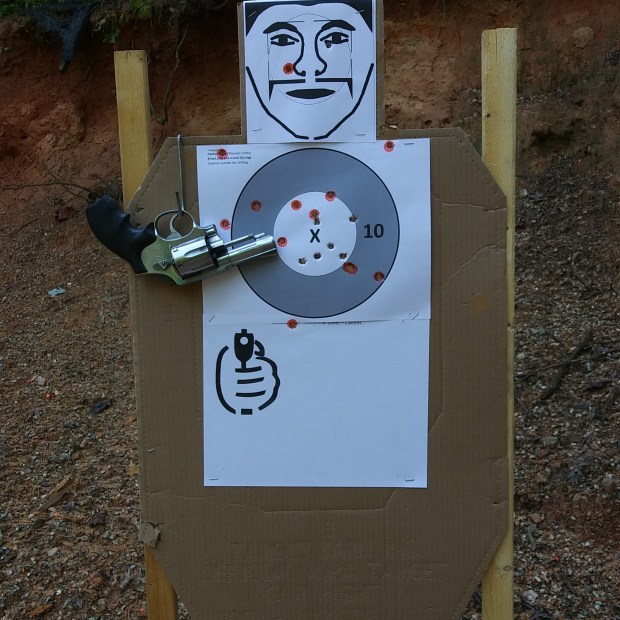
Model 65

Model 642-2
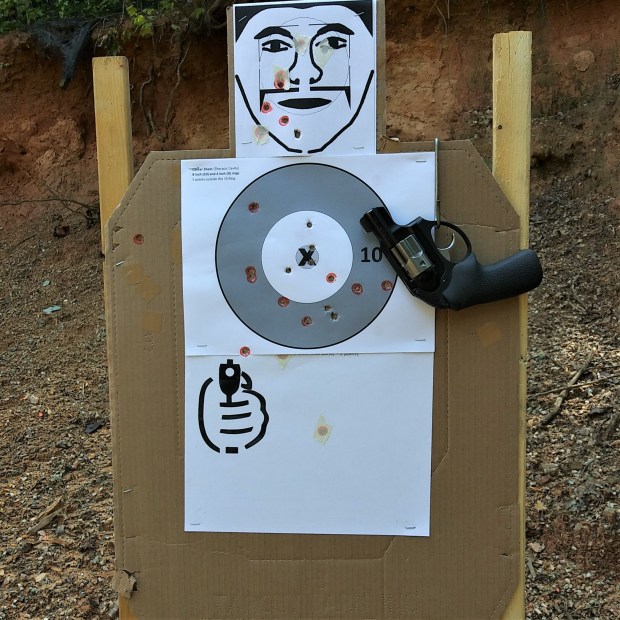
Ruger LCR

SD9VE
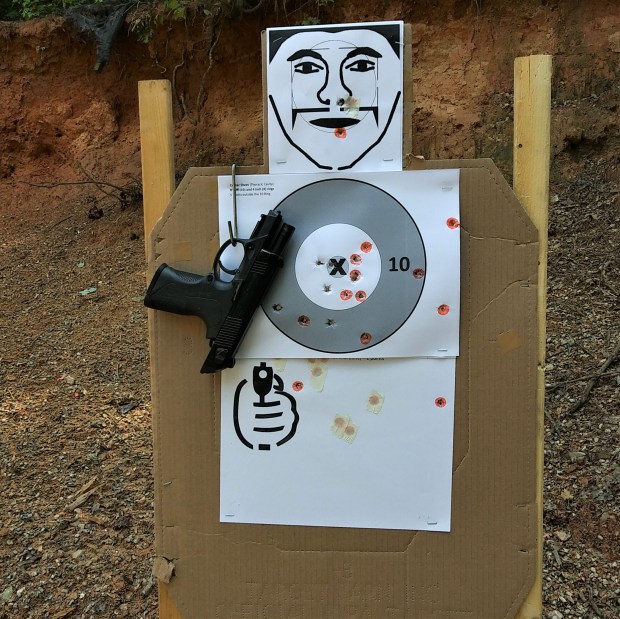
Beretta PX4 Storm Compact
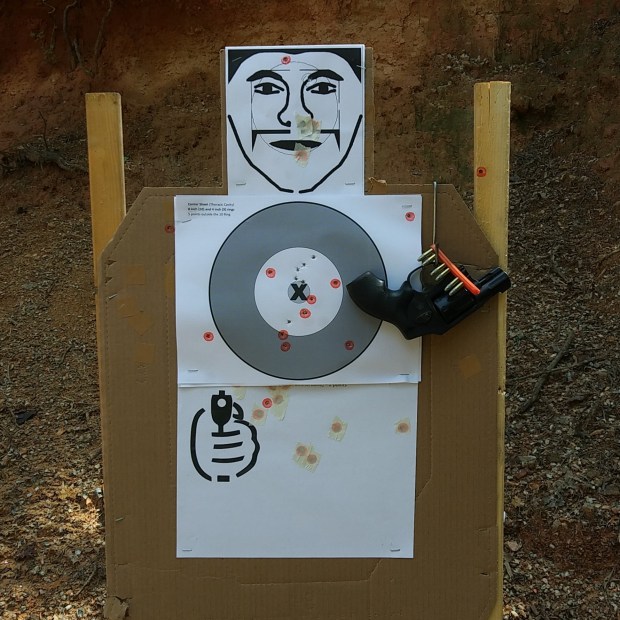
Model 43C
Here’s how the results came out.
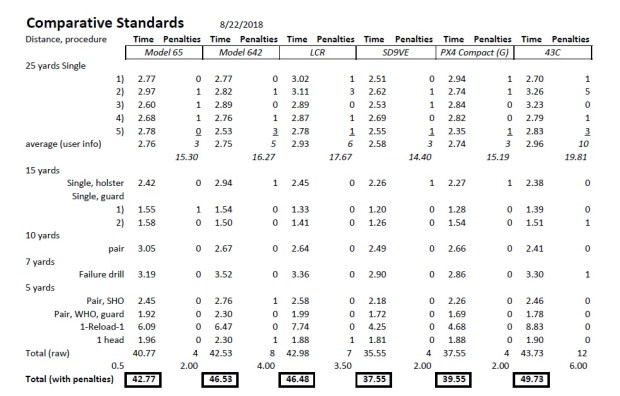
It’s a demanding benchmark analysis. I’m looking forward to seeing the results of the other testers.
If you would like to purchase Concealed Carry Skills and Drills, the link to the downloadable ebook is here. http://concealedcarryskillsanddrills.com
Decisions and Drawstrokes – What’s really important?
A recent discussion about a man unintentionally shooting his stepson https://www.panews.com/2018/08/14/man-accidentally-shoots-stepson-12-after-meteor-watching/ got me to wondering “How fast is too fast?” A little research was in order, so I did two experiments. One was a decisional drill that’s an evolution of the Thinking Drills in my Concealed Carry Skills and Drills ebook. The other was a comparison of the times between Cooper’s original Five Count drawstroke and the Four Count drawstroke it has evolved into.
Circumstances of a murder
In lieu of #wheelgunwednesday, an interesting and sad case study came up on Facebook. It is a personal experience and something I have never forgotten.
While I was still living in Chicargo, I often took public transit, especially the Elevated trains. One Sunday morning, I was going to play a softball game. However, the POlice had closed the Elevated station. A woman had been raped and murdered and a would-be rescuer stabbed within an inch of his life at 10AM on an otherwise beautiful Sunday morning on the platform.
A rare second cup of coffee kept me out of that situation. I never have a second cup. To this day, I still wonder if I could have done a hip throw (a Hand to Gland Combat technique) on the criminal onto the third rail. Or maybe I would have ended up like the would be rescuer. He was a runner; the paper said if he hadn’t been in such great shape he would have died too.
My Guardian Angel was looking out for me, as is often the case.
The circumstances of the incident were as follows:
The Origin and Evolution of Dot Torture
Dot Torture is a well known practice regimen among skilled shooters. Its origins and evolution are less well known, however.
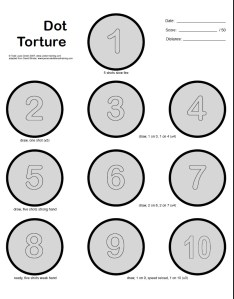
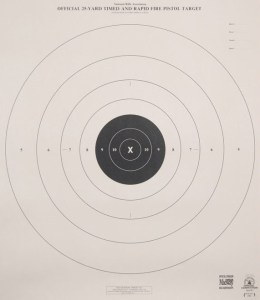
Shooting on dot targets, i.e., small filled in circles from 1.25 to 5.54 inches in diameter, as a speed shooting training and practice exercise, was originated by John Shaw, a World Champion shooter, in the early 1980s. In his book, You Can’t Miss: The Guide to Combat Pistol Shooting, he explains the training standard he established for his students. Until they could consistently hit the black bullseye (5.54 inches) of an NRA B-8 bullseye target from the holster in two seconds at seven yards, he didn’t allow them to move on to more advanced drills.
Shaw’s school, the Mid-South Institute of Self-Defense Shooting evolved the concept of dot shooting to a high level. Combined with shooting at steel targets, as originated by Bill Rogers, founder of the elite Rogers Shooting School, dot shooting became a standard component used in the practice regimens of knowledgeable shooters who aspired to a higher level of competency.
The concept of dot shooting was so effective at teaching shooters to hit the target, it quickly became part of military counter-terrorist pistol training. The US Army Special Forces developed a course called ‘Special Operations Training’ [SOT] during the 1980s to train its personnel to use the 1911 pistol at a level not seen before that time in the military.
Myths and Misconceptions
I was privileged to be the Guest Speaker at The Mingle 2018, a firearms community networking event this past Saturday. My topic was Myths, Misconceptions, and Solutions in the Firearms Training World. There is such a myriad of examples that I have decided to start writing #mythsandmisconceptionsmonday. I would like to acknowledge the influence John Farnam, Greg Hamilton, and Craig Douglas have had in the development of my fascination with the topic.
The misconception that resonated the most with the audience was Training is not an event, it’s a process. Too often in the training community, we put on a training event and our clients then leave with the impression they are ‘trained.’ Nothing could be further from the truth. Training is only the preparation for practice.
Updated version of Boyd’s Aerial Attack Study
Thanks to Rob Pincus, I have found a cleaner copy of Colonel John Boyd’s Aerial Attack Study (AAS). It was recreated by Mr. Mark Hart from the declassified 1964 version. The recreation is much easier on the eyes than the reproductions of the original mimeographed edition that are generally available.
Prior to Colonel Boyd’s AAS, fighter combat was viewed by the majority of fighter pilots as an intuitive skill rather than one that could be codified. Some conceptual principles had been developed along with elementary tactics such as the Thach Weave, but Boyd was the one who wrote the definitive book. Only Major General Frederick “Boots” Blesse had preceded Colonel Boyd in writing a book, No Guts No Glory, about jet fighter combat. Major General Blesse’s book wasn’t the exhaustive treatise on the subject that the AAS was.
Comparing capabilities
For a long time, I’ve wanted to do a comparison of two very popular pocket pistols; the Airweight J Frame and the Ruger LCP. This #wheelgunwednesday, I made it happen. In this case, I used a S&W 642-2 for the Airweight.
The test I used for the comparison was the Nevada Concealed Firearms Permit Qualification Course. I used this as the graduation exercise in my Snub Nose Revolver Classes many times. It’s still one of my favorite CCW qualification courses. The course goes as follows:
The humanoid target, B27 or B21 or equivalent as determined by the firearm instructor shall be utilized.
For 6 shot or higher capacity:
3 yards 6 rounds No time limit Freestyle
5 yards 12 rounds No time limit Freestyle
7 yards 12 rounds No time limit Freestyle
For 5 shot or lower capacity:
3 yards 5 rounds No time limit Freestyle
5 yards 10 rounds No time limit Freestyle
7 yards 10 rounds No time limit Freestyle
A total of 30 rounds for 6 shot or larger capacity, 25 rounds for 5 shot capacity must be fired. A 70% minimum (18/25, 21/30) must be scored to pass.
Notice that as with the majority of State Qualification Courses for Private Citizens, drawing from the holster is not required. Nevada is not one of the States that forbid drawing from the holster, so I include a little holster work.
The way I did the test was to:
- Use the -1 zone of the IDPA target. Then, I fold the bottom tapered part up behind the target. This gives an area approximating the FBI QIT target, which I like.
- Shoot 25 rounds with both guns, even though the LCP would fall into the ‘6 shot of higher capacity’ category. This gives an apples to applies comparison of the two guns.
- Conduct the first Stage as five individual one shot draws.
- Do the second and third stages as two individual strings of five shots each.
- Carry the 642-2 in an AIWB holster, concealed under a polo shirt.
- Carry the LCP in a pocket holster.
- Start the draws with hand on gun.
- Start the Five shot strings with the gun at Low Ready, aimed below the base of the target.
In the end, I was able to achieve slightly better results with the 642-2 (19.87 seconds) than with the LCP (20.71 seconds). I’m not sure a 4% difference is worth writing home to Mom about, though.
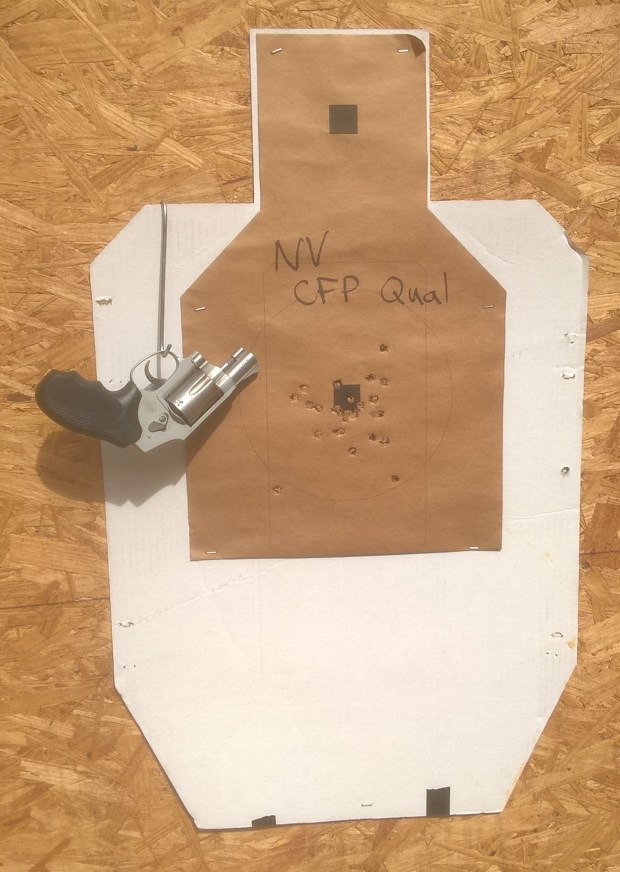

Both guns were mostly stock. The front sights on both are painted with Fluorescent Orange paint. The LCP has a Hogue Hybrid Handall installed. This makes the gun much more pleasant to shoot and I highly recommend it. The 642-2 wears Sile rubber stocks, which are no longer made, unfortunately. No special trigger work has been done on either, other than a fair amount of dry practice.
In the end, either of these in your pocket will provide more personal protection than some big honking clunky autoloader that gets left home. What’s the best concealed carry handgun? The one you have on you.
Wheelgunning at the Tactical Conference
This past weekend, Friday through Sunday, was the 20th Anniversary Rangemaster Tactical Conference. I have a long history of wheelgunning at the Conference, having shot it with a revolver in 1999 through 2001.
This year was no exception. I’ve also taught for many years at the Conference. This year I decided to re-visit teaching my Intro to Snubby Skills block of instruction. One of the other trainers had to cancel due to a family emergency. This gave me the opportunity to conduct my class on both Friday and Saturday. A total of 37 shooters took the two classes. I kept it to two hours and less than 50 rounds. Shooters sometimes lose their focus if the class is longer or the round count is higher and I want to set them up for success.
The topics I focused on were:
- Grip the snub firmly
- See the sights
- Press the trigger smoothly
- Followthrough
We did all the drills dry first and then live. For the live practice, most included spinning the cylinder after a few shots to create a ball and dummy drill. Revolvers do this much more efficiently than autoloaders. I also emphasize loading with loose rounds because speedloaders are not as secure an ammunition holding device as an autoloader’s magazine.
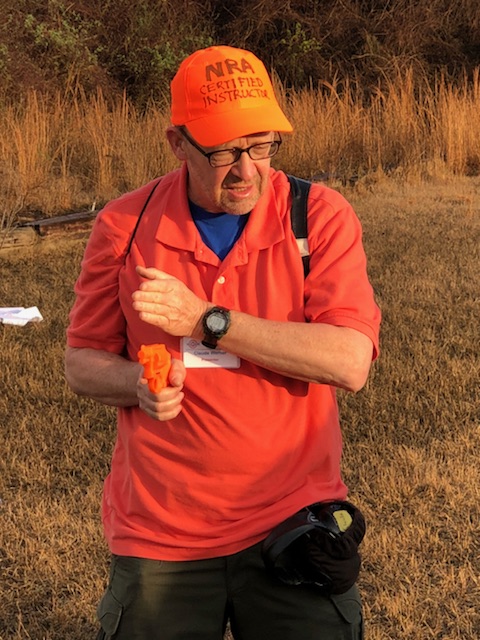
Photo credit: Roka Arms
As the final exercise, the shooters fired all five shots into an eight inch circle, reloaded with two loose rounds and then fired both shots at a facial target 3 inches by 4 inches. This is a good exercise for practicing shooting quickly and then accurately.
After the second class, I then shot the Pistol Match with a Model 65 S&W revolver. Out of 186 people who chose to shoot the Match, two of us used revolvers. The Match featured turning targets, which made it both challenging and fun. The entire match is shot with the shooter’s equipment concealed.
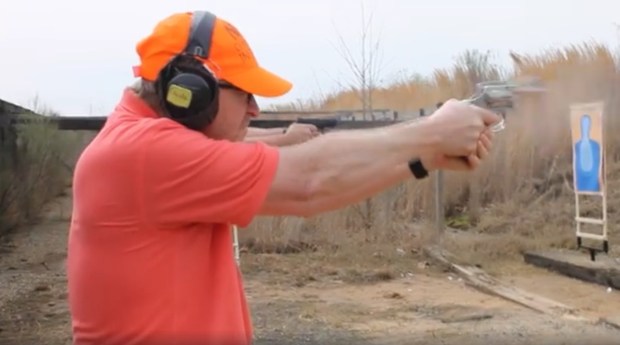
Photo credit: Philip Young III
I’ve been using a Galco Walkabout holster for my J Frame so I used a homemade Kydex centerline speedloader carrier. I’m finding that a speedloader carrier at the centerline is extremely fast. One observer noted that on the Stage that required a mandatory reload, I finished first among my squad.
For each string, we had to shoot a given number of rounds in a fixed amount of time while the target faced. Those who fired a perfect score made it into the Semi-Finals.

The Semi-Finals were held on Sunday morning. Turning targets were used again but this time the Course of Fire was only 10 rounds and was shot on a B-8 25-Yard Timed and Rapid Fire Target. The Course of Fire is revolver neutral but I threw two shots into the 7 ring and that put me out of the running for the Final Shootoff.
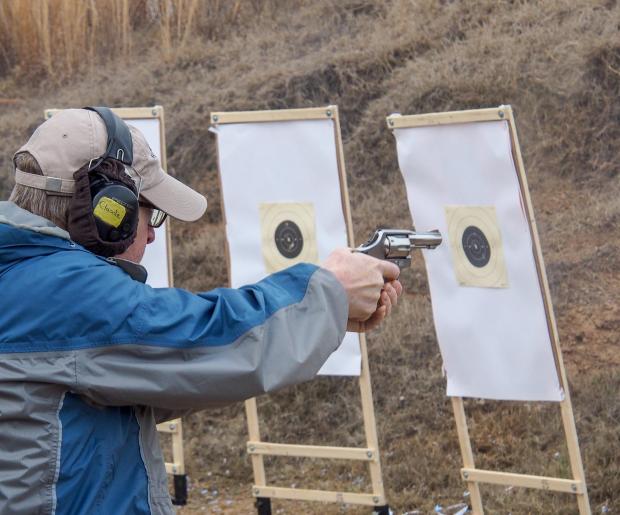
Photo credit: Tamara Keel
The Final Shootoff was a single elimination contest shot on reactive falling targets. Two mannequins with a concealed steel hit area had to be knocked down first. Then a mini Pepper Popper had to be knocked down. Whichever shooter knocked down the Popper first was the winner. The competition was fierce and Mr. Gabe White was the winner.
The Ladies did not have a Semi-Final and the top eight Lady shooters of the Match went straight to the Shootoff. It followed the same format as the Men’s Shootoff. Once again, the competition was fierce. Ms. Melody Lauer was the Winner.
Three days of good training was a true pleasure. There were more blocks of instruction, both live fire and lecture, than can be attended. It was a great time and I’m glad I was able to attend and present again.
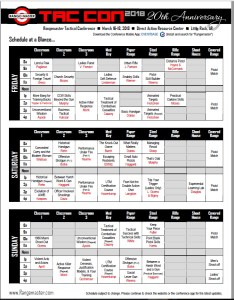
Next year’s Conference will be held just north of New Orleans on March 15-17, 2019. It is open to all those interested in personal protection.
If you would like to purchase my eBook Concealed Carry Skills and Drills, the link to the downloadable ebook is here. http://concealedcarryskillsanddrills.com
If you would like to purchase my eBook Indoor Range Practice Sessions, the link to the downloadable ebook is here. https://store.payloadz.com/details/2501143-ebooks-education-indoor-range-practice-sessions.html
Wheelgun Wednesday
For some reason, #wheelgunwednesday had never crossed my radar before yesterday. Viewing this as a serious deficiency on my part, I decided to shoot the IDPA 5×5 Classifier with some revolvers. It’s a 25 round Course of Fire shot entirely at 10 yards.
I like the 5×5 because it’s five shot friendly and is a demanding skill drill. As some shooters have observed, the IDPA 5×5 is not as easy as it looks. It shares this in common with the 5^5 drill that I designed.
Whenever a Course of Fire is shot repeatedly, there’s a ‘training effect.’ This means that simply understanding the sequence helps the shooter do better. Since I was shooting service revolvers down to Airweight J Frames, I chose to bias the training effect in favor of the J Frames, which are inherently harder to shoot. The order I chose to shoot the wheelies was:
- Model 66, four inch (.38 Special)
- Model 65, three inch (.38 Special)
- M&P 5 screw, 2 inch (.38 Special)
- Model 640-1, 2 ¼ inch (.38 Special)
- Model 36-1, 3 inch (.38 Special)
- Model 642-2, 2 inch (.38 Special)
- Model 30, 3 inch (.32 S&W Long)
- Model 432PD, 2 inch (.32 S&W Long)
Shooting the guns from heavy to light also helped keep me from getting beaten up by recoil early in the process. I’m glad I approached it that way.
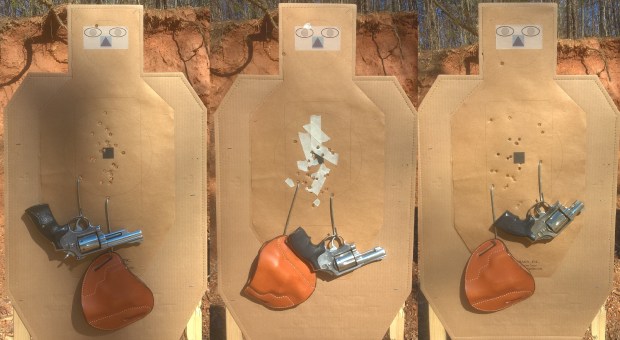
For the K Frames, I used the KIS “Keepin’ It Sippel” holster from Leather Creek holsters. It’s a very comfortable holster that distributes the weight of a service pistol well on the belt and allows a quick presentation. For the reload on String 3, I used a Safariland Comp II speedloader and pouch. When I bought the M&P 5 screw, it had the half moon front sight that was commonly used in the pre-1950s era. This is not an easy sight to see, so I flattened the rear with a file, serrated it, and painted it fluorescent orange with a white undercoat. All of the K frames also have had the rear sight blackened with a Sharpie to provide more contrast and reduce glare.
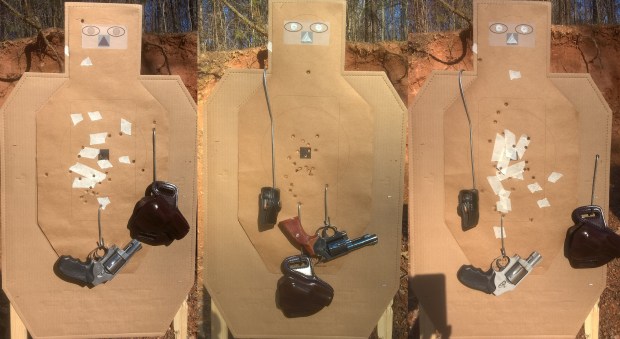
For the J Frame .38s, I used a Galco ‘Concealable’ holster. The forward molded design makes it very comfortable because it doesn’t press on my hip bone at the four o’clock position. Reloading was done with a Safariland Comp I speedloader and pouch.
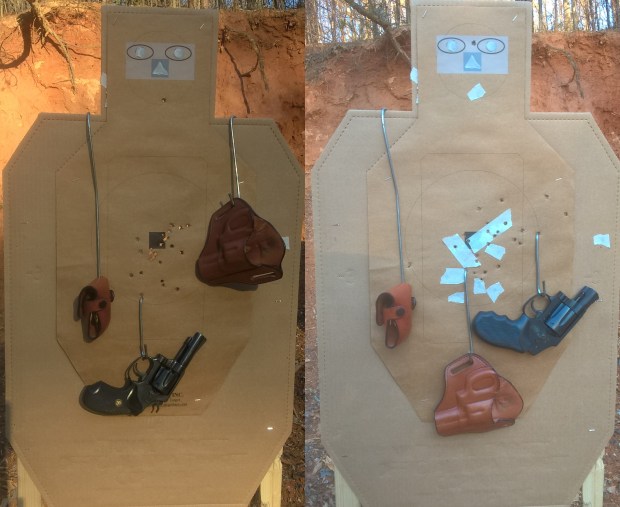
For the J Frame .32s, I used a Bianchi Model 57 ‘Remedy’ holster. This is also a comfortable forward molded design. Reloading was done with an HKS 32-J speedloader and Bianchi pouch.
The ammo used was mostly Tula 130 grain FMJ .38 Special. I can’t recommend this ammo. Probably because of the steel case, it’s very difficult to extract. Most of the time, I have to use a rubber mallet to give the extractor rod a whack to eject the cases. I bought a case of it and when it’s used up, that’s the last I will ever buy. When the stage required a reload, I started with Federal American Eagle 130 grain FMJ, which extracts easily.
In the .32s, I used Georgia Arms .32 S & W Long 85 grain Jacketed Hollow Point and Fiocchi 97 grain FMJ. They both shoot to similar point of impact and proved reliable in the .32s.
#wheelgunwednesday, it’s going to be more of a habit from now on.
Note that the holsters were provided to me at no cost by the manufacturers but I receive no compensation for my evaluation.
 tacticalprofessor
You must be logged in to post a comment.